New3x the coverage, same rigorous quality. 300 positions benchmarkedExplore

ROI of reliable compensation benchmarks: How to justify the investment to leadership

Benchmarking

Relying on fragmented, outdated, or inaccurate compensation benchmarks shows up in small ways at first: 

  • Offers that are either rejected or accepted at higher-than-necessary salaries
  • Salary bands that are hard to explain or defend
  • Long internal debates over which data source to trust

Over time, these gaps compound into real costs: overpaying new hires, unplanned salary adjustments, and avoidable employee turnover. They also create growing pay inequity, increasing both compliance and employee trust risk.

That’s exactly where reliable compensation benchmarks make a difference with the investment often covered by avoidable costs you’re already paying for in your hiring and compensation decisions

This guide breaks down the ROI of reliable compensation benchmarks – where and how a real-time, accurate data source like Ravio delivers value – and how to make the case for investing in it so you can make confident, defensible pay decisions at scale.

We’ll cover: 

  • How inconsistent or outdated market data leads to overpaying, rejected offers, and reactive salary corrections 
  • How reliable benchmarks improve offer competitiveness, retention decisions, and control over compensation spend
  • How to build a clear, defensible business case for benchmarking internally. 

TL;DR – key takeaways: 

  • You’re already paying for unreliable compensation data through overpaying hires, rejected offers, salary corrections, and avoidable employee turnover that compound into far higher costs than investing in reliable benchmarks.
  • The ROI of reliable compensation benchmarking shows up in faster, more defensible pay decisions – reducing unplanned salary adjustments and inconsistent pay bands, while improving hiring efficiency, pay fairness, compliance readiness, and cost control.
  • Strong business cases focus on cost, risk, and hiring impact – quantify compensation mistakes, tie benchmarking to hiring and budget metrics stakeholders are already tracking, and show how reliable data enables faster, defensible decisions.

When does investing in reliable compensation benchmarks make sense?

Investing in reliable compensation benchmarks isn’t always a priority early on. But there are clear points where relying on traditional annual salary surveys, free data sources, or one-off purchases start to create risk, slow decisions, or increase costs.

We break down when to invest in compensation benchmarks in detail in this guide but here’s a quick gist of the most common scenarios when the investment in worthwhile: 

  • You’re hiring across multiple markets. Pay varies widely by location and without accurate, up-to-date benchmarks, offers can miss the local market, leading to overpaying or rejected offers.
  • Building or formalising salary bands. Without a consistent external reference, ranges become harder to justify and can easily drift out of line with the market.
  • Preparing for pay transparency. You need clear, defensible data to explain how salaries are set and identify gaps before they become compliance or employee trust issues.
  • Scaling hiring and headcount. As hiring volume increases, manual benchmarking becomes inconsistent and time-consuming, slowing decisions and reducing control over compensation.

The ROI of reliable compensation benchmarks 

For most teams, the question isn’t whether compensation data matters – it’s whether investing in reliable benchmarks actually pays off compared to using annual salary surveys or free data sources.

In practice, the ROI shows up across 7 areas that directly affect cost, hiring outcomes, risk exposure, and team productivity: 

  1. Prevent overpaying new hires and inflating salary bands 
  2. Prevent internal salary compressions and costly corrections 
  3. Make competitive offers faster and improve offer acceptance rates 
  4. Prevent costly employee turnover and respond faster to competing offers 
  5. Support pay transparency and reduce compliance risk 
  6. Reduce manual work and speed up compensation planning 
  7. Plan team expansion with confidence and build a scalable compensation strategy.

1. Prevent overpaying new hires and inflating salary bands

One of the most common – and least visible – costs in hiring is overpaying candidates.

Even small overpayments (e.g. 5-10%) can compound quickly into tens or hundreds of thousands in additional spend, especially when reflected across multiple hires and future salary band updates.

At Plastometrex, for example, before they invested in Ravio as their source for relevant benchmarks, the team discovered they were “paying substantially above the national average,” according to James Dean, the Co-founder and CEO.

Between relying on Glassdoor and recruiter input (which often skews high due to commission), they struggled to reconcile national averages with local market realities – especially in Cambridge, where salaries can exceed broader UK benchmarks

But the actual misalignment only became clear once they benchmarked against Ravio’s relevant, reliable dataset.

“We were paying substantially above the national average but hadn’t fully understood the Cambridge premium. We knew Cambridge might be an outlier to the rest of the region, but I didn’t realise just how different it was relative to national averages.”

Headshot: James Dean, CEO and Co-founder of Plastometrex

James Dean

Co-founder and CEO, Plastometrex. 

Gaps like this don’t stay contained to a single hire – they reset expectations across the team and put upward pressure on salary bands over time.

Reliable benchmarks prevent this by giving you a clear, up-to-date view of what the market is paying for a role – by level, location, and company context – at the moment you make an offer.

This gives you a clear view of where you’re over- or under-paying, so you can anchor offers and salary bands to the market – and avoid costly downstream decisions. Which means, you can: 

  • Sanity-check candidate expectations against market data
  • Set offers confidently without over-indexing on negotiation pressure
  • Keep salary bands aligned to the market rather than reacting to it.

This makes the financial impact of reliable compensation benchmarking immediately visible – both in terms of risk avoided and cost savings unlocked:

  • If you’re underpaying critical roles, the retention risk becomes visible early – giving you a chance to act before employees start exploring external offers
  • If you’re overpaying, the gap to market represents immediate cost-saving opportunities across current and future hires.

The ROI is straightforward: more controlled compensation baseline and lower long-term salary spend.

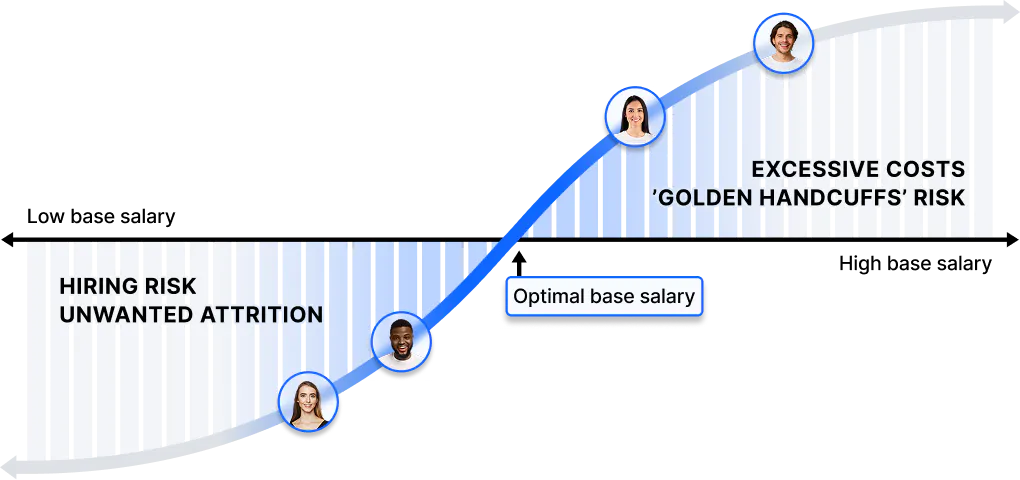
Low base salary: hiring risk and unwanted attrition. High base salary: excessive costs and golden handcuff risk.

2. Prevent internal salary compression and costly corrections

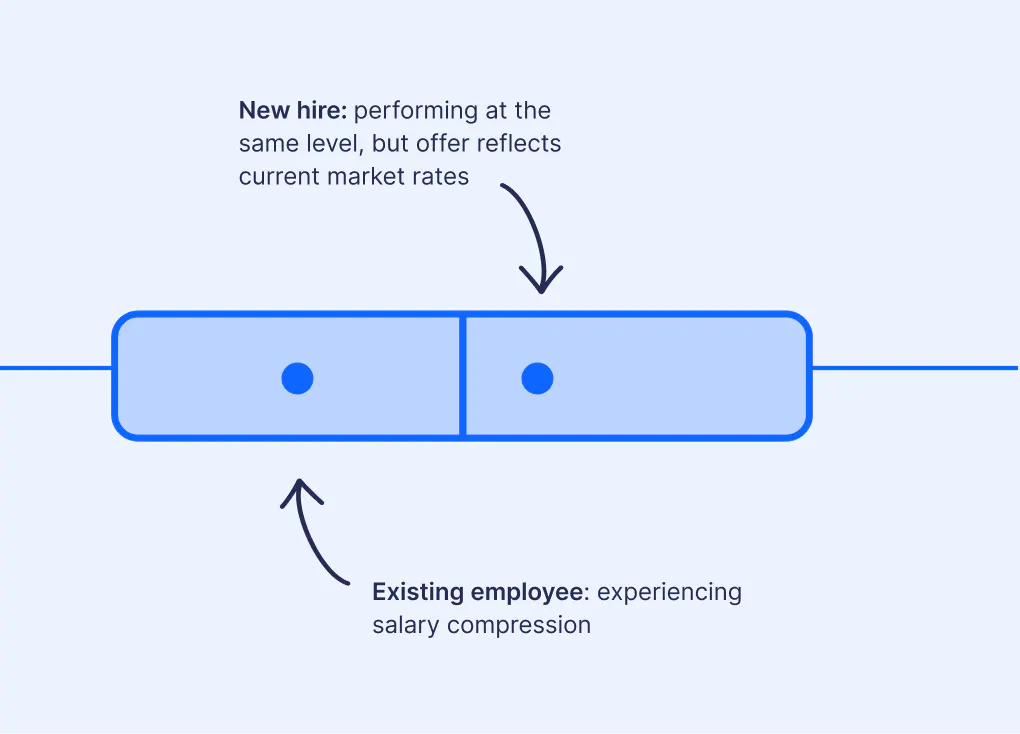
As market rates rise, new hires often enter at higher salaries than existing employees in similar roles – creating internal salary compression.

This creates internal inequity where existing employees fall behind new hires, which often goes unnoticed until annual reviews, when fixing it requires multiple, unplanned salary adjustments.

salary compression

By then, the cost is much higher:

  • Multiple employees require off-cycle adjustments
  • Budgeting becomes reactive rather than planned
  • Pay equity concerns start to surface internally.

For example, correcting a £5k gap across just 10 employees means £50k in unplanned salary increases – often outside the original budget cycle.

This risk further amplifies when you rely on fragmented, infrequently updated data. 

If your compensation data refreshes only once or twice a year, you’re updating pay using insights that are already months out of date.

The result is that misalignment continues building up quietly and by the time it surfaces, corrections are larger, more urgent, and more expensive.

By contrast, access to year-round, up-to-date benchmarking using a provider like Ravio, lets you continuously compare internal salaries against market ranges – so you can spot pay gaps early, before it turns into a costly correction exercise.

This lets you take a proactive approach to salary compression:

  • Adjust new hire offers in line with internal benchmarks
  • Flag roles drifting out of range before review cycles
  • Maintain consistent salary positioning across teams.

The ROI is clear: fewer large corrective raises, more predictable compensation budgets, and reduced risk of internal pay disparity issues.

3. Make competitive offers faster and improve offer acceptance rates

Offer decisions often stall at the final step when compensation needs to be validated.

But without reliable benchmarks on hand, HR teams have to cross-check multiple inputs – salary surveys, recruiter feedback, and internal salary bands – before making an offer.

Even when offers are approved, you can still miss the mark if the underlying data is inconsistent or outdated.

This creates a cascade of issues at a critical moment:

  • Offer approvals get delayed while data is validated
  • Hiring managers hesitate without confidence in the numbers
  • Candidates receive offers late or below market.

In some cases, it also leads to candidates dropping out of the process altogether if the offer isn’t competitive. 

For instance, the current market median for a P3 software engineer in the UK is £70,000 (as of April 2026 via Ravio’s live benchmarking dataset). But if you were to base your offer on free sources and offered, say £51,000 (Indeed currently shows this rate for the same role and level), you’ll likely see candidates dropping out. 

Given that many roles take 29-37 days to fill, even small delays at the offer stage here increase the cost of vacancy – from lost productivity and revenue to wasted recruiter time.

Altogether, the impact is clear: lost candidates, longer time-to-fill, and the cost of roles staying unfilled. 

This is exactly where reliable benchmarks make a difference.

With reliable benchmarks, compensation decisions become faster and more confident – removing a key bottleneck at the offer stage.

Teams can:

  • Instantly access current market ranges by role, level, and location during offer planning
  • Share transparent compensation ranges with candidates early in the process

The team at HERO does this using Ravio’s benchmarks. Their Director of People & Culture explains

“Our talent acquisition team now actively uses salary ranges and shares them transparently with candidates. [The result is that,] our time to hire is super fast. We don’t waste time on salary negotiations because everything is clear from the start.”

Headshot image of Anna-Lena Grimm, Director People & Culture at HERO Software

Anna-Lena Grimm

Director People and Culture, HERO

The ROI shows up in measurable improvements to hiring speed, efficiency, and offer outcomes:

  • Faster offer approvals and shorter time-to-hire. Access to real-time benchmarks removes the need to wait for survey data to refresh or sift through multiple sources to find relevant benchmarks for the role, level, and location you’re hiring for. This is especially impactful for commercial roles, where every day a role remains unfilled directly impacts revenue.
  • Higher offer acceptance rates. Offers are aligned with current market expectations from the start, reducing rejections, avoiding wasted recruiter effort, and shortening time-to-fill.
  • Fewer late-stage renegotiations. Clear, defensible salary ranges reduce back-and-forth and delays just before offer acceptance, preventing last-minute drop-offs, and shortening the hiring cycle.
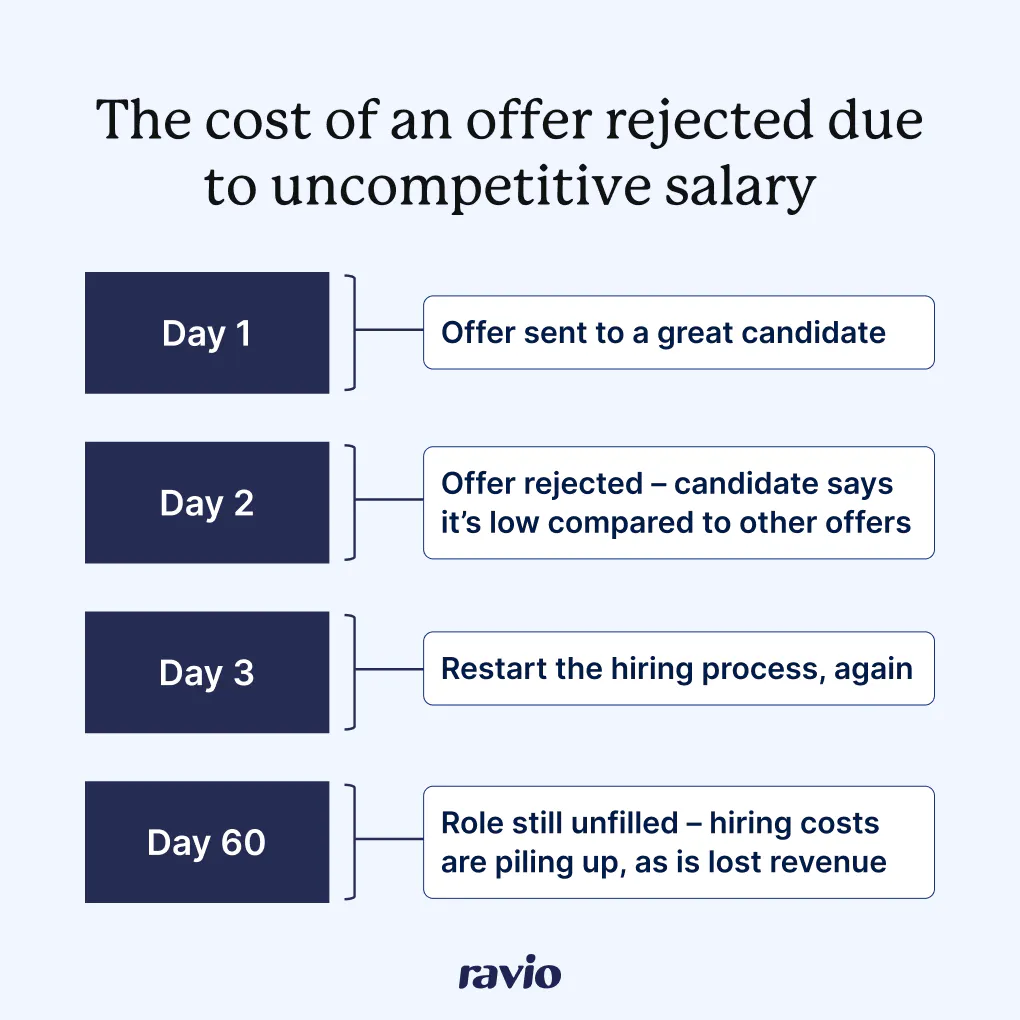
The cost of an offer rejected due to uncompetitive salary

4. Prevent costly employee turnover and respond faster to competing offers

Employee salaries that fall behind market rates are an immediate retention risk – those employees are going to start seeing job adverts elsewhere with higher salary ranges.

Replacing an employee typically costs between 50% and 200% of their annual salary, depending on seniority and role complexity. 

For example, a mid-level software engineer in London earns an average of £70,000 (based on Ravio compensation benchmarks) – meaning replacing them could cost anywhere between £35,000 to £140,000. 

At scale, this adds up quickly: a 500-person company with just 5% churn could be losing around £1.7M each year.

Despite this, many teams only realise employees are underpaid when an external offer opens the conversation. 

At that point, HR teams are forced into reactive decisions with limited time to respond. This becomes even more challenging if you scramble to gather data from traditional salary survey sources.

Relying on them means you’re often working with data that’s already months – or even a year – out of date. This delays counteroffers, eventually leading to decisions based on outdated figures or recruiter guesstimates.

But preventing even a few avoidable exits can offset the cost of investing in compensation benchmarks.

Real-time benchmarks shift retention offers from reactive to proactive – giving teams continuous visibility into how their salaries compare to the market and enabling two critical shifts:

  • Make proactive pay adjustments before employees start looking externally
  • Respond faster to competing offers with informed, defensible decisions.

In practice, this means identifying pay gaps early – before they turn into competing offers or employee attrition. 

The result is lower turnover costs, fewer reactive decisions, and greater control over one of your largest operating expenses.

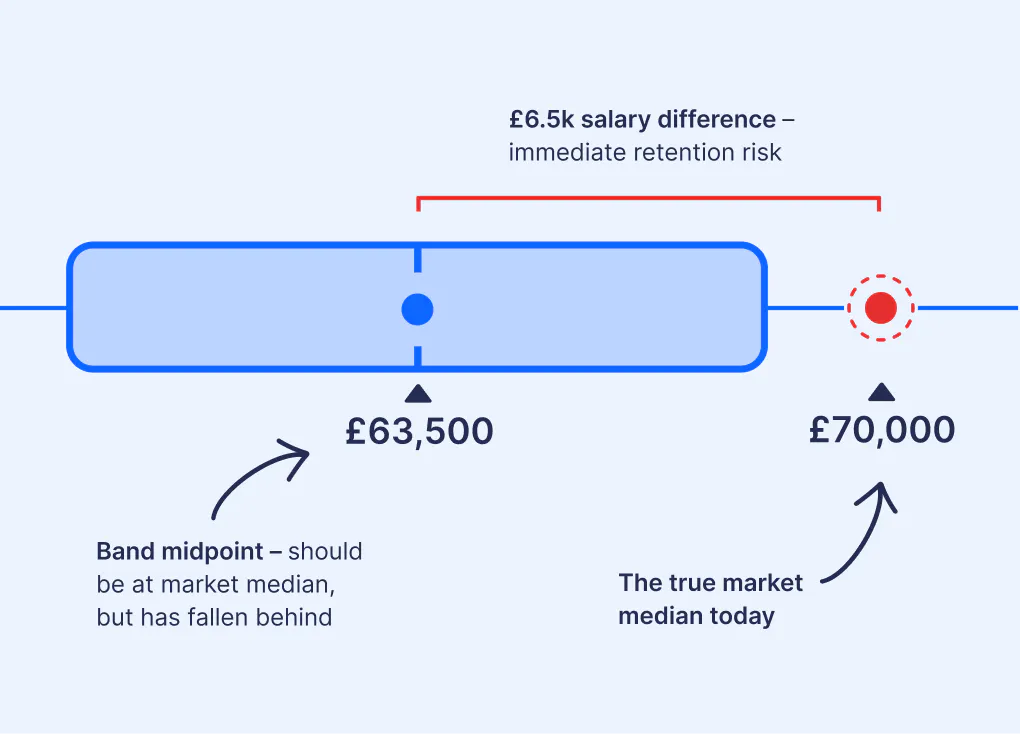
Compensation bands falling behind market

5. Support pay transparency and reduce compliance risk

Pay transparency is no longer optional – especially for companies operating in or hiring from Europe. What was once internal policy is now a compliance requirement.

Regulations like the EU Pay Transparency Directive are making it mandatory for organisations to identify and explain pay gaps, justify how salaries are set, and provide clear, consistent salary ranges.

As enforcement tightens, the cost of getting this wrong is also rising. In Cyprus, for example, proposed legislation outlines fines and even jail time for business leaders in cases of non-compliance.

Employee expectations here are also rising with 82.6% saying pay transparency  is essential to them – increasing pressure on managers to justify pay decisions.

But when salary decisions rely on inconsistent or ad hoc data, pay disparity goes unnoticed and decisions become difficult to defend, eroding employee trust and increasing legal, financial, and reputational risk.

With reliable, defensible benchmarks underpinning your pay decisions though, you can:

  • Spot pay gaps early when building or reviewing salary bands
  • Back up pay conversations with employees and stakeholders with objective, defensible market data 
  • Stay ahead of transparency requirements instead of reacting to audits or complaints.

Take it from the team at FTAPI that relied on a mix of salary surveys, peer input, and internal formulas – yet lacked confidence in defending their compensation decisions to leadership.

When hiring managers questioned salaries, there was no credible data to reference, and employees increasingly perceived decisions as subjective.

But after switching to a single source of reliable benchmarks, FTAPI’s Head of People & Culture, Kim Heckner, notes their compensation discussions have become far more productive:

“Before Ravio, three people Googling the same question would find three different answers, so we’d waste time debating which data was right. Now we start from a shared baseline – ‘here’s what Ravio shows - and focus our discussion on the actual decision. The quality of our conversations has gone from a 5 out of 10 to an 8 out of 10."

Kim Heckner

Kim Heckner

Head of People & Culture, FTAPI

The ROI is clear: reduced risk of fines, legal exposure, and costly corrective actions – along with more productive, defensible compensation discussion.

6. Reduce manual benchmarking work and speed up compensation planning

If you’re handling compensation planning manually, you know just how much of it turns into heavy, repetitive work and how little confidence you often have in the final data.

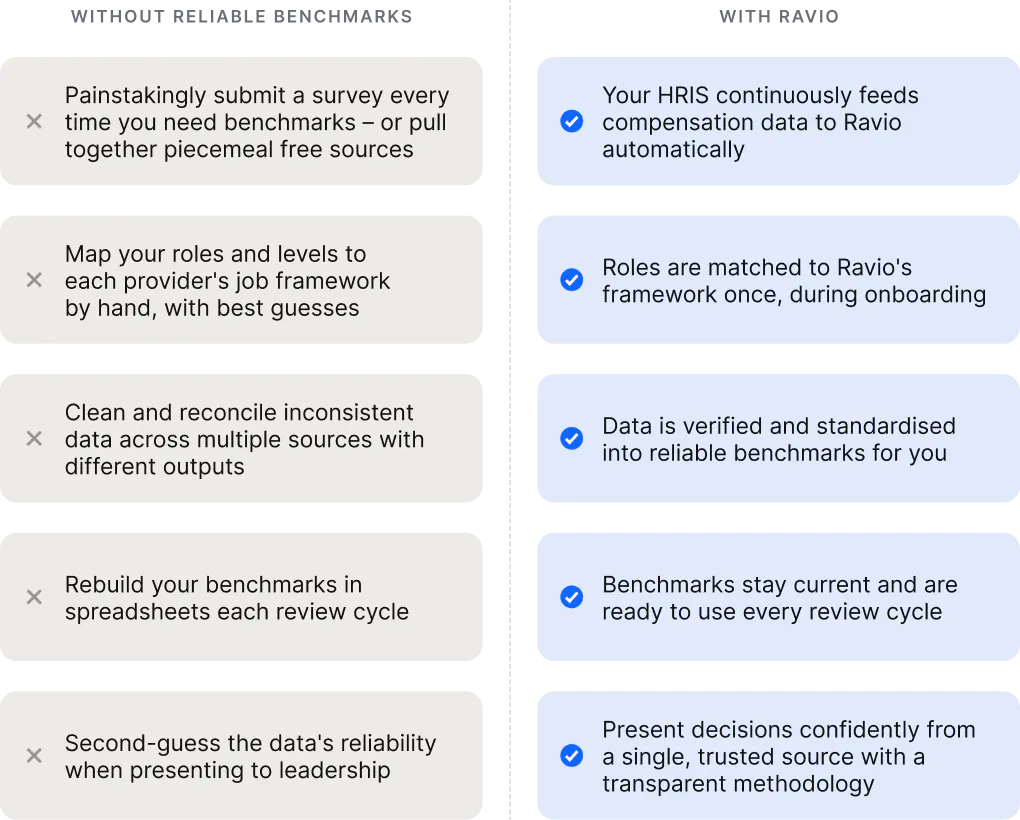
This gets worse when you’re working with fragmented salary data sources or traditional surveys, and have to put effort into: 

  • Submitting the same internal data repeatedly across multiple salary surveys
  • Mapping internal roles to different provider’s broad frameworks 
  • Cleaning and validating inconsistent datasets
  • Rebuilding benchmarks in spreadsheets every review cycle.

The operational cost adds up quickly – hours of repetitive, manual work that’s prone to error and difficult to scale, pulling time away from more strategic compensation decisions.

Evert Kraav, Senior Compensation Manager at Bolt, describes this well:

“If you work in compensation, then there are only so many times you want to fill in surveys and questionnaires. 

“With one survey provider, I might get an Excel file with 150+ different columns to fill in. With another, I will need to fill in an Excel file for each country, even if we only use them for a certain region. It’s an inconvenient and highly rigid process.

“Because most providers also have their own job levelling and job families structure, it’s a huge effort to then convert ours to theirs. It requires keeping up with all the changes they might have implemented during a year.”

And after all that work, you’re still left second-guessing the data’s reliability – without full confidence in the recommendations you’re expected to defend in front of leadership, managers, and employees.

So instead of stitching together data manually each cycle, using reliable pay benchmarks helps you make faster, more consistent decisions. 

This shift comes from having access to verified, ready-to-use benchmarks – not raw compensation data. Ravio, for instance:

This removes much of the manual work involved in mapping roles, cleaning data, and rebuilding benchmarks each review cycle, so you can work from benchmarks that are already structured, comparable, and ready to use.

The ROI shows up in time saved and greater confidence in your decisions as you:

  • Spend less time gathering and mapping data
  • Run faster, more consistent compensation cycles
  • Confidently present recommendations to leadership.
With vs without reliable compensation benchmarks – the business impact

7. Plan team expansion with confidence and build a scalable compensation strategy 

Expanding into new markets introduces a different kind of risk – making hiring projections and compensation decisions without a clear view of what the local market actually pays.

Compensation can vary significantly by region, role, and market conditions, even within the same country. 

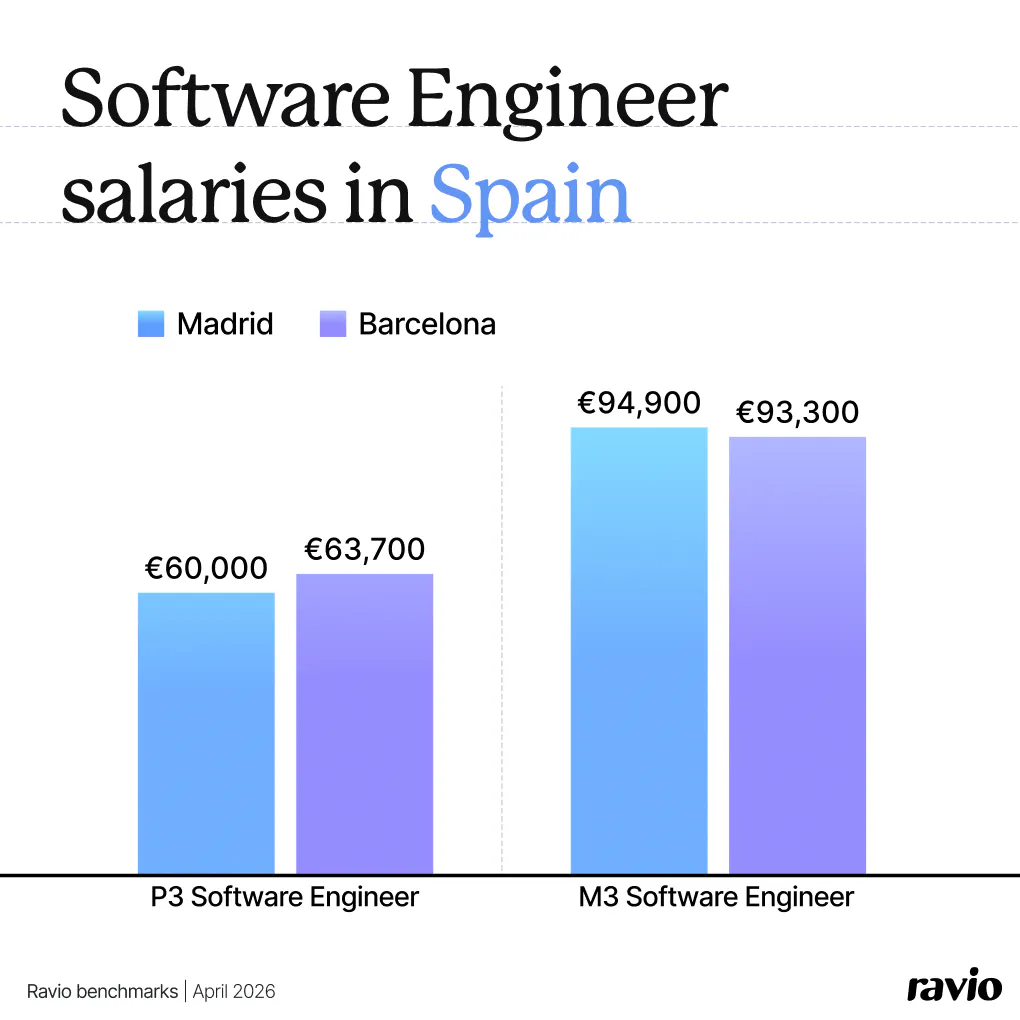
For instance, compensation for a P3 Software Engineer in Madrid is €60,000 but, within the same country but different city, it’s €63,700 in Barcelona (Ravio benchmarks, April 2026).

Software Engineer salaries in Spain, Ravio benchmarks April 2026

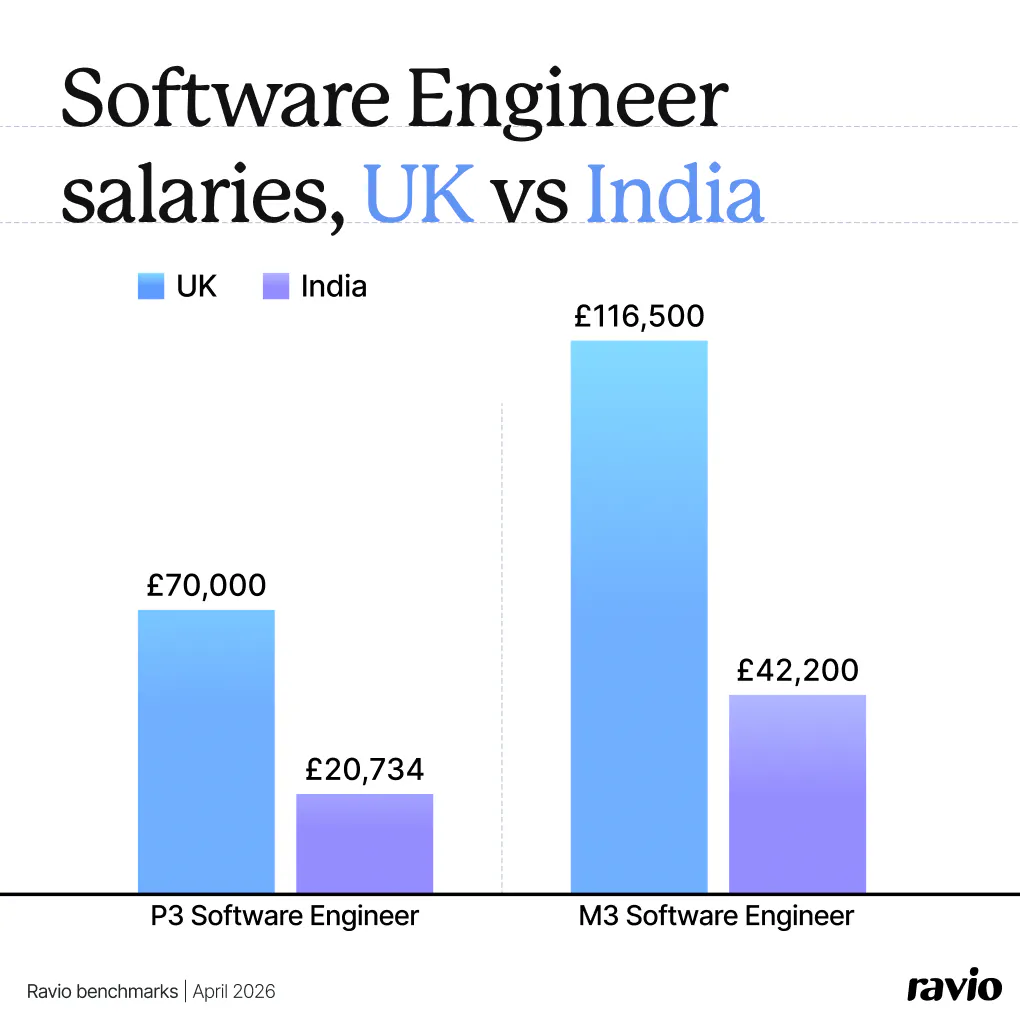
Similarly, there's a significant difference in regional benchmarks. So if you’re hiring from a talent diverse market like India, the average is £20,734 (₹2,606,500) for a Software Engineer at mid-P3 level, whereas, £70,000 for the same role and level in the UK (Ravio benchmarks, April 2026).

Software Engineer salaries India vs UK, Ravio benchmarks April 2026

Anzhela Radchenko, Total Rewards Lead at Ideals, describes the importance of understanding the reality of a market like India:  

"India is an extremely large and diverse market that cannot be easily generalised. Rather than applying a simple multiplier or aligning roles only within a function, we evaluate each role individually and analyse how compensation for that exact role is represented in the local market using reliable market benchmarks.”

Anzhela Radchenko

Total Rewards Lead at Ideals

So using national averages that don’t reflect local market realities or stale survey data can distort expansion forecasts from day one – with hiring estimates potentially off by millions.

If offers are set too high, they inflate long-term payroll costs. If they’re set too low, they slow hiring, reduce offer acceptance, and create early retention risk.

These early decisions don’t stay isolated. 

As teams expand geographically, a few misaligned offers can set the wrong salary bands from the outset, shaping pay across an entire new team or region.

A single source of locally accurate, up-to-date benchmarks across locations – including emerging markets – removes the need to purchase and piece together data from multiple regional surveys.

This gives you trusted pay benchmarks to confidently plan, price, and forecast hiring in new markets so you can: 

  • Model the cost of hiring in new markets before expanding
  • Set salary bands aligned to local benchmarks from day one
  • Build a consistent, scalable compensation framework across regions.

At Bolt, for example, this global coverage allows the team to access compensation benchmarks in countries they’re looking at for future expansions.

“With Ravio, we can get access to countries where we don’t have people yet. It means I can then also give reliable insights to teams responsible for expansions.”

Evert Kraav, Senior Compensation Manager at Bolt

Evert Kraav

Senior Compensation Manager, Bolt

The ROI is both financial and strategic: avoiding costly misalignment in expansion plans, improving hiring efficiency, and building a scalable compensation strategy with defensible hiring costs forecasts that stand up to investor scrutiny.

How to justify compensation benchmarking internally

Compensation tools are rarely approved on features alone. They’re approved when HR can clearly show financial risk, hiring impact, and operational efficiency gains.

If you’re working on convincing leadership to invest in compensation benchmarking, focus on outcomes your stakeholders already track.

Here’s how: 

Show how benchmarking improves hiring and retention outcomes

Identify the outcomes your stakeholders are prioritising, then tie benchmarking directly to them.

As Alistair Fraser, founder of Justly advises, position compensation benchmarking as an investment in industry competitiveness, pay equity, employee engagement, and talent retention – outcomes leadership already prioritises.

Then connect these outcomes to metrics your stakeholders already track:

  • Faster offer approvals due to clear, trusted salary ranges
  • Higher offer acceptance rates from competitive, market-aligned offers
  • Fewer retention escalations by identifying pay gaps earlier
  • More predictable compensation budgets with fewer reactive adjustments

Focus on how benchmarking improves speed, accuracy, and control in pay decisions. 

And remember to speak your C-suite’s language too. Anastasia Efremova, Global Director of Total Reward at Semrush advises

“Instead of coming to [stakeholders] with data on ‘employee engagement’ or ‘talent density’ we need to be talking about ‘net income’ or ‘revenue growth’ – or really whatever metrics your C-suite is using to measure success.”

Headshot: Anastasia Efremova

Anastasia Efremova

Global Director of Total Reward at Semrush

Quantify the cost of compensation mistakes

Turn risks into numbers, strengthening your business case by shifting the conversation from “nice to have” to the cost of inaction. Even rough estimates help make your case:

  • Cost of replacing an employee (often 50-150% of employee salary, e.g. replacing a £70k employee can cost £35k-£105k)
  • Offer rejection rate and impact on time-to-hire (e.g. 2 rejected offers can add 2-4 weeks to hiring if each cycle takes about 1-2 weeks)
  • Time-to-hire delays and cost of unfilled roles (e.g. a 2-week delay for a revenue-generating or critical role means lost output, delayed projects, even missed revenue)
  • Cost of salary compression corrections (e.g. £5k increase across 10 employees can lead to £50k in unplanned compensation spend)
  • Hours spent on manual benchmarking and data validation (e.g. 10-15 hours per compensation review cycle, repeated across quarterly or annual planning cycles.

Connect compensation benchmarking to business risks

Frame the investment in terms leadership already cares about:

  • Overpaying hires due to outdated or inconsistent data used to set offers
  • Unbudgeted salary adjustments caused by salary compression discovered during review cycles
  • Losing candidates to uncompetitive offers, increasing time-to-hire and vacancy costs
  • Employee turnover when compensation falls behind the market and retention decisions become reactive
  • Compliance risks when pay decisions can’t be clearly explained or justified under transparency requirements.

At FTAPI, for example, the Head of People and Culture, Kim Heckner, built buy-in for Ravio by aligning the investment with the company’s core priorities: fair and consistent pay, building trust in compensation decisions, and bringing structure to how salaries are set as the company scales.

Kim recalls: 

“Of course, people wanted to understand why we have to spend money on a product when we can search for the same information online for free. But Google and LLMs are not the Mr. Know-It-All.” 

Kim Heckner

Kim Heckner

Head of People & Culture, FTAPI

To address this, she explained that HRIS-integrated benchmarking provides accurate, up-to-date, company-reported compensation data – not synthesised estimates from mixed-quality online sources. 

This gave the team a shared, defensible baseline for pay decisions and improved trust across leadership and employees.

Use a simple ROI framing when presenting the investment

Keep the narrative straightforward and outcome-led. Here’s an example: 

“Without reliable benchmarks, we risk overpaying new hires, losing candidates due to uncompetitive offers, and discovering pay gaps only when they become costly to fix.

With benchmarking, we can align salaries to the current market, improve offer competitiveness, and manage compensation costs more predictably – with decisions we can confidently defend.”

This makes the investment easier to understand and easier to approve.

Remember: the strongest business cases don’t focus on tools – they show the cost of getting compensation decisions wrong.

Wrapping up: What the ROI of compensation benchmarking looks like in practice

The ROI of compensation benchmarking isn’t just in better data. It shows up in:

  • Improving offer competitiveness to increase acceptance rates and reduce time-to-hire
  • Controlling compensation costs to stay within budget and avoid unplanned adjustments
  • Preventing pay inequity to reduce compliance and employee trust risks
  • Reducing employee turnover to avoid costly replacements and retention issues
  • Making defensible pay decisions to confidently justify salaries to leadership and employees.

If you’re already making offers, setting salary bands, or planning compensation with incomplete or inconsistent data, the cost isn’t hypothetical – it’s already showing up in your hiring outcomes, budgets, and retention.

This is exactly how teams like Plastometrex, HERO, and Bolt have moved from reactive decisions to more predictable, defensible compensation.

If you want to validate your current benchmarks, access 3 free Ravio benchmarks for your roles, levels, and locations.

Use them to validate your salary ranges, identify gaps, and build a clear, data-backed buy-in for compensation benchmarking – before misaligned decisions turn into costly corrections.

Test Ravio's benchmarks for yourself

FAQs

What is the ROI of compensation benchmarking? 

The ROI of compensation benchmarking comes from better pay decisions that reduce costs, risk, and inefficiency. It helps prevent overpaying, avoid reactive salary adjustments, improve offer competitiveness, and reduce employee turnover. The result is more predictable compensation spend and decisions you can confidently justify to leadership and employees.

Why do companies use salary benchmarking tools? 

Companies use salary benchmarking tools to access reliable market pay data when setting salaries, making competitive offers, and building salary bands. These tools replace fragmented sources of compensation data with a consistent reference point – helping teams make faster, more accurate compensation decisions and avoid relying on outdated surveys or guesswork.

What are the benefits of salary benchmarking tools? 

By giving you reliable, role- and location-specific total compensation data, salary benchmarking tools help you make competitive offers, align salary bands with current market rates, and identify pay gaps early. In turn, this results in faster pay decisions, fewer reactive adjustments, and more consistent, defensible compensation practices across the organisation.

How does compensation benchmarking save money?

Compensation benchmarking saves money by preventing overpaying new hires, reducing unplanned salary adjustments, and lowering employee turnover. It also improves budget accuracy by aligning salaries with market rates from the start, helping companies avoid costly corrections, inflated salary bands, and inefficient compensation decisions over time.

Is real-time compensation data better than salary surveys?

Yes, real-time compensation data is typically more accurate and up to date than salary surveys. Traditional surveys update only periodically and rely on time-consuming, manual data submissions, so the data is often outdated and prone to reporting errors. In contrast, real-time data uses HRIS integrations to automatically collect and continuously update compensation data, reflecting current market conditions. This enables more timely, accurate pay decisions based on reliable benchmarks.


Get the Compensation Review straight to your inbox

Your monthly dose of market insights and expert perspectives

You might also like