New3x the coverage, same rigorous quality. 300 positions benchmarkedExplore

How to make confident, defensible compensation decisions with Ravio

Between point-in-time salary survey data and the time consuming work required to map it to your job architecture, compensation decisions often become guesswork.

Because manual job mapping relies on interpretation, like-for-like comparisons also become less reliable. 

That affects how competitive and consistent your pay outcomes turn out to be and increases the risk of overpaying, underpaying, or losing talent to better-aligned offers. 

It also makes decisions harder to justify internally – especially when department leads or leadership ask how the numbers were set.

The solution? Replace fragmented, manual workflows with a structured approach built on real-time, validated market benchmarks.

In this guide, we’ll show you how to move from manual interpretation to consistent, defensible compensation decisions grounded in reliable, comparable market data.

We’ll take you through: 

  • How to decide how much to pay for a role using Ravio
  • How to align pay decisions with your compensation philosophy and budget
  • How to secure stakeholder buy-in with transparent, defensible rationale.

Let’s get on with it.

How Ravio helps People and Reward Leaders make confident compensation decisions

Fair compensation decisions don’t happen in isolation. 

They follow a clear sequence: define and level roles correctly, benchmark them against reliable market data, translate benchmarks into structured compensation bands, test decisions against your budget, and align stakeholders before final sign-off. 

When any of those steps rely on manual interpretation or outdated data, decisions become harder to trust and harder to defend. 

Below, we break down each step and how Ravio fits into that workflow to support confident compensation decisions.

1. Accurately map roles before benchmarking 

Accurate compensation benchmarking starts with mapping each role you’re hiring for or reviewing to your internal job architecture. Then correlating your internal job architecture to your compensation data provider’s job taxonomy and level framework.

When using traditional salary surveys for market benchmarks, this typically means manually aligning your roles to the provider’s vast library of job codes and levels. 

Admittedly, the process is time-consuming and often confusing because job architectures are complex and open to interpretation – increasing the risk of benchmarking against the wrong level.

That misalignment can directly affect the salaries you set and the bands you build.

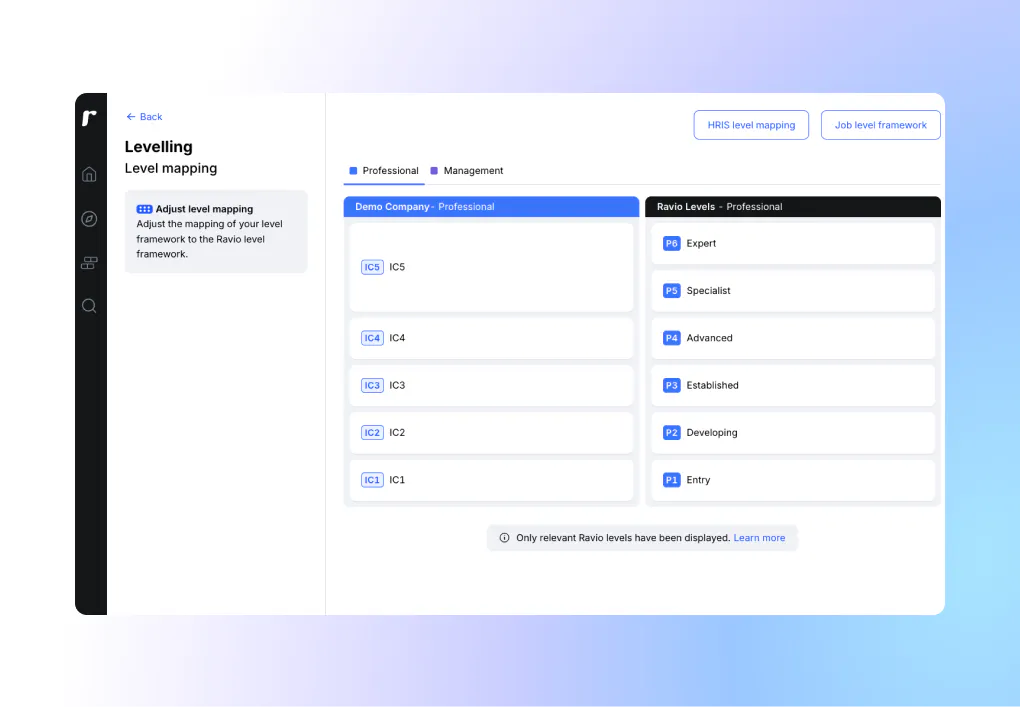
With Ravio though, benchmarking experts handle job mapping during onboarding – aligning your employees to the same job architecture (families, roles, levels) we use within our compensation benchmarking data.

In the end, you get a correlation table showing exactly how your levels match up to Ravio’s – and when you view each employee in your organisation, you'll see their internal job title and level and the Ravio job title and level side-by-side too.

Plus, if you’re in a startup that doesn’t have a level framework yet, as part of this process you can simply adopt Ravio’s level framework as yours – like many of our startup users do.

Level mapping in Ravio

All of this means that when you benchmark a P3 engineer, you can be confident it corresponds to the same role and level in Ravio’s market dataset.

The result is twofold: less manual work and, more importantly, accurate benchmark alignment, which reduces the risk of comparing apples to oranges. 

Every compensation comparison and band decision that follows is built on a consistent, defensible foundation.

2. Benchmark pay against reliable, current market data

With job levels in place, shift to establishing an accurate market reference point for each role. 

This takes reliable, up-to-date market insights, relevant to you, to determine what the market actually pays for comparable positions today – not what it paid last year.

To benchmark confidently, you need clarity on three things: data freshness, quality, and relevance. 

In Ravio, you work from a single source of validated total rewards data covering base salary, variable pay, benefits, and equity.

Review benchmarks, sourced via live integrations with HR systems – validated by a team of benchmarking experts – and refreshed monthly to reflect current market conditions rather than fixed survey snapshots.

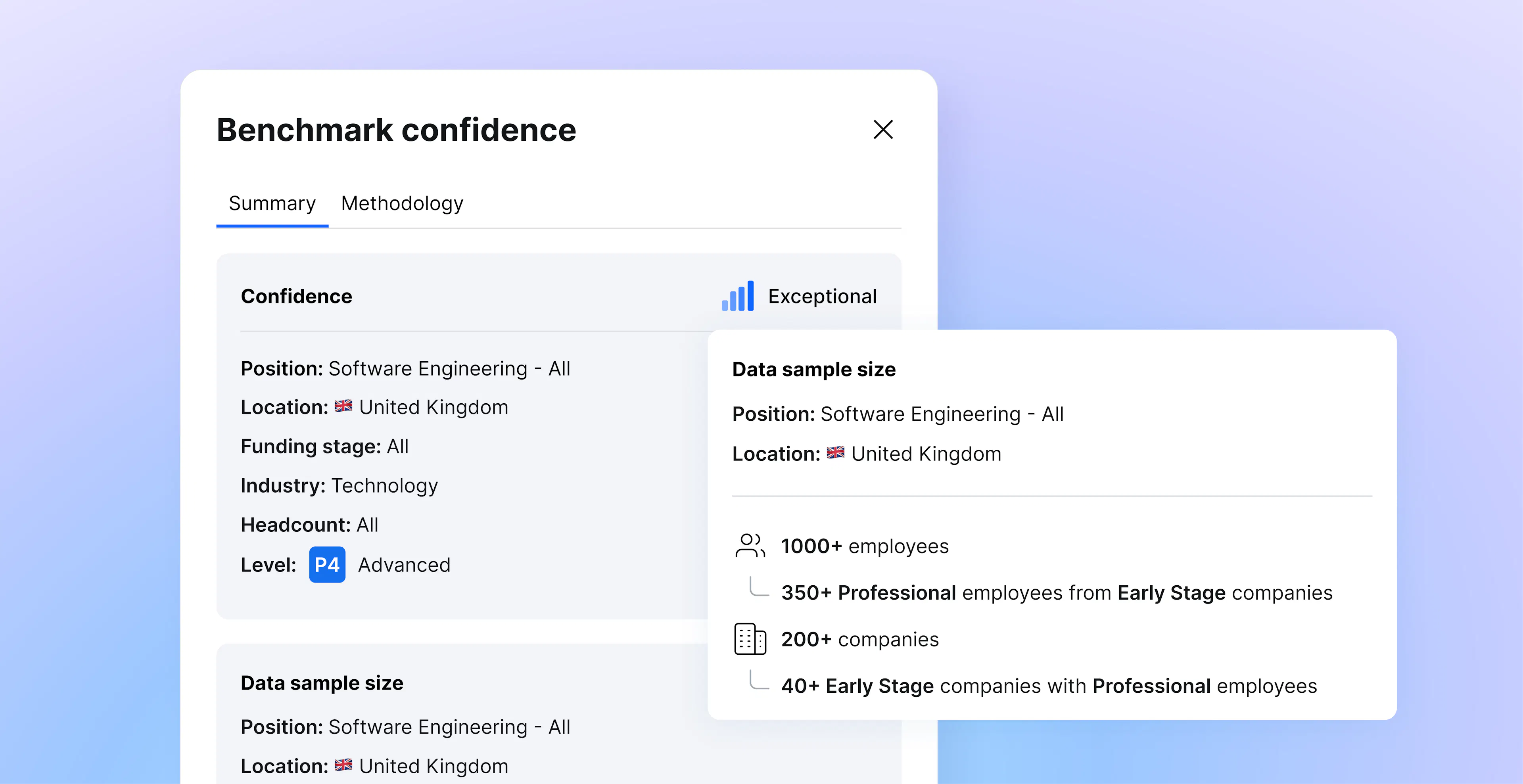
You can also assess benchmark confidence and methodology before relying on them. 

Each benchmark includes a benchmark confidence indicator – ‘exceptional’, very strong’, ‘strong’, ‘good’, or ‘moderate’ – alongside transparent details on sample size and data source. (This also makes it easier to explain how figures were derived and defend your decisions to stakeholders).

Ravio's sample size indicators

And you can refine comparisons using peer filters such as location, industry (for example, fintech versus broader tech), headcount, company size and funding stage.

This helps avoid broad averages and anchors comparisons to your real talent competitors.

Peer group filters in Ravio

3. Build compensation bands aligned to your compensation philosophy

Once you’ve established reliable market benchmarks for each job level, use them to build structured compensation bands and anchor those bands in your compensation philosophy.

For example, you might target the 60th percentile overall, position certain departments above market, or differentiate between base salary and total cash.

In Ravio, you can create and manage compensation bands directly within the platform, and they update dynamically as underlying benchmarks refresh. Here’s what to do:

Set your band approach

Start by defining the primary way you manage employee compensation via bands – in base salary (like 70% of our users do), or in total cash. 

Auto-create compensation bands in Ravio

Set your market position

Then define your target market percentile

Many organisations anchor bands at a chosen percentile – for example, the 50th, 60th or 75th percentile as the midpoint for each job level.

Configure this through your target percentile settings:

Setting a target percentile in Ravio

Apply a company-wide target or adjust it for specific departments or pay components, such as base salary versus total cash, so your midpoints reflect your compensation strategy in practice.

Creating compensation bands in Ravio: choose whether to group bands for the whole organisation, per department, or per job role

Define the market segment your compensation bands should be anchored to

Set peer group filters – such as industry, company stage, and headcount – that determine the market baseline behind your band midpoints.

Rather than adjusting comparisons each time, this establishes a consistent market reference that reflects your pay strategy and competitive positioning.

Edit compensation band ranges in Ravio

Structure your band range

Now, set the width of your compensation bands (for example, ±15% around the midpoint) so you’ve the minimum and maximum range around that midpoint.

Analysing salary bands against market benchmarking data in Ravio's salary bands software

Apply location logic consistently

If you offer location-based pay, define a base location – often your HQ  – so that you can tie regional pay variation to a clear reference point rather than handling it ad hoc.

This ensures geographic adjustments are consistent across roles and levels.

Creating compensation bands in Ravio: choose whether to group bands by location

The best part is that once you’ve set your pay philosophy and benchmarks, you don’t need to rebuild ranges every review cycle. You can view them against a live market target reference line – and refresh benchmarks in a click – so you can instantly see if bands have drifted behind the market and update them when you choose.

The outcome isn't just process efficiency – it's pay ranges that stay updated and predictable, without needing hours of manual maintenance, or running the risk of a broken formula derailing things at exactly the wrong moment.

And by continuously seeing how your bands compare to the market and adjust proactively, rather than reacting months later when outdated spreadsheets reveal you’ve fallen behind.

4. Align compensation decisions with organisational budget 

Next, forecast the cost of new hires and pay changes – whether market adjustments or pay equity fixes – and compare different scenarios to understand their financial impact before committing. 

Done well, compensation budgeting turns Reward Leaders from reactive firefighters into strategic planners – ones who can justify every number in front of leadership or finance.

Model different compensation scenarios

Before making salary adjustments or new hire offers, pressure-test the financial impact instead of committing to changes and calculating the cost afterwards.

Using scenario planning in Ravio, model how different decisions affect total compensation spend. For example, you might model:

  • The cost of aligning compensation bands to your target market percentile (including testing different percentile strategies by function or location)
  • The cost of bringing employees currently below midpoint up to your target band level
  • The budget impact of correcting pay gaps or addressing underpaid outliers (including gender-based adjustments).

Scenario planning gives you visibility into total spend under each option, making trade-offs explicit. You can assess whether to phase salary increases, prioritise certain roles, or adjust hiring plans – all before finalising decisions.

The result is strategic compensation spend, fewer budget surprises, and stronger alignment with Finance when approving salary changes or hiring plans.

Ravio compensation bands: cost scenarios – cost to bring employees to market target

Alignment doesn’t stop at modelling, it also requires accurate forecasts for hiring and merit cycles.

Static data from annual survey providers makes this challenging.

You end up forecasting hiring budgets on last year’s numbers or survey cuts, adding “just in case” buffers, or risking under-budgeting roles because of the unknowns or because the market has already shifted by the time new benchmarks are available. 

This is especially true when exploring expansion into new markets, where last year's survey cuts may offer no coverage at all – leaving you applying manual uplifts to data that's both out of date and built for entirely different markets.

Access to real-time benchmarks and live market trends – such as broader salary movement, hiring rates, and attrition patterns – allows you to forecast based on current conditions. 

Market trends in Ravio: attrition rates, hiring rates, salary increases

That means fewer mid-cycle budget corrections, fewer surprise offer adjustments, and more predictable total compensation spend – again, giving you stronger alignment with Finance and greater confidence when presenting plans to leadership.

5. Create stakeholder alignment and decision transparency

Compensation decisions typically move through several hands – from hiring managers to HR or Reward, and often to Finance or leadership for sign-off. 

At each stage, stakeholders need to understand the rationale behind the numbers. Without shared visibility into how pay levels were set, even well-benchmarked and budget-aligned decisions can stall.

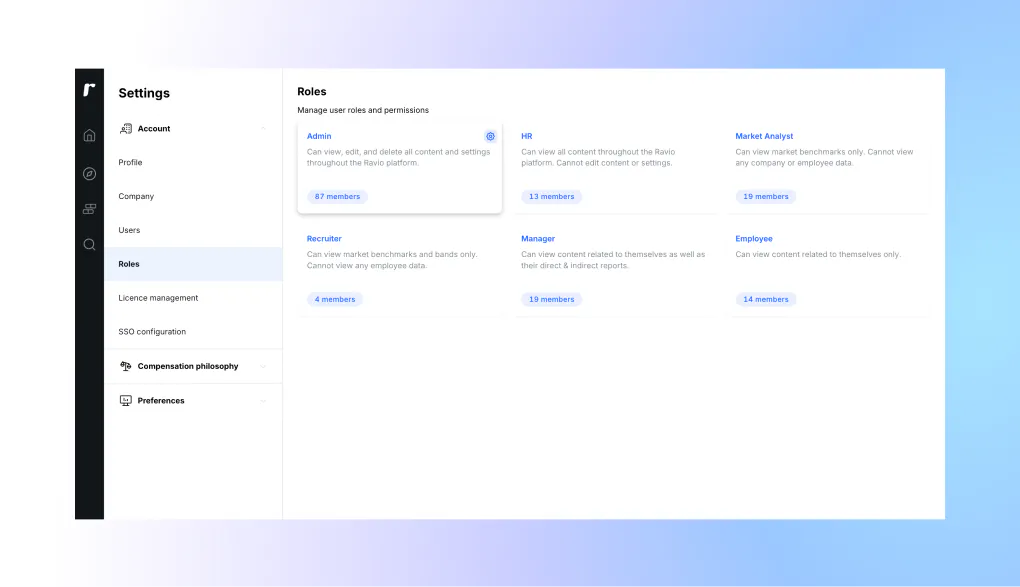
In Ravio, you can configure user permissions so stakeholders see only what’s relevant to them:

For example, hiring managers can view their team’s compensation bands, Talent can reference benchmarks for roles they’re hiring for, while HR or Reward Leaders retain full visibility across the organisation.

This ensures everyone has a single source of truth for compensation discussions, referencing the same market data and band logic, so discussions shift from questioning the numbers to aligning on the decision itself.

All this leads to faster approvals, clearer internal alignment, and more transparent communication. 

It also strengthens your ability to demonstrate objectivity in pay decisions – particularly relevant as regulations such as the EU Pay Transparency Directive require organisations to show their pay structures are consistent, and gender-neutral for all employees doing comparable work.

Wrapping up: Make competitive, fair pay decisions

Confident compensation decisions don’t depend on instinct or one-off survey snapshots. They depend on real-time market insights and clear decision logic. 

Without them, pay decisions become inconsistent, unpredictable, and harder to defend.

Here’s how the full picture comes together:

Compensation decision making pillar

Risk if missing

How Ravio supports it


Role clarity


Misaligned benchmarking, inconsistent band positioning, and unreliable comparisons


Human team maps your roles to a consistent job architecture (level framework and job taxonomy) during onboarding so benchmarks are instantly usable and support like-for-like comparisons


Market confidence 


Overpaying, underpaying, or losing talent to competitive offers


Provides validated, up-to-date, defensible market benchmarks with transparent methodology and peer filters


Internal fairness 


Pay compression, compliance concerns, and reduced employee trust 


Enables structured salary bands aligned to your compensation philosophy and easily maintain them against current market positioning


Financial sustainability 


Budget overruns, reactive adjustments, or uneven reward distribution


Supports scenario modelling so decisions are tested against approved budgets before implementation


Governance 


Decisions can’t be clearly explained to managers, Finance, or regulators


Facilitates creating consistent band logic and shared benchmark visibility to support objective, transparent rationale

When these pillars work together, compensation decisions shift from reactive guesswork to structured, defensible choices – grounded in reliable data and aligned with both market reality and your compensation philosophy.

Want to test this approach using your own roles? Start with three free benchmarks in Ravio and see how your compensation compares to today’s market.

Explore Ravio's benchmarks for yourself

How can compensation teams decide how much to pay for a new role?

To decide how much to pay for new roles, map the new role to the correct job level, then benchmark it against relevant peer data. Use your target percentile and compensation philosophy to set the salary range. Finally, validate affordability using scenario modelling to make sure the final offer is both market competitive and aligns with your budget.

How does Ravio help me ensure pay decisions are fair and competitive?

Ravio supports fair, competitive compensation decisions by giving you up-to-date, reliable market benchmarks mapped and validated using a consistent methodology. This enables accurate like-for-like comparisons – allowing you to define and adjust compensation bands with confidence, ensuring pay decisions reflect current market conditions, and remain fair across comparable roles.

How can compensation teams align pay decisions with company budgets and compensation philosophy?

Start by defining your target percentile and band structure first, as these determine your pay band midpoint and range for your job roles. Then model different scenarios to see how new hires, merit increases, or pay corrections will affect your total compensation spend. This ensures decisions stay aligned with your compensation philosophy and approved budgets before implementation – giving Finance greater predictability and leadership greater confidence in compensation spend.

How can compensation teams defend pay decisions internally?

Base pay decisions on up-to-date market benchmarks, clearly defined compensation bands and a documented compensation philosophy. Make sure you can show your target percentile, how you set the band midpoint and range, and how each decision fits that structure – so you can consistently and objectively defend pay decisions to managers, Finance and other stakeholders.

How does Ravio help maintain employee trust and pay transparency?

Ravio gives you accurate, up-to-date market benchmarks to help you build compensation bands aligned with both current market conditions and your compensation philosophy. Those aligned bands create a consistent pay structure, reducing ad hoc decisions, supporting objective explanations, and helping demonstrate fairness.

And with configurable user permissions in the platform, you can also empower your managers and wider employees too – enabling confident, transparent pay conversations that strengthen employee trust.

Share Blog

Read Next

Ravio partnerships: Ravio x Comp for Brazil compensation benchmarking

Ravio partners with Comp to bring you trusted Brazil benchmarks

Ravio updates

benchmarking

A woman doing salary benchmarking at a desk.

The complete guide to salary benchmarking: How to run a best practice process

benchmarking

The AI compensation and talent trends shaping the job market in 2026

market trends

benchmarking

Share Blog