Ravio partners with Comp to bring you trusted Brazil benchmarks
Ravio has partnered with Comp to bring trusted Brazil benchmarks directly into the Ravio platform.

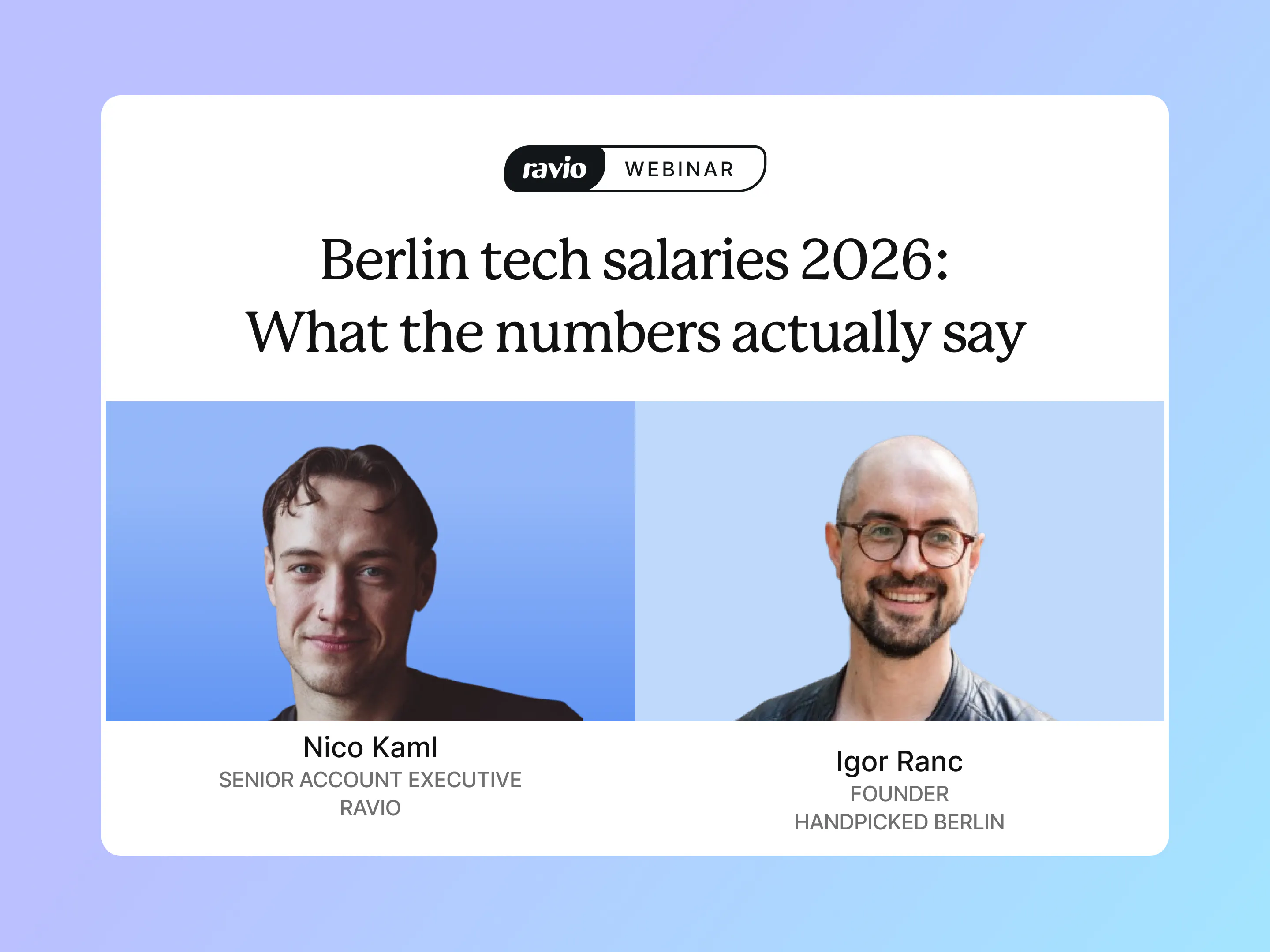
Berlin's annual tech salary survey returned – and this year, Handpicked Berlin's findings were set against Ravio's real-time European compensation benchmarks for the first time.
Igor Ranc (Handpicked Berlin) and Nico Kaml (Ravio) worked through five standout findings together: where Berlin salaries sit relative to Europe, where the steepest compensation jumps occur, which roles command a premium, what the gender pay gap data actually tells us, and why a third of Berlin tech workers are planning to leave.
If you're more of a reader than a watcher, here's a few of the most interesting insights from Igor and Nico's discussion.
Berlin's tech salary median hit €80,000 in 2026, up 4.6% year on year. That figure is surprising given the broader market mood, because 45% of respondents received no raise at all last year, and another 37% got 1 to 5%.
The most likely driver is job switching. When people move, they negotiate – and the median is probably being pulled upward by switchers landing better packages, not by companies getting more generous.
Ravio's data adds context: at mid-level and manager track, Berlin sits roughly 14 to 16% above the European median. At executive level, it's essentially on par. The premium is most pronounced in the middle of the market.
Pay barely moves for the first five years, then jumps sharply: the step from 3 to 5 years to 6 to 10 years of experience represents a €16,000 (25%) increase in a single band – the biggest on the whole curve. After that, it flattens fast.
This isn't about tenure. It's about replaceability. Seniors operate independently, own outcomes, and are hard to replace. The market prices that accordingly.
For employers, the practical implication is to budget the step-up before someone hits six years, not after. That's the band where people are most likely to leave.
AI and ML engineering debuted at €95,000 this year, putting it above general software engineering (€88,000) and making it the highest-paid individual contributor role family in the city. Engineering leadership sits higher at €115,000, but that's a management track.
The driver is supply and demand. Companies need AI and ML engineers faster than the talent pool is growing, and that gap is expected to persist for years. Ravio sees the same premium across Europe – it's not a Berlin-specific story.
One note for reward teams: AI roles are among the hardest to benchmark right now. Role definitions vary, levelling isn't standardised, and the market is moving faster than annual survey cycles. These roles are worth reviewing every 3 to 6 months.
The raw gap – women earning a median €70,000 versus €85,000 for men – is slightly narrower than 2025's 20%, but still a €15,000 per year difference. When controlled for experience, role family, seniority, and company size, it drops to 6.6%.
The controlled figure is genuinely encouraging on like-for-like pay. But the raw gap is what lands in bank accounts, and it barely moved. The 11-point difference between the two figures is largely explained by women being underrepresented in higher-paying roles and senior levels – which isn't a neutral fact.
Ravio's European data shows the same pattern across every function and every level. No department reports a raw gap below 8%. For reward teams, this is increasingly a compliance question: the EU Pay Transparency Directive requires companies to be able to produce and defend a controlled gap analysis.
33% of respondents say they're likely or very likely to change jobs in 2026, up around 2 points on last year. 45% cite significantly higher compensation (20%+) as their primary reason – more than three times the next answer.
The math is straightforward: four in five people fell behind in real terms last year. The internal market stopped delivering, so people are looking at the external one. Switchers are the ones getting the 20%+ bumps – which is also what's pulling the median up to €80,000.
The most at-risk group is senior ICs with 5 to 8 years of experience: the same band as the experience cliff, with the strongest external optionality. As Nico put it, if your pay isn't sitting where it needs to be for that band specifically, you'll find out through attrition rather than a conversation.
Your monthly dose of market insights and expert perspectives

Ravio has partnered with Comp to bring trusted Brazil benchmarks directly into the Ravio platform.

Ravio now benchmarks up to 300 positions in 46 countries. So you can hire the teams you need to scale
Every Ravio benchmark now shows exactly how it was built so you can explain your compensation decisions with clarity, not guesswork.