New3x the coverage, same rigorous quality. 300 positions benchmarkedExplore

Why trust Ravio's data over a salary survey company with a huge dataset

Benchmarking

The long-standing reputation that traditional salary survey companies like Mercer and Radford have built, can make it relatively easy to get buy-in for purchasing their compensation data.

After all, these providers offer millions of salary datapoints across industries, markets, roles, and levels. 

On the surface, that sounds like exactly what you need to make informed pay decisions.

But then why do teams still struggle to trust the data enough to act on it confidently? Why do they still struggle to defend and explain their compensation decisions to employees and leadership?

It comes down to a simple reason: more data doesn’t automatically mean the right data, or lead to better pay decisions. 

No matter how large a dataset is, it won’t help you make confident compensation decisions if the data isn’t verified, up to date, or reflective of the peers you compete against and the roles and markets you hire in.

TL;DR – key takeaways: 

  • Large compensation datasets don’t automatically create better benchmarks. If the data isn’t relevant, verified, and up to date, it becomes harder to trust in real pay decisions.
  • Traditional salary survey data often creates friction in practice – from manual job mapping and outdated benchmarks to inconsistent regional coverage and slower compensation decisions.
  • Real-time benchmarking providers like Ravio focus on data quality over quantity with data sourced from relevant peer groups via HRIS integrations – giving you continuously updated, verified benchmarks you can confidently use and defend.

Why large salary survey datasets aren’t as reliable as you’d think 

No matter how large a dataset is, it won’t help you make confident compensation decisions if the data isn’t verified, up to date, or reflective of the peers you compete against and the roles and markets you hire in.

With traditional salary survey providers that offer millions of compensation datapoints, gaps in data accuracy, freshness, and relevance tend to be prominent – as you’ll learn below. 

For multinational organisations hiring for broad, non-tech roles, these gaps may not matter much. 

But in several instances, such as in fast-moving industries like tech, having more data doesn’t solve these concerns– it just masks them.

Here’s why large survey datasets aren’t as reliable as you’d think: 

1. Broad datasets, but not necessarily relevant to you 

Salary survey companies like Korn Ferry and Radford aggregate data from large, global enterprises across industries and locations – with extensive job catalogues spanning hundreds of roles, levels, and codes.

Radford’s technology compensation survey alone, for example, covers 899 roles. 

That breadth sounds like a strength – giving you millions of datapoints. But it comes from aggregating data across companies that often look nothing like yours.

Evert Kraav, Senior Compensation Manager at Bolt, explains it well

“Usually, what we find in the big surveys is that larger companies are the only ones to participate, rather than the smaller tech companies that might be more relevant to us.”

Evert Kraav, Senior Compensation Manager at Bolt

Evert Kraav

Senior Compensation Manager at Bolt

In other words, survey data draws from companies that typically don’t match your context. And you only realise it when you try to use the pay data, but it doesn’t clearly reflect your funding stage, company size, hiring market, or role structure.

That makes salary benchmarking harder than it should be.

Because if the underlying data doesn’t reflect your peer group, it becomes unreliable – regardless of how large the dataset is. 

Plus, there can still be gaps in the specific benchmarks you need, like how much an AI Engineer is paid in Estonia, simply because the peer group is too narrow, underrepresented, or missing altogether. 

2. Manual data submission makes survey data less reliable 

Traditional salary survey providers run on a give-to-get model – you submit your employee data to access survey results once they’re aggregated and published.

In practice, that means:

  • Filling in large spreadsheets in detail
  • Aligning your employee data to the provider’s standardised framework
  • Repeating the process every quarter or year to maintain access

It’s a process that Bolt’s Evert describes as “inconvenient and highly rigid.”

“With one survey provider, I might get an Excel file with 150+ different columns to fill in. With another, I will need to fill in an Excel file for each country, even if we only use them for a certain region. It’s an inconvenient and highly rigid process.”

Evert Kraav, Senior Compensation Manager at Bolt

Evert Kraav

Senior Compensation Manager at Bolt

Because manual data reporting relies on fitting your roles and levels into a predefined framework, inconsistencies are hard to avoid.

Even small differences in how roles are interpreted or reported can carry over into the dataset, affecting the reliability of the final data.

So you’re not just relying on the survey data itself – you’re relying on how consistently contributing companies interpreted and submitted their data.

To top that, with limited visibility into how the submitted data is checked or standardised, trust in the final benchmarks breaks down further.

3. You get data, but turning it into usable benchmarks is manual

Salary surveys give you raw compensation data, not ready-to-use benchmarks.

You’re working with large datasets – structured tables, salary percentiles, and job catalogue codes – that need to be aligned to your job roles and levels before they can be used.

spreadsheet vs ravio dashboard

And it’s not a one-time task.

It’s repeat work every time the dataset refreshes.

As Bolt’s Evert Kraav explains:

“Because most providers also have their own job levelling and job families structure, it’s a huge effort to then convert ours to theirs. It requires keeping up with all the changes they might have implemented during a year.”

Evert Kraav, Senior Compensation Manager at Bolt

Evert Kraav

Senior Compensation Manager at Bolt

So while data is abundant, it’s not immediately usable.

You’re constantly translating between systems – your internal job architecture and the provider’s framework – and building your own benchmarks on top of it.

This adds time, slows decisions, and makes benchmarks harder to use consistently.

It’s also where the risk comes in, because the benchmark you end up with depends on how you interpret raw data and apply it to your roles and levels. 

Again, even small differences here can distort benchmarks and compound across salary bands. 

That shows up directly in decision-making:

  • Offers need internal validation before going out, because there’s no single clear benchmark to rely on
  • Compensation decisions get revisited or challenged later – making them harder to explain, align internally, and defend 
  • Confidence in the benchmark drops because it’s unclear how closely it reflects the role

In short, when benchmarks rely on manual mapping, they take time to build and repeat – slowing down decisions and adding unnecessary work to your plate. 

4. Survey data struggles to keep up with fast-moving roles

Salary surveys run on fixed cycles – typically annually or biannually.

That means the data reflects what the market looked like when it was submitted, not when you’re making decisions. According to Evert Kraav, Bolt’s Senior Compensation Manager: 

“Traditionally, the survey providers launch once per year, and everything that happens after that date isn’t available until the following year.”

Evert Kraav, Senior Compensation Manager at Bolt

Evert Kraav

Senior Compensation Manager at Bolt

This creates a real challenge for benchmarking new roles. If you’re using data from 18 months ago to make a hiring decision today, you’ll likely struggle to close the hires you need because the market has already moved.

And it becomes even more problematic in fast-moving tech roles – especially across product, engineering, and newer areas like AI – where demand and compensation shift quickly.

Which means by the time survey data is published and used:

  • Hiring demand may have changed
  • Salary expectations may have moved
  • New role variations may not even be captured yet

So even if the dataset is large, it can be out of date in the areas that matter most. 

This gap shows up clearly in how compensation decisions play out:

  • Offers miss the mark – they’re either too low for competitive roles or higher than necessary
  • Salary bands drift out of sync with the market, because they’re based on past data
  • Hiring slows down as teams adjust or override benchmarks to reflect what they’re seeing in real time

So it’s not about how much data is available. It’s about whether that data reflects the current market, especially for tech roles where change is constant.

5. Global coverage creates gaps, not completeness

Traditional salary survey companies offer global coverage. But “global” doesn’t mean consistent depth across markets.

Coverage depends on which companies are actively submitting data – and that varies by region. 

Established markets tend to be well represented, while niche or emerging markets have thinner, less consistent datasets, meaning you lack the depth needed in specific hiring markets.

Bolt’s compensation team ran into this issue directly:

“The trouble with using different survey providers is that they have different levels of popularity and coverage. It means that even if you use a provider with global access, you will always need to use additional providers for certain locations – especially in countries like South Africa, Ghana, Nigeria, Thailand, and Azerbaijan.”

Evert Kraav, Senior Compensation Manager at Bolt

Evert Kraav

Senior Compensation Manager at Bolt

So instead of relying on a single dataset, teams often resort to combining data from multiple providers to fill gaps across regions.

This introduces another layer of complexity. 

Because now you’re working across different datasets, each with its own job catalogue and role definitions – and you need to reconcile them before you can use them.

That shows up quickly in your day-to-day:

  • More time spent stitching together and validating data across sources
  • Slower decisions as teams compare benchmarks from different providers
  • Harder to standardise benchmarks across regions, because they’re built on different inputs.

Put simply, global coverage, even with millions of datapoints backing it, doesn’t guarantee local relevance – making it challenging to scale compensation when hiring across markets.

Why trust Ravio data over salary survey companies with huge datasets

Large datasets increase coverage, but much of that is just noise. What matters is how closely the data reflects your actual hiring market.

When data is broad, manually submitted, and periodically updated, small inconsistencies start to compound. What looks comprehensive becomes harder to trust in practice.

That’s where Ravio works differently. It doesn’t rely on millions of irrelevant data points – it’s built specifically to reflect how high-growth tech companies actually hire and pay. Here’s more: 

1. Focused, relevant data from European countries 

Ravio’s total compensation dataset is built on data from 1,500+ European tech companies – including fintech and other fast-growing sectors across both major and niche hiring markets.

You’re covered across 50+ countries and 100+ roles, without having to rely on broad, less relevant datasets.

Because it’s a more focused dataset, it’s far more useful as it reflects the companies you actually compete with.

This changes what you’re comparing against.

Instead of working through broad datasets that include companies nothing like yours, you’re benchmarking against organisations that resemble your industry, funding stage, team structure, and hiring market.

Take it from the team at FTAPI that needed German benchmarks covering companies and roles they cared about – not broad, global data. Their Head of People and Culture, Kim Heckner, recalls:

“Being a scale-up SaaS B2B company, the companies we wanted to compare ourselves to needed to be in the same sphere. We cannot compete with Google salaries, for example.”

Kim Heckner

Kim Heckner

Head of People and Culture

With Ravio, they now get “a more trustworthy base.” Kim shares: 

"Having the customer base – knowing where you get the data from and who we compare against – is very helpful. When I last looked at the list, we spotted companies that we wanted to compare ourselves to. That's very important."

Kim Heckner

Kim Heckner

Head of People and Culture

And because of access to relevant benchmarks, Kim notes their “compensation discussions are more productive now.”

“We [no longer] waste time debating which data [is] right. Now we start from a shared baseline - 'here's what Ravio shows' - and focus our discussion on the actual decision. The quality of our conversations has gone from a 5 out of 10 to an 8 out of 10.”

Kim Heckner

Kim Heckner

Head of People and Culture

2. Real-time data sourcing, not fixed survey cycles

Ravio’s data isn’t collected through periodic survey submissions. It’s pulled directly from HR systems through real-time integrations.

When you onboard, the team matches your job roles and levels to a consistent job architecture and connects your HRIS to our platform. 

This changes how the data is collected, delivered, and refreshed.

Instead of relying on manually submitted data at fixed points in time, compensation data refreshes continuously as contributing companies update their systems. 

A team of data scientists then verifies collected data and ensures new benchmarks continue aligning with your job architecture, so the verified benchmarks you see reflect how roles are currently paid. 

That removes two core issues with survey data at once:

  • You don’t have to manually submit data or map raw data to your job roles and levels, which reduces reporting errors, gives you instantly usable benchmarks, and makes comparisons consistent.
  • Because the data updates continuously, you’re not working with benchmarks that lag behind the market.

Together, this means you’re working with pay benchmarks that mirror the current market – not a snapshot from months ago. 

This shows up directly in how decisions get made:

  • You don’t need to wait for the next cycle to update benchmarks
  • You’re not adjusting outdated data to reflect current offers
  • You’re not second-guessing whether the market has already shifted
  • You’re on top of compensation for emerging roles, such as AI roles 

Bolt’s team notes this makes a huge difference for them: 

“We don’t have to worry about expired or old data or how we should age it. Those questions go out of the window now that we have Ravio.”

Evert Kraav, Senior Compensation Manager at Bolt

Evert Kraav

Senior Compensation Manager at Bolt

So when you make an offer or update salary bands, you’re not pausing to sense-check the data – you just move with confidence.

3. Built-in data quality, not dependent on how data is submitted

Yet another reason teams like Wise and Pipedrive trust Ravio is how we handle data after it’s collected. 

On top of directly pulling data from source systems, a team of data  scientists actively verifies and standardises it – reviewing it monthly to: 

  • Remove outliers, duplicates, and stale records.
  • Apply role-specific thresholds to create benchmarks so they’re only made available when there is sufficient statistically meaningful data for that particular role.
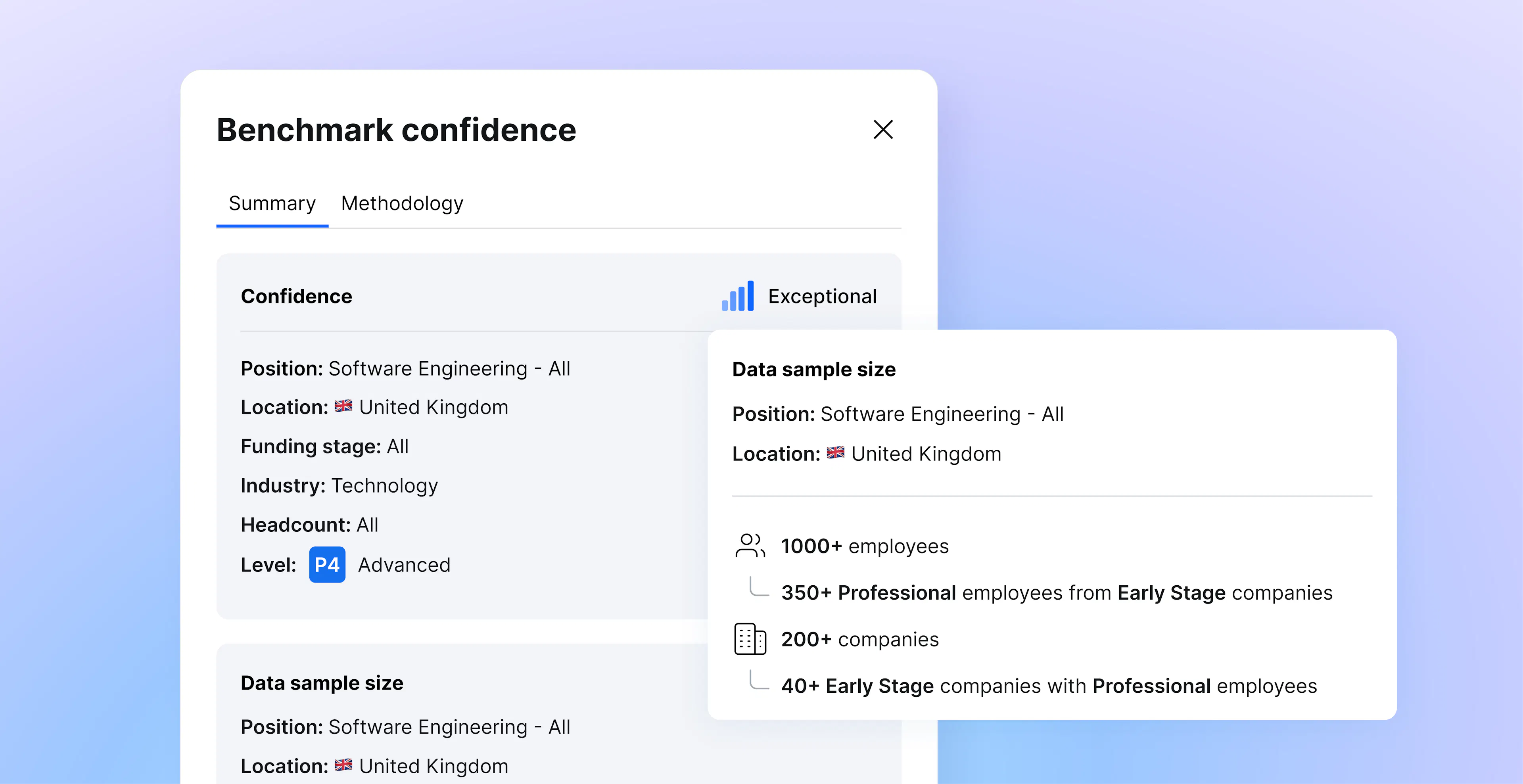
  • Add data source, sample size, and confidence indicators (‘exceptional,’ ‘very strong,’ ‘strong,’ ‘good,’ or ‘moderate’) to benchmarks so you can see how reliable they are. 
Ravio's sample size indicators

Subsequently, benchmarks are more consistent and easier to trust.

Instead of relying on aggregated survey responses being rolled up into a single “benchmark,” you’re working with data that’s been checked, standardised, and made comparable.

This way, you’re not questioning how well contributing teams reported their data or whether errors and inconsistencies were accounted for.

Even without millions of data points, the dataset becomes more reliable because it’s built on consistency, relevance, and visible benchmark quality.

The real value of compensation data is confidence in your decisions

Data quantity isn’t what brings confidence to your compensation decisions. It’s whether you can trust the data enough to make confident, defensible decisions with it.

Because if there’s an abundance of salary data, but it’s difficult to interpret, validate, or explain, and there are gaps when you need answers, the impact spreads quickly across hiring, approvals, salary bands, and employee trust.

Millions of datapoints may look comprehensive on the surface. But broad coverage, manual submissions, periodic updates, and manual role mapping make benchmarks harder to trust, maintain, and act on over time.

And as compensation becomes more visible internally – through pay transparency legislation, leadership scrutiny, and employee expectations – confidence in the benchmark matters even more.

That’s why more compensation teams are moving toward real-time benchmarking providers like Ravio.

Because the value isn’t in having more data. It’s in having the benchmarks you actually need, and knowing that they’re always relevant, current, verified, and ready to use.

Still unsure how costly unreliable compensation benchmarks can become in practice?

Dive into this guide on the ROI of reliable compensation benchmarks to learn how poor benchmark quality affects hiring speed, salary banding, retention, and compensation planning over time.

FAQs 

Is Mercer salary data accurate for tech companies?

Mercer salary data can be accurate, but it’s updated periodically rather than in real time and often reflects large, cross-industry companies rather than tech-specific peers. This makes it harder to access up-to-date benchmarks for quickly evolving, emerging, or niche roles. Tech benchmarks accuracy depends on how closely the dataset matches your company’s stage, market, and role structure – not just its size.

Why use real-time compensation benchmarking tools?

Real-time benchmarking tools provide continuously updated, accurate data, so you’re working with current pay data – not outdated snapshots or manually reported inputs. They remove manual submissions, reduce errors, and give you ready-to-use benchmarks, helping you make faster, more confident compensation decisions without needing to manually map or validate the data first.

Are salary surveys accurate for tech companies?

Salary surveys can be directionally accurate, but often lack precision for tech companies. They rely on broad datasets, manual submissions, and periodic updates, which may not reflect fast-changing roles or niche markets. This can lead to mismatches when benchmarking specialised or rapidly evolving tech positions.

What’s the difference between salary surveys and real-time benchmarking?

Salary surveys provide periodic, aggregated data that requires manual mapping. Real-time benchmarking uses continuously updated data from HRIS integrations, with benchmarks already mapped and standardised (specifics depend on the provider). The key difference is usability – surveys give you broad data to analyse from large corporations, while real-time tools give you benchmarks you can act on without manual effort.

Is more compensation data better when benchmarking salaries?

Not necessarily. More data doesn’t guarantee better benchmarks. What matters is whether the data is relevant, up-to-date, and comparable to your company. Large datasets can include mismatched roles or markets, making decisions harder. Smaller, relevant datasets often lead to more accurate and defensible compensation decisions.

How do you know if compensation benchmark data is reliable?

Reliable compensation benchmark data is consistent, up-to-date, and transparent. You should know how it’s collected and verified, how roles are matched, and how much data supports each benchmark. If you need to interpret, adjust, or validate data before using it, reliability is lower. Trustworthy data can be used directly with confidence. Here are 7 questions to ask compensation data providers when evaluating them. 

Why do companies switch from Mercer or traditional salary surveys to Ravio?

Companies switch or add a real-time tech benchmarking provider when survey data slows down decisions. Manual mapping, outdated data, and unclear relevance make benchmarks harder to trust. In contrast, Ravio provides real-time, standardised benchmarks from relevant tech companies that a team of data experts maps to a standard job architecture when they onboard you. This lets teams make faster decisions without manual job levelling or questioning whether it reflects their market.

Is Ravio data reliable for niche or emerging tech roles?

Yes. Ravio’s compensation data comes from real-time inputs from European tech companies like Bolt, Wise, Deezer, and Personio, so it reflects how roles are actually paid today. Because the data updates continuously, it captures changes in newer or evolving roles faster than annual surveys. This makes it easier to price roles accurately, where traditional surveys often lack timely coverage.

Get the Compensation Review straight to your inbox

Your monthly dose of market insights and expert perspectives

You might also like