Free ToolYour EUPTD plan, done in minutes.Build your checklist

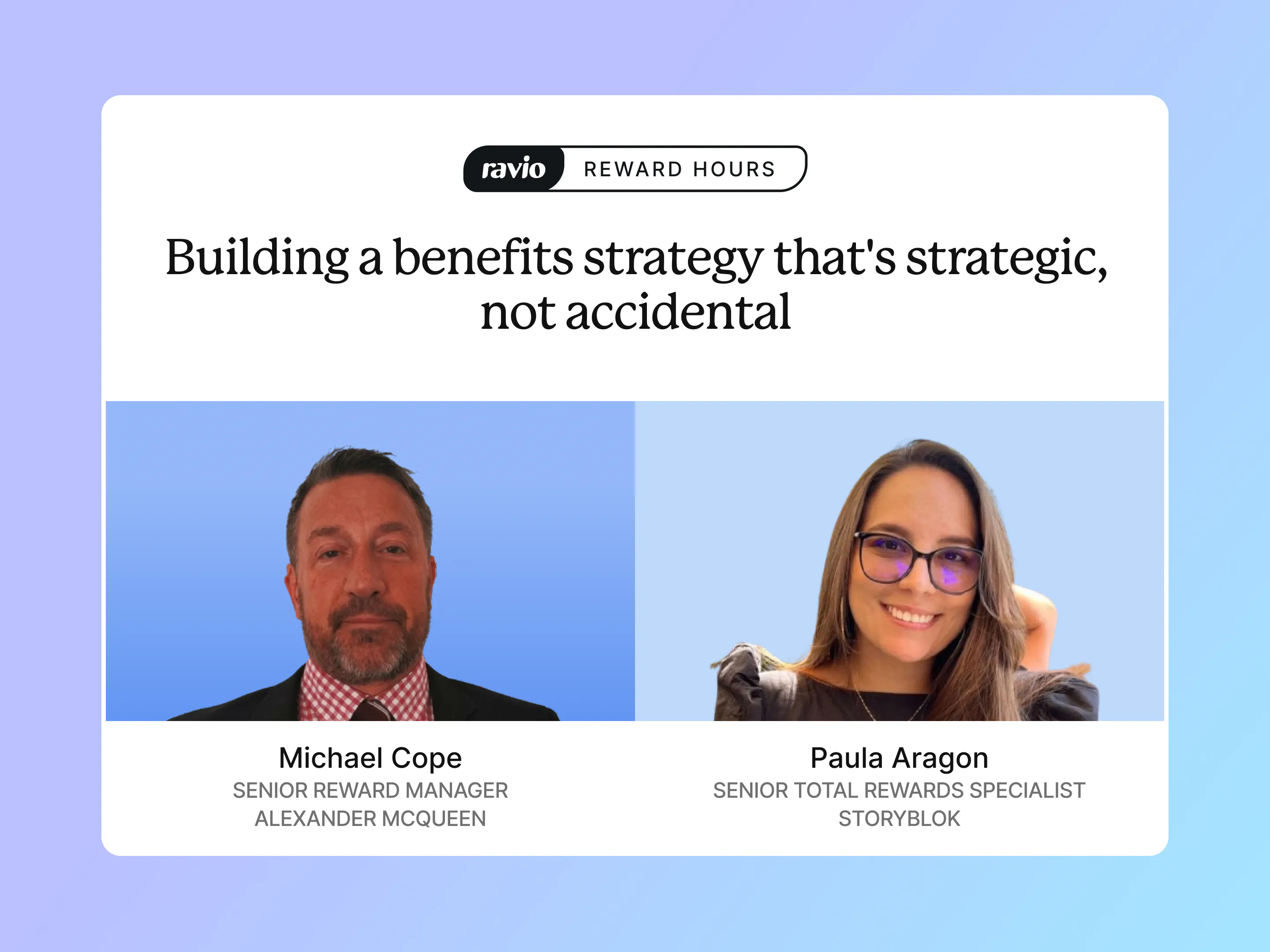
Reward Hours: Building a benefits strategy that's strategic, not accidental

Reward HoursBenefits

A perk gets added during a hiring push, a local requirement lands unexpectedly, and over time you end up with a pile of benefits that are expensive, inconsistent, and hard to explain to the people it's meant to serve.

Designing employee benefits strategically means answering some harder questions. 

Which benefits actually align with your compensation philosophy? What does the programme cost in total – and how do you quantify the value to employees? How do you build something coherent when your workforce spans multiple countries, each with different norms, regulations, and expectations?

Michael Cope and Paula Aragon have both had to build, rebuild, and defend benefits programmes in practice.

This session covered:

  • Building a benefits strategy from first principles – philosophy, scope, and prioritisation
  • Quantifying cost and value: making the case for benefits spend, and measuring whether it's working
  • Managing benefits across multiple locations – where consistency matters and where local flex is non-negotiable
  • What good looks like at different company stages and sizes

Expect practical frameworks and honest conversation – and plenty of time to raise your own questions or experiences too.

Catch up with the webinar recording on-demand

Watch now

Key takeaways from the webinar

If you're more of a reader than a watcher, here are a few of the most interesting insights from Michael and Paula's discussion on building a benefits strategy that's strategic rather than accidental.

Key takeaway 1: Most benefits programmes aren't designed – they accumulate

A benefits programme that made sense five years ago can quietly become an expensive, inconsistent collection of decisions that nobody would have made in one go.

Acquisitions add legacy entitlements. Trends prompt new additions. Budget pressure means some things get cut and others get grandfathered. Over time, what you're left with reflects history more than intent.

The question to start with is: what are we actually trying to achieve.

Attracting talent, retaining people, supporting wellbeing, meeting statutory requirements: most programmes are trying to do some or all of these at once, but without a clear philosophy, the spend ends up distributed across all of them without doing any of them particularly well.

Picking a lane – and being explicit about it – is what turns a collection of benefits into a strategy.

💡 Practical application: Before your next benefits review, write down in one sentence what the programme is primarily there to do. If you can't, that's the gap. If different stakeholders give different answers, that's the conversation you need to have before you touch anything else.

Key takeaway 2: It's easier to give a benefit than to take one away

Once something is in the package, removing it is painful – even if people rarely use it, it's no longer relevant, and there's a better alternative. The pushback tends to be disproportionate to the value people were actually getting from it.

That means every addition is effectively a long-term commitment, and the decision to introduce something deserves more scrutiny than it often gets.

Ask: would we still offer this if we were starting from scratch today? If the honest answer is no, the question becomes how to manage the transition – phasing things out gradually, offering something in exchange, communicating clearly about why. None of those are easy, but they're easier than living with a programme that no longer reflects what the business actually needs.

Key takeaway 3: Asking employees what they want is a double-edged tool

Surveying employees on benefits is valuable but it creates expectations. If people are asked what they'd like and then nothing changes, the damage to trust is worse than if you hadn't asked at all.

It can land as a promise, even when it wasn't meant to be one.

The more useful framing isn't "what would you like us to add?" but "which of the things we already offer do you value most?" That gives you signal on where to focus energy and investment without implying an open-ended commitment.

And when something really isn't possible right now, saying so explicitly – with a timeline for when it might be – does more for trust than silence.

💡 Practical application: If you run benefits surveys, add one question that asks employees to rank their top three existing benefits rather than just flagging gaps. You'll often find the things people value most are already in the package – they just aren't being communicated well enough.

Key takeaway 4: Benefits that aren't communicated might as well not exist

People hear about their benefits package during onboarding and then rarely again.

Over time, especially in a remote environment, benefits that differentiate you – flexible working, learning budgets, wellbeing platforms – start to feel like the default rather than the deal. By the time someone is weighing a counteroffer, they may not be factoring in half of what they'd actually be giving up.

Regular communication – seasonal campaigns, monthly spotlights, total reward statements that show the full picture in one place – isn't a nice-to-have, it's a must to ensure what you’re spending on benefits translates into value for employees.

A benefit nobody remembers is a benefit nobody values, and a benefit nobody values isn't doing any retention work.

Register to join the next Reward Hours

Sign up now

Get the Compensation Review straight to your inbox

Your monthly dose of market insights and expert perspectives

You might also like