
Job architecture
Job levelling: a step-by-step guide
Learn how to build a job levelling framework with our step-by-step guide. Includes expert advice, real examples, and a ready-to-use template.


When you’re looking for "job evaluation software," you'll find tools that do very different things sitting next to each other in the results.
Some offer the tooling to run a formal job evaluation process – helping you assess the relative value of every role in your organisation using a trusted method like point-factor.
Others automate job levelling as part of a broader compensation platform, getting your employees mapped to an industry-standard framework so you can benchmark and build salary bands from day one.
Both show up under the same search term. Both are useful.
But they solve different problems, and choosing the wrong one means either over-engineering a process you didn't need – or under-building a foundation that will cause problems later.
This guide maps the full landscape: what the different tool types actually do, which problem each one is built for, and what to look for when you're evaluating options.
These three terms can sometimes get used interchangeably, but they describe distinct things – and there's software built specifically for each.
Because there are so many ways to approach job evaluation, and so many related concepts (job architecture, job levelling, job analysis), it can be difficult to navigate the job evaluation software space.
So, before we jump into individual providers, let’s take a look at the three broad categories of job evaluation tooling.
These are tools built by the large HR consultancies – Mercer, Korn Ferry, WTW, Croner – where the job evaluation methodology came first and the software exists to deliver and maintain it.
The evaluation process is typically led or supported by the consultancy, and the tool is how you access and store the output.
Examples include Mercer IPE, the Korn Ferry/Hay Guide Chart method, and WTW's Global Grading System – all of which have been in use for decades and are recognised across industries and geographies.
They carry significant institutional credibility, align with the same provider's salary survey data, and are the default choice for large, complex organisations where senior stakeholder buy-in to the methodology matters.
The trade-off is cost, complexity, and ongoing dependency on the consulting relationship.
You're likely looking for this category if:
Software-first tools that give you a structured, formal job evaluation process without the enterprise price tag or consulting dependency. Most use a point-factor methodology.
The difference from the category above is that these are self-serve products without the consultancy project dependency – you own and operate the process, with support available but not required.
Examples include gradar, Easygrading, and PayGrade by PayData – tools built specifically for job evaluation and job architecture, without a consulting relationship attached.
You're likely looking at this category if:
These tools don't run a formal evaluation methodology – instead, they map your employees to an industry-standard level framework and to a standardised role catalogue at onboarding, giving you a consistent job architecture foundation that feeds directly into benchmarking.
Examples include Ravio – a compensation benchmarking platform where expert-led levelling is included for every customer as the foundation for a broader compensation workflow rather than a standalone process.
The limitation to be clear about: if you need a formal analytical methodology for regulatory compliance or legal defence, automated levelling isn't a substitute for a full job evaluation scheme.
You're likely looking at this category if:
The tools below span all three categories that we outlined above. A few cover the full sequence from evaluation through to job architecture; others focus on one step.
Type: Compensation platform with built-in levelling
Ravio is a compensation benchmarking and management platform built for high-growth and tech-enabled companies.
Rather than running a formal point-factor job evaluation methodology, Ravio maps your employees to an industry-standard level framework and standardised role catalogue at onboarding – handled by Ravio's team of experts.
For companies with no existing job architecture, Ravio evaluates each employee and assigns them to the correct level and role in the Ravio framework, giving you a ready-made structure from day one.
For companies with an existing job architecture, Ravio provides a correlation table showing exactly how your levels and roles map to theirs.
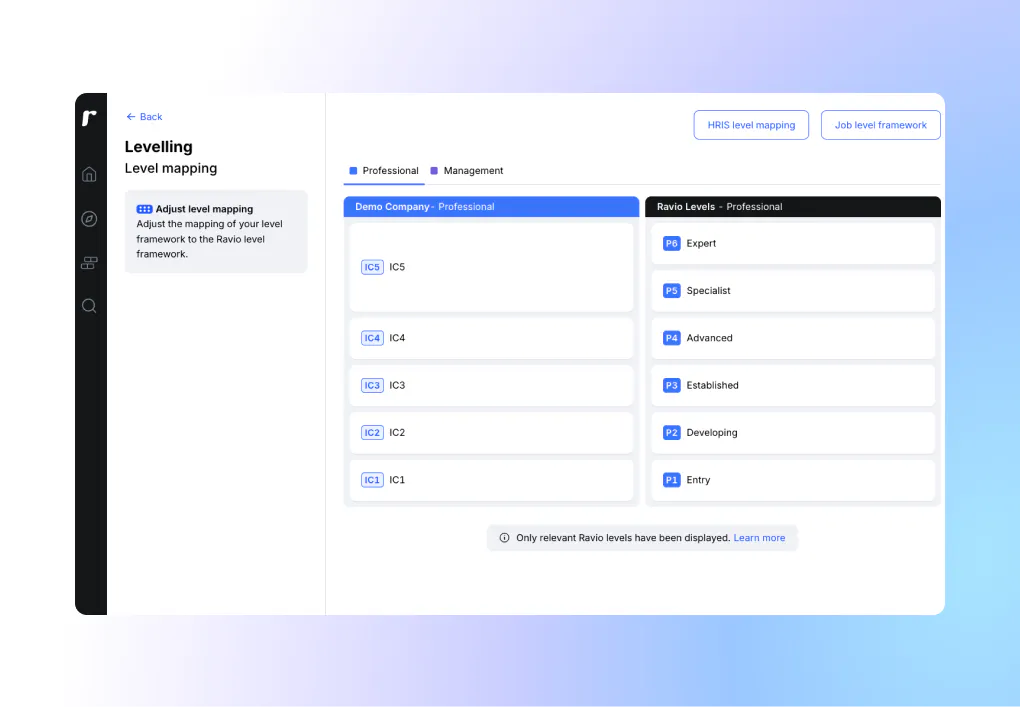
Either way, the result is a consistent levelling and role foundation that feeds directly into benchmarking, salary band design, and pay equity analysis – all within the same platform.
Mapping for each employee is always visible in the platform, manual adjustments can be made at any time, and HRIS integration means changes to employee roles or levels are reflected automatically – you only need to run this process once, ever.
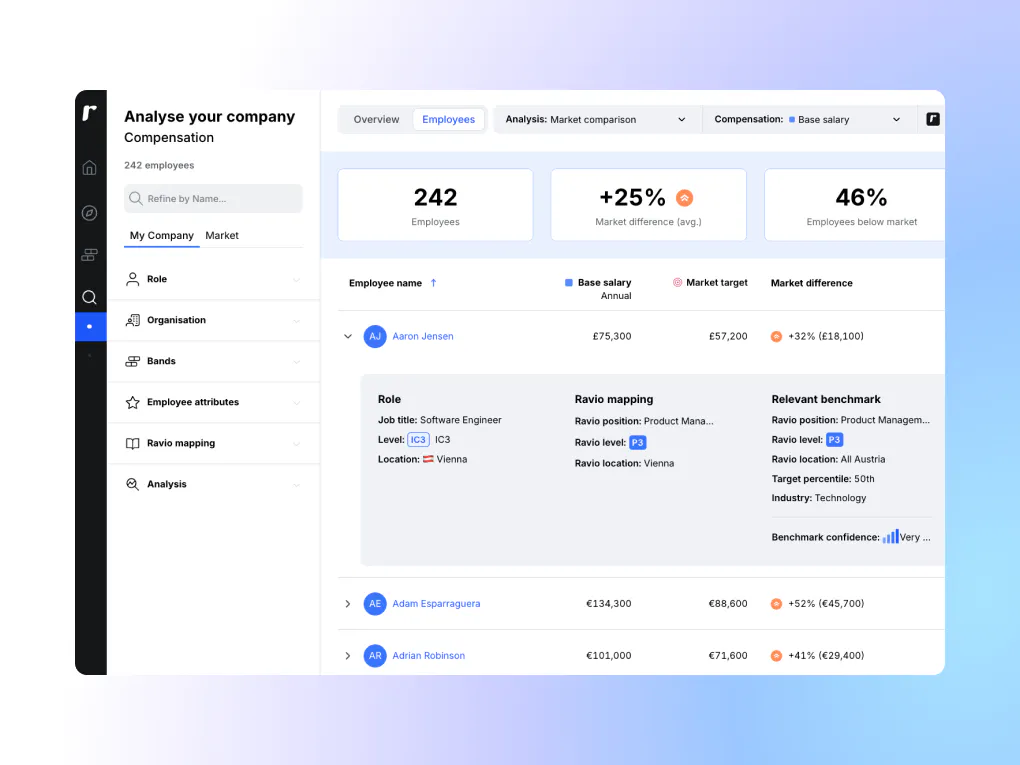
Right for you if: you're a startup or scaling tech company that needs a consistent level framework and standardised role catalogue quickly, and wants to move straight into benchmarking and compensation decisions without running a full evaluation process.
Not right for you if: you need a formal point-factor methodology – if that’s your approach to EUPTD equal value groupings, for instance. Ravio's approach is market-pricing led, not a full analytical job evaluation methodology.
Type: Independent job evaluation software
gradar is a platform specifically designed for end-to-end job architecture development.
It uses a point-factor method to evaluate roles across a set of factors that vary by career track – individual contributor, management, and project management – and produces a grade within a 25-level framework.
Beyond job evaluation, gradar includes competency management, compensation analytics, equal pay reporting, AI-generated job descriptions, and HRIS integrations. Users can upload external benchmarking data or purchase third-party survey data directly within the platform.
Right for you if: you need a structured, software-led point-factor evaluation with strong compliance documentation.
Not right for you if: you need proprietary benchmarking data included in the platform, or executive-level credibility that comes with a recognised consultancy brand.
Type: Independent job evaluation software
Easygrading is a job evaluation tool founded by HR consultant Bill Roberts. It uses a point-factor method across nine core factors, customised per organisation based on an initial sample evaluation.
The output – a score showing the relative impact of each role – is accessible in the platform or exportable as a PDF.
Consultancy services are also available alongside the tool: total reward strategy, reward policy development, and salary benchmarking support.
Right for you if: you want a point-factor evaluation with hands-on expert support available throughout, and prefer working with a small specialist team.
Not right for you if: you need a platform with broader compensation features beyond the evaluation itself, or a faster self-serve option you can run independently.
Type: Independent job evaluation software
PayGrade is a job evaluation tool by PayData, a UK-based reward consultancy.
It uses a point-factor method across five factors: knowledge/expertise, scope, impact, complexity, and communicating/influencing. The output aligns with PayData's salary survey data and can also be mapped to other survey providers.
Right for you if: you're a UK-based organisation already using PayData's salary surveys and want a lightweight evaluation tool that connects directly to your benchmarking data.
Not right for you if: you need broader compensation features beyond the evaluation itself, coverage outside the UK, or a platform with a wider feature set for ongoing compensation management.
Type: Enterprise consultancy-backed job evaluation tool
Korn Ferry is a global management consultancy. Its job evaluation methodology – the Korn Ferry Hay Guide Chart method – is the most widely used in the world, applied by over half of the world's largest employers.
Korn Ferry Architect is the software module within the Korn Ferry Intelligence Cloud that delivers this methodology.
Roles are assessed against four factors: knowledge, problem-solving, accountability, and working conditions. The result is a job grade within a ready-made job architecture, which can inform career progression frameworks and pay ranges. Salary benchmarking (Korn Ferry Pay) and employee listening modules are available alongside it.
Right for you if: you need a globally recognised methodology with deep institutional credibility – particularly for large, complex, or multinational organisations where senior stakeholder buy-in to the approach matters, or where you're already using Korn Ferry for benchmarking.
Not right for you if: you're a scaling company looking for a fast, affordable, self-serve solution. The complexity, two-day paid training requirement, and consulting dependency make this a significant undertaking without dedicated Reward resource.
Type: Enterprise consultancy-backed job evaluation tool
Mercer is one of the world's largest HR consultancies, and its International Position Evaluation (IPE) system is one of the most widely used job evaluation methodologies globally.
Mercer IPE assesses roles against five factors: impact, innovation, knowledge, communication, and risk.
Mercer works with organisations on a project basis to implement IPE and deliver a job architecture structure, accessible via a web-based tool for visualising, editing, and storing the output. Mercer can also support ongoing use of the framework for salary band design and career pathway development.
Right for you if: you need an internationally recognised methodology with strong credibility at board and executive level, and are already a Mercer benchmarking customer – using the same provider for both evaluation and benchmarking simplifies supplier management and ensures alignment between the two.
Not right for you if: you want a self-serve solution you can operate and maintain independently. Mercer's model is consultancy-led, and adjustments typically require going back to the provider – which adds cost and time every time your structure changes.
Type: Enterprise consultancy-backed job evaluation tool
Willis Towers Watson (WTW) is a global advisory and solutions firm. Its Global Grading System (GGS) has been in use for more than 30 years across large multinationals.
WTW GGS uses a two-step process: banding, which places roles within a hierarchy based on their contribution to the organisation, and grading, which assesses roles against compensable factors that vary by role type and band.
The framework supports up to 25 grades, scaled to the size, headcount, and complexity of the organisation, and covers both management and individual contributor career paths. WTW has added AI-supported job levelling to GGS, processing bulk role uploads and providing baseline grade evaluations in seconds. GGS grades align directly with WTW's global compensation surveys.
Right for you if: you're a large multinational needing a consistent levelling framework across multiple regions, and already use WTW salary surveys for benchmarking.
Not right for you if: you need an intuitive, self-serve platform or a quick implementation. WTW's compensation software has received consistent user criticism for being complex and time-consuming to navigate, and the consulting relationship adds overhead for ongoing maintenance.
Whichever category of job evaluation tool you're considering, these seven questions will help you assess fit before you commit.
1. How transparent and communicable is the methodology? Can you understand how roles are being evaluated – and can you explain the rationale to managers and employees without a consultant in the room? Opaque, black-box methodologies create dependency and make it harder to maintain consistency over time. If the answer to either question is no, factor in the ongoing cost of that.
2. How secure is the platform? You're inputting or integrating sensitive employee compensation data. Check what security certifications the provider holds – SOC 2 Type II and ISO 27001 are the standard to look for – and how role-based permissions are managed across your team.
3. Does it meet your legal and compliance requirements? If your organisation needs to comply with equal pay legislation – or defend pay decisions in the event of a claim – a formally documented, objective job evaluation methodology is the foundation that makes that possible. The EU Pay Transparency Directive is the most immediate driver for many European companies right now, requiring audit trails, documented equal value groupings, and gender pay gap reporting by group. Check what applies in each jurisdiction you operate in, and verify that the tool you're considering produces the documentation those requirements actually need.
4. How easy is it to maintain over time? The initial job evaluation process is one thing; keeping it current is another. What happens when a role changes, a team restructures, or you hire for a new function? Does the tool make updates straightforward, or does every change require going back to the vendor? Maintenance is where many frameworks fall apart.
5. Can you make manual adjustments? No methodology fits every organisation perfectly. The ability to override or adjust individual grading decisions – without undermining the overall structure – matters, particularly as your company evolves and edge cases emerge.
6. What reporting and dashboarding does it offer? Can you produce the summaries and outputs you need for leadership without exporting everything to a spreadsheet first? This is a known gap in several tools in this space – worth testing before you buy, not after.
7. Does it connect to your broader compensation workflows? Job evaluation creates a structure. What matters is what you can do with it. Does the tool feed directly into benchmarking, salary band design, and pay equity analysis – or does the output sit in a silo that requires manual work to use downstream?
Job evaluation software supports the process of assessing the relative value of roles within an organisation. Some tools run a formal evaluation methodology – like point-factor – to produce a legally defensible grading structure. Others use market pricing as their approach to job evaluation – mapping employees to an industry-standard level framework and role catalogue as part of a broader compensation platform, rather than running a formal point-factor process. The term covers both, which is why it's worth establishing which you need before evaluating options.
Job architecture software helps you build and maintain the overarching framework of job families, functions, and levels. Job evaluation software supports the process of assessing the relative value of roles within that structure, typically using a defined methodology like point-factor. Job levelling software handles the mapping of employees to levels within the framework. In practice, many tools cover more than one of these – some handle all three.
For most scaling tech and high-growth companies, the priority is a consistent levelling framework and standardised role catalogue that feeds directly into benchmarking and salary band design – rather than a full point-factor scheme. Ravio is built specifically for this: levelling and role mapping are handled at onboarding by Ravio's expert team, and connect directly to real-time benchmarking data and compensation workflows in the same platform. If you need a formal methodology for compliance purposes, gradar is the most accessible independent option.
Job evaluation automation refers to software that handles the evaluation or levelling of roles programmatically, rather than through a fully manual, assessor-led process. Most tools automate part of the process: gradar uses its point-factor methodology to generate grades automatically; WTW's AI-supported job levelling processes bulk role uploads in seconds; Ravio automates the mapping of employees to its level framework at onboarding. Full automation is rarely the whole picture – human review and calibration remain important, particularly for senior roles and edge cases.
The Mercer International Position Evaluation system (IPE) is Mercer's proprietary job evaluation methodology. It uses a point-factor approach, assessing roles across five factors: impact, innovation, knowledge, communication, and risk. It's delivered primarily as a consultancy project, with the output accessible via Mercer's web-based tool.
Your monthly dose of market insights and expert perspectives
Learn how to build a job levelling framework with our step-by-step guide. Includes expert advice, real examples, and a ready-to-use template.

Learn how to build the right compensation foundations as a startup – with advice on best practices and lessons learnt by Hannah Reif from implementing pay structures at Luminovo.

Job architecture is the structure to ensure consistent job titles, roles, families, and levels. Experts Figen Zaim and Rob Green explain how to design the right structure for your company.

