
Compensation strategy
10 best compensation planning software, compared (2026)
Compare the best compensation planning software in 2026. Learn what to look for, compare leading platforms, and choose the right solution for your organisation.


Last updated: 28 September 2026
First published: 19 December 2025
There’s no denying that most of us start making compensation decisions using spreadsheets and manual processes.
But as soon as hiring scales, pay structures become more complex, or teams expand across markets, spreadsheets start breaking and often start creating more inconsistency than clarity.
That’s where compensation management software comes in. It’s designed to help organisations plan, benchmark, manage, and communicate pay in a more structured, reliable way.
This guide goes into the nitty-gritty of how compensation management software works, what it actually helps you with, and whether you even need it. If you find yourself agreeing that your organisation needs a compensation management tool, there’s also a practical evaluation checklist at the end to help you choose the best fit.
Compensation management software gives organisations the tools to plan, benchmark, manage, and communicate employee pay in a structured, data-driven way.
In simple terms, it’s software that supports compensation management – the set of activities involved in deciding how you pay employees and keeping those decisions consistent over time.
Compensation management typically includes:
As companies grow, these activities become harder to manage manually – especially across teams, roles, and locations, where spreadsheets easily break as more people are involved in pay decisions.
Compensation management software brings these activities into one system, so you aren’t relying on spreadsheets, email threads, and manual approvals every time a hiring decision, raise, or promotion is on the line.
Ultimately, this makes pay decisions easier to manage at scale, more consistent, and defensible as the organisation grows.
Note: Compensation management software does not typically include payroll, equity, bonus, or benefits management. There are several specialised tools that support each of these, such as cap table management platforms, sales incentive software, etc.
Compensation management software can help People and Rewards teams set competitive pay, build compensation bands, run reviews, and communicate pay clearly – supporting consistent, compliant pay decisions as organisations grow
Here are 9 ways you can use compensation management platforms:
When hiring managers, recruiters, and HR rely on different salary data sources, pay decisions quickly become inconsistent – and increasingly uncompetitive.
Compensation management software gives you access to up-to-date market benchmarks, helping you base offers and raises in real compensation data instead of guesswork.
This reduces the risk of under- or overpaying employees, leading to fairer pay decisions that are easier to justify and help you better attract and retain talent.
When equity, bonuses, or other variable components are involved, it’s easy to lose sight of the full value and cost of an offer.
Compensation management software gives teams visibility into base pay alongside bonuses and equity, allowing you to make salary decisions in the context of total compensation – even when those components are managed in separate systems.
This helps teams make more informed pay decisions based on total reward value and align offers with both talent expectations and budget realities.
As organisations grow and pay decisions involve more people, keeping compensation consistent becomes harder without a shared structure.
Compensation management software helps you build compensation bands by role, level, and location using market data – whether those bands are salary-only or factor in total cash or total compensation.
This creates a clear, shared pay framework that you can visualise and easily update in the software without having to deal with all the spreadsheet formulas. These bands stay consistent across teams, align with seniority, and are easier to explain and defend – while still scaling as the organisation grows.
Pay decisions often happen outside HR’s direct control, with recruiters and hiring managers relying on candidate expectations or negotiation pressure rather than a shared framework.
Compensation management companies give recruiters and hiring managers controlled access to market benchmarks and salary bands, so offers are made within agreed ranges and principles.
This keeps new hire offers consistent and fair, reduces back-and-forth during hiring, and allows HR to maintain oversight without becoming a bottleneck in the recruiting process.
Pay differences typically become visible once they turn into employee complaints, compliance issues, or legal risk.
Compensation management software surfaces pay gaps, inconsistencies, and out-of-band salaries across roles, levels, or locations. Some tools also provide guidance or cost modelling to help teams understand how to correct those gaps and generate documentation to support pay transparency and compliance requirements.
This reduces legal and reputational risk, protects fairness across the organisation, and helps remove the “who negotiated best” effect from compensation decisions.
Compensation conversations often stall when employees ask, “Why am I paid this?” or “What would it take to earn more?” and HR has nothing beyond a number or a generic explanation.
Compensation management software gives you employee-facing tools like total rewards statements or self-serve access that help employees understand how their pay is structured.
Even without direct employee logins, having clear, visual salary structures and market benchmarks makes it easier to explain pay decisions.
The result? HR and line managers can communicate compensation with more clarity and confidence, reduce misunderstandings, and build trust by showing employees that pay is based on consistent, well-defined principles rather than arbitrary decisions.
Salary and merit review cycles are often where compensation processes break down, with spreadsheets emailed back and forth and little visibility into what’s changed.
Compensation management software replaces this by centralising workflows for budgeting, approvals, and change tracking.
This makes reviews easier to run, faster to complete, and far less error-prone, with a clear record of decisions and a reliable audit trail instead of spreadsheet chaos.
Without proper tooling, it’s easy to approve raises, promotions, and new hire offers without a clear understanding of their overall impact on cost – leading to unexpected spend, budget overruns, or difficult trade-offs later in the year.
Compensation management software lets HR and Finance see and compare the cost impact of hiring, raises, and promotions before decisions are finalised.
As a result, you stay in control of compensation spend and avoid accidental budget overruns even as headcount increases.
As expectations around pay transparency and compliance grow, it becomes harder to explain how compensation decisions were made – especially when those decisions span teams, managers, and time.
Compensation management software documents the logic behind pay frameworks, approvals, and changes as they happen, rather than requiring teams to reconstruct decisions later.
This makes it easier to explain pay decisions internally, prepare for audits, and demonstrate to stakeholders that compensation is consistent, fair, and defensible.
You don’t really need compensation management software from day one of startup life. In some cases, the added structure and overhead may be overkill if:
In these cases, spreadsheets may still be sufficient – at least until compensation becomes more complex.
But there’s a point where spreadsheets, one-off decisions, and informal approvals no longer hold up. Instead, they start creating inconsistency, risk, and hidden costs in the form of extra time, duplicate work, and avoidable fixes.
So the question isn’t how big your company is – it’s how complex your compensation decisions have become. The signs show up in a few clear ways:
Manual processes tend to break down once pay decisions involve more people, roles, or locations.
Yes, spreadsheets can run the show for small teams – but they quickly start to fall apart once you’re managing compensation for upwards of 100 employees. In fact, once companies reach 500 employees, only 23% still use spreadsheets to run pay reviews, per our recent survey of 140 companies.
At that point, teams either rely on fragile, hard-to-maintain files or end up with dozens of spreadsheets spread across roles, regions, and managers.
Look for these common signs confirming manual processes no longer serve you:
At this stage, ad-hoc tools don’t just slow teams down – they actively introduce risk.
Compensation management software also becomes necessary when pay decisions start carrying greater financial, organisational, or regulatory weight.
Look for the following signs showing compensation is no longer just an administrative task:
At this point, compensation becomes a strategic lever tied to hiring, retention, fairness, and financial planning.
Compensation management software works by combining market data, structured frameworks, and compensation workflows into one system. In doing so, it replaces piecemeal, spreadsheet-based compensation workflows with a single, scalable way to manage pay decisions.
Here’s a detailed rundown of what a compensation management platform can do (the exact capabilities vary by different software providers):
Compensation management software brings market pay data into the system, allowing teams to reference current benchmarks when making pay decisions.
Benchmark coverage and sources vary by provider, though. Some tools offer global datasets, while others focus on specific regions – with data coming from third-party surveys, or real-time proprietary data from live integrations with HR systems.
It’s also worth noting that not all compensation management tools offer market data – some focus purely on workflows. But in reality, without pay benchmarks, even the best workflows can leave teams guessing, given how streamlined processes can’t replace market context.
Using AI or human support, compensation management software aligns your internal job titles and roles to standardised role families or levelling frameworks within the platform.

Example correlation table in the Ravio platform, showing how a company's levels are mapped against the Ravio framework
In turn, this reduces ambiguity, so teams don’t end up benchmarking the same role differently across departments or locations – which often leads to inconsistent salary bands and unreliable pay decisions.
The result is more consistent benchmarking across the organisation, with significantly less manual job-matching work for your team.
When defining salary bands, compensation management software shows you where current employees sit within a range – who’s below market, aligned, or outside the expected range.
It also lets you define clear minimums, midpoints, and maximums for each role and level based on market evidence, rather than negotiation history or gut feel.
And because these salary bands are tied to real-time market benchmarks, they stay up to date – so promotions and pay adjustments are based on current data, not outdated ranges.
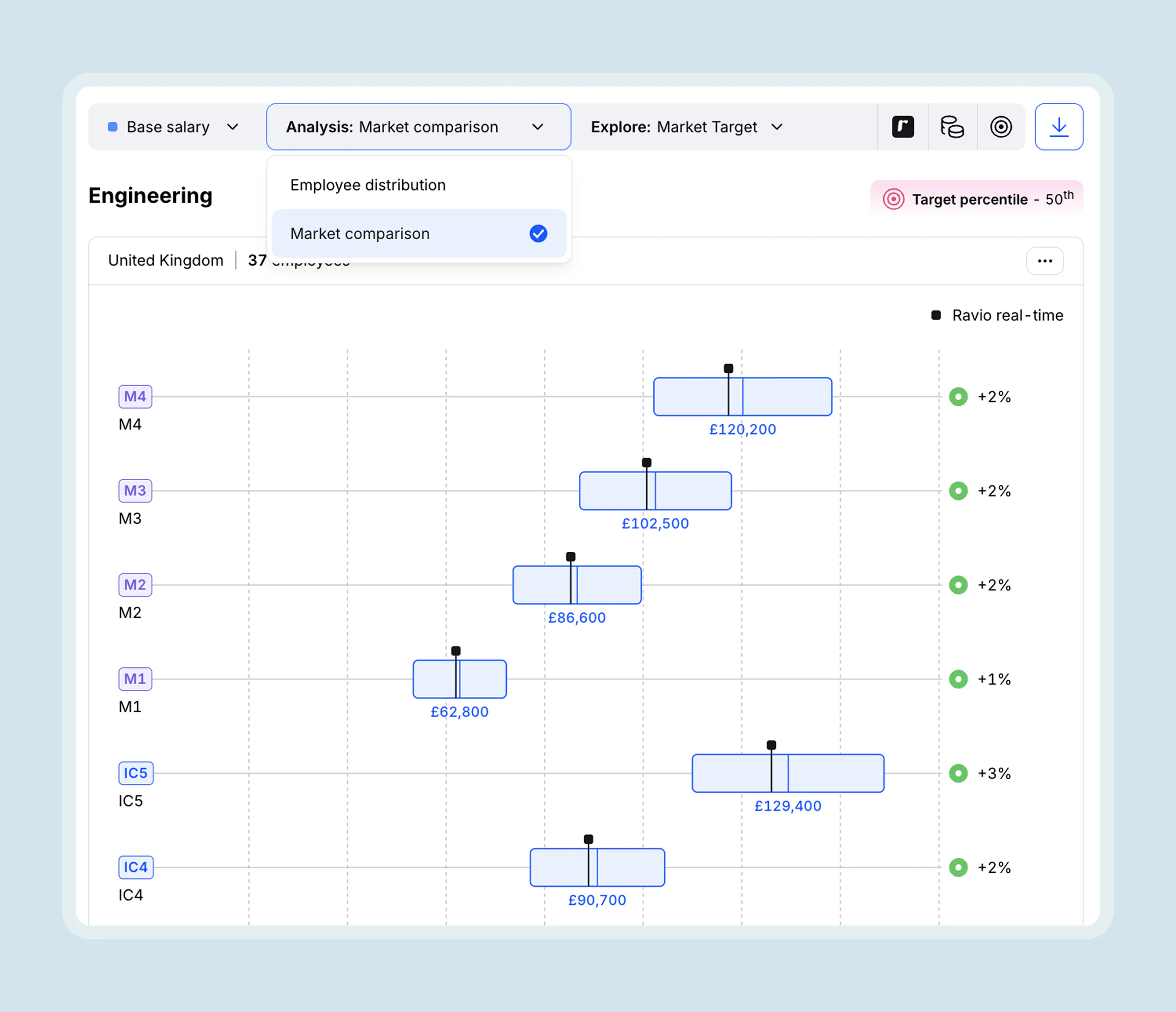
Ravio compensation bands – market comparison analysis
Without the right compensation management tool, salary bands aren’t something you build once – because there’s no live market data behind them, they quickly go out of date.
Every time benchmarks refresh, a promotion cycle runs, or market conditions shift, teams have to manually recreate or adjust those ranges – all within spreadsheets. This quickly turns into avoidable, productivity-draining repeat work as you wrangle spreadsheet formulas to recalculate bands, validate benchmarks, and double-check which salaries still fit.
With compensation management software, the salary structures you build are connected to market benchmarks and refresh automatically over time. This keeps ranges market-aligned and instantly usable in compensation reviews, promotions, and salary adjustments without manual rework.
Depending on how you structure bands, some tools support salary-only bands or total cash bands (base salary plus variable). They also make it possible to compare compensation packages across roles – for example, reviewing higher base salaries in engineering alongside commission-heavy sales roles.
Compensation management software also provides structured workflows to run compensation reviews, such as annual salary reviews, promotion cycles, or market adjustment rounds, within a single system.
During a compensation cycle, the software becomes your single workspace for reviews. Managers see a list of employees in scope, the compensation bands that apply to them, and a budget to work within.
You enter proposed raises or adjustments directly into the system. Those proposals are then reviewed and approved step by step, with every change saved automatically and the remaining budget updated as decisions are made.
As teams decide raises, promotions, or new hires, compensation management software lets them model different scenarios and see the financial impact immediately.
For example, increasing salaries by a certain percentage, planning a promotion, or hiring new employees updates the total cost against available budget – showing how spend shifts at the employee, team, or organisation level.
Consequently, teams can easily compare trade-offs and make informed pay decisions before approvals are finalised, rather than uncovering budget issues later.
Compensation management software continuously analyses pay data across roles, levels, and locations to surface gaps, inconsistencies, and out-of-band salaries.
This allows teams to spot misalignment early, before it escalates into equity, compliance, or retention issues.
Without this visibility, pay equity problems often only surface later when they’re harder to explain, correct, or plan for.
Teams can review these signals in context, alongside market benchmarks, salary bands, and recent pay changes, to understand whether differences are expected, defensible, or need action.
At the same time, every compensation change is recorded automatically. Decisions, approvals, and adjustments are logged as they happen. This way, teams don’t have to reconstruct history later when questions arise – making pay decisions easier to explain, review, and defend over time.
Considering a compensation management platform? It’s worth keeping in mind that each provider differs in the benchmarks, job-mapping capabilities, and compensation management features it provides.
Below are six of the best on the market, with a detailed guide following this overview:
Ravio is a dedicated compensation management platform that combines real-time market benchmarks with tools for building dynamic salary/total compensation bands and pay equity analysis.
During onboarding, Ravio’s team aligns your internal roles with its levelling framework, reducing the need for manual job levelling and mapping.
Ravio’s strength lies in proprietary, continuously updated benchmarks with particularly strong coverage across Europe.
CompUp is a compensation management platform covering compensation cycles, salary bands, pay equity, total rewards statements, and candidate offers.
Its core strength is the compensation cycle itself, offering merit and increment planning, budget simulations, multi-level approvals, calibration, and automated compensation letters – and all in a highly configurable way, with the ability to adapt to your existing structures across business units, employee cohorts, countries, and currencies.
CompUp's native benchmarking data focuses on India, so teams hiring in other markets may need an additional benchmarking provider.
Pave is a compensation management platform that combines total rewards data with tools for salary bands and running compensation reviews.
It uses AI-led job matching and offers benchmarks with particularly strong coverage in the United States and Canada.
Assemble is Deel’s compensation management tool, bringing together salary band creation, compensation reviews, and pay transparency tooling within a single system.
Because Assemble sits within Deel’s broader global payroll platform, it provides basic compensation management capabilities integrated with payroll workflows. Job mapping is manual, with teams managing data upload and levelling themselves.
Beqom is an enterprise compensation management platform focused on salary planning, compensation reviews, and pay equity management at scale.
Unlike tools like Ravio and Pave that provide real-time market benchmarks, Beqom integrates traditional salary survey data providers. Its strength lies in supporting complex, global compensation processes and governance rather than owning benchmarking data itself.
Compport provides tools for managing compensation workflows, including salary band management, review cycles, and worldwide pay equity compliance.
Like Beqom, it doesn’t provide native benchmarking data or market insights. Instead, organisations have to manually upload and map their pay data within the platform.
Once you’ve decided you need compensation management software, the harder question is which one actually fits your organisation.
Tools vary widely in data quality, geographic coverage, workflows, and flexibility – and the wrong choice can lock you into processes that don’t scale.
Use the checklist below to assess your needs and evaluate platforms against what matters most for your team:
Compensation management software isn’t about adding another HR tool to your stack. It’s about bringing structure, consistency, and accountability to some of the most sensitive decisions an organisation makes.
If your pay decisions rely on fragmented data and piecemeal manual workflows, the risk isn’t just inefficiency – it’s misalignment, inequity, and decisions that are hard to explain or defend as you scale.
The right platform gives you reliable market benchmarks and intuitive tools that make compensation decisions clearer – for HR, Finance, managers, and employees alike.
The key is choosing software that fits how your organisation actually pays people today, while supporting where you’re headed next. Use the checklist above to cut through marketing claims and focus on what will genuinely improve how you manage pay.
Compensation software helps you decide what people should be paid, whereas payroll software helps you pay them. Compensation tools focus on market benchmarking, building salary bands, and running merit cycles. Payroll systems handle salary payments, taxes, and deductions. In practice, compensation software informs decisions that payroll then executes.
No, compensation software isn’t just for enterprises. It’s most valuable when hiring scales, pay decisions involve multiple managers, or teams operate across markets. Many companies adopt compensation tools between 100–200 employees, when spreadsheets start breaking down, and consistency, budget control, and defensibility become critical.
Yes, many compensation management tools can be used without a full HR suite. Some allow manual data uploads to get started. However, integrating with an HRIS improves data accuracy, reduces manual work, and keeps employee, role, and salary data in sync over time.
Implementation typically takes anywhere from a few weeks to a couple of months, depending on the compensation management software. Integration timeline varies by factors like data readiness, job mapping complexity, and integrations. Generally, tools with guided onboarding or human job-matching support tend to go live faster than highly customised enterprise platforms.
Compensation software pricing varies widely. Costs are usually based on employee count, market data needs, and selected modules. Smaller teams might pay a few thousand per year, while buying multiple salary survey datasets paired with consultancy-led job mapping can cost significantly more.
The best compensation software for small businesses depends on needs. Teams focused on benchmarking and salary bands may prioritise tools with reliable market data and a simple setup. Others may value lightweight review workflows or integrations with payroll. Early-stage teams often benefit most from tools that reduce manual work without heavy configuration.
Compensation management is the process of planning, structuring, and maintaining employee pay. It includes benchmarking roles, setting salary bands, managing raises and promotions, and ensuring decisions stay consistent over time. The goal is to balance competitiveness, fairness, and budget constraints as organisations grow.
The main objective of compensation management is to pay employees fairly, competitively, and consistently. It ensures pay decisions align with market data, internal frameworks, and company budgets – while supporting hiring, retention, performance, and compliance. Done well, it removes guesswork from pay and makes decisions easier to explain and defend.
Typically, growing companies where pay decisions involve multiple managers, markets, or review cycles need compensation management software. People, Rewards, and HR teams use it most, often alongside Finance. It becomes especially valuable for teams hiring frequently, operating across regions, running formal pay reviews, or managing equity and pay equity risk.
Your monthly dose of market insights and expert perspectives
Compare the best compensation planning software in 2026. Learn what to look for, compare leading platforms, and choose the right solution for your organisation.

The best compensation management software gives you tools for real-time benchmarking, salary bands, compensation reviews, and pay equity compliance. See how top platforms compare in 2026.
Join Henriette Zimmer and Gina Trautwein for an honest conversation about retention – spotting the risk before the resignation letter lands, deciding which lever actually works, and knowing when pay alone won't cut it.

