1. Ravio
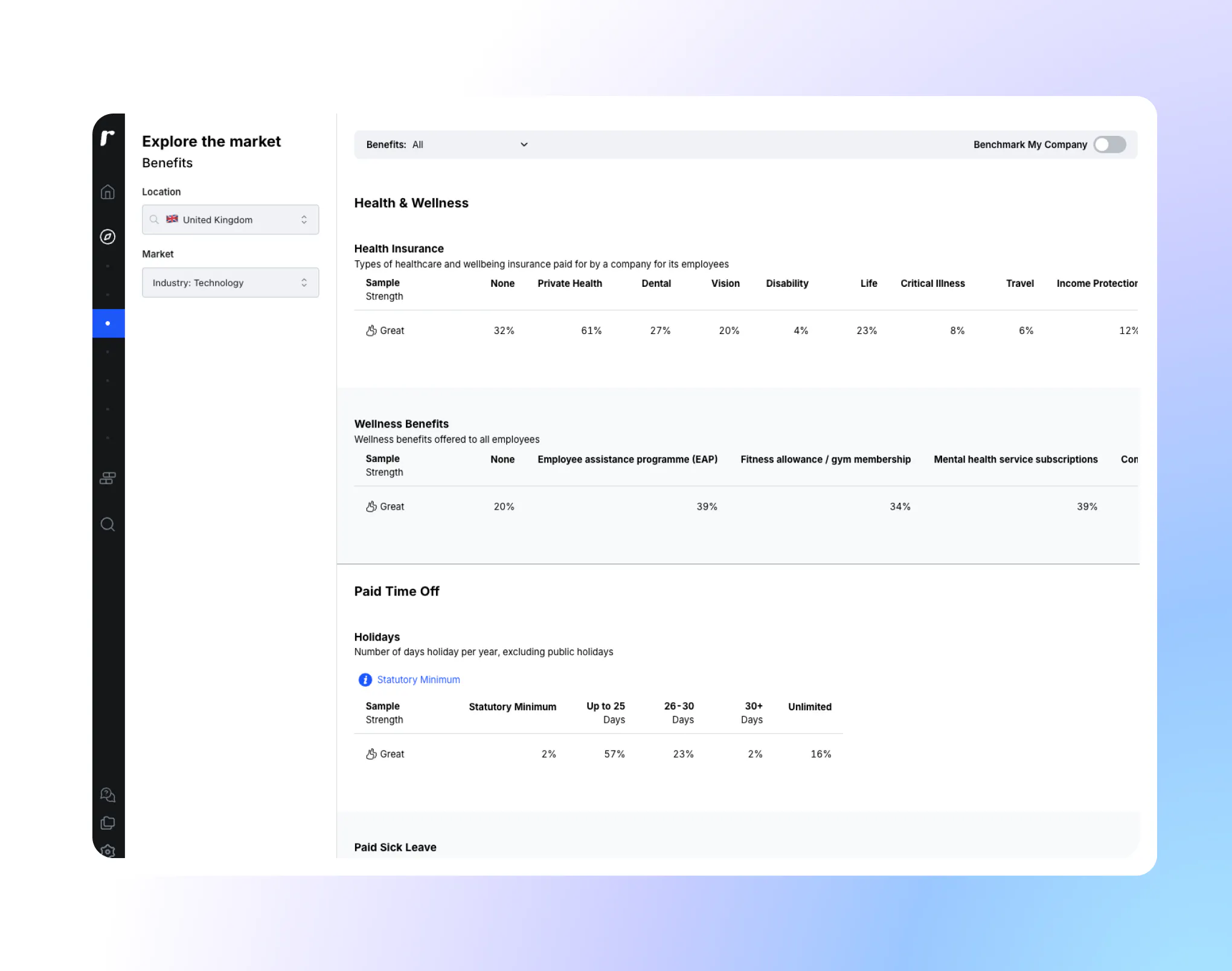
Ravio is a real-time total rewards benchmarking tool that also provides employee benefits benchmarks sourced across the UK, Belgium, France, Germany, Ireland, the Netherlands, Spain, Sweden, and the US.
Who is Ravio ideal for: Tech and tech-enabled companies in Europe and the US looking for comprehensive employee benefits benchmark data and salary benchmarking in one platform.
Available benefits benchmark categories:
- Paid time off
- Family
- Wealth
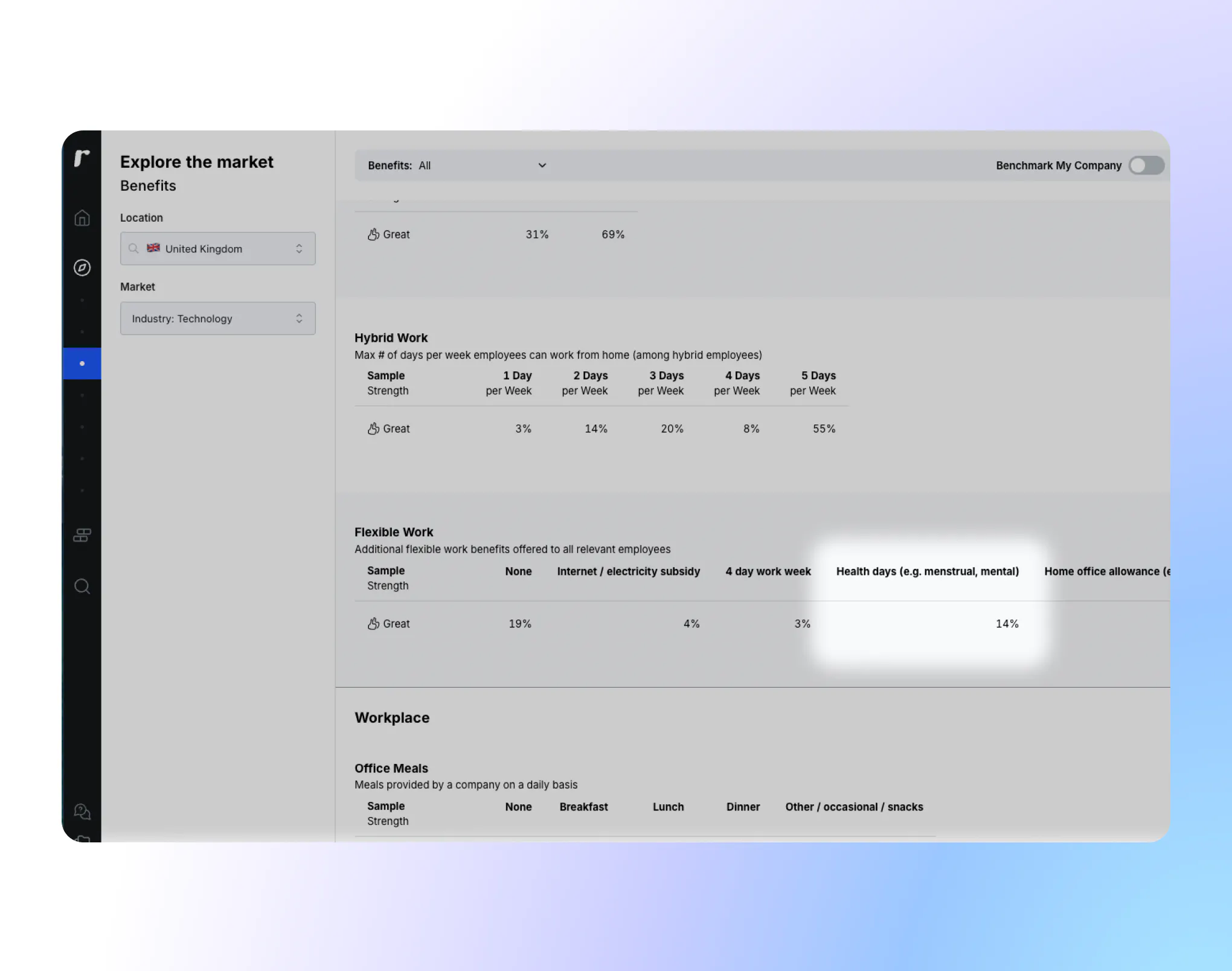
- Flexible work
- Workplace
- Equity eligibility
- Notice periods
- Health and wellness
- Learning and development
- Candidate referral bonuses
Upon onboarding, Ravio’s team sources employee benefits data from customers – reducing manual work on your plate.
Data specialists then verify submissions, check for outliers, and standardise the data before it’s added to the benchmark dataset.
This gives you reliable employee benefits benchmarks you can compare alongside Ravio's salary, variable pay, and equity benchmarks, helping you make more informed total rewards decisions.
Pros:
- Salary and employee benefits benchmarks in one platform.
- No manual data submission required.
Cons:
- Benefits benchmark coverage is wider in Europe than in the US.
- Benefits benchmarking doesn’t yet support company size or industry filters.
2. Radford Aon
Radford Aon is a long-established HR consultancy offering employee benefits benchmarking from 1,200 participating organisations across 50 industries in the US.
Who is Radford Aon benefits benchmarking ideal for: Enterprises in the US with in-house teams to manage benefits data submissions.
Available benefits benchmarks categories:
- Active and retiree health care
- Time off with pay benefits
- Retirement income
- Cash-based benefits
- Active welfare
Aon’s benefits benchmarking is available with a handful of options:
- Benefit Index. A custom PDF benchmarking report based on a give-to-get model, where you submit your benefits data to get peer-group benchmarks.
- Benefit SpecSelect. Aon's online benchmarking platform for accessing and comparing Benefit Index data against custom peer groups.
- Employee Benefits Benchmarking Platform. Aon's online platform for designing regional and global benefits programmes with support from an Aon consultant.
Pros:
- Separate consulting services available.
- Well-recognised name among enterprise stakeholders.
Cons:
- Manual data submission to access benchmark data increases the risk of human error.
- Multiple overlapping products can make it difficult to understand which benchmarking solution best fits your needs.
3. Mercer Marsh
Like Aon, Mercer is an HR consultancy offering multiple survey-based employee benefits benchmark datasets across 76 markets.
Who is Mercer benefits benchmarking ideal for: Large, global corporations.
Available benefits benchmarks categories:
- Death
- Disability
- Medical
- Retirement
- Social benefits
- Social security
- Flexible benefit programs
- Prerequisites and allowances
- Parental benefits and dependent care
Mercer’s benefits benchmark data is delivered through PDF reports, with customised reports available for industry and custom peer groups.
The datasets draw on data from more than 1,200 participating organisations, collected through Mercer’s traditional give-to-get benchmarking model.
Mercer also offers additional benchmarking resources, including Transportation Policies & Costs, Worldwide Benefit & Employment Guidelines, and Social Security & Medicare guidance.
Pros:
- Customised benchmarking reports available by industry and peer group.
Cons:
- PDF-based benchmark data requires manual mapping to your job architecture.
- Manual data submissions increase administrative work and the potential for human error.
- No self-service benchmarking platform for analysing benefits data.
4. Reed
Reed is a UK recruitment agency that publishes free salary and employee benefits reports based on annual employee surveys.
Who is Reed ideal for: Organisations in the UK looking for high-level employee benefits and workforce trends rather than detailed employer benchmarking.
Available benchmark categories: Reed focuses on broader employee benefits, salary, and workplace trends rather than employer benefits benchmarks.
Reed’s free benefits reports combine survey findings with salary data to highlight the benefits employees receive, the benefits they value most, and broader recruitment and retention trends.
Rather than benchmarking employer benefits against peer organisations, the reports focus on employee preferences and broader salary trends in the UK.
Pros
- Free to access.
- Useful overview of UK employees’ benefits preferences.
Cons
- Based on employee survey responses rather than employer benchmark data.
- No employer-to-employer benchmarking or custom peer-group comparisons.
5. Benepass
Benepass is primarily a benefits administration platform that also publishes an annual employee benefits benchmarking report based on aggregated customer data.
Who is Benepass ideal for: Teams looking for high-level employee benefits benchmark data and total rewards trends.
Benepass’s annual benchmarking report combines employee benefits benchmark data and market insights from more than 280 organisations across 90+ countries.
It focuses primarily on lifestyle spending accounts, pre-tax benefits, employer contribution benchmarks, and broader employee benefits and total rewards trends.
Available benefits benchmarks categories:
- Flexible Spending Accounts (FSAs)
- Health Savings Accounts (HSAs)
- Lifestyle Spending Accounts (LSAs)
- Commuter benefits
- Weight health benefits
Pros:
- Free to access
- Useful starting point for understanding trending benefits.
Cons:
- Point-in-time data updated annually.
- Smaller benchmark dataset than other benefits providers.
6. Willis Towers Watson (WTW)
Willis Towers Watson is another legacy provider that offers global benefits data from over 19,000 participants across 100+ countries.
Who is WTW benefits benchmarking ideal for: Global organisations building regional benefits packages with an in-house team to manage data submission and analysis.
Available benefits benchmark categories:
- Retirement
- Healthcare
- Wellbeing
- Time off
- Meal benefits
- Risk benefits
- Business travel insurance
Organisations can contribute benchmark data either by completing WTW’s benefits questionnaires or by sharing plan documents, which WTW can enter on their behalf for an additional fee.
WTW offers two employee benefits benchmarking products:
- Benefits Design Practices Reports. Annual PDF reports benchmarking employee benefits across 100+ markets. Separate market practice reports, such as the Company Car & Commuting Benefits Report, are also available
- Benefits Data Source. WTW’s online benchmarking database with custom peer-group filters. In selected countries, it also includes BenVal, a benchmarking tool that scores how competitive your benefit plans are against peers.
Pros:
- Extensive global coverage with 19,000+ participating companies.
- Separate consulting services available.
Cons:
- Annual reports provide point-in-time benchmark data.
- Manual data submission or paid document upload service.
- BenVal availability is only available in selected countries.
7. Kota
Kota is an employee benefits administration platform that offers a free benefits benchmarking tool built on data from 1,800+ companies across the UK and Ireland.
Who is Kota ideal for: Growing organisations in the UK and Ireland looking for self-service employee benefits benchmarking.
Available benchmark categories:
- Pension
- Group life
- Dental plan
- Income protection
- Health insurance
- Spend/Wellness benefits
Kota’s benchmarking tool lets you compare your benefits package against similar organisations by industry, company size, and region.
Additionally, you can compare both the benefits you offer and your employer contribution levels against similar organisations.
Pros:
- Benchmarks employer contribution levels, not just benefit availability.
- Filter results by industry, company size, and region.
Cons:
- Covers a narrower range of benefit categories than other providers.