
Compensation strategy
10 best compensation planning software, compared (2026)
Compare the best compensation planning software in 2026. Learn what to look for, compare leading platforms, and choose the right solution for your organisation.

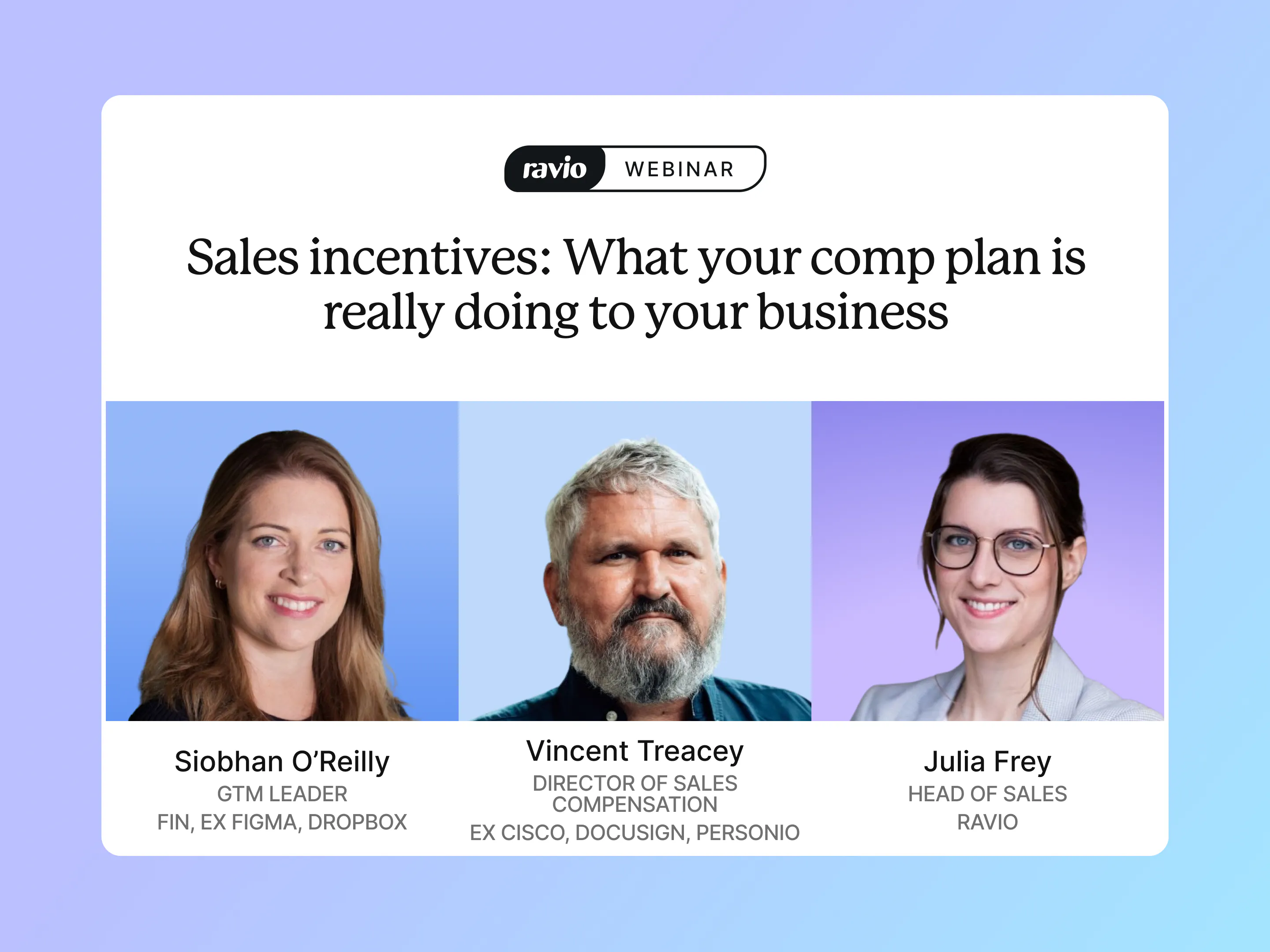
Sales comp sits at one of the most consequential intersections in building a company.
It shapes who you can hire, how long they stay, and whether the behaviour it drives actually matches the business you're trying to build. Get it wrong and you feel it in attrition before you see it in the data. Change it badly and you lose the people you most wanted to keep.
Vincent and Siobhan have navigated it from very different angles.
Vincent has spent over 15 years designing sales comp at serious scale – from Cisco, where he worked across 16,000 salespeople and a comp budget north of $1 billion, through hypergrowth SaaS at DocuSign and Personio, and now consulting across the European market on comp design for companies at every stage.
Siobhan has lived it from the operator seat. As GM at now Fin and previously Figma and Dropbox she built and scaled sales teams through some of the most significant growth periods either company went through – making real decisions about how to attract talent they couldn't always outbid on cash, and how to hold onto people as the business changed around them.
Together they worked through the full arc of a sales rep's journey from the comp perspective:
As always, there will be plenty of opportunity to ask questions, share experiences, and hear from someone who's been in the room when these decisions were made.
If you're more of a reader than a watcher, here are a few of the most interesting insights from Siobhan and Vincent's discussion on sales compensation design.
The first test of any sales compensation plan is whether you can sell it.
A candidate who asks how they hit their OTE and gets a complicated answer starts to wonder whether quotas are achievable, whether the company understands its own sales motion, or whether there's a performance problem being obscured. A plan nobody can explain is a plan nobody will trust.
This normally runs deeper than just sales compensation. If the metrics are multiplying because the business is trying to drive five different behaviours through one compensation structure, that's not a comp plan problem – it's an org design problem in disguise.
💡 Practical application: Before your next planning cycle, run the ‘grandma test’. Can you explain the plan clearly to someone who has absolutely no context? If not, it's too complicated – and your reps are already confused.
Compensation consistently shows up in exit surveys and engagement data as a reason people leave. But the comp plan itself is rarely the real issue. What sits around it – territory design, quota setting, how well resourced a rep is to actually hit their number – is usually where the problem lives.
A rep planted in a new market with an ambitious target and no support isn't a compensation problem waiting to happen. Neither is a high performer sitting above 100% attainment but on a structure that doesn't sufficiently differentiate pay at the top.
The question worth asking isn't "is our OTE competitive?" but "what is this person actually taking home, and do they actually have what they need to get there?"
When the business model shifts – new product lines, new geographies, a move from transactional to recurring revenue – sales compensation is often the last thing to change and the first thing blamed when the transition stalls. The more damaging pattern, though, is using the comp plan to communicate the change itself.
A seller who receives a new sales plan before they've been enabled on the new motion, trained on the new product, or given time to understand what's actually different will read the plan as instruction rather than reinforcement.
he comp plan should be the thing that confirms everything else they've already heard. When it's the first signal of change, it creates confusion rather than alignment.
💡 Practical application: Map your enablement and communication timeline before touching the sales plan. By the time a rep sees a new comp structure, it should feel like the logical conclusion of conversations that have already happened – not the start of one.
The answer to a complicated comp plan isn't always to simplify it. Sometimes it's to reorganise the team. If the plan is carrying multiple objectives – new logos, expansion, product attach, new market penetration – that's often a sign the org hasn't clearly defined what different roles are responsible for.
One metric per role is the ideal. Every additional metric is a signal that someone hasn't decided what that job is actually for. The complexity doesn't disappear when you strip it from the plan – it moves into org design, territory structure, and how you resource people to succeed. And that's the right place for it.
Your monthly dose of market insights and expert perspectives
Compare the best compensation planning software in 2026. Learn what to look for, compare leading platforms, and choose the right solution for your organisation.

Learn what compensation management software does, when you need it, and how it helps teams make fair, defensible pay decisions at scale.

The best compensation management software gives you tools for real-time benchmarking, salary bands, compensation reviews, and pay equity compliance. See how top platforms compare in 2026.

