
Compensation reviewsCompensation strategy
Ravio Breakfast Club London: Comp planning for 2027
Join us for the launch of our Comp Trends 2027 report, fresh off the data.

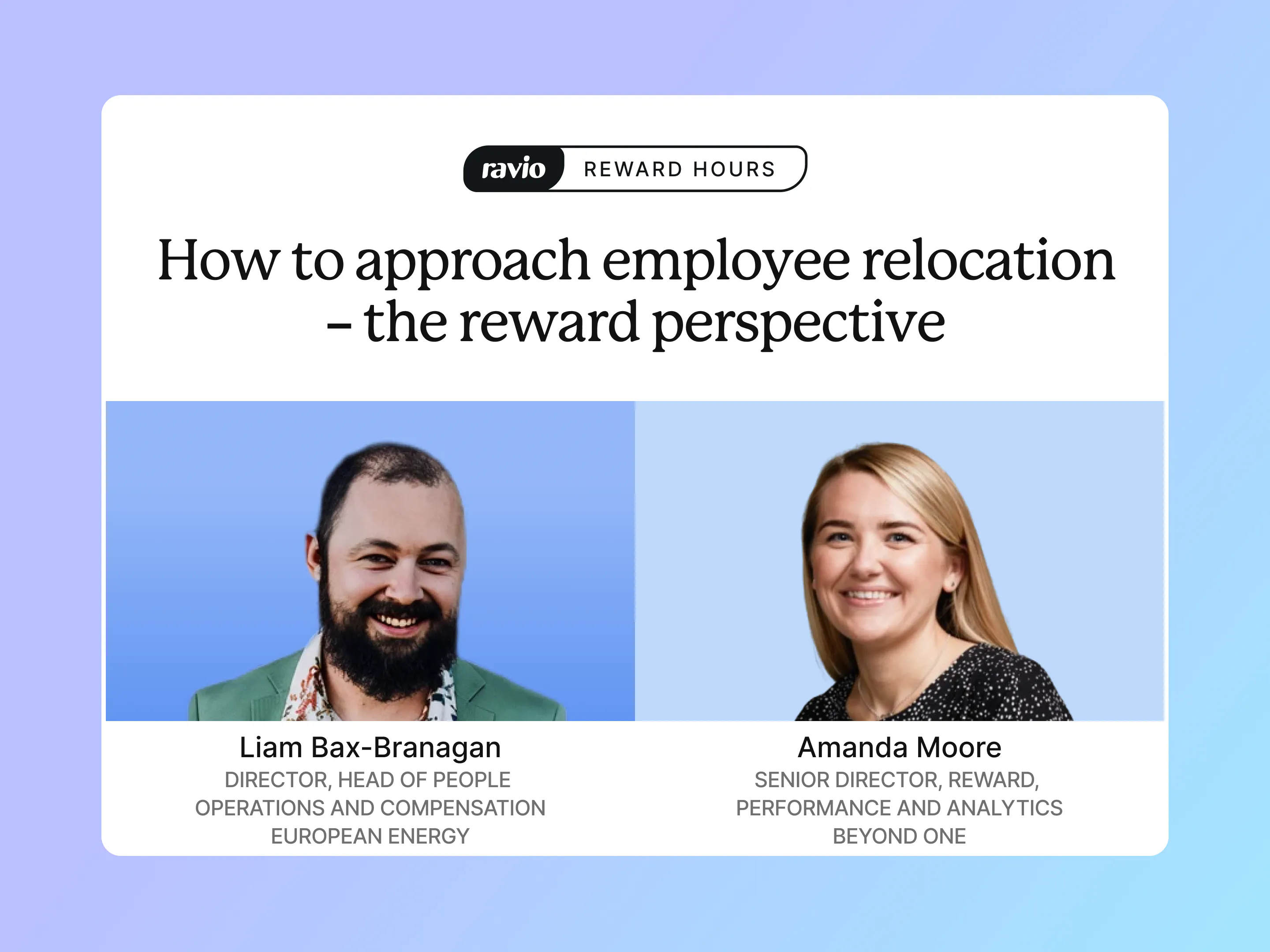
Relocation sits at one of the messiest intersections in reward.
It touches compensation philosophy, tax, benefits, legal compliance, and some of the most difficult one-to-one conversations a reward professional will have – and yet most teams are figuring it out case-by-case, with a policy that was written for a different business.
Amanda and Liam have navigated it from very different angles.
Amanda spent six years leading global mobility at Gymshark, moving people into new markets as the business scaled internationally, before relocating to Dubai herself for her senior director role at Beyond ONE – a scale-up spanning multiple markets with a rapidly growing headcount.
Liam brings a different lens entirely: over a decade at KPMG in global mobility, expat tax, and benefits advisory, followed by three years at Zalando, before joining European Energy as their first ever comp and ben hire – stepping into a 930-person business across 32 countries with no compensation framework in place and the task of building one from scratch.
Together they worked through four areas of relocation from a reward perspective:
If you're more of a reader than a watcher, here's a few of the most interesting insights from Amanda and Liam's discussion on approaching employee relocation.
Most reward professionals get pulled straight into the mechanics of a relocation request – salary methodology, tax treatment, benefit packages – without first asking the most important question: why is this move happening?
A business-critical move where you're sending a trusted person to launch a new market looks completely different to an employee-led move driven by family circumstances. That distinction shapes everything else: who drives the decision, what the company's obligations are, how generous the package needs to be, and what happens when things don't go to plan.
💡 Practical application: Before responding to any relocation request, ask whether it's business-led or employee-led. That single question will save you from building a policy that doesn't actually fit the moves you're making.
Anchoring compensation to the role and the local market is the most defensible approach. If pay follows the person, you quickly create equity problems in the new location – two people doing the same job on different salaries, with all the trust issues that brings.
That said, real life isn't clean. For strategic moves where a high performer has to move to support business goals whether they want to or not, you sometimes need to flex beyond your standard framework to make it work.
Medium-term assignments – roughly 6 months to 2 years – are the trickiest to set up, because employees often haven't broken tax residency in their home country but are already liable in the host country. That can mean paying tax twice until treaties work themselves out, which can absorb most of their package unless the company steps in.
Equity is another area that regularly blindsides people. RSUs granted years ago can trigger unexpected tax events when someone relocates, and the employee often doesn't realise until a bill arrives months later – at which point they feel let down, even if the company technically did nothing wrong.
💡 Practical application: Make tax and immigration advice a standard part of the relocation package. The cost of good advice upfront is almost always less than the cost of a frustrated employee, an unexpected company liability, or a retention problem six months after the move.
Compensation tends to get the most airtime in relocation planning – but for most people going through a move, it's the least of their worries. Finding a house, navigating a new school system, sorting immigration for the whole family, understanding how healthcare works – that's what actually consumes people.
A few things came up as low-cost, high-impact support that often gets overlooked: a practical relocation guide with real local context, a buddy in the new location who can answer the questions Google can't, and cultural training even when the destination shares the same language. Amanda put it plainly from her own experience relocating to Dubai: she wouldn't have survived without her buddy.
Your monthly dose of market insights and expert perspectives
Join us for the launch of our Comp Trends 2027 report, fresh off the data.

Join us for the launch of our Comp Trends 2027 report, fresh off the data.

Join us for the launch of our Comp Trends 2027 report, fresh off the data.

