
Market trendsBenchmarking
Startup salaries in 2026: What to pay from seed to Series C
What should you pay at seed vs Series A vs Series C? Startup salary benchmarks for 2026 by funding stage, plus equity, variable pay, and pay strategy advice.


The pressure to hire AI talent in 2026 is intense.
Leadership wants AI skills yesterday for product differentiation and workforce efficiency, competitors are hiring aggressively too, and the salary expectations you're hearing for AI talent are all over the place.
It’s hard to see through the noise and figure out what's actually happening in the market.
How much do AI Engineers actually earn? Do AI companies really pay more? And what do you need to pay to compete?
We analysed Ravio's live compensation data and surveyed 142 People and Reward Leaders for our 2027 Compensation Trends report to answer exactly those questions.
Quick answers: AI salaries and compensation in 2026
Just looking for the data? Here’s the TLDR:
Source: Ravio Compensation Trends 2027 – live data from 1,800+ companies and 618,000+ employee datapoints, plus a survey of 150 People and Reward Leaders.
AI talent is the one hot pocket in a cooling hiring market.
While the overall tech hiring rate fell to 21.8% this year, 27% of companies say they're paying a premium to hire AI/ML engineering talent – more than 4x the next most common skillset (source: Ravio Compensation Trends 2027).
Are you giving salary premiums for any specific roles or skill sets? | % of respondents |
|---|---|
No, we're applying standard pay bands across all roles | 57% |
AI/ML engineering roles | 27% |
Software engineering (non-AI) | 12% |
AI researcher | 10% |
Data roles | 10% |
Other AI roles (e.g. AI Product Manager) | 7% |
Late-stage startups feel this most: 46% pay a premium for AI/ML roles, compared with 18% of public companies.
"Recruiting has slowed down across the board – except for anything with AI integrated, which is where most of the hiring is actually happening right now," says Andreea Lupu, Compensation & Benefits Architect at Meaningful.
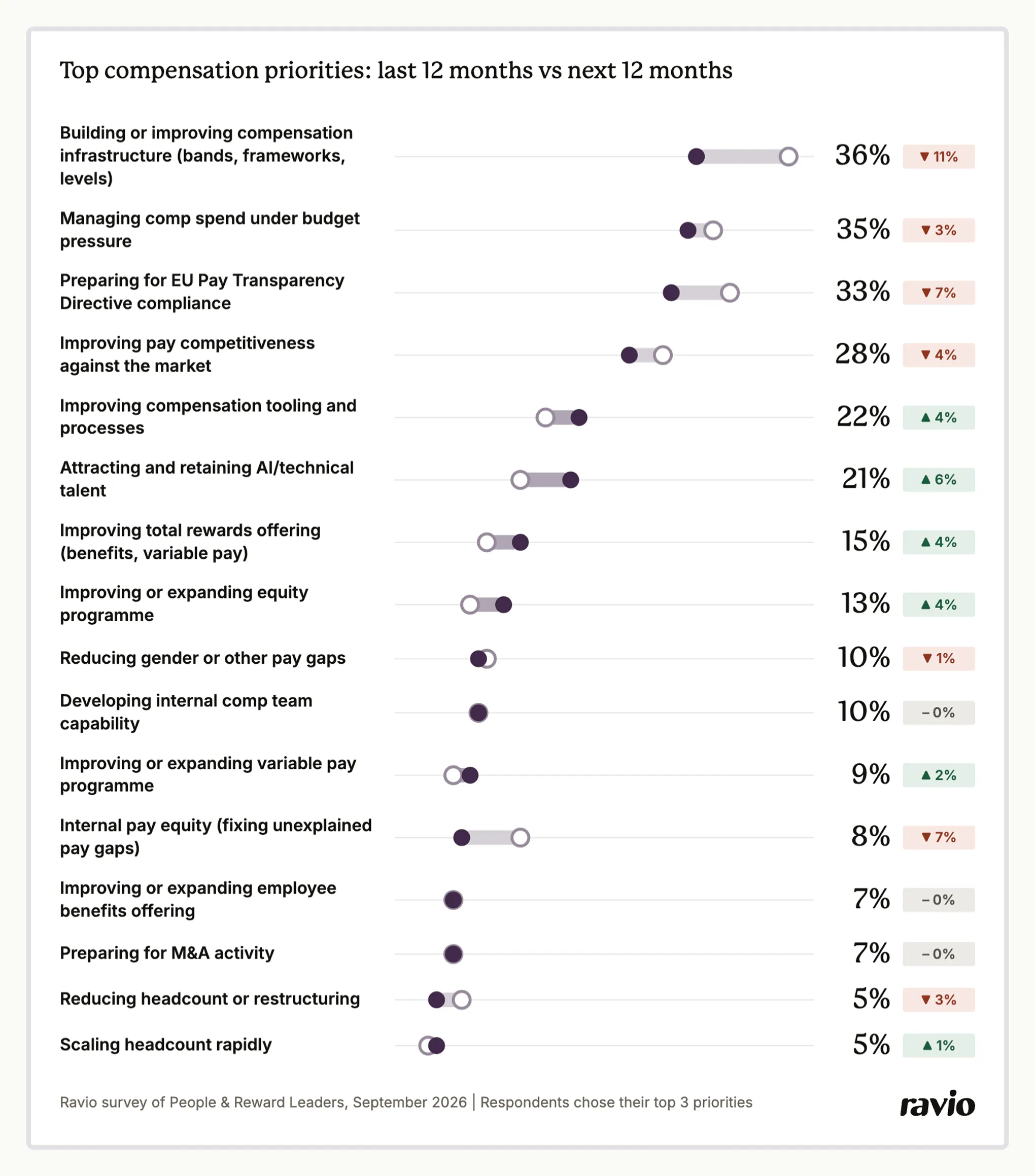
And it's moving up the agenda. "Attracting and retaining AI and technical talent" saw the biggest jump of any Reward priority – from 15% of companies in the last 12 months to 21% for the next 12 months.
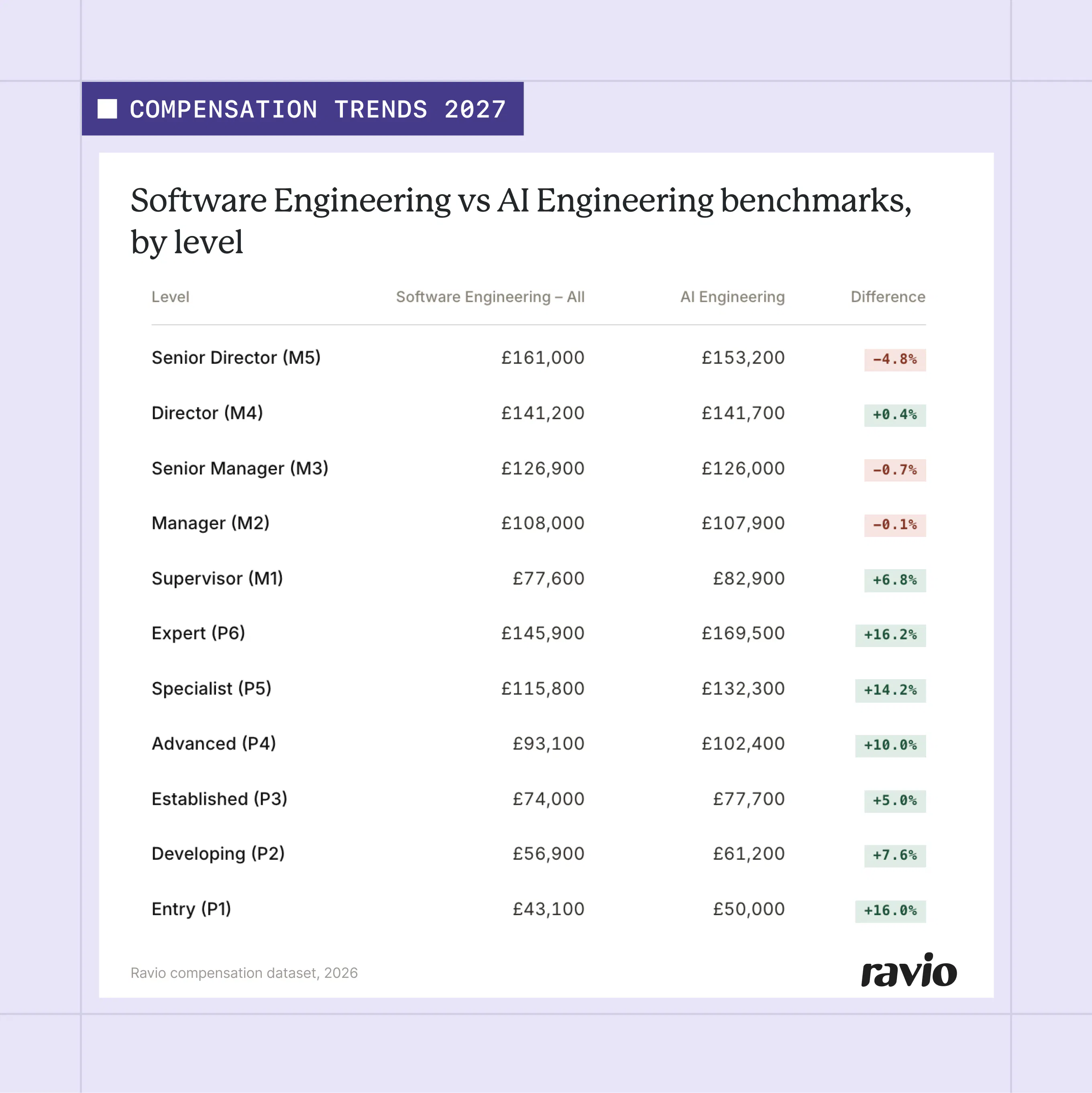
The median salary for a mid-level (P3) AI or Machine Learning Engineer in the UK is £77,700 in 2026 – 5% more than a Software Engineer at the same level (source: Ravio Compensation Trends 2027).
Level | AI/ML Engineering pay vs Software Engineering |
|---|---|
Entry (P1) | +16.0% |
Developing (P2) | +7.6% |
Established (P3) | +5.0% |
Advanced (P4) | +10.0% |
Specialist (P5) | +14.2% |
Expert (P6) | +16.2% |
Supervisor (M1) | +6.8% |
Manager (M2) | -0.1% |
Senior Manager (M3) | -0.7% |
Director (M4) | +0.4% |
Senior Director (M5) | -4.8% |
In 2026, there's a clear premium for AI Engineering at individual contributor (IC) level – AI Engineers earn 5-16% more than Software Engineers at every IC level, with the widest gaps at the most senior levels (P5-P6, +14-16%) and at entry level (P1, +16%).
In management, though, the premium all but disappears – AI Engineering pay sits within 1% of Software Engineering at M2-M4, and slightly below it at M5 (-4.8%).
That fits the "super IC" trend – companies are paying more for exceptional individual builders, not for the people who manage them.
"We're seeing a real focus on talent density – a willingness to pay more for a smaller number of exceptional people, specifically for IC work rather than leadership," says Franky Roberts, Head of Talent & Community at Evantic Capital.
The one management level that still carries a premium is M1 (+6.8%) – likely the founding-engineer-style roles that lead small teams while still building themselves.
Michelle Cheng, European Talent at Bessemer Venture Partners, sees the same pattern: "A lot of companies are hiring at M1 level but not giving them huge teams – that's where you get a lot of these founding engineer roles, founding go-to-market roles."
Where AI makes a much clearer difference to pay is the type of company you work for.
Employees at companies where AI is core to the product earn 9.7% more than those at non-AI companies, for the same role, level, and country (source: Ravio Compensation Trends 2027).
AI company pay premium vs non-AI companies | Premium |
|---|---|
Overall | +9.7% |
Marketing | +11.0% |
Engineering | +10.2% |
People | +10.0% |
Commercial | +8.7% |
Operations | +5.9% |
Product | +5.2% |
The premium isn't just for engineers – Marketing (11.0%) and People (10.0%) roles also earn notably more at AI companies.
It's also bigger for managers (14.3%) than for professionals (10.6%) or support roles (9.3%), and it grows as AI companies mature: late-stage AI companies pay a 17.4% premium, compared with 9.6% at growth-stage.
Chloe Paramatti, Talent Partner at EQT Ventures, sees AI companies building senior teams earlier than usual.
"AI companies are hiring later-stage calibre executives much earlier than we’ve traditionally seen," she says. "Even at Series B, the complexity of the business, pace of growth and value at stake can require leaders with experience operating at a much greater scale."
At the very top of the market, frontier AI labs and big tech companies set the pace on pay – and most companies can't match them on cash.
"Keeping up with frontier AI labs and big tech companies' salaries and equity offering is our biggest challenge – from a revenue perspective we're far from competing, but we fight for the same talent," one Reward Leader told us.
That pressure is pushing more established companies to pay up, too.
"Pre-AI companies faced a decision: adapt their product to stay relevant in an AI-first world, or risk falling behind," says Dennis Eriksson, Talent Director at Northzone.
"Making that pivot means competing for AI talent against the AI labs themselves, which is one of the reasons we're seeing late-stage companies pay a premium to attract that talent."
And it isn't only engineers. Ben Newsome, VP Talent & People at Cherry Ventures, sees AI labs "aggressively acquiring sales talent, creating scarcity downstream" – see our guide to tech sales salaries for more.
For more advice on this topic, see our guide to benchmarking emerging AI roles.
Among companies that pay more for AI skills, the most common approach is a base salary premium over the closest comparable role (42%), followed by separate pay bands for AI roles based on market rates (31%) (source: Ravio Compensation Trends 2027).
How are you compensating for AI/AI-adjacent skills? | % of respondents |
|---|---|
Base salary premium vs closest comparable role | 42% |
Separate pay bands using market rates for specific AI roles/skills | 31% |
Targeting a higher percentile against closest comparable role | 22% |
Higher equity allocation | 3% |
Other | 3% |
Often, though, the premium is being set by candidates rather than companies. Ben Newsome sees it most in equity negotiations.
"We're seeing the AI premium being driven mainly by candidates, especially negotiating for large equity packages – including planned refreshers and liquidity events," he says. "There's a small amount of skilled talent available, and they know their worth."
And for many candidates, money isn't the deciding factor once every offer is strong.
"Once packages are all significant, scope of work becomes the real decision-making lever – not just the money," says Franky Roberts, Head of Talent & Community at Evantic Capital. "It's who you'll work with, what problems you get to solve, how much access you have to compute and data."
It's not just about hiring AI talent.
46% of companies have taken some form of workplace restructuring action in response to AI adoption – most commonly introducing upskilling programmes for existing staff (33%), rather than reducing headcount (15%) (source: Ravio Compensation Trends 2027).
Which functions are being impacted by AI adoption? | % of respondents |
|---|---|
Engineering | 78% |
Product | 60% |
Data | 51% |
Marketing | 47% |
Commercial/Sales | 45% |
People/HR | 45% |
Operations | 42% |
Entry-level roles across all functions | 29% |
Engineering and Product are feeling it most – and entry-level roles are being affected across every function.
As AI takes on more of the output, what companies hire for is changing.
"As AI makes producing output faster and cheaper, human judgement becomes more valuable," says JooBee Yeow, Director of People & Organisation at Notion Capital. "The differentiator is no longer simply 'can you produce something?' but 'can you tell whether it's the right thing?'"
For more on how AI is changing hiring overall, see our guide to tech hiring trends.
When the pressure is on to secure AI talent, there's a temptation to throw out salary bands and pay whatever it takes. But those "exceptional" salaries set precedents you can't easily reverse.
"In my experience, with shifts in demand like we're seeing for AI, the market almost always spikes and then settles down," says Jenny Packer, Senior Reward Consultant at Gallagher. "That market premium doesn't last forever, but the consequences of baking it into your payroll costs via a higher than desirable base salary do."
Instead, consider ways that you could apply flexibility without breaking your structures – leveraging techniques such as time-limited adjustments with clear review cycles rather than permanent increases, or leveraging other elements of total compensation like enhanced equity or sign-on bonuses to secure AI talent.
And don't forget the people you already have. "Retaining existing talent who are seeing job adverts with salary ranges much higher than their own is equally (if not more) important," says Katie Cook, Reward Consultant at Gallagher.
Read more: How to compete for in-demand jobs without breaking your compensation structure
Not all AI roles are equally critical to your business, and are therefore worth the premium compensation costs.
Consider which AI capabilities you genuinely need to meet business goals – both from a product (i.e. AI features) and workforce (i.e. AI tooling) perspective – and focus your premium compensation on the roles that will truly drive competitive advantage.
"The risk is overpaying for skills that may commoditise quickly," says Noor van Boven, Co-founder of Invested. "Companies need a clear workforce plan: which AI skills are truly differentiating and worth the premium, and where they can reskill existing talent."
When benchmarking emerging AI roles, relying on limited data points can lead to costly mistakes.
"Over-relying on only a few isolated data points or anecdotal evidence from peers is a big risk when benchmarking niche or emerging roles and skills like AI," says Jörn Diekmann, Independent Total Rewards Consultant.
Cross-check multiple data sources, especially real-time data from providers like Ravio, and look for patterns to make informed decisions about market positioning.
Read more: How to benchmark emerging or niche roles
With candidates negotiating hard on equity and weighing up scope, access to compute, and who they'll work with, the strongest offers for AI talent are about more than base pay.
Make sure your equity story (including refreshers and any liquidity events) and the role itself are as compelling as the number.
Ravio can support you with reliable total compensation benchmarks, book a short, no-strings-attached demo to learn more.
While focusing on AI hiring, remember the impact on career progression and succession planning. 29% of companies say AI is impacting entry-level roles across all functions – so how are you developing your future AI talent?
Consider evolving junior roles to include AI-native skills rather than cutting them entirely.
"If you don't hire and nurture young talent now, what will your mid-level and leadership positions look like in five years?" says Renita Käsper, Global Talent Acquisition & Employer Branding Leader and Co-founder of Cohorts.
Read more: Early career hiring is down 73% – here's why it's time to redesign entry-level roles
Put your comp data where your AI tools already are
Ravio's MCP server lets your team query live benchmarks – including AI roles – directly from the AI assistant they use every day.
AI talent refers to professionals with skills in artificial intelligence and machine learning, including roles like AI Engineers, AI Researchers, Machine Learning Engineers, and AI-focused specialists across functions (such as AI Sales Prompt Engineers or AI Compliance Officers).
The median salary for a mid-level (P3) AI Engineer in the UK is £77,700 in 2026 – 5% more than a Software Engineer. AI Engineers earn a premium at every individual contributor level (5-16%), but in management roles the premium all but disappears (Ravio Compensation Trends 2027). For benchmarks at other levels and locations, get three free benchmarks.
AI is creating intense demand for a small set of skills, while changing how companies think about headcount elsewhere. In Ravio's 2027 Compensation Trends survey, 27% of companies pay a premium for AI/ML engineering talent, and 46% have taken restructuring action in response to AI – most often upskilling existing staff (33%) rather than reducing headcount (15%). Engineering (78%) and Product (60%) are the functions most affected, and 29% say AI is impacting entry-level roles.
Recruiting AI talent requires a strategic approach that balances competitive compensation with clear workforce planning:
Yes – AI/ML engineering is the most in-demand skillset in European tech. 27% of companies pay a premium to hire AI/ML engineers, more than 4x any other skillset, and late-stage startups are the most likely to do so (46%) (Ravio Compensation Trends 2027).
Yes – especially for individual contributors. In Ravio's 2026 data AI Engineers earn 5-16% more than Software Engineers at every individual contributor level, with a median of £77,700 for a mid-level AI Engineer in the UK. In management roles, the premium all but disappears. The type of company matters too: AI companies pay 9.7% more overall, and 10.2% more for Engineering roles, than non-AI companies.
For emerging AI roles, look for real-time compensation providers that draw data directly from live HRIS and ATS integrations – ensuring market shifts and new roles are captured as they happen, rather than relying on annual salary surveys with 6-18 month old data.
Equally important is robust methodology: with emerging roles inevitably experiencing market volatility, you need benchmarks that are statistically validated with significant sample sizes and confidence levels.
Ravio provides real-time salary benchmarks with a specialisation in the tech industry, meaning it captures emerging AI roles and skillsets like AI Engineering as they develop. Ravio's compensation database covers 618,000+ employees across 1,800+ tech companies, with every benchmark verified by expert benchmarking specialists to ensure accuracy and reliability.
Your monthly dose of market insights and expert perspectives
What should you pay at seed vs Series A vs Series C? Startup salary benchmarks for 2026 by funding stage, plus equity, variable pay, and pay strategy advice.

Average employee tenure in European tech is 794 days – about 2 years 2 months – in 2026. See tenure by country, function, and stage, and for leavers vs stayers.

Tech hiring rates fell to 21.8% in 2026 – but it's a two-speed market, with AI and top sales talent still hot. See hiring by country, function, and stage.

