Ravio partners with Comp to bring you trusted Brazil benchmarks
Ravio has partnered with Comp to bring trusted Brazil benchmarks directly into the Ravio platform.

What should you be paying your Software Engineers? How do salaries compare across European markets? Are you staying competitive with the market rate in 2026?
For People and Reward Leaders setting the strategy, Talent Acquisition Leads scouring the market, and line managers making decisions on new hire offers and salary increases to retain existing team members, understanding Software Engineer salary trends is essential.
Offer too little and you'll lose candidates to competitors. Overpay and you'll strain budgets and create internal pay equity issues.
So, to help, let's look at the latest data on average Software Engineer salaries – including how salaries differ by location, funding stage, and the premium AI Engineers are commanding right now.
The average salary for a Software Engineer is currently £70,500 (Ravio Compensation Trends report, October 2025).
This is the median salary as per Ravio’s salary benchmarking data, for a UK-based P3 Established Professional Software Engineer – a mid-level professional (or Individual Contributor), someone with in-depth knowledge of their discipline who works independently with minimal guidance and has a moderate impact on the success of their discipline.

Software Engineer salaries in the UK increased modestly in 2025, up 1.6% from £68,900 in 2024. This continues a trend of slowing salary growth, with 2024 having seen an 8.5% increase from 2023's £63,500.
The slower growth in 2025 suggests Software Engineer salaries may be stabilising after the rapid increases seen in previous years.
Software Engineer salaries vary significantly across European markets, with the UK maintaining the highest median salaries whilst Spain has the lowest:
Ravio’s 2026 Compensation Trends report highlights that most European markets saw modest salary increases in the 1-2% range in 2025, notably slower than the previous year. The UK, which saw 8.5% growth in 2023-24, recorded just 1.6% growth this year.
Sweden stands out as the exception to this trend, continuing to see strong salary growth at 5.5% – building on the 16.9% growth seen in 2024. This reflects Sweden's maturing tech ecosystem and increasing demand for engineering talent.
"The cost advantages of hiring Engineering hubs in lower-cost countries like Poland or Romania are still very attractive. But we're also seeing an increase in startups deliberately keeping their hiring local in the early days, avoiding the added complexity of managing different market rates, employment laws, and cultural expectations."

Talent Director at Atomico

The average salary for a Senior Software Engineer is £110,200 (Ravio Compensation Trends report, October 2025).
This is the median salary as per Ravio’s salary benchmarking data, for a UK-based M3 Senior Manager Software Engineer – a role providing leadership to other managers, accountable for the results of a team.

Senior Software Engineer salaries in the UK saw minimal growth in 2025, up just 0.3% from £109,900 in 2024. This represents a significant slowdown from 2024's 1.1% increase from 2023's £108,700. The near-flat growth in 2025 suggests Senior Software Engineer salaries have largely stabilised in the UK market.
Senior Software Engineer salaries vary significantly across European markets, with the UK maintaining the highest median salaries:
Whilst the UK and Netherlands saw minimal salary growth for Senior Software Engineers (0.3% and 1.7% respectively), France, Spain, and Sweden showed much stronger increases – 5.4%, 4.0%, and 6.8% respectively.
The gap between highest and lowest paying markets is narrowing, with traditionally lower-paying markets growing engineering management salaries at several times the rate of established high-paying tech markets like the UK.
The stronger growth in France, Spain, and Sweden could reflect these tech ecosystems maturing and requiring more senior engineering leadership, or a lower supply of experienced engineering managers in these markets driving more competitive salaries.
Software Engineer salaries increase consistently as startups progress through funding stages, reflecting both company maturity and ability to pay competitive rates.
Late-stage companies (Series C+, IPO) pay approximately 15% more than early-stage companies (pre-seed, seed) for mid-level Software Engineers, and 31% more for senior engineering leadership roles. This premium reflects both the financial resources available at later stages and the increased complexity and scale of engineering challenges.
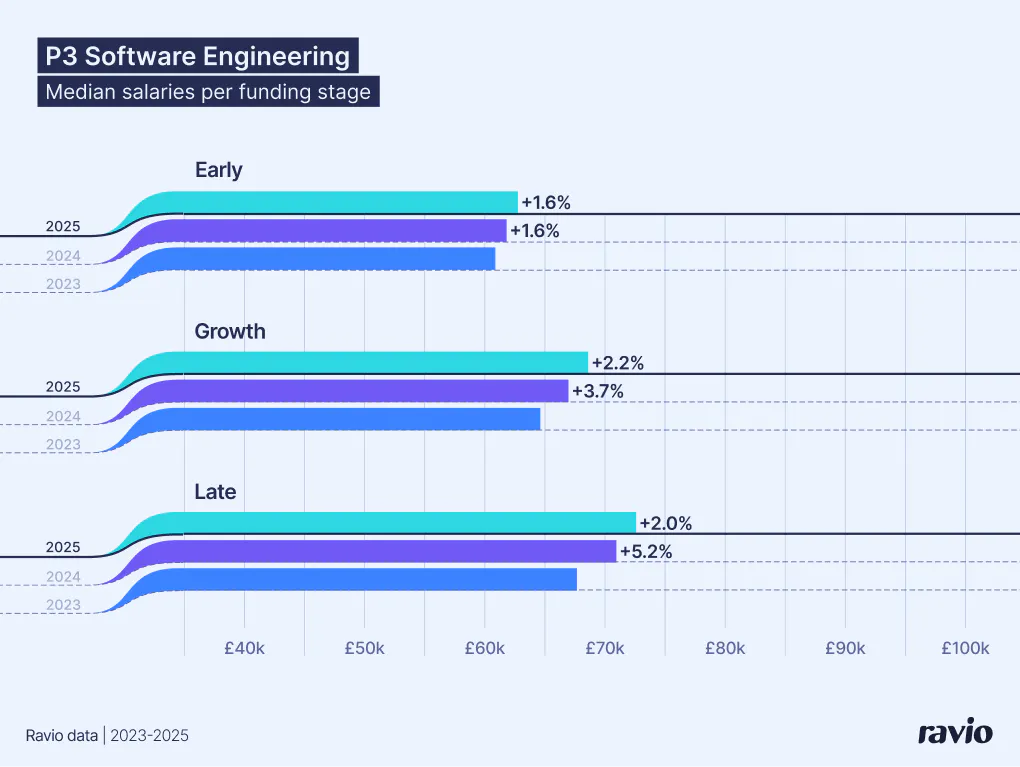
For mid-level Software Engineers, median salaries are:
Software Engineer salaries increased modestly across all funding stages in 2025, with growth and late-stage companies seeing slightly higher increases (2.0-2.2%) compared to early-stage (1.6%). This consistent pattern maintains the typical salary differential as companies scale.
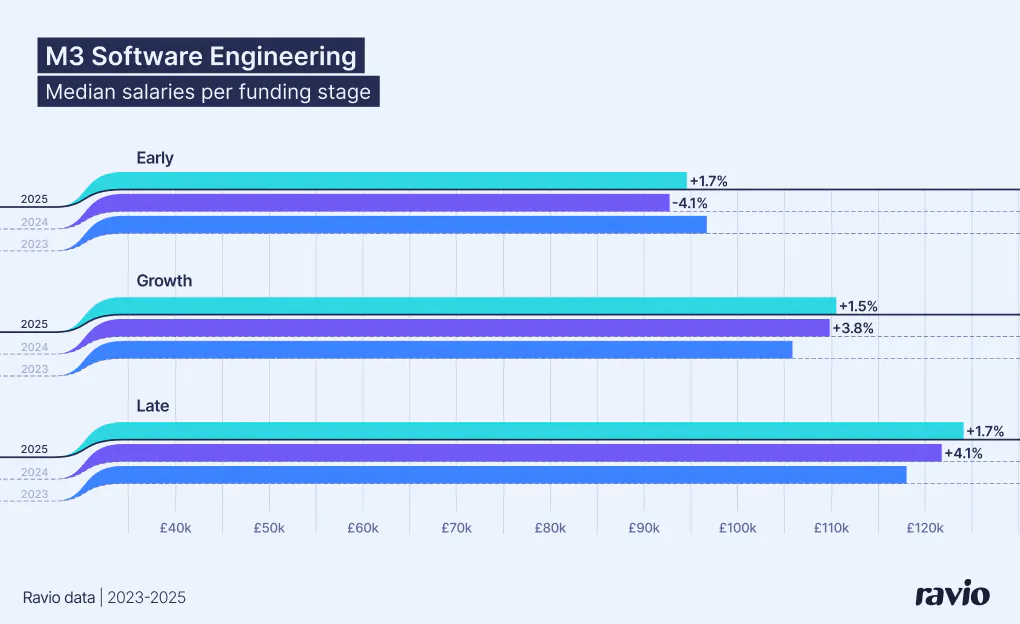
For senior engineering leadership, median salaries are:
Senior Software Engineer salaries showed similarly modest increases across all stages in 2025 (1.5-1.7%). This uniform growth contrasts with previous years when different funding stages often showed more varied patterns, suggesting salary structures are stabilising across the startup ecosystem.

One Software Engineer salary trend that’s top of mind is that AI Engineers now command a significant salary premium over general Software Engineers – reflecting the high demand for AI expertise in the talent market.
AI Engineers now command a significant salary premium over general Software Engineers, reflecting the high demand for AI expertise in 2026.
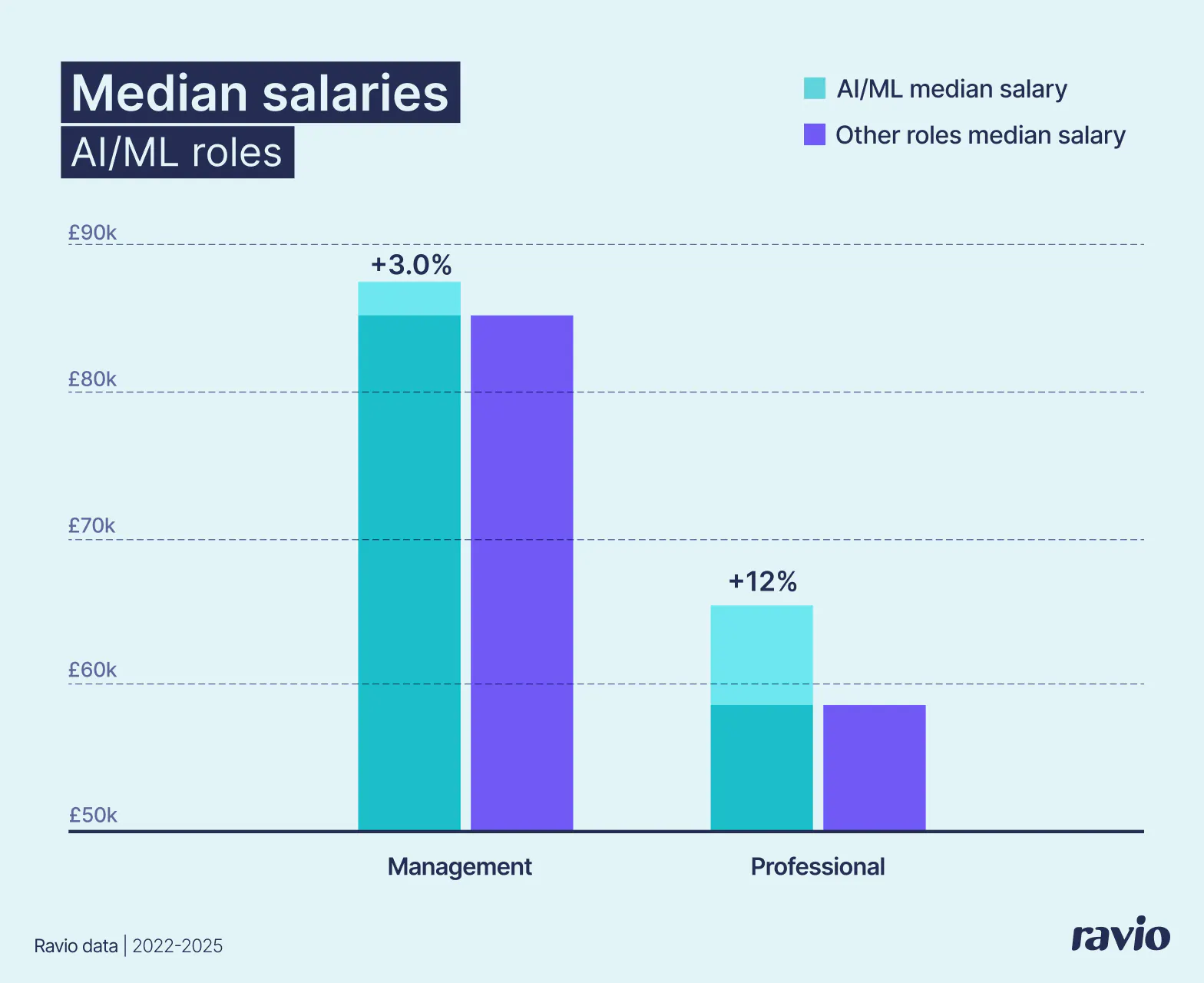
For our 2026 Compensation Trends report we analysed the pay premium for AI/ML roles vs all other roles and found an average 12% AI pay premium in the Professional (IC) career track, and an average 3% AI pay premium in the Management career track.
So, if we apply this data to average Software Engineer salaries:
Software Engineer (P3) vs AI Engineer salary:
Senior Software Engineer (M3) vs Senior AI Engineer salary:
This salary premium reflects the value companies are placing on AI expertise as they race to build AI capabilities into their products and services.
"Every company is either hiring for AI talent or upskilling existing teams, but success depends on being intentional about it. Some clearly understand what AI capabilities they need; others are just reacting to FOMO. The companies that balance being lean with rewarding high-impact AI talent are the ones attracting both funding and the right people."

Early Stage People Lead at EQT Ventures
The average salary of a Software Engineer is £70,000. This is the median salary for a P3 Established Professional Software Engineer in the UK as per Ravio’s Compensation Trends report (published October 2025) – Software Engineer salaries vary significantly by location and level. For example, Germany averages £64,500 whilst Spain averages £48,600 for the same P3 level. Senior Software Engineers (M3) earn considerably more, with UK median salaries at £110,200.
The average salary of a Software Engineer in the UK is £70,000 for a P3 Established Professional level (Ravio Compensation Trends report, October 2025). For Senior Software Engineers (M3 level), the UK median salary is £110,200. Salaries increased modestly in 2025 (1.6% for P3, 0.3% for M3), suggesting Software Engineer salaries are stabilising after the rapid increases seen in previous years.
The average salary of a Software Engineer in the US is $150,000 for a P3 Established Professional level (Ravio benchmarks, October 2025). For Senior Software Engineers (M3 level), the US median salary is $219,800. US Software Engineer salaries are significantly higher than European markets, with the UK equivalent being £70,000 for P3 and £110,200 for M3. Ravio's platform includes real-time salary benchmarks for different US locations, job levels, and Software Engineering specialisms.
Typical total compensation for a Software Engineer includes base salary plus equity compensation. In the tech sector, it's common for Software Engineers to receive equity as part of their compensation package – with the median new hire equity grant at 8.6% of base salary at the 50th percentile (Ravio equity benchmarking data). Variable pay is less common for Software Engineers, though some companies offer on-call payments or company-wide programmes like performance bonuses or profit-sharing schemes.
The top hiring trends in Software Engineering in 2026 (from Ravio’s Compensation Trends report) include:
Reliable Software Engineer salary benchmarking data comes from real-time compensation platforms like Ravio, which draws from direct HRIS integrations. Unlike annual salary surveys that provide 6-18 month old data, Ravio's benchmarks are continuously updated to reflect current market conditions. Ravio provides global Software Engineer salary data, across all job levels and multiple specialisms (Backend, Frontend, Full Stack, AI/ML, etc).
Your monthly dose of market insights and expert perspectives

Ravio has partnered with Comp to bring trusted Brazil benchmarks directly into the Ravio platform.

Ravio now benchmarks up to 300 positions in 46 countries. So you can hire the teams you need to scale
Every Ravio benchmark now shows exactly how it was built so you can explain your compensation decisions with clarity, not guesswork.