Explore 2026 Compensation Trends Download report

11 best Korn Ferry alternatives for salary benchmarking in 2026

Korn Ferry’s brand reputation often makes it a familiar choice for salary benchmarking, but its outdated data and slow refresh cycles are two major reasons why many teams explore Korn Ferry alternatives. 

Its give-to-get model also requires manual survey submissions, adding administrative load and increasing the risk of human error, which, in turn, leads to inaccurate insights.

Korn Ferry’s dataset is also so broad and detail-oriented that it can be difficult to use without significant analysis, slowing teams down.

Value for money is another concern. Korn Ferry compensation data costs about the same as modern benchmarking providers – yet those tools offer real-time, accurate total rewards data, automated job mapping, and built-in compensation management features for nearly the same price.

So it’s no surprise you’re exploring Korn Ferry alternatives.

To help, we reviewed the market to find the best Korn Ferry alternatives in 2026 – comparing 11 compensation benchmarking providers.

Whether you’re choosing your first benchmarking provider, replacing Korn Ferry, or supplementing its data, this guide shows how each alternative compares in data coverage, reliability, and compensation features so you can select the one that best fits your organisation’s needs.

Quick recap: What does Korn Ferry offer?

Korn Ferry is a global consulting firm that helps companies structure their teams, hire the right people, and advise them on employee growth and engagement.

Its services fall under three main areas:

1. Consulting services

Korn Ferry advises companies on organisational strategy, hiring and developing talent, retaining employees, and improving sales effectiveness.

2. Compensation surveys

Korn Ferry surveys 32,000 companies across 150+ countries to provide salary and benefits data that helps you spot pay gaps and plan fair, competitive compensation. It uses a give-to-get model, where you manually submit your organisation’s compensation data to access salary insights from other survey participants.

3. Analytics tool

Korn Ferry Pay lets you access salary survey data and use it to compare your compensation and benefits packages across roles, peer companies, and countries.

Who is Korn Ferry ideal for?

With the breadth of its global dataset, Korn Ferry’s compensation data is best suited for large enterprises and multinational organisations, especially those in regulated industries such as finance, pharmaceuticals, and manufacturing.

Because Korn Ferry’s salary survey submissions are manual and its data analysis tooling is basic, it works best for companies with dedicated compensation teams that can handle manual survey submissions, data mapping, and analysis.

Fast-growing or scaling tech companies typically need intuitive software and real-time data, so Korn Ferry’s survey-led compensation model can feel more resource-intensive for them. 

Korn Ferry pros and cons

Although Korn Ferry has a longstanding industry reputation, its manual survey submission process means the dataset is prone to error, compromising data accuracy. 

Not to mention, Korn Ferry compensation data is so voluminous to sift through that it can feel rigid and complex, making it unusable for quick decision-making. 

Here’s a full breakdown of the pros and cons of using Korn Ferry for salary benchmarking: 

Korn Ferry pros

The main benefits of using Korn Ferry salary benchmarking data are:

  • Brand trust and credibility. As a long-established consulting provider, Korn Ferry has strong brand recognition among corporate HR stakeholders, which can make it easy to secure buy-in.
  • Broad, global dataset. Because Korn Ferry collects data from large enterprises across 150+ countries, multinational organisations get access to wide-ranging benchmarking insights that align with their scale and geography.
  • Consulting services available. Since Korn Ferry is primarily a global consulting firm, companies can also get support on team structures, compensation planning, and broader organisational strategy.

Korn Ferry cons

The main limitations of using Korn Ferry for salary survey benchmarking are:

  • Error-prone data. Because survey submissions are manual, the accuracy of Korn Ferry’s benchmarks depends entirely on the quality of the inputs submitted. Even small mistakes in human reporting can carry through into the final dataset.
  • Outdated compensation data. Because Korn Ferry’s compensation data is collected through annual surveys, it takes time to gather, aggregate, and publish the results. By the time benchmarks reach you, they’re often historical snapshots – and they won’t refresh again until the next survey cycle.
  • Hard to use data. While Korn Ferry’s broad compensation dataset is valuable, its sheer volume can make it challenging to quickly find the specific insights you need, leading to slower decision-making.
  • Manual job matching. Korn Ferry requires you to match your internal roles to its job catalogue, which can be a tedious, time-consuming process that introduces room for error – especially when dealing with complex job levels, blended roles, or non-standard titles.
  • Limited value for money. Traditional salary surveys, including Korn Ferry surveys, typically cost between $10-$30k (£7k-£22k) a year, compared to modern compensation software like Ravio, starting at £5,000 a year for a 500-person company. This software integrates with your HRIS to give you real-time, continuously updated benchmarks and an intuitive platform to map, find, and use total rewards data quickly. In contrast, Korn Ferry requires manual data submission and job mapping, and its survey dataset can feel overwhelming – offering less usability for a lower price point

Recommended reading: How real-time salary data helps you stay on top of market changes for every compensation cycle

Korn Ferry vs top salary benchmarking alternatives: side-by-side comparison table (2026)


Korn Ferry

Ravio

Pave

Payscale

CompUp

CompAnalyst

Carta

Assemble

Workleap

Workday

Lattice

Salary data

Yes

Yes

Yes

Yes

Yes

Yes

Yes

Yes

Yes

Yes

Yes

Equity data

No

Yes

Yes

Yes

Yes

Yes

Yes

Yes

Yes

No

Yes

Benefits data

Yes

Yes

Yes

Yes

Yes

Yes

No

No

Yes

No

Yes

Talent market trends data

Yes

Yes

Yes

Yes

Yes

No

No

No

Yes

No

No

Geographic focus

Global

Global (strongest in Europe)

Global (strongest in North America)

US

India

US

US

US

Global

N/a

Global

Automated job mapping

No

Yes

Yes

No

No

No

No

Yes

No

No

No

Salary bands

No

Yes

Yes

No

Yes

Yes

Yes

Yes

Yes

No

Yes

Pay equity analysis

No

Yes

No

No

Yes

Yes

Yes

Yes

No

No

No

Consulting services

Yes

No

No

Yes

No

No

No

No

No

No

No

11 best Korn Ferry alternatives for salary benchmarking in 2026

Korn Ferry alternatives broadly fall into three categories:

Some companies also use job adverts (e.g. Indeed) or employee-reported sources (e.g. Glassdoor). But because this data is too broad to be useful, is based on historical averages, and lacks any verification process, we haven’t included them as reliable Korn Ferry alternatives. 

1. Ravio

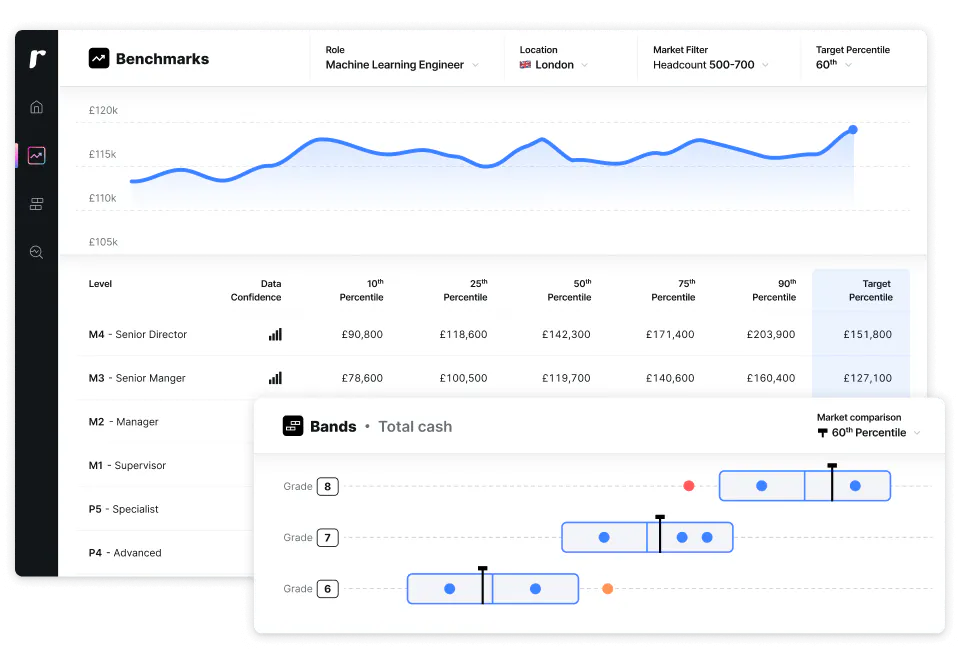
Ravio is a salary benchmarking software offering real-time, total rewards benchmarks with built-in compensation management tools. It’s ideal for high-growth global tech companies with a strong presence in Europe.

Key features

  • Total, global compensation benchmarks available for over 50 countries and 100+ roles – strongest in Europe.
  • Live integrations with 100+ HRIS to automatically source and update benchmarks in real-time, rather than manual, lagging survey submissions.
  • Data is reviewed by a team of data scientists and benchmarking experts who validate collected data, check for outliers, fill gaps, and ensure quality.
  • Advanced filters for roles, location, industry, headcount, and company size to give you relevant benchmarks.
  • Automated job matching, supported by the onboarding team that aligns your job roles to the Ravio level framework for consistent, like-for-like comparisons.
  • Built-in compensation management tools to create, manage, and refresh salary bands and conduct pay equity analysis
Ravio's real-time salary benchmarking data

Korn Ferry versus Ravio

Where Korn Ferry is an organisational consultancy that separately sells survey data, Ravio is a modern salary benchmarking provider that gives you real-time total rewards benchmarks and compensation management tools.

Both offer global benchmarks, with Korn Ferry’s data strongest in core markets like the US and UK, and Ravio’s strongest across Europe – particularly for niche roles.

Like other traditional salary survey providers, Korn Ferry collects data by surveying large organisations with structured job hierarchies. To access this data, companies have to manually submit their employee information and map roles to Korn Ferry’s framework – a tedious process that adds administrative burden and introduces room for error.

In contrast, Ravio automatically sources data through live HRIS integrations and aligns benchmarks to its level framework – reducing the manual effort and data errors that come from manual submissions and job mapping. Ravio also has a team of human experts who verify every benchmark to further ensure data quality.

There’s also a difference in usability. Korn Ferry’s compensation data comes in overwhelming volume, which makes it highly difficult to work with – requiring significant analysis before you can use it to inform compensation decisions, which slows teams down.

In contrast, Ravio provides clean, decision-ready benchmarks that teams can use to make fast, confident compensation decisions.

Explore Ravio now with 3 free benchmarks

💡 Pro tip: If your organisation uses multiple data sources to make compensation decisions, pairing Korn Ferry with Ravio will give you the best results, as Ravio fills the gaps that traditional salary survey data cannot cover.

From what you’ve read so far, you already know that traditional salary surveys like Korn Ferry provide broad, global coverage but come with trade-offs – the data is slow to refresh, prone to error due to manual submissions, and tends to be strongest for legacy industries and large enterprises only.

Ravio complements this by giving you real-time benchmarks from 1,500+ global tech companies, deeper insights for niche and emerging roles, and granular filtering by industry, location, headcount, and funding stage.

Because its data is sourced directly through HRIS integrations, benchmarks refresh continuously – and every data point is reviewed by a team of benchmarking experts, ensuring data accuracy. This helps you validate trends and spot market shifts sooner than annual or quarterly survey cycles allow.

Just ask Bolt. Their team added Ravio alongside their existing salary survey provider to access a more relevant dataset, stay ahead of market trends in real-time, and improve decision-making speed.

“With a live benchmarking dataset, you are able to build and track what’s going on in the market.” – Evert Kraav, Snr. Compensation Manager, Bolt.

The best part? With Ravio’s custom market upload option, you can simply upload your Korn Ferry survey data into the platform and use different benchmarks for different roles or locations.

2. Pave

Pave is a US-based compensation management platform offering real-time salary benchmarks via HRIS integrations – ideal for US-based startups and enterprises in tech, healthcare, and gaming industries looking for accurate North American benchmarks.

Key features 

  • Global data with strong coverage in the US and Canada, as 67% of Pave’s benchmarks come from the US, with 14% from Europe.
  • Total compensation data covering base salary, equity, and variable pay. No equity, benefits, and variable pay benchmarks outside Pave’s core US market though.
  • Monthly data updates keep benchmarks up-to-date as real-time employee information is pulled directly from connected HRIS.
  • Automated job mapping using machine learning to define job levels by track, family, and number.
  • End-to-end compensation management workflows to automate salary band creation and management, get market-aligned, and manage end-to-end merit cycles. (Note: compared to top compensation management software, Pave doesn’t offer pay equity analysis or reporting capabilities.) 

Korn Ferry vs Pave

Pave is a compensation management software versus Korn Ferry, which is an organisational consultancy.

Where Pave integrates with company HRIS to automatically pull real-time benchmarks – strongest in the US and updated monthly – Korn Ferry relies on annually collected survey data from large organisations to provide global raw compensation datasets.

Pave also offers automated job mapping. Comparatively, Korn Ferry’s survey submissions are a time-consuming process, with job mapping being manual and complex, making the dataset difficult to use.

3. Payscale

Payscale is a compensation data and software provider that combines benchmarks from multiple sources and offers consulting services and compensation management software as separate products.

It’s ideal for enterprises that need global data from varied sources and want to manage complex survey participation and benchmarking workflows in one platform.

Key features

  • Broad product portfolio, including MarketPay for aggregating salary surveys from traditional providers like Korn Ferry, Payfactors for multi-source benchmarking that blends third-party surveys, employer-reported HRIS data, and employee-reported insights, and a Compensation Planning module for managing merit cycles, manager workflows, salary adjustments, and pay-equity compliance.
  • Total compensation benchmarks covering base salary, variable, equity, and benefits – strong in the US, less so internationally.
  • Data update frequency varies by source, with traditional surveys refreshing annually or quarterly, employer-reported data updating quarterly, and HRIS-sourced insights updating continuously.
  • End-to-end compensation management capabilities, including salary management tools like templates in MarketPay that simplify submitting survey data to traditional providers.
  • Consulting support is available for job matching and benchmarking implementation.

Korn Ferry vs Payscale

Both Korn Ferry and Payscale’s datasets are limited, they don’t automate job mapping, and users complain that their platforms are challenging to use. The differences, however, lie in the number of data sources and the subsequent quality of data.

As a benchmark provider, Payscale is a data aggregator that brings together compensation data from multiple sources, including Korn Ferry survey data. In contrast, Korn Ferry gives you only its survey dataset.

Payscale’s compensation management module offers tools for managing merit cycles and pay equity compliance that are far broader than Korn Ferry Pay, which only lets you access and analyse data.

As for data integrity, Korn Ferry gathers survey data once a year through manual submissions, which introduces potential errors. The long collection and aggregation cycle also means the data is outdated by the time it’s published.

Payscale’s survey datasets share the same limitations as Korn Ferry’s, but its HRIS-sourced data is comparatively more accurate and up-to-date, and therefore more reliable. 

4. CompUp

CompUp is an India-only salary benchmarking provider ideal for India-based startups, mid-market companies, and service firms running structured reviews.

Key features

  • India-only compensation benchmarks sourced through automated HRIS and payroll integrations.
  • Total compensation coverage, including base salary, variable pay, equity, and benefits.
  • Live, continuously updated data sourced from 250+ Indian startups actively contributing their employee compensation information.
  • Compensation management tools include budget simulation, performance-linked pay adjustments, automated merit cycles, approval workflows, and the ability to generate Total Rewards Statements for employees.

Korn Ferry vs CompUp

Compared to Korn Ferry’s annually updated, global compensation data sourced from surveying large, multinational organisations, CompUp offers real-time, India-only benchmarks sourced via live HRIS integrations with Indian startups.

The data pool also varies. Where Korn Ferry surveys over 32,000 companies, CompUp sources from 250+ active Indian startup contributors. This makes CompUp a strong fit for Indian startup compensation planning but less so for globally distributed teams.

5. CompAnalyst by Salary.com 

CompAnalyst is Salary.com’s compensation management platform that aggregates third-party survey data into one system – ideal for large US-based enterprises with complex pay structures and the in-house resources needed for implementation and ongoing training.

Key features:

  • Compensation benchmarks are strongest in the US, with additional global HR-reported data sourced through Salary.com’s surveys.
  • Benchmarking data from multiple sources, including traditional compensation surveys from providers like Mercer and Willis Towers Watson, and employee-reported insights from job adverts and career sites – supplemented by AI-powered gap-filling for missing data.
  • Data freshness is tied to its data sources, with traditional compensation surveys refreshing annually or quarterly, depending on the survey provider.
  • Comprehensive compensation management tools include salary band creation, pay equity identification, performance-based increase modelling, compensation statement creation, labour cost forecasting, and survey participation tools.

Korn Ferry vs CompAnalyst by Salary.com

CompAnalyst aggregates data from multiple sources and pairs it with tools for compensation management, while Korn Ferry offers native survey data and consulting services.

This means the major difference between them is that CompAnalyst is a multi-dataset provider, whereas Korn Ferry is a single-source benchmarking provider.

Despite offering data from varied sources, though, it’s hard to conclude that the CompAnalyst’s benchmarks are fully reliable.

Like Korn Ferry survey data, CompAnalyst offers compensation data from traditional providers, so it's also prone to error and typically updated either quarterly or annually. And because its user-reported insights from job adverts and career sites are based on outdated averages and aren’t verified, they aren’t as reliable either.

Lastly, both CompAnalyst’s compensation platform and Korn Ferry’s data access tool aren’t intuitive – even as the product scope varies, with one offering end-to-end capabilities and the other only letting you analyse data.

6. Carta Total Comp 

Carta Total Comp is the salary benchmarking tool from cap table management platform Carta – ideal for VC-backed, US-based private companies already using Carta to manage ownership and equity. 

Key features

  • Strongest coverage in the US private-market ecosystem, with global benchmarks available but less robust across European and other international markets.
  • Real-time salary and equity benchmarks from Carta’s proprietary US private-market dataset, with equity benchmarks more mature than salary data due to Carta’s origins as a cap table platform.
  • Continuous data refresh by automatically syncing compensation, job levels, and employee data via 100+ HRIS integrations.
  • Cap table integration that tracks ownership, forecasts vesting schedules, and manages share allotments.
  • Comprehensive compensation planning tools, including scenario modelling for equity dilution, ownership impact and compensation runway, and structured workflows to plan and approve salary and equity offers.

Korn Ferry vs Carta

Carta Total Comp and Korn Ferry differ in their geographic focuses, benchmarks, and offerings.

Where Carta Total Comp focuses on real-time salary and equity benchmarks in the US for private, VC-backed startups via HRIS integrations, Korn Ferry provides annually updated, static global salary and benefits data collected through traditional surveys.

On the tooling side, Carta Total Comp sits inside Carta’s cap table platform and offers built-in compensation planning and equity management tools. In comparison, Korn Ferry provides a basic benchmarking tool, Korn Ferry Pay, for accessing raw survey data, alongside broader organisational consulting services.

7. Assemble by Deel

Assemble is a compensation management tool that offers a proprietary biotech dataset and sources salary data from Carta’s private-company benchmarks – making it ideal for private healthcare and biotech companies in the US.

Key features

  • US-focused coverage with healthcare benchmarks from its own dataset called CompGrid and private benchmarks from the US-based equity management platform, Carta. There’s also the option to manually upload and combine additional compensation data sources.
  • Equity-heavy benchmark dataset from its Carta integration, as Carta’s private-company equity data is mature, while its salary benchmarks are still developing since Carta is relatively new to the space. 
  • Manual job mapping since Assemble does not collect compensation data directly and relies on user-managed uploads, mapping, and a combination of multiple datasets.
  • Comprehensive built-in compensation management tools, including customised planning workflows, salary band creation, structured compensation reviews, approval chains, and offer letter generation.

Korn Ferry vs Assemble by Deel

Assemble is a software-led compensation data provider that sources benchmarks from Carta, while Korn Ferry is a consulting-led provider offering annually updated global compensation survey data.

Where Assemble gives you real-time salary and equity insights for private, VC-backed US companies – especially in healthcare and biotech – Korn Ferry provides broad, global benchmarks, but with slow refresh cycles and manual survey submissions.

Assemble also supports manual uploads of additional datasets and includes built-in compensation tools, features that Korn Ferry doesn’t offer.

8. Workleap 

Workleap is a talent management system that offers a compensation add-on with global benchmarks via a Mercer partnership and review tools from its acquisition of the compensation management tool, Barley. 

It’s ideal for SMBs already managing employee engagement and performance in Workleap and needing basic compensation coverage. 

Key features 

  • Global benchmarks from a traditional salary survey provider, Mercer, with the option to upload additional datasets.
  • Benchmark freshness depends on how up-to-date the datasets you upload are, with Mercer benchmarks typically refreshed quarterly.
  • Manual survey data uploads and resource-intensive job mapping, requiring users to export and complete a job-mapping template, re-import it, and manually assign any unmapped roles in the platform.
  • Built-in compensation tools for creating salary bands, running compensation reviews, generating offer letters, spotting pay gaps, and budget planning.

Korn Ferry vs Workleap

Korn Ferry and Workleap both use traditional benchmarking data, with Korn Ferry collecting annual survey submissions and Workleap sourcing quarterly updated Mercer survey data.

As a result, data from both inherits the same limitations – it's outdated, not updated in real-time, and requires manual job mapping.

The difference between the two, however, lies in their scope.

Where Korn Ferry combines its global dataset with organisational consulting services, Workleap offers a compensation add-on with tools tightly integrated into its broader talent suite. Workleap also lets you upload additional datasets, making it more flexible than Korn Ferry’s single-source approach.

9. Workday 

Workday is a human capital management platform that blends customer-aggregated benchmarking data with limited real-time insights from its Compa integration, offering basic compensation management tools within a broad HR suite.

It’s ideal for large global enterprises that want basic compensation coverage and have the internal resources to manage HR, finance, and talent operations within the Workday ecosystem.

Key features

  • Global benchmarks via customer-aggregated survey data and select real-time insights through a Compa integration (the integration doesn’t include live market trends, hiring rates, or competitive intelligence).
  • Manual data sourcing, uploading, and job mapping since users must import benchmarks and manually align internal compensation data to third-party benchmarks.
  • Deep integration between compensation, performance, talent management, and succession planning.
  • Basic compensation management tools with manual salary band creation and no built-in pay equity analysis or compliance tools.

Korn Ferry vs Workday

Korn Ferry is a consultancy that conducts annual salary surveys. In comparison, Workday is a full HR platform offering a basic compensation module with limited real-time data and the option to upload external datasets.

Which means, while Korn Ferry gives you a single global survey dataset, Workday can support multiple datasets – but only if your organisation already purchases those surveys.

That said, Workday’s compensation tools are basic and leave most of the manual work, including job mapping, on your team – similar to the effort required when using Korn Ferry survey data.

Users also report that Workday’s interface isn’t intuitive, which mirrors the experience of using Korn Ferry Pay, the tool used to access and analyse Korn Ferry’s survey data.

10. Lattice

Lattice is an all-in-one HR platform that offers a compensation benchmarking add-on through a third-party Mercer integration – ideal for mid-market teams that need basic total compensation coverage and already use Lattice for people management.

Key features

  • Global compensation coverage via Mercer, a Korn-Ferry-like, consultancy-led survey provider that uses a give-to-get model to collect data from enterprise-scale companies.
  • Total compensation benchmarks including base salary, equity, variable pay, and benefits.
  • Quarterly or annual data refresh cycles since Mercer’s manually submitted salary surveys update on traditional survey schedules rather than in real time.
  • Manual job mapping as you get Mercer survey data in a PDF with job level descriptions that you need to manually match to your internal roles. 
  • Unifies compensation and HR data by combining Mercer benchmarks with employee performance data for a more complete analysis of your workforce.
  • Basic built-in compensation tools for pay equity analysis, salary band creation, merit cycle management, budget tracking, and internal collaboration on compensation adjustments.

Korn Ferry vs Lattice

Lattice and Korn Ferry both offer compensation data, but they serve different purposes. Lattice is a broad HR platform with a compensation add-on, while Korn Ferry is a consulting firm providing traditional market data and advisory services.

The similarity? Both tools rely on traditional survey data – Lattice through its Mercer integration and Korn Ferry through its own annual surveys.

This means their datasets share the same limitations: updates only quarterly or annually, no real-time visibility, broad regional coverage only, and manual job mapping.

11. Alternative salary survey providers: Radford, Willis Towers Watson, Mercer

Korn Ferry is one of several consulting-led providers that sell compensation data through traditional salary surveys conducted annually, bi-annually, or quarterly. Others include:

  • Mercer
  • Radford
  • Altura
  • Empsight
  • Culpepper
  • Salary.com
  • William Towers Watson
  • Brightmine (previously XpertHR and Cendex)

Like Korn Ferry, these providers rely on manually submitted employer data, which introduces room for human error, leading to inaccuracy in the published data. And because surveys take months to collect, compile, and publish, the data is already dated by the time it’s released – and only refreshes again on the next quarterly or annual cycle.

Most of these consultancies offer basic tools to analyse survey data, but these platforms are typically limited compared to modern compensation software that offer real-time data, automated job mapping, and advanced compensation management tools.  

How to choose the best Korn Ferry alternative?

The best Korn Ferry alternative depends on your organisational needs, including factors like your team size, geographic footprint, and budget. Make sure to review the following six factors as you select one or more salary benchmarking providers that match your compensation needs:

  • Provider's industry and geographic coverage (data relevance)

Assess how broad the provider’s dataset is (global vs regional and industries covered) against where you hire – in one region, across multiple markets, or globally – and who you compete with for talent. Choose a provider with strong data coverage in your target locations and industries, and the ability to filter for the right peer group.

  • Provider’s data source and update frequency

Assess where the provider gets compensation data from and how often that data is updated (e.g. annual manual surveys or continuously updated HRIS integrations) – as well as how often the benchmarks created from that data are refreshed. Align this cadence with your hiring and review cycles.

  • Provider's data methodology and quality

Review how benchmarks are sourced, validated, cleaned, and updated. Providers relying on manual submissions carry a higher risk of human error and slower refresh cycles, while HRIS-integrated, real-time data sources improve accuracy and timeliness. Strong providers also use defined verification processes – including teams of human experts who review and validate benchmarks before they are published.

  • Your team size and complexity

Smaller teams often need easier, software-led tools with pre-built pay bands to get started quickly, while large enterprises often require flexible platforms that support complex job architectures.

  • Hiring speed, scale, and role types

Determine whether you hire competitively, in high volumes, or for niche roles. Fast-growing companies or those filling competitive roles gain more value from real-time or frequently updated data than from annual survey snapshots.

  • Budget and internal compensation expertise

Decide whether you need full compensation planning software or just reliable benchmarks to support your in-house team. Software platforms typically bundle compensation workflows with benchmarks, whereas survey providers require separate annual purchases. 

So is Korn Ferry still the best compensation benchmarking option?

Korn Ferry is still a credible source of global, enterprise-grade compensation data – but it’s no longer the best standalone option.

Its manual submissions introduce errors, survey results arrive outdated, and the dataset is so detailed that it’s hard to quickly find the insights you need – making it difficult to justify the value for money compared to modern benchmarking software.

For high-growth, fast-moving companies, especially in tech, the strongest approach is to pair Korn Ferry’s broad, legacy-industry coverage with a real-time benchmarking tool. This gives you fresh, accurate total rewards data and makes it far easier to find and use the insights you need quickly.

The team at Mollie, for instance, uses Ravio for live benchmarks and notes the night-and-day difference it makes:

“Access to Ravio’s live market data means no more headaches from delayed data sets or having to age compensation data [from traditional salary survey providers, which has been a real friction point for us in the past.” – Jodi S, VP of People at Mollie.

If Ravio’s one of the Korn Ferry alternatives you shortlisted, test it out with 3 free benchmarks to start reviewing if it’s worth the investment for you. 

FAQs

What does the Korn Ferry Company do?

Korn Ferry is a global organisational consulting firm that helps companies design team structures, define roles, hire talent, and improve how they manage and develop employees. It also provides salary and benefits data through large-scale compensation surveys.

How often does Korn Ferry update its salary benchmarks?

Korn Ferry updates its salary benchmarks annually, not in real-time or continuously, as it surveys large organisations once a year for their employee data. Because the survey process takes months to collect, aggregate, and publish, the data is often a historical snapshot by the time you receive it.

Can I combine Korn Ferry data with real-time benchmarks?

Yes, you can combine Korn Ferry data with real-time benchmarks and many companies already do this to improve accuracy. Korn Ferry gives you broad, global coverage, while real-time providers like Ravio fill gaps with continuously updated insights for fast-moving roles and markets. Using both lets you validate trends, reduce data lag, and make more confident compensation decisions.

What’s a modern alternative to Korn Ferry compensation surveys?

A modern alternative to Korn Ferry’s compensation surveys is real-time benchmarking software like Ravio or Pave. These tools pull live compensation data via HRIS integrations, update benchmarks continuously rather than annually, automate job mapping, and include built-in compensation management tools – making them more accurate, up to date, and more usable than traditional survey-based providers like Korn Ferry.

How do I import Korn Ferry survey data into compensation software?

You can import Korn Ferry survey data into a compensation management software that gives you the option to upload custom market datasets. Most tools accept CSV or Excel files, and some, like Ravio, let you map Korn Ferry job codes to internal roles so you can compare benchmarks across roles, levels, or locations.

What is the best salary benchmarking tool?

The best salary benchmarking tool is the one that fits your organisation’s structure, hiring footprint, and budget. Prioritise platforms that integrate with your HRIS, provide real-time salary and total rewards data, and offer strong coverage in your key regions. The right tool should deliver accurate, current, decision-ready benchmarks.

Are salary surveys still relevant in 2026?

Salary surveys are still used, but their relevance is fading. Because they’re updated only once or twice a year and rely on manual submissions, the data is error-prone and outdated by the time it reaches you. Most surveys also skew toward large, legacy enterprises, which is why more companies now pair or replace them with real-time HRIS-based benchmarking tools.

Share Blog

Read Next

Does a ‘lead-the-market’ pay strategy actually work?

benchmarking

compensation design

Reward Hours: AI in Total Rewards: Moving from experiments to enterprise value

compensation software

Is an HRIS compensation module enough for effective compensation management? 

compensation software

benchmarking

Share Blog