New3x the coverage, same rigorous quality. 300 positions benchmarkedExplore

7 ways teams use compensation data beyond hiring: A case against one-off salary benchmarks

For many teams, the most common use of compensation benchmarking is setting salary ranges and new hire offers. That makes sense — you want to make competitive, market-aligned offers to win talent.

But here’s what’s easy to overlook: compensation management isn’t limited to hiring sprees. It happens throughout the year — during promotions, merit cycles, retention discussions, budget reviews, new role creation, and pay transparency conversations.

Each of those moments requires current market context, not last year’s data.

But when you rely on one-off benchmarking for each role, your pay strategy becomes reactive. Gaps widen quietly. Retention conversations start too late. Budget forecasts rely on historical averages.

That’s how you end up overpaying the wrong roles, underpaying critical talent, and weakening trust in your pay strategy.

So if you’ve been evaluating whether year-round access to salary benchmarking data is truly necessary, this guide is for you. We break down seven practical situations where access to continuous, real-time compensation data makes a measurable difference.

7 reasons why People and Rewards teams need compensation data year round

Pay benchmarks shouldn’t be just a one-off hiring reference — they’re a continuous operating input for how you plan, defend, and adjust compensation decisions.

From individual pay reviews and retention conversations to salary budgeting and hiring cost projections, you need more than one-off salary benchmarking. Here are seven practical, real-world reasons you need ongoing access: 

  1. Protect internal pay fairness while staying competitive in hiring
  2. Support retention and counter-offer decisions with real data
  3. Keep pay aligned with market movement and stay competitive
  4. Enable accurate budget planning and payroll cost forecasting
  5. Strengthen pay transparency, communication, and manager decision confidence
  6. Adapt compensation frameworks to organisational change and evolving talent market trends
  7. Support company scaling, market expansion, and hiring growth decisions.

Let’s dive in.

1. Protect internal pay fairness while staying competitive in hiring

When you compensate new hires using current market rates, existing employees in similar roles can easily fall behind if internal pay isn’t reviewed using the same data. 

Over time, this creates internal pay gaps, salary compression, or pay inversion – where newer hires earn equal to or more than experienced employees. 

For Reward Leaders, this creates real risk: managers escalating pay concerns to HR, weakened trust, and growing retention pressure among high performers who feel undervalued compared to recent hires.

Year-round access to up-to-date compensation benchmarks here allows teams to bring refreshed market data into their compensation review cycles, rather than relying on outdated snapshots. This makes it easier to review internal pay alongside hiring offers, identify gaps early, and adjust before fairness issues compound. 

In turn, this helps you maintain credible and defensible pay bands, ensuring internal equity evolves in step with market pricing – rather than drifting apart from it.

2. Support retention and counter-offer decisions with real data

Retention risk can surface unexpectedly – after funding rounds, leadership changes, emerging skills demand, or competitor hiring pushes. 

And with employees in tech switching jobs every 2 years, it’s no surprise talent retention is the biggest workforce challenge for 62% of organisations – often becoming real when high-performing employees receive external offers or raise compensation concerns. At that point, teams need to evaluate adjustments quickly and defensibly.

But without current market pay context, retention decisions become inconsistent or overly reactive, increasing the risk of overpaying, underpaying, or losing critical talent.

Again, access to year-round compensation benchmarks helps by allowing you to:

  • Assess counter-offers confidently
  • Respond faster to attrition risk
  • Defend retention decisions with data.

This reduces guesswork, allowing you to make fast and fair compensation decisions that protect key talent without creating new internal fairness gaps.

3. Keep pay aligned with market movement and stay competitive

Salary markets shift throughout the year – all thanks to funding cycles, inflation, skill shortages, and competitor hiring activity. 

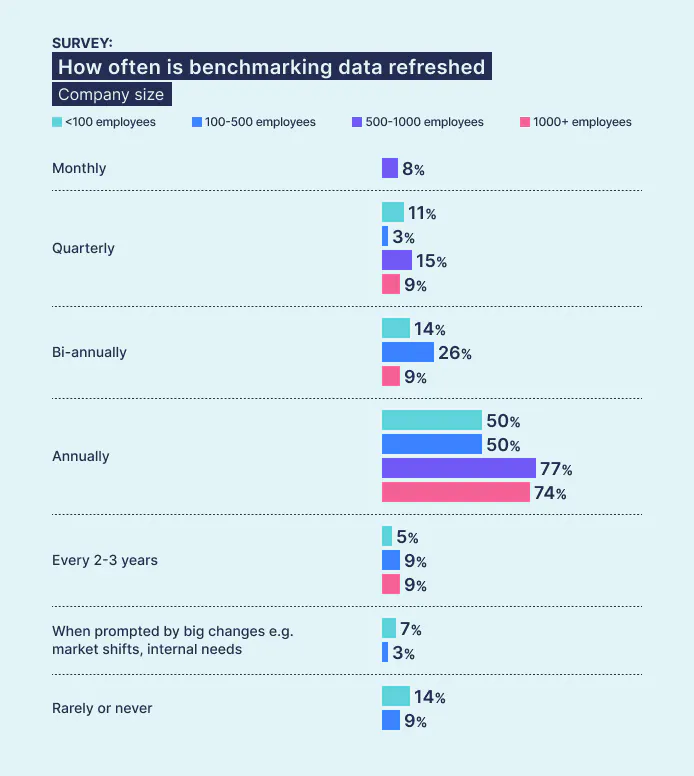
And while 82% of companies include market adjustments in compensation reviews, benchmarking data is not always refreshed beforehand.

Ravio pay review survey: How often is benchmarking data updated?

Not to mention, if your benchmarking source is an annual salary survey, you’d end up updating pay using data that’s months old.

The result? Pay decisions end up reflecting outdated market conditions, particularly when benchmarking only happens during hiring or annual review cycles, causing employee compensation to fall behind real market rates.

Year-round compensation benchmarking helps teams track market movement continuously – letting you to adjust salaries before gaps affect retention or engagement. 

Practically, this means having continuous access to real-time salary data allows organisations to:

  • Keep compensation reviews grounded in current market reality
  • Maintain competitiveness in fast-moving talent markets
  • Support structured, market-aligned merit increases, promotions, and pay adjustments
  • Maintain predictable, defensible pay progression across roles and levels.

Altogether, real-time salary benchmarks ensure your compensation strategy reflects evolving market salary trends, not outdated snapshots.

4. Enable accurate budget planning and payroll cost forecasting

Compensation is typically one of the largest operating expenses for most organisations, making salary planning central to workforce and financial strategy. 

Finance, People, and executive leadership teams regularly revisit payroll costs, hiring budgets, and headcount plans  – not just during hiring or annual planning cycles.

But with one-off compensation benchmarks, budget decisions end up relying on assumptions or point-in-time data, which increases the risk of overspending, under-budgeting, or misaligned hiring plans.

With year-round access to compensation benchmarks though, organisations can:

  • Forecast payroll costs more accurately
  • Model hiring scenarios using realistic salary expectations
  • Evaluate how market pay movement could impact salary budgets
  • Support headcount planning with up-to-date market inputs
  • Provide leadership with defensible compensation projections.

This strengthens workforce planning and reduces financial surprises. It also equips compensation teams to provide senior stakeholders with reliable data for hiring, headcount, and payroll cost decisions – positioning them to contribute more strategically in leadership discussions and expand their influence across the organisation.

5. Strengthen pay transparency, communication, and manager decision confidence

With 82.6% of employees viewing salary transparency as essential, managers are under increasing pressure to clearly explain and justify pay decisions.

And with the EU Pay Transparency Directive coming into force soon, this is no longer just a communication challenge – it’s a compliance requirement. Employers must be able to demonstrate that pay structures and salary decisions are objective, consistent, and gender-neutral for all employees doing comparable work.

Without clear market context though, pay conversations quickly become subjective, inconsistent, and difficult for managers and HR teams to navigate confidently.

The challenge remains if you rely on static salary survey data – because the data is already outdated by the time it reaches you, you don’t have the most up to date data to make objective, defensible conversations (here’s more on this). 

The solution? Continuous access to reliable market pay data that gives HR teams and managers clear guardrails for discussing pay, promotions, and salary adjustments. This way, you can: 

  • Communicate compensation decisions more transparently and backed with evidence
  • Reduce escalation risk and perceived pay inequities
  • Improve manager confidence during pay conversations.

It matters more than it might seem at first, really. 

By grounding pay discussions in current market data, you strengthen employee trust, have transparent communications with them, and reduce the administrative and emotional burden of compensation disputes across the organisation.

Organisational restructures, new team additions, geographic expansion, and changing business priorities often change what a role is responsible for, the value of that role to the business, and how much that role should be paid.

These shifts are even more pronounced in fast-growing startups, where adding new management layers and specialised roles requires clearer differentiation across levels, responsibilities, and pay bands

They’re also common in fast-changing sectors, where new technologies, automation, and digital transformation rapidly redefine job requirements and market pay benchmarks.

At the same time, talent markets continue evolving as new skills emerge, demand for specialised expertise shifts, and entirely new roles develop across industries – often driving skill-based hiring sprees outside traditional hiring spikes.

Take AI and Machine Learning roles, for example. Hiring demand for these skills has grown by 88% this year – but without real-time salary data, pricing these roles becomes guesswork. 

In fact, access to real-time compensation benchmarks gives you accurate market data to: 

  • Price new or hybrid roles using current market signals
  • Update salary bands as job architectures evolve
  • Adjust pay for emerging or specialised skill sets
  • Respond confidently to organisational transformation.

This turns compensation into a proactive strategy rather than a reactive correction exercise.

7. Support company scaling, market expansion, and hiring growth decisions

When organisations scale, enter new markets, or expand into new industries, leadership teams need to understand the cost of building teams in unfamiliar talent markets. 

Needless to say, pay levels can vary significantly by geography, industry, and talent availability – making accurate visibility into hiring costs essential for growth planning.

But without up-to-date market benchmarks, growth plans risk underestimating these costs, even delaying expansion decisions.

Again, year-round access to salary benchmarks helps leadership:

  • Estimate accurate hiring costs in new markets or locations
  • Model headcount growth scenarios with realistic salary expectations
  • Stress-test expansion plans against current market pay levels
  • Provide investors and stakeholders with defensible hiring cost projections.

The bottom line? Reliable market visibility here helps organisations make strategic hiring growth decisions with confidence while avoiding costly expansion miscalculations.

What happens when teams only benchmark compensation during hiring

Using compensation benchmarks only to price new hires when new roles open once in a while creates a reactive pay strategy. 

You end up tying pay decisions to one-off hiring events rather than ongoing workforce planning, which introduces structural, financial, and governance risks across the organisation.

Let’s break it down:

  • Pay compression builds quietly

You may not see it at first, but pricing new hires at current market rates without reviewing existing salaries can lead to newer hires earning equal to or more than experienced employees, quietly widening the gap between the two. 

Eventually, those gaps become visible – eroding trust, increasing internal equity pressure, and requiring disruptive salary corrections.

Not to forget, such an approach increases compliance risk since it’s no longer legal under the EU Pay Transparency Directive to price new and existing hires at different market rates.

  • Retention conversations happen too late

Retention conversations usually start when a high performer arrives with a stronger external offer in hand. 

At that stage, what could have been a proactive market adjustment quickly becomes a reactive effort to prevent them from leaving – making retention more expensive, less predictable, and harder to resolve consistently across teams.

With ongoing access to current benchmarks, you can adjust pay as the market shifts – often reducing, even eliminating, the need for those urgent counter-offer conversations altogether.

  • Promotion increases become inconsistent

When you rely on point-in-time salary benchmarks, promotion increases often depend more on individual manager judgement than clear, updated compensation guardrails. 

The result is that employees promoted at similar levels can end up with different salary outcomes across teams. This creates uneven pay progression, weakens promotion credibility, and increases pressure to correct inconsistencies later.

  • Budget forecasts drift from reality

Workforce and hiring plans frequently rely on outdated salary assumptions. As market salaries shift, projected hiring and payroll costs fall out of sync with actual compensation expectations.

This can result in underestimated hiring costs, unexpected payroll overspend, or last-minute workforce plan revisions that disrupt financial and headcount planning.

  • Pay equity risks increase

Without regularly updated market benchmarks, pay gaps across gender, tenure, or role level can also widen gradually – often only becoming visible during audits or employee complaints.

Disparities that accumulate across hiring, promotion, and retention decisions increase compliance and reputational exposure and often require complex off-cycle adjustments once identified.

  • Managers rely on guesswork in pay discussions

Managers frequently lack clear guardrails when explaining compensation decisions, forcing them to rely on assumptions, past hiring offers, or informal comparisons.

This ultimately leads to inconsistent pay conversations across teams, more escalations to HR or leadership, and weaker employee confidence in compensation decisions.

Lead compensation with confidence, not catch-up

If you reference compensation data only when new roles open, you’re forced into reactive moves – fixing compression after it surfaces, scrambling on counter-offers to retain talent, revising budgets mid-cycle, and defending pay without solid market backing.

But when you have year-round access to reliable, real-time compensation benchmarks, the dynamic shifts.

You move from reactive salary corrections to proactive pay planning – from rushed retention decisions to confident, data-backed adjustments and defensible compensation conversations.

In a nutshell, compensation benchmarking isn’t just a hiring reference tool.

Year-round, real-time salary data is the foundation for fair pay, stronger retention decisions, accurate workforce budgeting, and consistent salary band management.

Evaluating real-time salary benchmark sources? Start with our guide to the top salary benchmarking tools and how they compare.

FAQs 

1. How often should companies review compensation benchmarks?

Companies should review compensation benchmarks at least annually for full salary band updates, with quarterly or biannual check-ins to track market movement. Additionally, review benchmarks during promotions, retention risks, new role creation, or geographic expansion to ensure pay decisions reflect current market conditions.

2. Do companies need compensation benchmarking data outside hiring?

Yes, companies need access to compensation benchmarks beyond hiring to make market-reflective promotion decisions, manage retention discussions, run merit reviews, and assess role scope changes. They also support salary band updates, workforce budgeting, market expansion planning, pay equity reviews, and manager pay conversations with accurate, defensible data.

3. How is compensation benchmarking used during performance and merit review cycles?

During performance and merit cycles, compensation benchmarking validates raise ranges, promotion increases, and salary adjustments against current market data. It ensures pay progression stays competitive externally while maintaining internal consistency, preventing outdated benchmarks from driving uneven increases or widening pay gaps across similar roles.

4. How does compensation benchmarking help with employee retention decisions?

Real-time compensation benchmarking supports retention by keeping employee pay aligned with current market rates – reducing the likelihood that high performers are drawn away by higher external offers. And when employees receive external offers, up-to-date benchmarks let you make faster, defensible responses, reduce overpayment risk, and support consistent retention decisions without creating new internal equity issues.

5. When should companies update salary bands or pay ranges using market data?

Update salary bands at least annually and reassess them whenever market conditions shift significantly. For example, during rapid salary inflation, sudden spikes in demand for specific skills, funding surges in your sector, or noticeable competitor pay increases. It also helps to refresh pay ranges when you create new roles, expand into new regions, restructure teams, or face sustained retention pressure to make sure your employee compensation stays aligned with current market value.

6. How does year-round compensation benchmarking support pay equity and compliance?

Access to year-round compensation benchmarks helps you identify pay gaps across gender, tenure, or role level by comparing internal salaries with current external ranges – before they grow into larger equity risks. Real-time benchmarking also strengthens compliance with the EU Pay Transparency Directive that requires employers to justify pay differences using objective, gender-neutral criteria. And finally, it reduces reputational exposure, ensuring your salary bands stay aligned with evolving market standards rather than outdated assumptions.

Share Blog

Read Next

A woman doing salary benchmarking at a desk.

The complete guide to salary benchmarking: How to run a best practice process

benchmarking

The AI compensation and talent trends shaping the job market in 2026

market trends

benchmarking

Does a ‘lead-the-market’ pay strategy actually work?

benchmarking

compensation design

Share Blog