New3x the coverage, same rigorous quality. 300 positions benchmarkedExplore

Remuneration benchmarking software: How it works and what to evaluate before buying

Benchmarking

Compensation benchmarking is straightforward in theory: understand what the market pays, and use that data to make sure your salaries are in the right place.

In practice, it's harder. 

Remuneration survey data goes stale because roles evolve faster than survey cycles. Free data gives you different insights to what you're hearing from real job candidates. And when someone questions a pay decision – a candidate, an employee, a founder – doesn't hold up if the data is 12 months old, built on submissions from companies twice your size, or crowdsourced from people who may not be in your market at all.

What you actually need are benchmarks that are accurate, current, and comparable to the markets you hire in. 

And you need them in a platform that makes them easy to access and act on.

That's where remuneration benchmarking software comes in. 

But there's a wide range of options on the market today, with different approaches – both to how benchmarks are built and to the platform features that help you use them.

This guide covers what to look for when evaluating remuneration benchmarking software, how leading providers compare, and what separates useful benchmark data from data that just looks credible.

What is remuneration benchmarking software? 

Remuneration benchmarking (or salary benchmarking, compensation benchmarking, rewards benchmarking, pay benchmarking) is the process of comparing employee pay against external market salary data to understand whether your compensation is competitive, fair, and aligned with the market.

Remuneration benchmarking software helps with it – letting you access, analyse, and manage pay benchmarks in one place. 

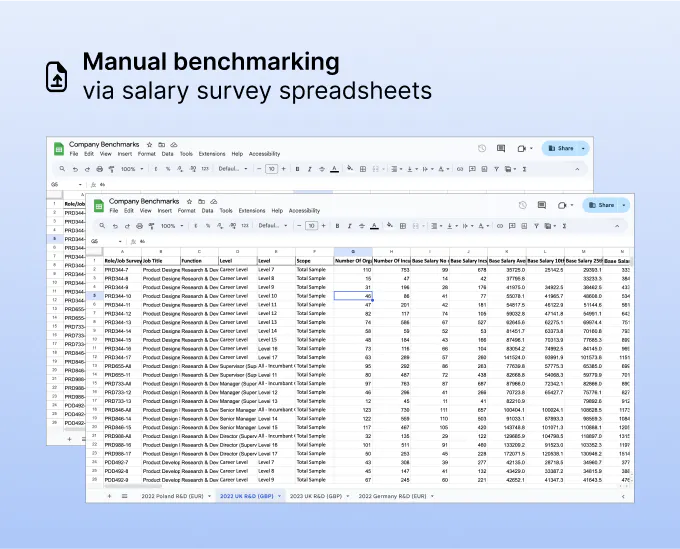
It replaces spreadsheets by centralising compensation data, helping teams compare internal roles against external pay data more consistently and reducing the manual work involved in salary benchmarking.

What does remuneration benchmarking software help with? 

Remuneration benchmarking software helps People and Rewards teams make faster, more consistent, and more defensible pay decisions. Use the software to: 

  • Benchmark salaries against the market – understand whether pay is above, below, or aligned with current market rates across roles, levels, and locations
  • Replace manual benchmarking work – rather than exporting remuneration survey cuts, mapping roles in spreadsheets, and comparing to internal employee data by hand, do it all in one platform
  • Improve offer competitiveness – set compensation packages that are competitive enough to win candidates without inflating payroll
  • Give leadership and employees confidence in compensation decisions – back pay decisions with market evidence so they're easier to explain and harder to challenge
  • Support salary band creation – ground pay ranges in market data for consistent decisions organisation-wide
  • Inform compensation reviewsrefresh salary bands and identify where existing employees have fallen behind the market, not just new hires
  • Forecast salary costs for new roles and markets – understand what employee costs look like before expanding into a new location or adding headcount
  • Support pay equity and pay transparency – use an objective market reference point to identify gaps and build defensible compensation structures.

When do you need remuneration benchmarking software?

Most teams start looking for remuneration benchmarking solutions when pay decisions become too frequent, too visible, or too difficult to defend using instinct and free data alone.

The sooner you invest in reliable market data, the better. 

A five-person startup making its third or fourth hire faces the same core problem as a 200-person company running a full pay review: without a reliable market reference point, pay decisions are harder to make and harder to explain.

You’ll typically need total remuneration benchmarking software when:

  • You're making structured hires for the first time. When compensation starts to matter beyond the founding team, you need market data to set pay you can stand behind – not estimates based on what felt right at the time.
  • Pay decisions are being made without a shared reference point. When hiring managers, HR, and leadership are all working from different instincts or data sources, pay becomes inconsistent and difficult to explain. Benchmarks give everyone the same market foundation to work from.
  • You can't explain or defend a pay decision when challenged. By a candidate, an employee, or a founder. If the honest answer is "that's just what we pay," it's time for a more structured approach.
  • You're building or refreshing salary bands. Bands built without reliable benchmarks are built on internal precedent rather than market reality. Benchmarking software gives you the market reference point to set ranges that are grounded, defensible, and consistent across roles and levels.
  • You're expanding into a new location or market. Whether you're opening a new office or hiring your first employee in a new country, you need local benchmark data to understand what competitive pay actually looks like there – and what it will cost.
  • You're running a compensation review. Fair and competitive pay isn’t just for new hires. Benchmarking software lets you check whether existing employees have fallen behind the market and identify where market adjustments are needed before people start looking elsewhere.
  • You’re preparing for pay transparency requirements, such as the EU Pay Transparency Directive or Australia’s Workplace Gender Equality Amendment Act 2023, which are increasing pressure for more structured compensation practices.

Why use remuneration benchmarking software instead of remuneration surveys, free salary data, or your HRIS’ compensation module?

Whether you're benchmarking pay for the first time or moving away from a solution that's no longer working, when you’re exploring your options for remuneration benchmarking you'll likely come across four types of options. 

Here's how they differ on what matters most for benchmarking:

Remuneration benchmarking software versus free salary data:

  • Free salary data sources – like Glassdoor’s salary checker or Hays salary guides – are self-reported or crowdsourced and unverified, making them unreliable as a foundation for pay decisions.
  • Free sources give you no visibility into methodology, sample size, or data confidence – so there's no way to assess whether you trust the approach to aggregating pay data, or whether a figure is reliable or an outlier.
  • Free data is typically averaged across roles, levels, and locations that don't reflect your specific context. Without filters for company size, industry, or funding stage, the resulting figures are too broad to benchmark against meaningfully.

Remuneration benchmarking software versus remuneration surveys:

  • Traditional remuneration surveys rely on manual company submissions, typically once or twice a year. By the time data is collected, validated, and published, it's already months old – and won't refresh until the next survey cycle.
  • Because submissions are manual, reporting errors are common. The benchmarks you receive reflect what companies said they paid, not necessarily what they actually paid.
  • Survey data tends to skew toward large global enterprises, which makes benchmarks less relevant for fast-moving or tech-focused companies competing for a different talent pool.

Remuneration benchmarking software versus HRIS compensation modules:

  • HRIS compensation modules are an add-on to an existing product, which can make them tempting for tool consolidation, but they lack benchmarking depth and expertise. They typically surface third-party data with no way to map it to your internal roles or use it directly in compensation workflows.
  • Benchmarks in HRIS modules often come from remuneration survey partnerships, refresh quarterly at best, and peer group filtering is limited. You can't filter by funding stage, company size, or industry in the way a dedicated benchmarking platform allows.
  • Because benchmarking isn't the core product, job mapping is manual and unsupported – meaning the data is difficult to use accurately even when it's available.

Key considerations when selecting remuneration benchmarking software in 2026

Compensation benchmarking software has evolved significantly beyond static remuneration survey spreadsheets.

You can choose from several types of remuneration benchmarking software – each differing in how compensation data is sourced, verified, updated, and how usable the data itself is: 

  • Real-time benchmarking platforms (e.g. Ravio) that use direct HRIS integrations to continuously source compensation data – the closest match to ‘remuneration benchmarking software’ you’ll find. These combine external market benchmarks with internal employee pay data and also often give you other compensation management tools, such as salary bands
  • Remuneration survey software from traditional salary providers (e.g. Mercer WIN), which give you software access to traditional compensation data with easier filtering than static spreadsheets alone.
  • HRIS compensation modules (e.g. Lattice) that offer market data (sourced from third-party sources) and basic compensation management features directly inside broader HR systems. 
  • Survey submission software (e.g. Payscale MarketPay), which help companies participate in remuneration surveys and manage survey-based market pricing more efficiently.
  • Compensation management software (e.g. Beqom), which focus more heavily on compensation workflows like salary reviews, budgeting, and pay planning, often alongside third-party benchmarking data integrations.
  • Free salary tools (e.g., Glassdoor) that provide salary estimates using public, crowdsourced, or self-reported compensation data with limited benchmarking depth and verification controls.

When comparing remuneration benchmarking software providers, focus on how current, accurate, relevant, and usable the data actually is for your hiring location(s) and compensation strategy: 

1. Local market coverage and data relevance  

Some providers may cover many countries but have limited benchmark depth for smaller markets, specific industries, or niche roles. Others may rely heavily on broad geographic averages to create modelled estimates when local data coverage is limited.

Large compensation datasets also don’t automatically produce better benchmarks.

So what really matters is whether the compensation data is actually comparable to your company’s hiring markets, roles, and compensation structure.

Look for:

  • Strong benchmark coverage in the markets where you hire in
  • Reliable benchmark coverage across roles, levels, and functions
  • Relevant peer groups by industry, company size, and growth stage
  • Location-specific benchmarks rather than broad regional averages
  • Transparency around benchmark sample sizes and confidence levels

Global remuneration data providers, for instance, may offer very large datasets. But much of the data typically comes from large multinational companies with very different compensation structures, hiring budgets, and job architectures from those of fast-growing tech companies.

This can make pay data less useful for smaller, scaling, or venture-backed companies trying to make market-aligned compensation decisions.

Put simply, benchmark data that lacks comparability can make compensation decisions harder to trust and defend internally, even if the overall dataset itself is large.

2. Real-time vs point in time survey data

Traditional remuneration survey providers usually operate on a give-to-get model, where you manually submit employee pay data in exchange for access to survey data.

Given the scale of these surveys, collecting, aggregating, and publishing the data takes long, so they typically refresh quarterly or annually. 

This comes with two major limitations: 

  • Manual data submissions increase the risk of reporting errors and add significant admin work for compensation teams.
  • By the time the benchmark data publishes, compensation expectations may already have shifted – particularly in fast-moving hiring markets. And it doesn’t refresh until the next due survey cycle.

In contrast, real-time remuneration benchmarking software use HRIS integrations to pull compensation data automatically and more continuously. 

This reduces manual reporting work, lowers the risk of data inconsistencies, and gives teams access to more regularly refreshed pay benchmarks. 

3. Data sourcing, verification, and benchmarking methodology 

Compensation benchmarks are only as trustworthy as the data sourcing and validation methodology behind them.

When evaluating providers, ask them: 

  • Where the benchmark data comes from
  • How often does it update 
  • How roles are levelled and matched
  • How outliers or inaccurate data are handled
  • How they turn raw data into mapped benchmarks

Some providers are transparent about how they source compensation data, but give little visibility into how that data is verified, matched, and turned into usable benchmarks.

This is often because traditional remuneration survey providers mainly give teams raw compensation data, leaving you to manually map roles, interpret the data, and build benchmark ranges yourself.

This creates more room for inconsistent job levelling, reporting errors, and compensation decisions that are difficult to explain or defend internally.

In comparison, real-time benchmarking providers give you usable benchmarks that are already aligned to a consistent job architecture (the specifics vary by provider).

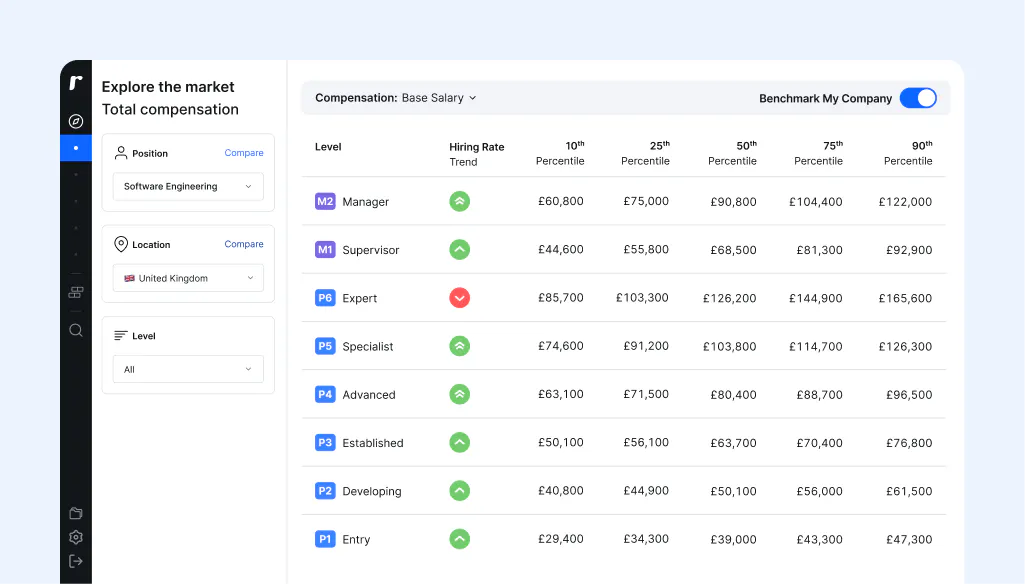
Ravio's compensation benchmarking platform

4. Total rewards coverage

Some remuneration benchmarking platforms only give you base salary benchmarks. Others, like Ravio and Pave, also include broader total rewards data, such as:

  • Equity compensation
  • Bonuses and variable pay
  • Benefits and allowances
  • Total compensation benchmarking

The right approach depends on your compensation philosophy and hiring strategy.

For example, equity benchmarks usually matter more to venture-backed tech companies that use stock options to stay competitive without overinflating cash compensation. 

Similarly, benefits benchmarking helps in highly competitive or regulated hiring markets where companies differentiate through healthcare, pension contributions, leave policies, or flexible work allowances rather than salary alone.

For distributed teams, benefits benchmarks can also help them understand how peers structure remote work models and whether they differentiate pay for remote employees. 

5. Software usability 

Lastly, look for how intuitive the platform is. 

Some providers mainly give teams access to raw compensation data. Others give you benchmarks and compensation workflows that make it easier to maintain salary bands, benchmark employees against the market, see how off-market your compensation is, and coordinate compensation decisions more consistently across teams.

When evaluating remuneration benchmarking software, review:

  • How do you set up the platform, and how easy and intuitive is it to use it
  • How do you submit your compensation data
  • Whether the platform supports automated job mapping
  • How easily can you filter benchmarks by peer group, location, company stage, market, or target percentile
  • How easily can you compare employee compensation against external market benchmarks
  • Whether managers, HRBPs, Finance, Talent Acquisition, and leadership can access compensation insights with appropriate permissions 
  • How much support is available from the provider to answer questions or customise the platform to your needs
  • What workflow tools exist beyond benchmarking, such as salary band management, pay equity analysis, compensation review workflows, or cost-to-fix analysis.

The more compensation decisions scale across managers, locations, and review cycles, the more important it becomes for compensation benchmarking software to support the operational side of compensation management – not just provide market data.

7 best remuneration benchmarking software

Below, we’ll look at the 7 best remuneration benchmarking software across the different categories – covering how each sources data, where their benchmark coverage is strongest, and the types of teams they’re best suited for:

1. Ravio

Ravio sources total rewards data via direct HRIS integrations with 1,500+ tech companies, removing the manual submission burden entirely. 

A dedicated team of data scientists verifies the raw data and converts it into mapped benchmarks – with outliers removed, stale data flagged, and benchmarks only published once role-specific confidence thresholds are met.

The result is a reliable dataset across 50+ countries and 300+ roles, with particular depth across tech and tech-enabled markets and roles. Inside the platform, you can review sample size and confidence level per benchmark, so you know exactly what's behind each figure.

During onboarding, the Ravio team maps your roles and levels to a consistent job architecture, so benchmarks are usable from day one. 

So what you get are focused datasets across 50+ countries in both major and niche hiring markets, including Australia.

See whether Ravio covers your roles and markets

2. REMSMART 

REMSMART is a consultancy-first pay data provider with a basic platform to access the data, ideal for organisations in Australia’s resources, energy, and rail sectors looking for compensation design and implementation consulting services.

It sources pay data from 200+ contributing companies using a give-to-get survey model, with benchmark data made available through a basic cloud-based subscription portal.

The data pool is relatively small, but it comes with the advantage of access to premium consulting and training services.

3. Hays

Hays is a recruitment specialist that publishes annual salary guides covering base salary data for 1000+ roles across 25 industries in Australia and New Zealand. 

While the base salary data comes from the local market, it’s either employee-reported (via a survey) or based on Hays' own data from job ranges or placements – both of which are unreliable, unverified sources. Hays also doesn't have deep compensation expertise, and so whilst the data is interesting, it isn't usable as statistically validated benchmarks representing market-typical pay.

And since the survey updates annually, the data also tends to be less current for fast-growing companies hiring across different regions or for evolving roles (such as AI roles) where compensation expectations change quickly.

4. Rumunera 

Rumunera is a remuneration data provider that focuses on offering executive pay benchmarking data for public companies in Australia, the USA, and Canada.

It sources base salary and equity data from publicly available company disclosures – covering proxy statements, remuneration reports, and regulatory filings.

Its platform lets you access executive market data, but focuses more on giving you compensation workflows.  

Because the platform relies on publicly disclosed compensation data, teams may still need to independently validate the accuracy and relevance of benchmarks for their own roles, levelling structures, and compensation philosophy.

5. Pave 

Pave is a real-time compensation benchmarking software, best for tech startups and enterprises in North America. 

Although Pave offers global pay data, most of its benchmark depth and total rewards coverage comes from companies in the US and Canada. 

Outside these markets, equity and bonus benchmark coverage is limited, and pay benchmarks rely more heavily on location multipliers based on US market averages.

Like Ravio, Pave also takes job mapping off your plate. But while Ravio uses a team of data experts to map data to a consistent job architecture, Pave uses AI-powered job mapping instead.

6. RemLive 

RemLive is another real-time remuneration benchmarking software that uses HRIS integrations to collect and update pay data.  

Compared to Pave and Ravio, however, it supports a more limited set of HRIS integrations, which may be a consideration if your HR system isn’t supported.

While RemLive automates job mapping, there’s limited publicly available information on benchmark coverage, including supported locations, role depth, sample sizes, and how benchmarks are created.

7. Mercer Marsh

Mercer is a well-established HR consultancy that runs periodic remuneration surveys, best suited to enterprises and multinational organisations looking for total rewards benchmark data from peer companies.

Mercer also offers regional survey datasets. In Australia, for example, companies can access local benchmark data through Mercer Marsh salary insights.

Much of this data comes from large multinational organisations – Mercer’s typical survey participants – which means the resulting benchmarks can be more aligned with enterprise compensation structures than those of fast-moving tech or tech-enabled companies.

The compensation data is also typically delivered through its delivery portal with basic filters that in-house teams need to manually map to internal job roles and levels.

8. Radford by Aon

Like Mercer, Radford by Aon is a legacy remuneration data provider that offers point-in-time salary data sourced from global enterprises – best suited to multinational organisations with the resources to manually submit and map compensation data.

Alongside total market benchmark data across countries, roles, and job levels, Radford also offers premium compensation consulting services.

Like many traditional survey providers, it also delivers data via its digital platform. However, the benchmark data is broad, so coverage for niche, emerging, or fast-evolving roles is more limited.

ROI of remuneration benchmarking software, and how to build buy-in

Investing in remuneration benchmarking software is rarely just about “buying compensation data.” It’s about improving the speed, consistency, and defensibility of compensation decisions across your company.

The investment often pays off by reducing costly compensation gaps that can compound over time, including overpaying new hires, avoidable employee turnover, delayed hiring, and pay structures that become difficult to defend internally.

You’ll typically see the ROI of reliable benchmarks in five key areas:

  • Better offer competitiveness. More accurate market benchmarks help companies avoid both underpaying and unnecessarily inflating compensation offers.
  • Reduced employee turnover risk. More competitive and internally consistent pay structures reduce the likelihood of employees leaving due to compensation concerns.
  • Time and cost saved. Real-time remuneration benchmarking software reduces the time, effort, and operational overhead involved in manual survey submissions, spreadsheet analysis, and job mapping – helping teams manage compensation more efficiently as headcount and hiring markets scale.
  • Fewer reactive salary corrections. Regularly refreshed benchmark data helps companies spot compensation gaps earlier instead of making expensive adjustments later.
  • Faster compensation decisions. Real-time benchmark access reduces the manual work and time that goes into survey interpretation, spreadsheet analysis, and compensation reviews.
  • Stronger pay transparency and compliance readiness. More structured compensation frameworks make it easier to explain, defend, and audit compensation decisions as pay transparency requirements increase.

The Plastometrex team, for example, was “paying substantially above the national average” before investing in benchmarking software, according to James Dean, the Co-founder and CEO.

They struggled to align national averages with local market realities – especially in Cambridge, where salaries can exceed broader UK benchmarks.

But the extent of the misalignment only became clear once they benchmarked against Ravio’s more relevant and reliable dataset.

Similarly, the team at TestGorilla was spending more resources managing compensation manually without dedicated remuneration benchmarking software. As the team explained it: 

“If you want ‘all of Europe’ from a provider like Korn Ferry, you need to buy Southern Europe, Central Europe, Western Europe, UK, Benelux, and Nordics separately, and then manually combine them into an average,” explains Luis. “You're paying for five or six different benchmarks when what you really want is one that combines them."

Plus, the team was investing time separately in building salary bands by hand – using free data to create company-wide pay ranges, with target percentiles the only way to account for pay differences per function or role. 

If you’re looking to convince stakeholders to invest in remuneration benchmarking software, build your business case around:

  • The cost of compensation mistakes including rejected offers, overpaying employees, unplanned salary adjustments, and avoidable turnover.
  • The operational time spent manually collecting, mapping, validating, and interpreting compensation data internally.
  • The growing need for more defensible compensation decisions as companies scale across locations, managers, and hiring markets.
  • Pay transparency and compliance pressure, especially for companies preparing for regulations such as the EU Pay Transparency Directive or Australia’s Workplace Gender Equality Amendment Act.

The key is to frame remuneration benchmarking software less as a compensation expense and more as infrastructure for making faster, more consistent, and more defensible pay decisions at scale.

We’ll leave you with this guide on how teams get CEO buy-in for investing in compensation data, with advice from Rewards expert Alistair Fraser.

Wrapping up: The best remuneration benchmarking software makes pay decisions easier to trust and defend

Remuneration benchmarking software isn’t just about accessing compensation data. 

It’s about helping you make faster, more consistent, and more defensible pay decisions as hiring markets, employee expectations, and pay transparency pressures continue to grow.

That’s why the best remuneration benchmarking providers don’t just offer large datasets. They offer usable benchmarks that are accurate, up-to-date, transparent, and relevant to the markets where you actually hire.

If you're looking to see how your compensation compares against real-time market data, try 3 free compensation benchmarks with Ravio.

Explore Ravio’s benchmarks for yourself

FAQs 

Can global compensation platforms benchmark Australia reliably?

Yes, but only if the provider has strong benchmark depth in Australia. Some global pay data providers cover Australia broadly – often relying heavily on multinational survey data or modelled estimates based on geographic averages rather than similar companies, hiring markets, or compensation structures. Look for providers with Australian hiring market coverage, transparent benchmark sample sizes, and location-specific benchmarks rather than broad APAC averages.

Can remuneration software support pay equity analysis?

Yes. Many remuneration benchmarking platforms, such as Ravio, support pay equity analysis through compensation comparison filters, pay gap visibility, and reporting tools. These features help teams identify compensation gaps across gender, role, level, department, and location before they widen over time, while also supporting pay transparency and reporting requirements. Here’s a guide on how to identify pay gaps with Ravio. 

How much time does remuneration benchmarking software save?

The biggest time savings come from removing the manual work that traditional benchmarking processes require: submitting survey data, mapping roles to provider frameworks, cleaning inconsistent datasets, and rebuilding benchmarks each review cycle. With a dedicated benchmarking platform like Ravio, that work is handled during onboarding and updated continuously – so when you need a benchmark, it's already there, mapped to your roles and ready to use.

How long does compensation software implementation take?

Compensation benchmarking software implementation timelines vary by provider and company complexity. Platforms with direct HRIS integrations and onboarding support can often be implemented within a few weeks. 

Can remuneration software automate job levelling? 

Some remuneration benchmarking platforms support automated job mapping using AI-powered matching systems (like Pave) or dedicated data teams (like Ravio). This reduces the manual work involved in mapping internal job titles to the provider’s benchmark roles and helps you compare equivalent roles and levels more consistently across the organisation.

Can managers access compensation benchmarking directly?

Yes, many remuneration benchmarking platforms support role-based access controls so managers can participate in compensation reviews without exposing sensitive compensation data more broadly – like Ravio’s user permissions. This helps you standardise compensation decisions while improving collaboration between People teams, leadership, and hiring managers.

How do compensation platforms replace spreadsheets?

Dedicated benchmarking platforms replace the manual work involved in sourcing, mapping, and maintaining compensation data. Instead of exporting survey cuts, mapping roles by hand, and rebuilding benchmarks in spreadsheets each review cycle, teams access verified, continuously updated benchmarks in one place – already mapped to their internal job architecture. This means less time spent on data preparation and more confidence in the benchmarks you're actually making decisions from.

Can you trust AI-generated salary benchmarks?

AI-generated salary benchmarks can be useful for broad salary estimates, but they aren’t reliable enough for compensation decision-making. AI tools pull compensation data from public sources that are unverified, inconsistently reported, and not standardised. The data also isn’t mapped consistently across job levels, locations, or compensation structures, which makes the resulting benchmarks difficult to trust for compensation decisions.


Get the Compensation Review straight to your inbox

Your monthly dose of market insights and expert perspectives

You might also like