New3x the coverage, same rigorous quality. 300 positions benchmarkedExplore

Glassdoor for salary benchmarking: how accurate is the data, and what should HR teams use instead?

Benchmarking

Glassdoor's salary checker is one of the most-visited salary tools on the internet.

It's free, instantly accessible, and full of numbers that look authoritative. 

For an employee wanting a rough sense of whether their pay is in the right ballpark, that has some value. 

For HR and Reward teams making decisions that affect pay structures, salary bands, and individual salaries, it's a sure-fire way to damage the credibility and market competitiveness of your pay decisions.

This piece explains how Glassdoor's salary data is collected and calculated, what that means for its reliability, and what to use instead when the decisions actually matter.

What is Glassdoor's salary checker?

Glassdoor's salary checker is a free tool that lets anyone search a job title and location and see a salary estimate: a base pay range and an average figure, alongside a "most likely range" representing the 25th to 75th percentile of reported salaries. 

It sits within Glassdoor's broader platform, which is primarily a place where employees leave anonymous reviews of their employers – covering company culture, management, interview experiences, and working conditions. 

Access to Glassdoor’s salary data is partially gated: access typically requires submitting your own salary information first – contribute your own salary, unlock the checker tool. 

How does Glassdoor get its salary information?

Glassdoor's salary data is crowdsourced. Employees and job seekers submit their own salary information – anonymously, and with no verification from Glassdoor or their employer.

The data comes from the people already using Glassdoor: a self-selected pool that skews toward individuals actively interested in salary transparency, pay comparisons, or job searching. 

There's no mechanism to verify that submitted figures are accurate, or that the person submitting is who they say they are.

And, the gated tool mechanism leaves the salary checker wide open for inaccurately reported salaries. Users are prompted to submit salary data to unlock access to the tool, which means someone could submit any figure just to get through the gate. They also have a rational reason to report a higher salary than they actually have – because a figure in the salary checker tool that shows the market rate above your current salary becomes leverage in a pay conversation with your manager. There's no way to detect or correct for that bias in the dataset.

There's also no methodology for removing or weighting down old submissions over time. Glassdoor aggregates all salaries ever submitted for a role – which means a figure reported two, three, or five years ago contributes to the estimate you see today. In a market where pay has shifted significantly over that period, the data is nowhere near current reality.

Glassdoor supplements this user-submitted data with what it describes as "the latest government data" – though it doesn't specify which datasets, how they're weighted, or how they interact with user submissions in the model.

How does Glassdoor calculate salary estimates?

Glassdoor doesn’t transparently explain their methodology for turning the raw salary data it collects from users into the salary ranges shown in its salary checker tool.

Here’s what we do know: 

  • Users are prompted to submit their job title, company name, and salary. This is often incentivised – submitting unlocks access to more salary data and company reviews. 
  • There's no verification step and no job mapping when users submit: if someone submits as a "Senior Software Engineer," that's taken at face value, regardless of what their actual level or scope of responsibilities looks like.
  • Glassdoor then aggregates those submissions using a ‘machine learning model’ – which isn’t explained further.
  • Critically, there's no indication that older submissions are removed or down-weighted: salaries submitted years ago appear to remain in the dataset alongside recent ones – it’s a historical average, not a current market figure.
  • Glassdoor then surfaces two outputs in the salary checker tool: an average salary figure, and the 25th to 75th percentile "most likely range." 
  • Confidence labels are given – "very high confidence" and so on – but they reflect sample volume, not the quality or consistency of what was submitted.

On methodology, Glassdoor's own description is: "Glassdoor salaries are powered by our proprietary machine learning model, which utilises salaries collected from our users and the latest government data to make pay predictions." 

That's the complete disclosure. 

There's no published detail on how the model weights different inputs, how it handles outliers, or how "government data" is incorporated. 

For a Reward team that needs to understand and defend the data behind a pay decision, that’s far from enough information to trust the data as a reliable view of the market.

How reliable is Glassdoor's salary data for compensation benchmarking?

Glassdoor's salary data has several structural limitations that make it unreliable for compensation benchmarking.

The data is unverified and historically aggregated, there's no job-level standardisation to ensure like-for-like comparisons, the methodology is opaque, and there's no way to filter for the peer group you actually compete with for talent. 

Here's what each of those looks like in practice.

Why Glassdoor falls short for benchmarking

1. Self-reported data with no validation

Every submission is anonymous and unverified. 

There's no way for Glassdoor to check whether a reported salary is accurate, whether the job title reflects the actual role, or whether the employer named is where the person actually works.

Employees also have a rational incentive to over-report. 

Submitting a higher salary makes you feel less underpaid relative to peers, and helps colleagues or successors negotiate up. 

There's no way to detect or correct for this in the data pool. The result is a systematic upward pressure on figures that can't be quantified or controlled for.

2. No job-level standardisation

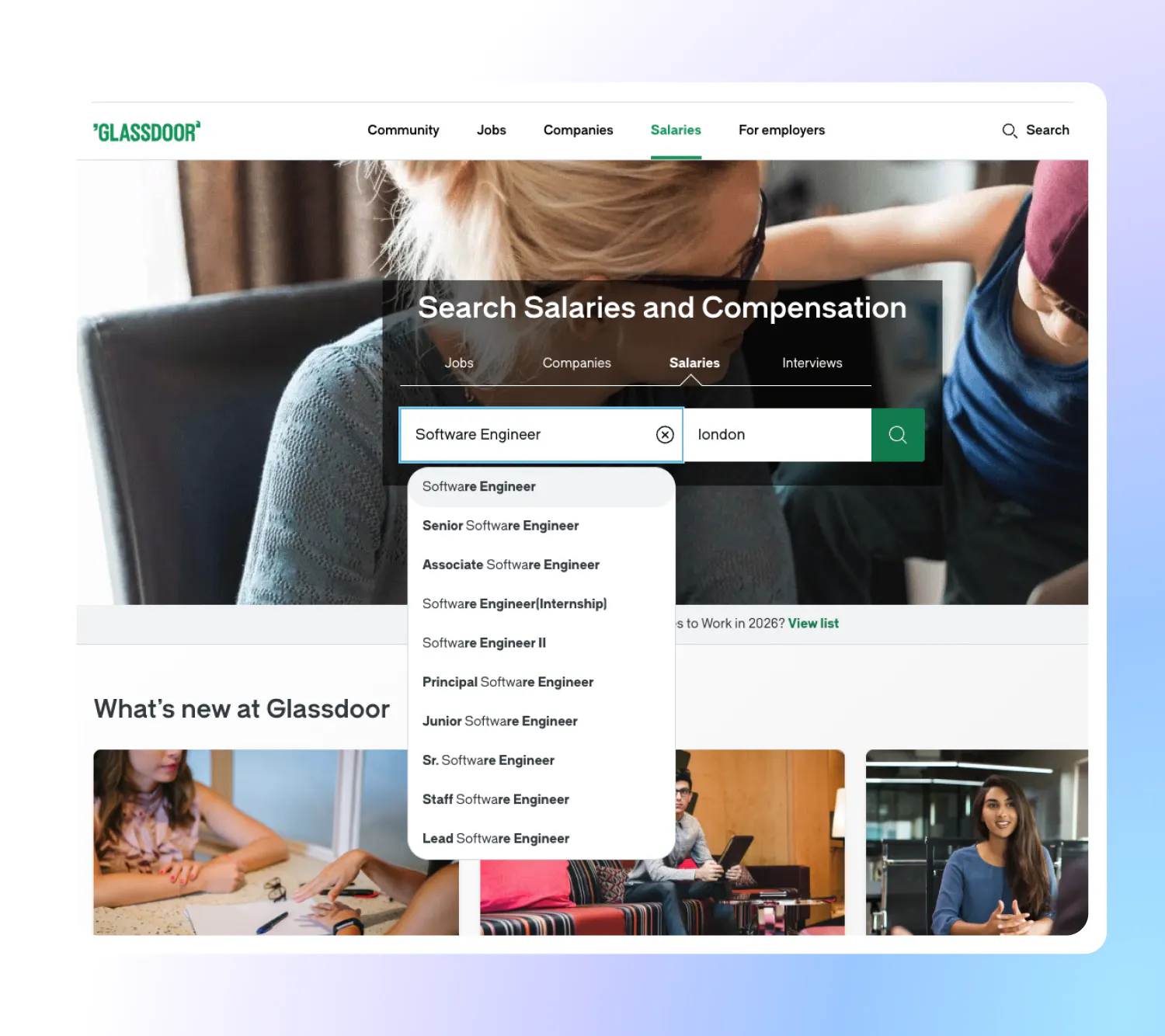
When you enter "software engineer" into Glassdoor's salary checker, the dropdown offers: Software Engineer, Senior Software Engineer, Associate Software Engineer, Software Engineer II, Junior Software Engineer, Principal Software Engineer, Sr. Software Engineer, Staff Software Engineer, Lead Software Engineer. 

Glassdoor salary checker – job titles

There’s no guidance on which to select, and no explanation of how these relate to each other – which means inevitable inconsistencies in how job titles, roles, and levels are described. 

The tool's only answer to this is to let you adjust by years of experience – sliding from 0-1 years up to 10+. 

But years of experience is a poor and subjective proxy for seniority. A P3 and a P4 Software Engineer can have overlapping tenure. 

What defines seniority is scope, accountability, and level – not time served. Using experience as the variable means the figures for any given title aggregate roles that could be meaningfully different in terms of market rate.

A defined levelling framework – one that maps roles to consistent, standardised levels before any analysis runs – is the foundation of reliable benchmarking

Glassdoor's salary checker doesn't have one.

3. A black-box methodology

As noted above, Glassdoor's methodology disclosure is a single sentence: a proprietary machine learning model trained on user submissions and government data.

There's no information on how inputs are weighted, how the model handles outliers, or what "government data" contributes to the output.

When a Reward team uses a benchmark to set a salary band or defend an offer, they need to be able to explain where the number came from. 

A methodology you can't describe or interrogate makes it impossible to defend to leadership and to employees.

4. No market segmentation

Glassdoor has no filters for industry, company size, or funding stage. 

A software engineer at a Series B startup and one at a FTSE 100 bank are both counted as software engineers in the UK. 

For any company benchmarking against a specific talent market – other growth-stage tech companies, for instance – the resulting figure is an average across a much broader and less relevant population.

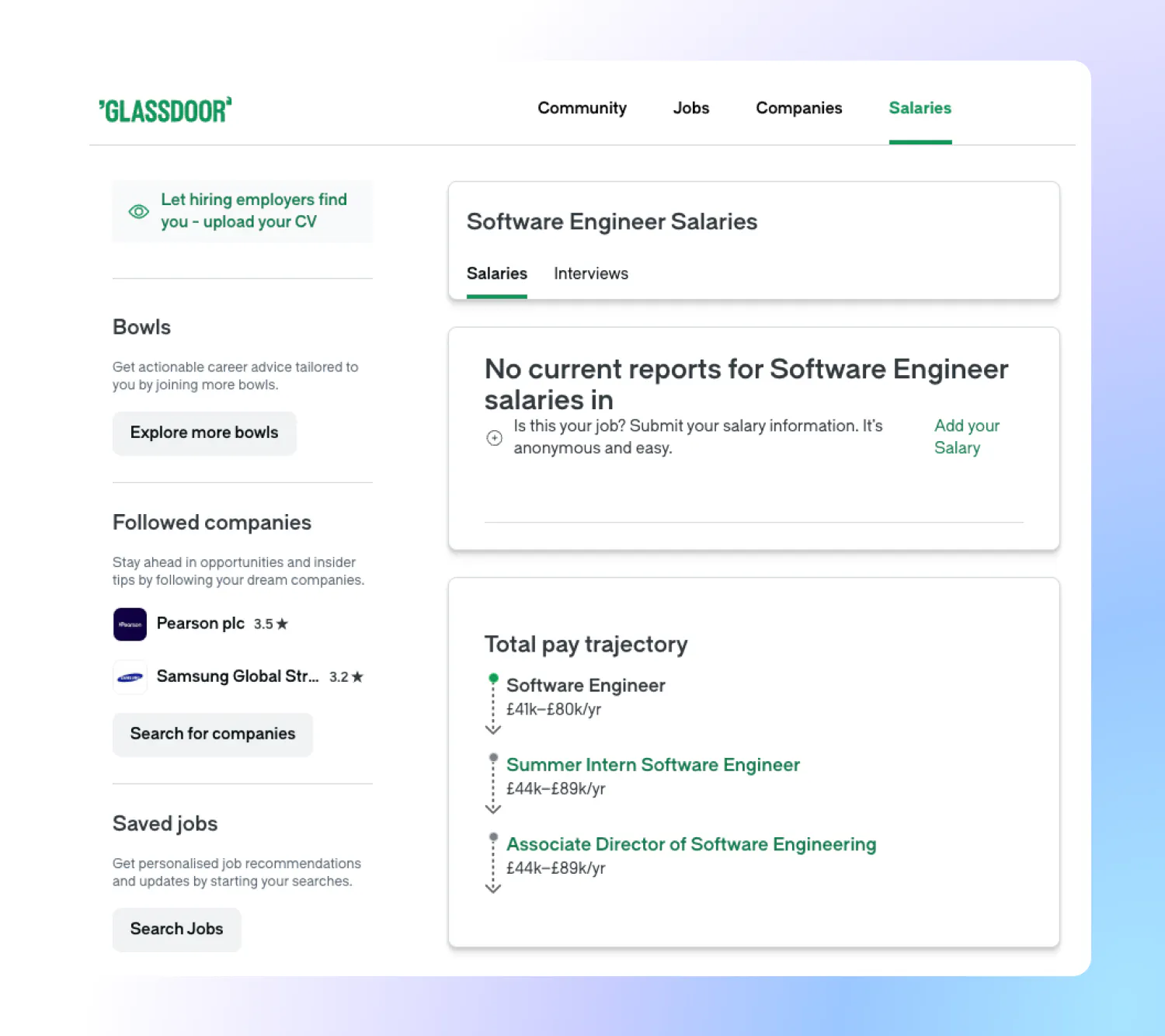
Location exists as an option in the salary checker, but testing the salary checker for Software Engineer filtered to London returns "no current reports” – for one of the largest tech hiring markets in London.

Comparing Glassdoor salary benchmarks against Ravio’s validated salary benchmarks

To illustrate how far Glassdoor figures can sit from validated market data, here's how results compare against Ravio benchmarks for three roles – all tested in the UK.

Glassdoor vs Ravio: Salary benchmarking a Software Engineer

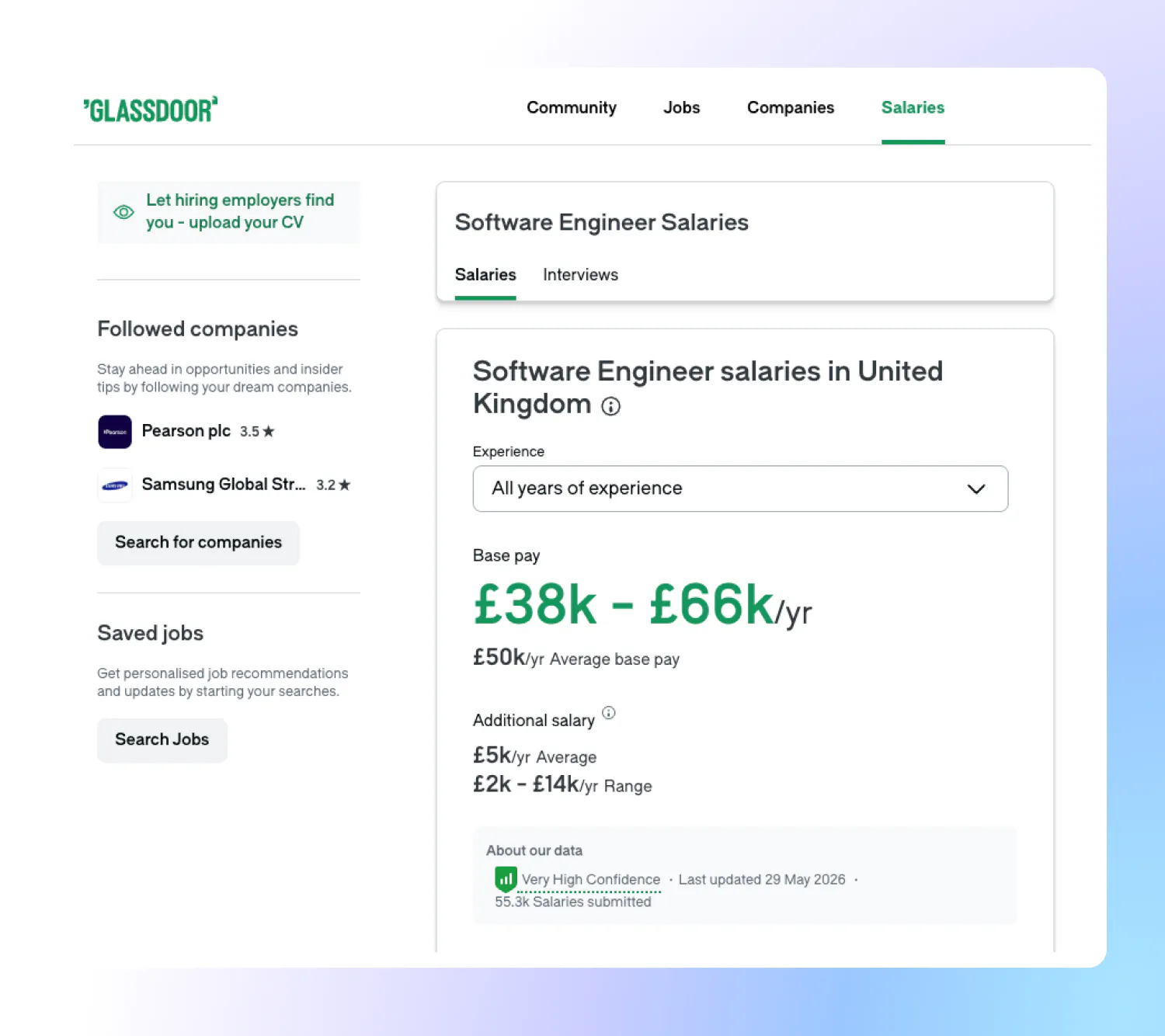
Glassdoor’s salary checker shows a base pay range of £38k–£66k, with an average of £50k. 

The Ravio benchmark for a P3 Software Engineer (mid-level Individual Contributor, the most common level for this title) puts the actual market at: P25 £62,300 / P50 £70,000 / P75 £78,600 (correct as of June 2026).

Which means the Glassdoor average sits £20,000 below the validated market median.

Glassdoor vs Ravio: Salary benchmarking a Director of Software Engineering

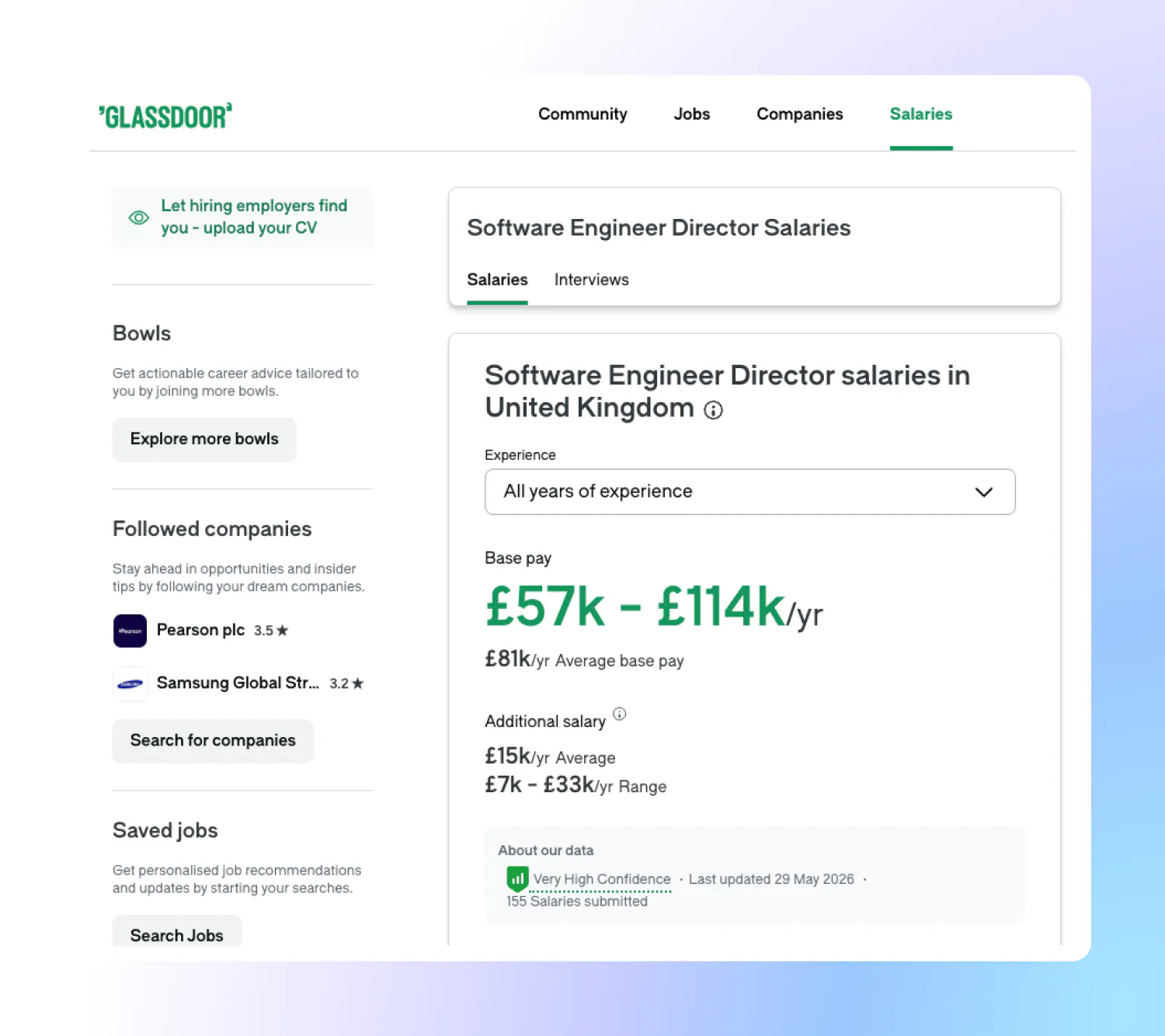
Glassdoor shows £57k-£114k, with an average of £81k – rated "very high confidence." 

The Ravio benchmark for an M4 Director: P25 £114,700 / P50 £135,700 / P75 £160,500 (correct as of June 2026).. 

The Glassdoor average is more than £50,000 below the validated midpoint, and falls below even the 25th percentile of the Ravio benchmark – if you relied on this to make a starting salary offer for a new leadership hire, your time-to-fill would be a long one.

Data Scientist

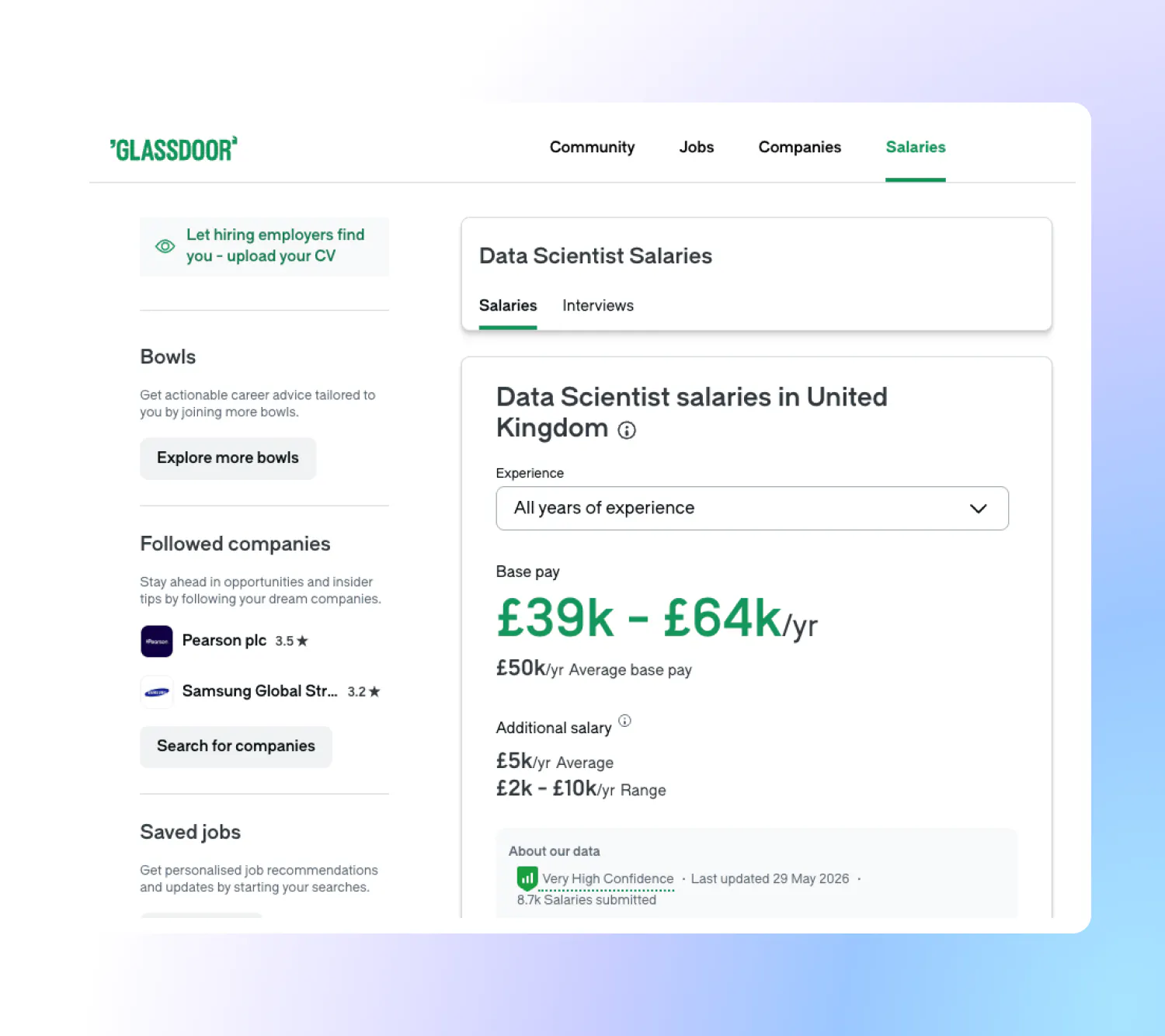
Glassdoor shows £39k-£64k, with an average of £50k – identical to its software engineer average, despite the roles commanding meaningfully different market rates. 

The Ravio benchmark for a P3 Data Scientist: P25 £61,500 / P50 £68,300 / P75 £75,900 (correct as of June 2026).

Glassdoor salary checker – data scientist uk

Try out the Glassdoor vs Ravio comparison for yourself

The gap isn't marginal in any of these cases – and it has very real consequences.

Pay decisions built on Glassdoor figures this far from the market have real consequences: offers that get declined, employees who leave when they find out what the market actually pays, and salary bands that compress over time as new hires are brought in at rates the bands can't accommodate.

This is a pattern we see consistently among companies that come to Ravio from relying on free tools like Glassdoor.

Tiqets, for instance, previously built their compensation framework using Glassdoor and LinkedIn data – and found that line managers simply didn't trust the figures. 

"It created frustrations with line managers. They didn't trust the data that we came with, which made it difficult for us to discuss compensation and talk about what people's pay should be," says Maartje Koopman, Head of People and Culture at Tiqets. 

At FTAPI, the same dynamic played out differently but with the same root cause. 

"Before Ravio, three people Googling the same question would find three different answers, so we'd waste time debating which data was right," explains Kim Heckner, Head of People and Culture at FTAPI. "Now we start from a shared baseline and focus our discussion on the actual decision."

Alternatives to Glassdoor for reliable, current salary benchmarking data

For compensation decisions, you need data that's current, validated, and drawn from companies you actually compete with for talent. 

Crowdsourced tools like Glassdoor simply don't meet that bar.

Traditional salary surveys from providers like Mercer or Radford are more rigorous: they collect data directly from HR teams, apply statistical validation, and cover a wide range of roles and markets. 

But data is typically several months old by the time it reaches you, and the submission process is manual and time-consuming. 

For fast-moving markets – and particularly for tech roles, where pay can shift quickly – that lag has a real cost. 

Which is why a growing number of HR and Reward teams are moving to modern, HRIS-integrated, real-time benchmarking platforms like Ravio as their primary source.

Here's how Glassdoor compares to Ravio as a salary benchmarking tool:

Glassdoor

Ravio

Data source

Self-reported by employees

Live HRIS integrations with 1,500+ companies

Update frequency

Unknown – no disclosure

Continuously updated

Robust methodology

No – no validation, no outlier removal

Yes – validated monthly by data scientists

Methodology transparency

No – "proprietary ML model," no further detail

Yes – sample size and confidence indicators per benchmark

Job-level standardisation

No

Yes – automated job mapping during onboarding

Location filters

Limited – no data for some markets

Yes – 50+ countries

Peer group filters 

No

Yes – industry, size, stage

Appropriate for compensation decisions

No

Yes

Try Ravio with 3 free benchmarks for any role – no commitment required

FAQs

How accurate is Glassdoor salary data?

For a broad directional sense of the market, Glassdoor can be useful – particularly for employees wanting to check whether their pay is roughly in line before a performance review or job search. For compensation benchmarking, it isn't accurate enough to rely on. The data is self-reported and unverified, there's no job-level standardisation to ensure like-for-like comparisons, and the methodology behind the estimates isn't disclosed. Tested against validated benchmarks from Ravio, Glassdoor figures can sit £20,000 or more below the actual market median for the same role – and further still at senior levels.

Can I use Glassdoor to set salary bands or run a compensation review?

No. Salary bands and compensation reviews require current, validated data matched to specific roles and levels. Glassdoor's salary data is crowdsourced, unverified, and built without a levelling framework – which means the figures for any given title can aggregate very different roles. Using it to set bands or run a review produces results that are difficult to defend to employees, leadership, or auditors, and that may be materially out of step with what the market actually pays.

What's the difference between Glassdoor and a compensation benchmarking tool?

Glassdoor is a review platform with a salary feature built on crowdsourced employee submissions. A compensation benchmarking tool collects data through more rigorous means – either via direct HRIS integrations (like Ravio) or structured employer survey submissions (like Mercer or Radford) – and applies validation methodology to produce defensible benchmarks. The key differences are data quality, methodology transparency, job-level standardisation, and whether the output is appropriate for pay decisions. Glassdoor is useful for individual employees checking market context. Compensation benchmarking tools are built for HR and Reward teams making pay decisions.

Is Glassdoor salary data accurate for London / UK roles?

Coverage is inconsistent. Testing Glassdoor's salary checker for Software Engineer filtered to London returns "no current reports" – a significant gap for the largest tech hiring market in the UK. For roles where London data does exist, the same limitations apply as elsewhere: no job-level standardisation, no peer group filters, and no methodology transparency. UK-wide Glassdoor figures also sit materially below validated benchmarks for tech roles – in testing, the Glassdoor average for a Software Engineer in the UK was £20,000 below the market median from Ravio's UK dataset.

How accurate is Glassdoor for software engineer salaries?

Based on direct testing, not accurate enough for compensation decisions. Glassdoor shows an average UK software engineer salary of £50,000. The Ravio benchmark for a P3 Software Engineer (mid-level Individual Contributor) puts the market median at £70,000 – a £20,000 gap at the midpoint. At Director level, the gap is wider still: Glassdoor's average of £81,000 compares to a Ravio benchmark median of £135,700 for an M4 Director. Part of this reflects the absence of a levelling framework – Glassdoor's "software engineer" figures aggregate roles across very different levels. But even controlling for that, the figures are consistently and materially below validated market rates.

What are the best alternatives to Glassdoor for salary data?

For HR and Reward teams making compensation decisions, you need a more rigorous source than Glassdoor. The best option is a modern HRIS-integrated real-time benchmarking platform like Ravio, which pulls data directly from company HR systems and updates continuously. Ravio offers three free benchmarks to search with no commitment required. 

Get the Compensation Review straight to your inbox

Your monthly dose of market insights and expert perspectives

You might also like