New3x the coverage, same rigorous quality. 300 positions benchmarkedExplore

How to determine the right compensation package for a new hire: a talent professional's guide

Hiring & offers

The starting salary offer you extend to a new hire will follow them (and the team they're joining) for years to come.

Place a candidate too high in their band and you risk compressing the pay of existing teammates doing similar work. 

Place them too low and their progression stalls before it's had a chance to start. 

Make an exception that doesn't hold up against your own criteria, and you've introduced an inconsistency that will cause a domino effect of issues – at the next pay review, or when a colleague asks why they're earning less for the same role.

These are the compensation decisions that typically sit with talent professionals day-to-day.

Rewards designs the framework – the salary bands, the compensation philosophy, the structure that keeps pay consistent and fair across the organisation. 

But it's TA who has to work within it in practice, role by role, candidate by candidate, often at speed. 

As Giovanni Di Felice, Director of Talent Acquisition at Statista, puts it: "Recruiters play an active role as business advisors." They’re doing more than just finding candidates and processing offers – they’re actively grounding hiring decisions in the company’s compensation framework, sharing insights when candidate expectations don’t match internal thinking, pushing back when hiring managers want to make exceptions, and understanding the downstream consequences of every offer they make. 

Get those decisions right, and you close great hires, whilst keeping compensation positioned fairly across the team.

In this article we’ll take a look at how to build a competitive and consistent offer for every new hire, with Giovanni’s advice to guide us.

Expert contributor: Giovanni Di Felice
Director of Talent Acquisition, Statista

What goes into determining the right compensation package for a new hire

Building a competitive and consistent offer comes down to three core decisions:

  1. Getting the hiring range right
  2. Building the offer itself
  3. Communicating the offer to the candidate
  4. Navigating negotiation.

Here's how to approach each one.

How to build strong new hire offers

1. Deciding the hiring range for the role

Determining the right compensation package for a new hire should start way before the role is even opened – a proactive, strategic approach, rather than a reactive one. 

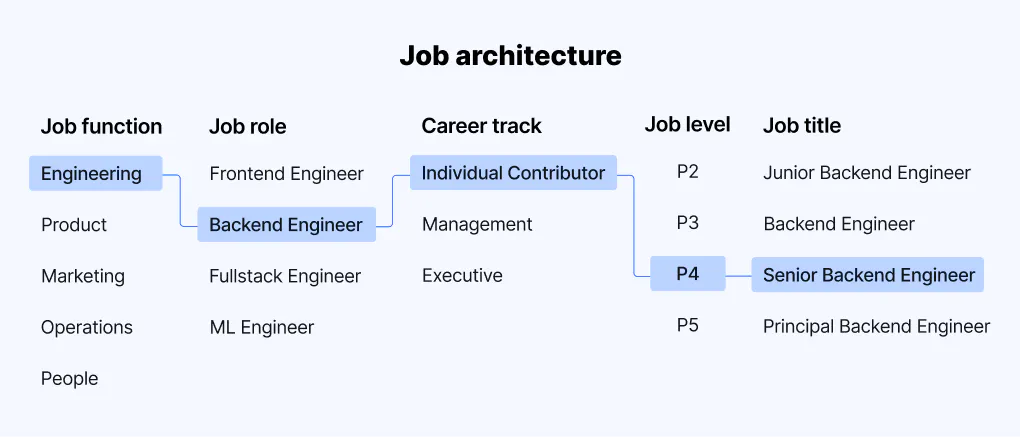
The foundation is the company’s compensation framework (pre-defined by your People or Rewards team): a structured job architecture that maps every role and level within the organisation, with salary bands sitting on top of that structure to set the parameters for compensation for each role and level. 

Graphic showing the different elements of job architecture: job function, job role, career track, job level, job title.

If that's in place, you're never making compensation decisions from scratch each time you hire, instead you're applying a consistent structure to each new role as it opens.

At Statista, this happens as part of an annual company-wide planning and budgeting cycle. 

"Our Rewards specialists update the compensation ranges each year based on thorough research," says Giovanni. “They’ll look at the latest market benchmarks to see whether we’ve drifted away from our target percentile, but also reflect on internal data and findings. 

“This is something we contribute to heavily as a talent team, because we see the shifts in the talent market as they happen. The signs are usually clear: either we’re consistently losing candidates at offer stage, or we’re having to hire at the top of the band each time.”

“At the same time, my talent team is working with managers to define their hiring plans for the year. In combination, that gives us a clear picture of compensation budgets, and how that budget will need to be distributed across the number and seniority levels of the roles they want to hire for.”

Hiring planning and the compensation framework refresh happen in parallel – so by the time a role opens, both the budget and the range are already aligned.

"The signs that your ranges have fallen behind the market are usually clear: either you're consistently losing candidates at offer stage, or you're having to hire at the top of the band each time."

Giovanni Di Felice, Director of Talent Acquisition, Statista

Giovanni Di Felice

Director of Talent Acquisition, Statista

It means that when a hiring manager's expectations expectations for the salary of a new hire drift from that (pushing for a more senior hire than the budget supports, for instance), it’s TA’s role to work through the trade-offs: removing a hire elsewhere, adjusting the seniority level, or consolidating two roles into one with a different scope.

From this process, you’ll know the salary range for each role you're hiring for. 

Some companies will then define a ‘hiring range’ within the salary range: a narrower window that reflects where a new hire should realistically land, giving them room to grow from there. 

Being clear on how you define the compensation range for each role you hire for is only becoming more important as pay transparency legislation is rolled out. 

Under the EU Pay Transparency Directive, for instance, European companies will be required to share salary ranges with candidates during the hiring process – which means the range you're working with needs to be objectively defined, up-to-date, and something you feel confident standing behind.

Salary range vs hiring range – what’s the difference?

A salary range (or salary band) covers the full earning potential for a job role across an employee’s time in that role at that seniority level, with the minimum to maximum of the range typically being a 30-50% spread.

A hiring range is a narrower window within that band used for new hires specifically, typically around a 10-20% spread.

That spread might be around the band's midpoint, if you're only hiring candidates who are expected to already be established in that level of seniority. Or it might be lower in the band, if you expect new hires to take some time to settle into the role, and want to allow room for meaningful progression and salary growth within their role.

Not every company defines a hiring range – others will use the full salary range for the role and hire anywhere within it, depending on the candidate’s skills and experience. Others will hire across multiple levels if they’re flexible on seniority, which means a much larger salary range for hiring. 

There's no single right answer. 

What matters is that the approach is defined in your compensation framework, understood by both TA and hiring managers, and applied consistently. 

salary range vs hiring range

2. Placing the starting salary within the hiring range

Once you have a candidate that you want to offer the role to, you need to decide how to define their offer within your hiring range. 

This is a decision with longer-term consequences than it might appear – not just for the cost of that hire, but for their own career and pay progression within the company, and for pay equity and compression across the wider team.

The key is having an objective, consistent framework for making that call, which is applied to every candidate, for every role. Without one, placement decisions default to gut feel, or worse, to whether a candidate negotiates effectively. 

"We avoid basing decisions on the previous salary of candidates or on who negotiated more aggressively," says Giovanni. "This is especially important in the context of pay transparency regulation."

"Two candidates with the same level, impact, and skills should always land in roughly the same place in the band."

Giovanni Di Felice, Director of Talent Acquisition, Statista

Giovanni Di Felice

Director of Talent Acquisition, Statista

At Statista, placement decisions are based on four criteria, applied consistently across every candidate for a given role:

  • Years and relevance of experience: not just how long someone has been working in a given role, but how directly applicable that experience is to the scope of the role at Statista 
  • Demonstrated proficiency against the competency framework: how the candidate performed against the objective criteria for that role and level during the hiring process, as defined by the underlying job architecture
  • Business criticality of the role: how urgent and important this hire is to the organisation's current priorities, aligning with the scope, impact, and business value of the role
  • Scarcity of the skillset in the market: how hard this profile is to find, which may justify a higher placement for genuinely scarce skills – but noting that under pay transparency legislation, the rationale for this will need to be objective, documented, and applied consistently for all roles of equal value.

"The idea is that two candidates with the same level, impact, and skills should always land in roughly the same place in the band,” Giovanni explains. “Then recruiters and hiring managers calibrate together, to ensure the placement is right.” 

That said, exceptions do happen.

At Statista, the starting point is always a strong, well-informed offer. 

"We refrain from making lowball offers," says Giovanni, "and aim for the highest possible degree of alignment with the candidate already during the first conversation." 

If there’s clear justification for a higher band placement or more competitive overall compensation package – like if the role has been open for a long time, the skillset is genuinely scarce, or the hire is particularly business-critical – that justification is built into the offer upfront rather than left to emerge through negotiation.

What matters is that any exception is made consciously, with a clear rationale, and with full awareness of what it means for the wider team. 

"If we realise that the skillset of the person we want to hire is vital for the company's development, we can make well-thought-through exceptions," says Giovanni.

“But we always factor in the impact on others in that band too. For instance, if we know we’re close to compensation review, we’ll note that we need to review salaries for others in comparable roles with comparable skillsets as a priority.” 

"We can make exceptions, but they’re always well thought-through and they always factor in the impact on others in that band."

Giovanni Di Felice, Director of Talent Acquisition, Statista

Giovanni Di Felice

Director of Talent Acquisition, Statista

3. Communicating the salary offer to the candidate

The best way to avoid a difficult negotiation is to make sure the offer doesn't come as a surprise.

At Statista, compensation conversations start long before the offer is extended. 

During the early stages of the hiring process, the talent team will sense-check the range fit directly with the candidate – surfacing the realistic salary range to see whether an offer in that window would work for them.

Equally, if it becomes clear that the candidate is operating at the lower end of the role’s scope, that conversation will also happen straight away. 

"We are absolutely candid," says Giovanni. "If after a hiring manager conversation we see the candidate is at a lower level, we say so – because of this reason, and that reason. If a candidate isn't happy with our assessment, they likely withdraw before we get to offer stage."

Better an early exit than a last-minute offer rejection.

This approach means that by the time the offer arrives, the candidate already knows roughly where they'll land and why. That makes the conversation itself much more straightforward.

Once it comes to the offer conversation itself, Giovanni varies the approach depending on the seniority of the candidate.

“For straightforward, more junior hires the offer conversation is usually recruiter-led,” he explains, “but for more senior or niche roles with more complex offers we’ll usually have a more structured presentation in partnership with the hiring manager to walk through the package.”

For Giovanni, the area that usually requires additional explanation is bonus structure: “candidates want a detailed view of what their bonus will look like in reality – how it’s calculated, what the goals are, what a realistic payout looks like, how it might change over time.”

Equity compensation is another area that can need careful communication, especially for candidates who haven’t had a role with equity previously. For companies hiring internationally or supporting relocation, benefits and taxation questions are worth addressing proactively too. 

When a candidate pushes back on a salary offer, a clear and transparent process gives you a firm foundation to work from.

As Giovanni outlined previously, if the offer was built on objective criteria (like experience, competency, market scarcity, business criticality), then you have a defensible rationale to refer back to – and that matters as much for candidate communication as it does for internal fairness and budgeting. 

For this reason, changing a new hire offer based on negotiation is a rarity at Statista – the conversations have already been had early on about expectations, and there’s clear rationale to explain why the candidate is receiving the offer they are.

"We avoid basing decisions based on who negotiated more aggressively," says Giovanni. 

“Because we’ve already been clear on what the package will look like, negotiation at the point of offer doesn’t happen often – and when it does, it’s sometimes more opportunistic than genuine.”

"Candor is one of our core values," says Giovanni. "If a candidate hasn't been transparent about their expectations from day one, and is pushing hard for substantially more than we’ve already aligned on, that tells us something about whether they're the right addition to the team."

Sometimes, though, negotiations are valid.

“There are instances where market demand shifts whilst you’re in the hiring process, which makes negotiation a more genuine need,” says Giovanni. “For example, with AI Engineering talent right now there’s growing demand on the talent market which is pushing market expectations up – with Ravio’s data showing a salary premium of around 12% for AI Engineers. Pushback for these roles is the norm at the moment, and if this is a skillset that’s genuinely business critical, we would take that market situation into consideration.”

In these situations, there might be room to increase the salary offer to a higher position in-range, reflecting the skill scarcity and business impact. 

Giovanni also recommends exploring how other compensation levers could contribute to a competitive compensation package. “Hybrid flexibility is a significant differentiator as return-to-office mandates return across the industry,” he says, “and internal mobility and real upskilling opportunities are increasingly important too – candidates are thinking about whether a role will keep them relevant, not just what it pays today.”

And unlike a negotiated salary exception, none of these create a permanent outlier in your bands.

"Candor is one of our core values. If a candidate hasn't been transparent about their expectations from day one, that tells us something about whether they're the right addition to the team."

Giovanni Di Felice, Director of Talent Acquisition, Statista

Giovanni Di Felice

Director of Talent Acquisition, Statista

Every starting salary offer should be a decision you can stand behind

Every compensation decision you make during a hire – the range you work within, where you place the candidate within it, how you communicate and negotiate – is a reflection of the wider compensation framework your Rewards team has built. 

When those decisions are grounded in objective criteria and up-to-date market data, they're defensible, consistent, and fair. 

When they're not, the consequences compound.

As Giovanni has outlined, that framework depends on a reliable view of the market – to understand what fair and competitive compensation looks like for each role and level in your business today. 

That market view is what allows Rewards to set ranges with confidence, and what gives TA teams the evidence they need day-to-day when a candidate's expectations don't match the current offer – whether to hold firm, or to make the case for a review to the wider business.

That's exactly what Ravio's real-time compensation benchmarking is built for.

Get the Compensation Review straight to your inbox

Your monthly dose of market insights and expert perspectives

You might also like