Ravio x Handpicked Berlin: Berlin tech salaries 2026 – What the numbers actually say
Handpicked Berlin and Ravio are unpacking five findings from the 2026 Berlin Tech Salary Survey – with European benchmark data added in real time.

You’ve got a strong candidate and a hiring manager who needs to hear a yes to fill that urgent role.
The band gives us our internal context, but current market rates and the candidate’s expectations mean offering a significantly higher starting salary.
So an exception is made.
And that exception lands hardest on the engineer who’s been with you for three years, performing and progressing solidly, and is now sitting below a new colleague in band.
Salary compression happens when market benchmarks rise faster than internal pay reviews can keep up.
So it should be a safe assumption that a stable market reduces the risk. If benchmarks aren't moving dramatically, the gap between new hires and existing employees shouldn't widen.
But our analysis of Ravio's compensation data for P3 Software Engineers across Europe suggests that isn’t the case. In fact, a lot of the risk arises from when companies hire.
Here's what the data shows.
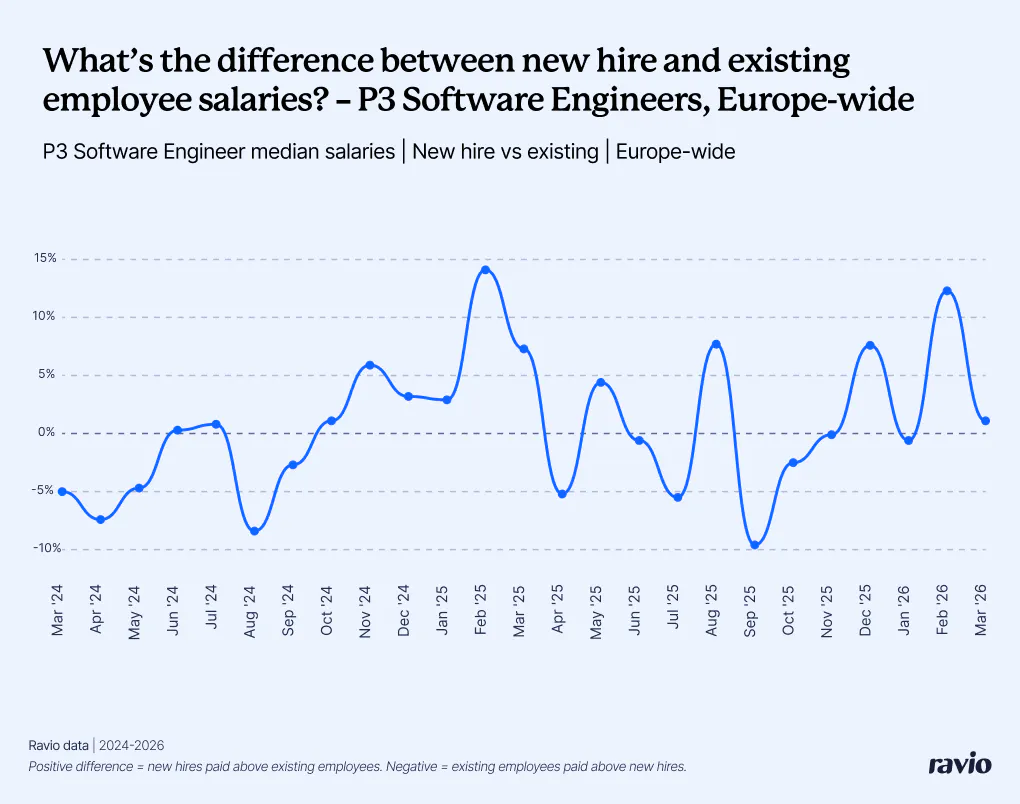
For much of the year, new hire and existing employee median salaries for P3 Software Engineers are broadly at parity, with new hires receiving slightly higher salaries – the average differential across the full dataset (January 2024-March 2026) is +0.5% in favour of new hires.
To give a couple of specific examples, take March 2025, when new hires came in just 1.8% above existing employees, or December 2025, where they’re 3.0% above.

This is to be expected, with salary compression a common issue. Companies often use more current market rates for those new hires compared to existing employees, and this combined with the role of salary negotiations pushes starting salaries higher.
However, when we look at seasonality, an interesting trend emerges.
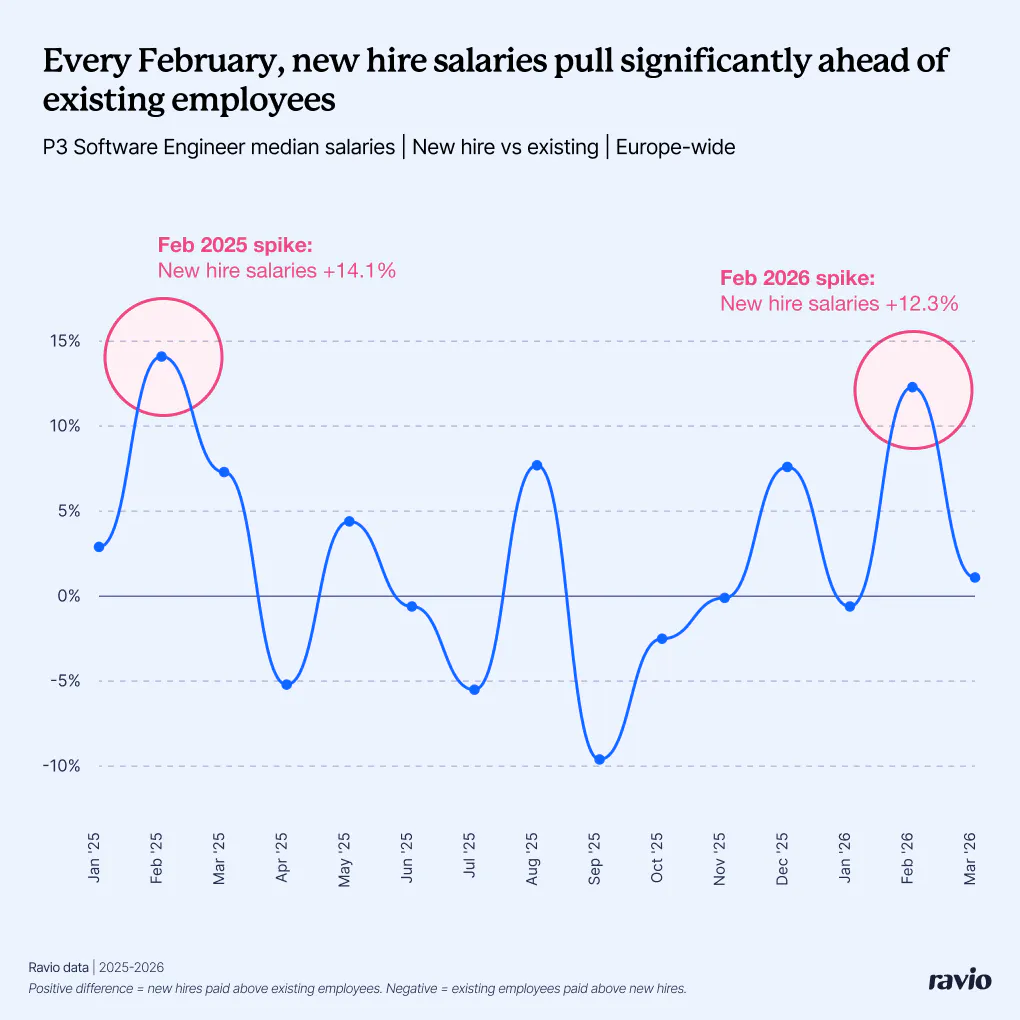
It isn't – and there’s a consistent enough pattern across two consecutive years to suggest it's structural rather than noise.
In February 2025, the median new hire salary for P3 Software Engineers spiked sharply, to 14% higher than salaries for existing employees.
In February 2026, the same spike reappeared: a 12.3% premium for new hires.
Smaller spikes are visible at other points in the data – August 2025 and December 2025 both show new hire premiums of around 7-8%. But these appear once, with no equivalent movement in the same months the following year, suggesting general market fluctuation.
February is the one that repeats – a pattern worth paying attention to.

As HR & Compensation Expert Marie Richter points out, the most likely explanation is budget cycle timing.
“This pattern aligns with what I see in the companies I work with,” she says. “January brings a wave of post-holiday resignation, and headcount approvals for the rest of the year. In combination, that creates urgency, and with urgency comes exceptions.”
Companies are left with a need to hire quickly to both backfill critical roles and bring the new headcount plans to fruition, and are paying particularly competitive starting salaries for new hires to do so.
Of course, that premium for hiring in February comes with consequences for the team you already have, creating salary compression where new hires are paid more than existing employees for performing the same role.
“Those exceptions create inconsistencies across an organisation,” says Marie. “It might seem like one small exception doesn’t matter, but over time it can compound into structural pay equity issues – and with the EU Pay Transparency Directive the ability to hide those issues is being removed.”
Under the EUPTD all job candidates will receive pay information before interview, and many member states will require salary ranges to be publicly shared in job adverts.
“Your existing employees will see those ads with a different range than their actual salary, or a higher range maximum to be able to absorb the premium paid to new hires, and they’ll start asking questions.”
When new hires are brought in on higher salaries it, of course, creates salary compression for existing employees – leading to disengaged workers and potential flight risk.
So do we see the reverse of this February spike in the data, with companies addressing the salary compression gap?
The gap does narrow – but not until several months later.
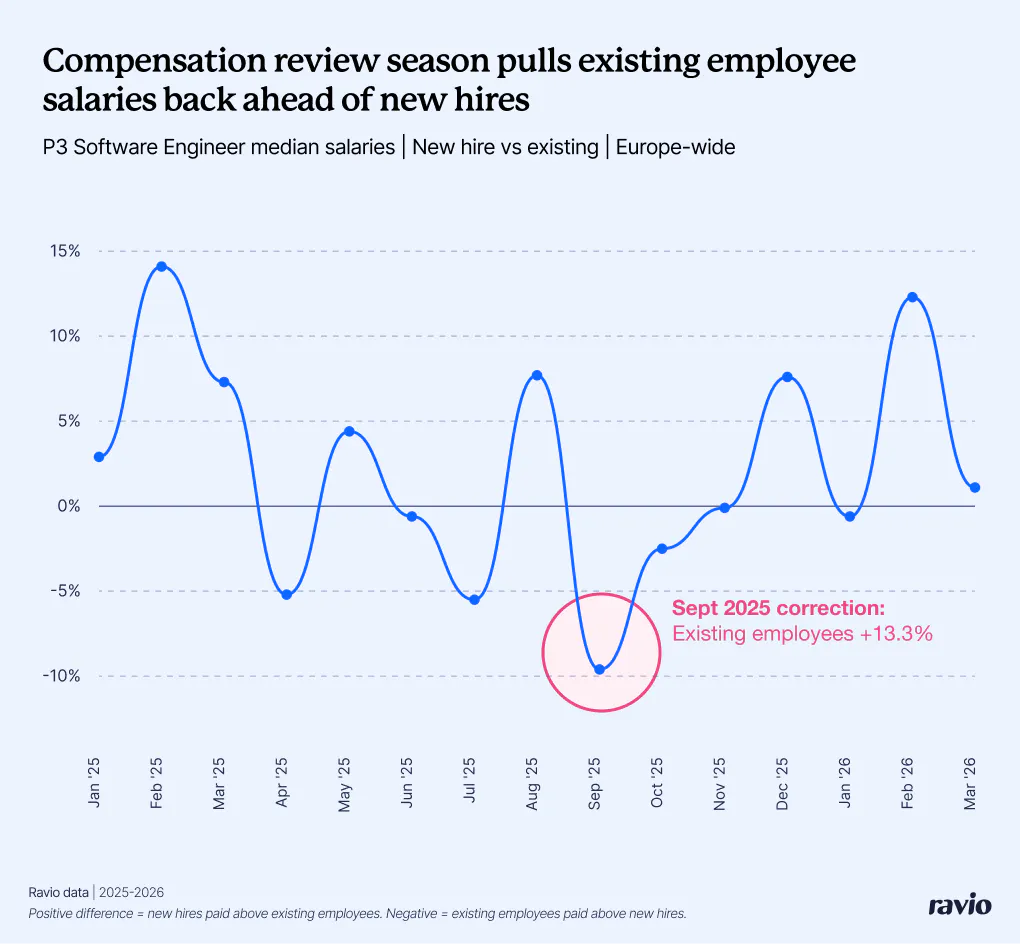
In July 2025 we see a 12.7% premium in existing employees' favour, and by September, the gap had widened further, with a 13.3% premium for existing employees.

The most likely driver is compensation review season.
Mid-year cycles taking effect from July onwards push existing employee salaries upward, as companies make market adjustments to bring them back in-line with current market rates or offer salary increases to reflect performance or progression.
At the same time as compensation reviews taking place for existing employees, the data shows new hire offer levels normalise – without the budget urgency and hiring pressure of Q1, the premium companies pay to secure candidates in February simply doesn’t seem to be there in the summer months.
So, when we look at the last 12 months as a complete cycle of new hire vs existing employee salaries, four distinct phases emerge:
What's notable is what's absent from this cycle: any proactive correction in the weeks immediately following February.
“This data matches what I see,” shares Marie. “Most companies have no mechanism to spot salary compression in real time and address it.”
“They have an annual pay review that might pick up the issue – or, even worse, it only surfaces when an employee resigns or a manager escalates flight risk. By then you’re in reactive mode, and it’s much harder to win that person back when they’re already halfway out of the door.”
In a rising market, benchmark movement can act as a forcing function for this – retention risk for great existing employees increases, and companies react by updating bands outside of the usual comp review cycle and making market adjustments for existing employees.
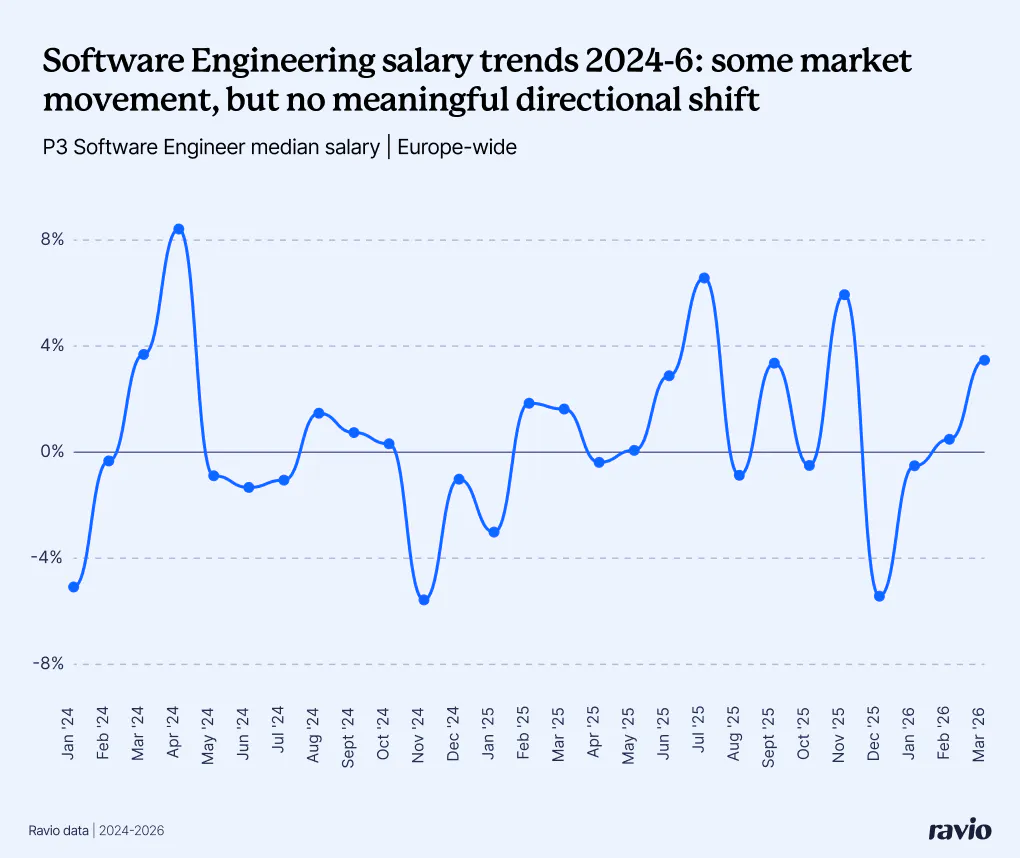
But when we look at the overall picture, P3 Software Engineering salaries have grown at just 1-2% annually over the past two years.


So there hasn’t been that market pressure prompting a mid-cycle review of existing employee pay – the gap seems to be purely down to the pressure of securing new hires at the start of the year, and the only mechanism that closes it is the comp review cycle, months later.
Marie does highlight that, again, the EU Pay Transparency Directive will change this.
“Employees will be able to formally request information on median pay by job category and gender, which means that salary compression will be made visible – with a regulatory clock forcing a response and a paper trail proving the discrepancy.”
“The Reward Leaders I work with are getting ahead of this by starting to track new hire vs existing employee compa ratios monthly."
"Cases where a new hire enters above the median of the existing population in the same band are flagged and surfaced to managers immediately, no waiting for the next cycle.”
Most companies treat salary compression as something you discover and fix.
As the data shows, the fix usually arrives too late – the gap created in February persists for months before the annual review cycle closes it, by which point compression has already had time to become a retention problem.
For Marie, the solution is to switch from a reactive approach to a proactive approach.
“Some compression is expected, but it has to be defensible and documented – especially as pay transparency legislation rolls out – which means that hoping your annual comp cycle will catch it isn’t enough,” Marie explains.
“The first action is to avoid hiring right at the top of your range – it causes compression, but it also leaves them no headroom to progress in-band over their tenure, so you either lose them, pay them above-band, or have to promote more quickly than you’d like.”
“Then, before any new hire salary offer is sent out there should be a non-optional pay equity check. Run a comparison against existing employees in the same role at the same level, and if the new hire will sit above the median of existing ‘meets or above’ performers, then it triggers an offer adjustment or a documented adjustment for the existing employee.”
Beyond new hire checks, Marie also recommends:
Ravio’s data draws directly from each organisation's HRIS, providing live intel on a company's salaries for both existing and new hire employees. Customers onboarded onto the Ravio platform have their employees mapped to our internal taxonomy, allowing for apples-to-apples comparisons across companies and markets.
The insights in this blog are drawn from our live data as new customers onboard onto the Ravio platform, with new hires defined as anyone with a start date in the past 6 months. The data reflects Europe-wide salaries, standardised into GBP.
Your monthly dose of market insights and expert perspectives

Handpicked Berlin and Ravio are unpacking five findings from the 2026 Berlin Tech Salary Survey – with European benchmark data added in real time.

AI compensation and hiring trends: 88% growth in AI hiring, 12% salary premiums, and how demand for AI skills is reshaping the tech talent market.

European tech has stabilised after years of volatility – but AI and pay transparency mean new transformation. Nico Kaml, Karam Deo, Chloe Paramatti, and Evert Kraav unpack the latest compensation trends for 2026 planning.