
Ravio updatesBenchmarking
Building a competitive package for top engineering talent
Engineering talent doesn't come cheap, and the market moves fast. Join Ravio to see how leading companies are building competitive packages that actually hold up.


Compensation decisions are often shaped by bias in hiring, promotions, performance reviews, and how different roles are valued across the organisation – creating pay gaps that are hard to spot.
And pressure is increasing to find and address those gaps.
Employees are asking harder questions about pay fairness, while the EU Pay Transparency Directive is introducing mandatory gender pay gap reporting requirements and a 5% threshold for unexplained pay gaps.
So if you're looking to investigate pay equity more closely, you’re in the right place. This guide walks through how to do that in practice, using Ravio’s pay equity software.
Effective pay equity analysis depends on clean employee data, comparable employee groups, and reliable market benchmarks.
In a previous guide, we talked about the fundamentals – what pay equity is, how to run a pay equity analysis, and how to close gaps.
In this one, we’ll walk you through how Ravio can support that process.
If employees performing comparable work are mapped inconsistently across roles, levels, or locations, your analysis can quickly produce misleading pay gaps – or hide real ones entirely.
For instance, comparing employees based only on job titles can create misleading results because titles often vary across teams and managers. A “Senior Analyst” in one department may operate at a very different level in another.
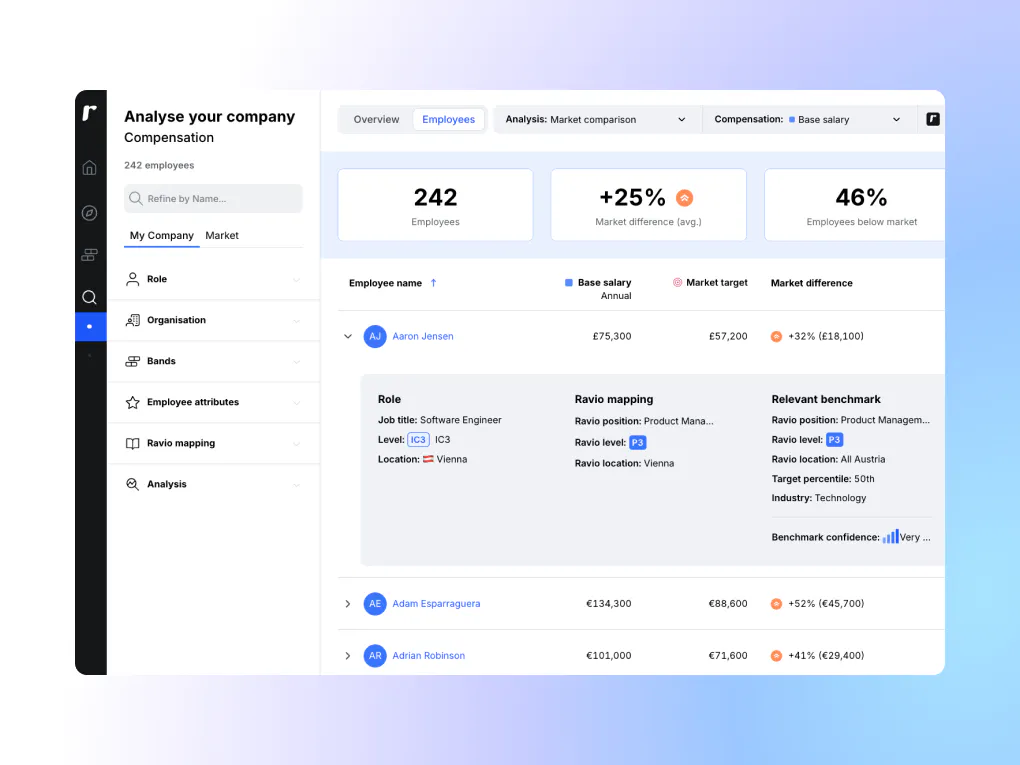
So the prerequisite here is clean, comparable compensation and employee data.
You'll need:
When you’re using Ravio, most of this data already lives there since the salary benchmarking tool is connected to your HRIS.
And, during onboarding, Ravio’s data specialists also map your internal job roles and levels to a standardised levelling framework.
The problem with doing this manually is that it almost always produces inconsistencies – different people make different mapping calls, and suddenly your analysis is comparing employees who aren't actually comparable.
With Ravio those decisions are made for you (and you can manually adjust them anytime), giving you a clear and consistent base for pay equity analysis across the organisation.
A company-wide gender pay gap figure can look reassuring while gaps in specific teams or levels or elements of total compensation go unnoticed.
So you need to be able to easily look at the broad picture, and calculate pay gaps per employee group – especially as legislation like the EU Pay Transparency Directive makes it mandatory to do so.
Ravio calculates your pay gaps for you, across those different factors.
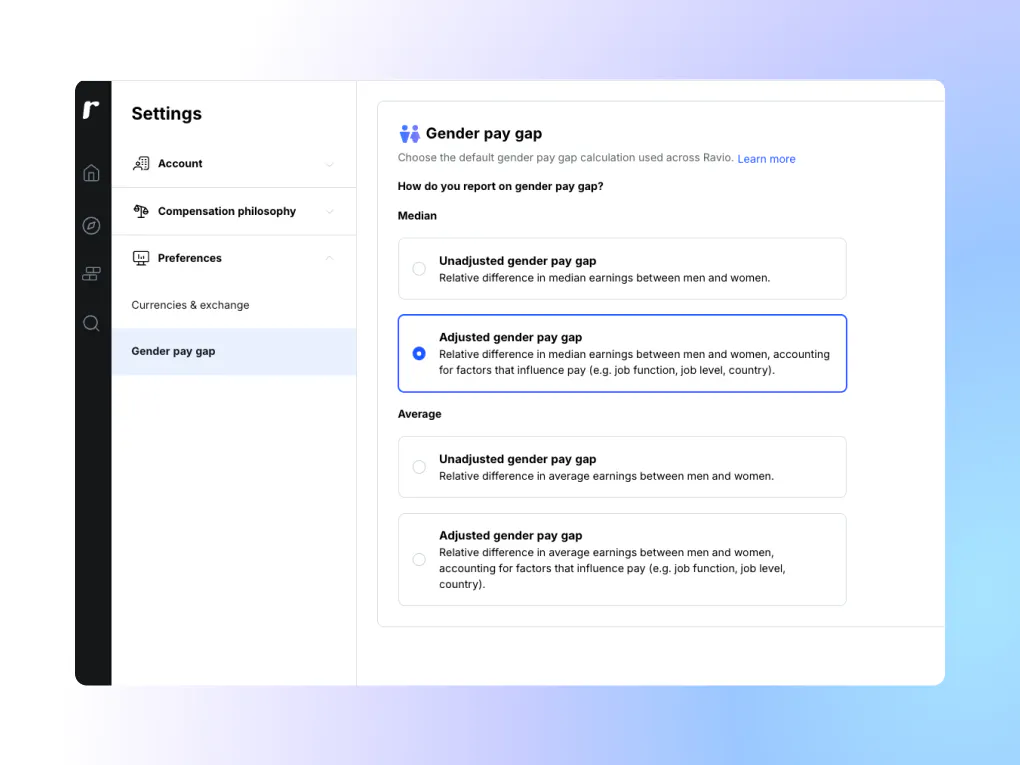
You’ll choose how you need to report pay gaps in your account settings (median vs average, adjusted vs unadjusted), and your selected calculation becomes the default view across the platform – but you can always toggle between the different options too.
From there, you can break the calculations down by the following to align with the groups of employees you need to interrogate, using filters inside the platform:
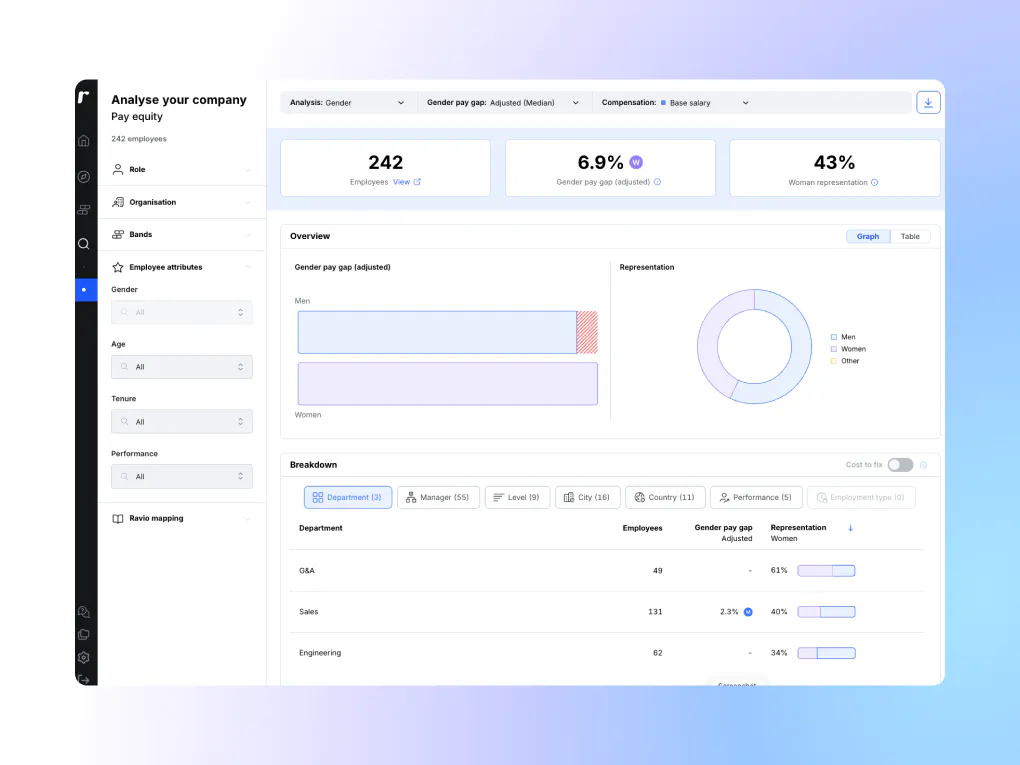
This makes it easier to compare like-for-like employee groups and identify where genuine pay gaps exist within specific cohorts rather than across broad company-wide averages.
It also enables you to control for legitimate factors that might influence pay gaps – like tenure or performance rating – to better understand where to focus attention. If a gap still exists after accounting for legitimate pay factors, it indicates an unexplained pay gap that requires further investigation.
You can also view representation data within each segment – such as 34% women and 66% men within an engineering team.
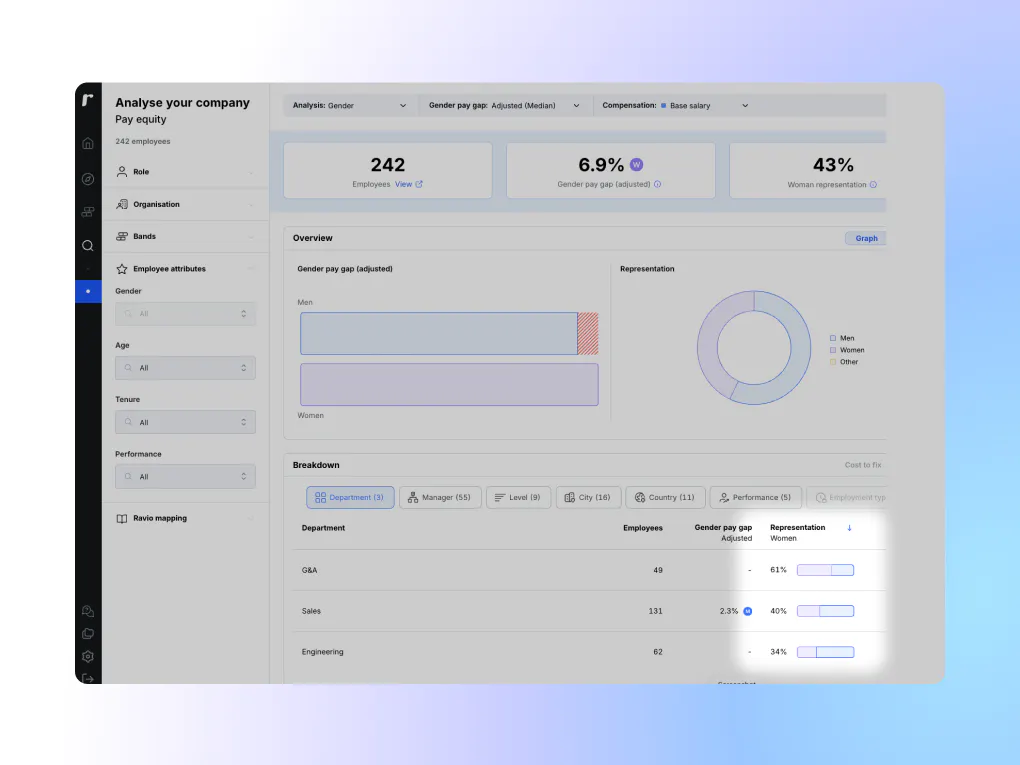
This way, you can also start to interrogate how gaps are caused, whether by unequal pay within a cohort, underrepresentation at certain levels, or both.
Most pay equity analysis happens once a year, in a dedicated audit. But pay gaps don't build that way – they compound gradually through individual hiring decisions, promotion calls, and band placements that each look reasonable in isolation.
To really keep on top of pay equity, it needs to be a visible part of daily compensation decision-making – not just an analysis run once a year.
The most practical example of this is being able to easily see the gender breakdown of your compensation bands.
Then, every time you make a decision, such as bringing on a new hire or refreshing bands before your compensation review, you can instantly see how things stand, and what impact that decision will have on pay equity.
Within Ravio’s Compensation Bands module, you can easily analyse salary band distribution by gender to identify patterns such as:
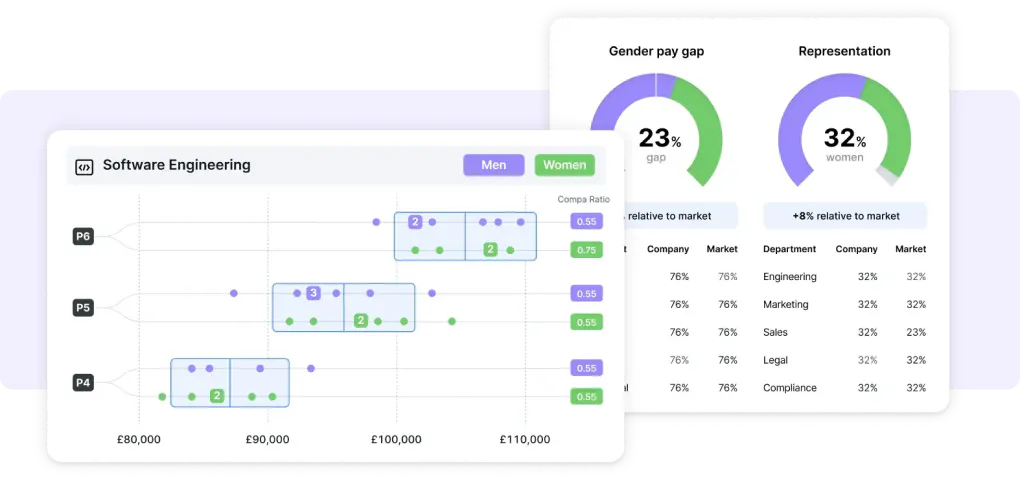
And since you can share bands with line managers in Ravio, they can also do the same – because often it isn’t the HR or Reward team making those day-to-day hiring or review decisions.
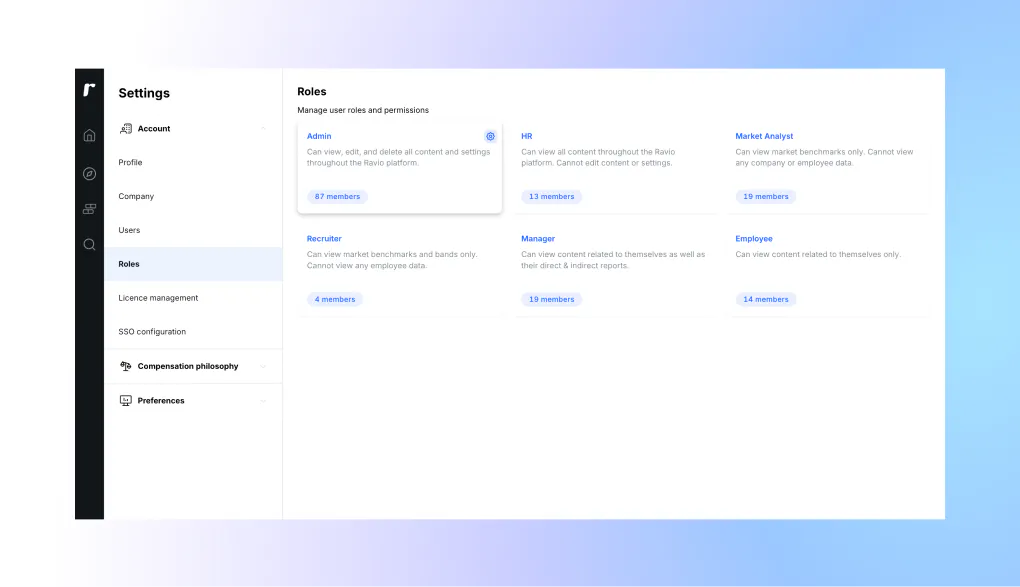
This way, your pay equity efforts aren’t limited to one-off, yearly analysis – rather, integrated into your day-to-day.
Internal pay equity analysis can only tell you so much. Without market context, a 12% gender pay gap might look alarming – or it might be consistent with what comparable companies are reporting. Without that comparison, it's hard to know where to focus, or how to frame findings to leadership.
Ravio lets you compare your internal gender pay gap figures per function against the equivalent across your hiring market – for example, against the whole of the UK tech sector.
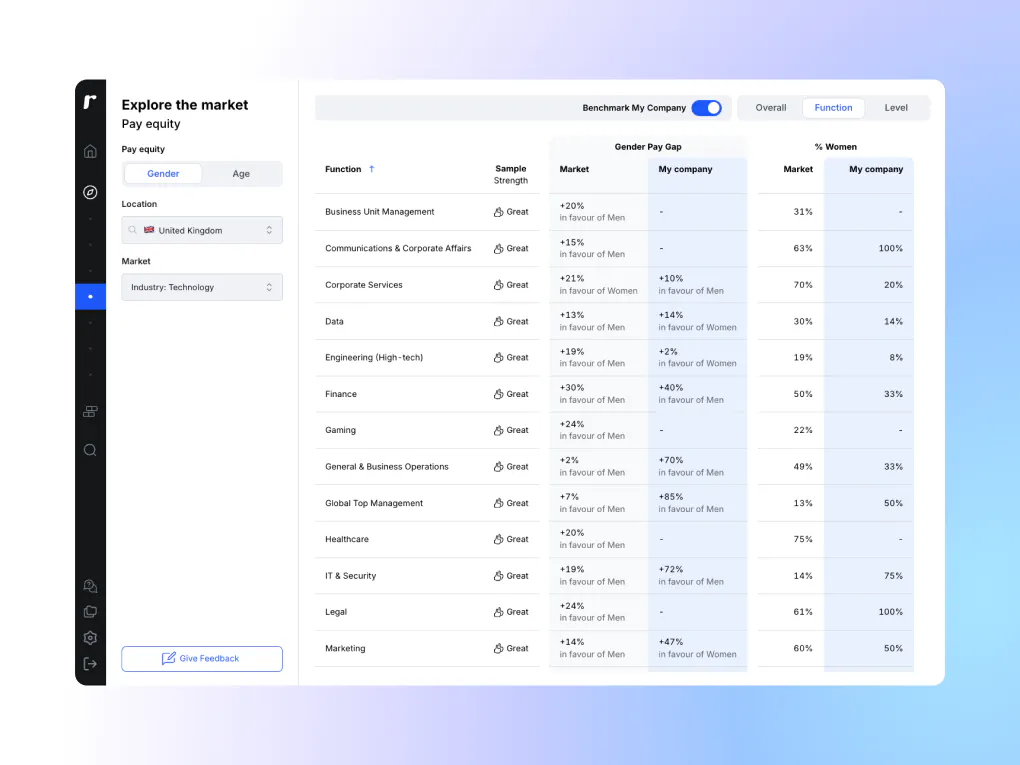
And because the underlying data comes from live HRIS integrations rather than point-in-time annual surveys, this data will always be an accurate reflection of market insights.
Finding a pay gap is one thing. Securing the budget to fix it is another.
Most pay equity work stalls not because the analysis is wrong, but because there's no clear answer to the question leadership always asks: what's this going to cost?
For each identified gap, you'll want to establish:
Ravio's scenario modelling lets you estimate the cost of closing identified gaps – overall, or broken down by employee group.
For instance, you might want to see the total cost to address gender pay gaps across your Sales team:
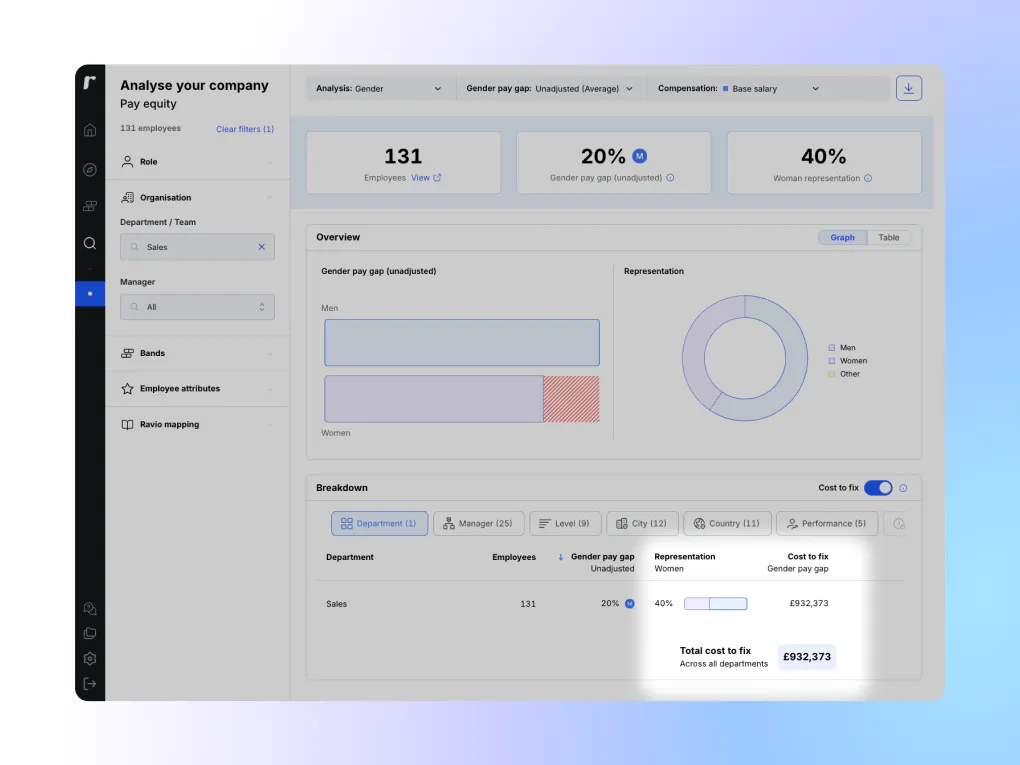
That gives you something concrete to bring into budget discussions – and the flexibility to decide whether you can address all gaps immediately, prioritise certain roles first, or phase increases over time.
Pay inequities rarely come from one isolated salary decision. More often, they build gradually across hiring, promotions, pay reviews, and salary progression over time.
That’s why pay equity analysis should never be treated as a one-time audit.
In fact, with pay transparency and gender pay gap reporting requirements becoming harder to ignore across Europe, ongoing pay equity analysis is quickly becoming part of long-term compensation strategy rather than a one-time compliance exercise.
Regularly monitor:
This way, you can surface emerging inequities before they widen into larger structural gaps.
Want to dig deeper into how Ravio helps teams analyse and monitor pay equity? Book a demo to explore how the platform could work for your organisation.
Segment employees into comparable groups by department, location, role, and seniority level before analysing compensation differences – using the average or median gender pay gap calculations. This helps identify whether pay gaps are concentrated within specific teams, hiring markets, or business functions rather than across the organisation overall.
To identify pay gaps accurately, you need clean, comparable employee and compensation data. This typically includes base salary, bonus, equity, job role and level, location, tenure, performance ratings, employment type, and protected characteristic data such as gender or ethnicity. Inconsistent job levelling or missing data can produce misleading pay gap results. A platform like Ravio ensures all of that data is accurately in one place, as well as providing tooling to support your pay equity analysis.
Market benchmarks simply reflect typical labour market rates per role, which means they can be influenced by gender inequity. Roles which were historically (or still are) seen as ‘feminine’ are often valued and paid less than traditionally ‘male’ roles. Therefore, if your compensation approach is entirely led by market benchmarks, this inequity will be baked into your decisions. Uncoupling this means evaluating each role objectively in terms of its value to the business. Employees performing roles of equal value should be paid comparably, even if market rates differ. For instance, if your job evaluation means that a P4 IT Manager and a P4 HR Manager are actually equivalent value to the business, they should receive comparable pay.
Pay gaps often emerge during hiring, promotion, or compensation review decisions. Hiring biases mean that men can often receive higher starting salaries than women, and men are also more likely to negotiate harder for an increased new hire package. Equally, biases can lead to uneven allocation of pay rises or promotion increases between men and women. Even small pay differences can compound across future salary reviews and progression cycles, so it’s important to address these structural differences.
Structured salary bands alone don’t prevent pay inequities. Gaps can still emerge through inconsistent hiring salaries, negotiation outcomes, promotion timing, bonus allocation, or where employees sit within the same pay band. Employees performing comparable work may still progress differently through the pay band over time.
Explain pay gaps using comparable employee groups, with legitimate pay variables such as tenure or performance factored in, alongside reliable compensation benchmarks. Focus on where gaps exist that cannot be explained by any justifiable factors, what may be driving them, the potential business or compliance risk, and the estimated cost of remediation. Clear visuals and cohort-level data analysis usually make pay equity findings easier to communicate – a pay equity tool like Ravio’s can help with this.
Compensation benchmarking tools improve pay equity analysis by standardising job architecture, making it easier to define and compare groups of employees, and providing current market context for compensation decisions across locations and departments. Some compensation tools (like Ravio) also offer a separate pay equity module where you can conduct pay equity analyses and reporting.
The best pay equity software depends on your needs. If you need dedicated pay equity analysis – calculating adjusted and unadjusted gender pay gaps, tracking representation, and preparing for EU Pay Transparency Directive reporting – purpose-built platforms like Ravio, Payfactors, and Syndio are worth evaluating.
If you want pay equity visibility built into everyday compensation decisions – not just a compliance exercise – Ravio goes a step further. Its salary band tool shows you where employees sit in-band by gender, so you can spot equity risks when hiring, promoting, or running pay reviews, rather than after the fact.
Broader HR suites like Workday or HiBob include basic pay gap reporting, but typically lack the analytical depth or real-time benchmarking context to act on what you find.
Your monthly dose of market insights and expert perspectives
Engineering talent doesn't come cheap, and the market moves fast. Join Ravio to see how leading companies are building competitive packages that actually hold up.

A complete guide to pay transparency in France: current law, what the EU Directive changes, how France's draft transposition bill goes further, and how to prepare for compliance.

What the EU Pay Transparency Directive requires, how each member state is implementing it, and what employers need to do to comply.

