New3x the coverage, same rigorous quality. 300 positions benchmarkedExplore

European salary benchmarking: How to find reliable data and choose the right provider

Benchmarking

Benchmarking salaries in Europe means dealing with fundamentally different pay markets – and getting it wrong is costly.

Pay in the region varies widely by country, city, and local hiring market. And relying on broad regional averages, outdated salary surveys, or modelled location differentials can quickly lead to misaligned salary bands, rejected offers, and inconsistent pay decisions across teams.

With regulations like the EU Pay Transparency Directive raising the bar for defensible and consistent pay, these gaps also create compliance risk – making compensation decisions harder to justify internally and externally.

This guide shows how to benchmark salaries accurately in Europe, including: 

  • European salary data sources to trust
  • Two ways European benchmarks are typically calculated
  • Providers offering reliable multi-country benchmarking in the region.

TL;DR – key takeaways: 

  • Reliable benchmarks reflect where you actually hire – and who you compete with. Use location-specific data from companies hiring in the same countries and cities, and similar in size, stage, and industry. Without this, benchmarks won’t reflect your actual hiring market.
  • Broad averages and survey data don’t reflect real market conditions. Europe-wide averages and global datasets flatten local differences, leading to misaligned salary bands, rejected offers, and inconsistent pay decisions across markets.
  • Location differentials are estimates, not real benchmarks. Many providers model European salaries using location differentials (e.g. applying US-to-Europe adjustments). Reliable benchmarks come from real-time data sourced from companies hiring in Europe – not blackbox modelled assumptions.

How do companies benchmark salaries in Europe?

Compensation in Europe varies widely by country and city, which makes salary benchmarking far from straightforward.

For example, a mid-level software engineer in London, Berlin, and Barcelona will have very different benchmarks, even as they’re all in the same region – reflecting differences in cost of labour and local talent demand.

Ravio benchmarks: P3 Software Engineer salaries, Europe

This is why fair European salary benchmarking depends on peer group and location relevance. That is, accurate European compensation benchmarks rely on:

  • Data from similar companies in your hiring market (size, stage, and industry)
  • Local salary data for countries and cities you hire in
  • Clear location adjustments (using defined location differentials based on comparable market data where direct sample sizes are limited).

In short, if you’re hiring across multiple European countries, you need reliable benchmarks for each location, not a single regional average.

When your data is too broad (e.g. Europe-wide averages or global surveys), it won’t reflect your hiring reality – leading to misaligned salary bands and inconsistent offers.

What data sources are used for salary benchmarking in Europe?

From free to annual subscriptions, there are several sources of European compensation data – but they vary significantly in reliability.

As we’ll cover below, benchmark reliability depends on how compensation data is collected, how well it reflects your hiring markets, and how recent it is. This is where most differences between sources come from.

With that, here are three of the most common European salary benchmarking sources:

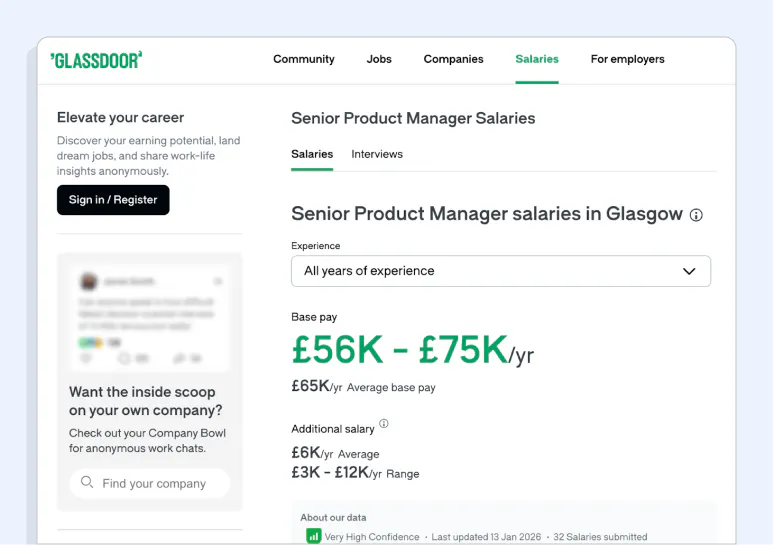
  • Free sources (e.g. LinkedIn, Glassdoor, and ChatGPT)
Free salary data sources: Glassdoor

Quick and accessible, free sources can be helpful for early research, particularly for junior roles.

However, most free salary data sources rely on self-reported data with limited verification, and offer little visibility into peer groups, role levelling, or location accuracy – reducing data reliability. 

Since AI tools like ChatGPT draw on these sources, accuracy is no better.

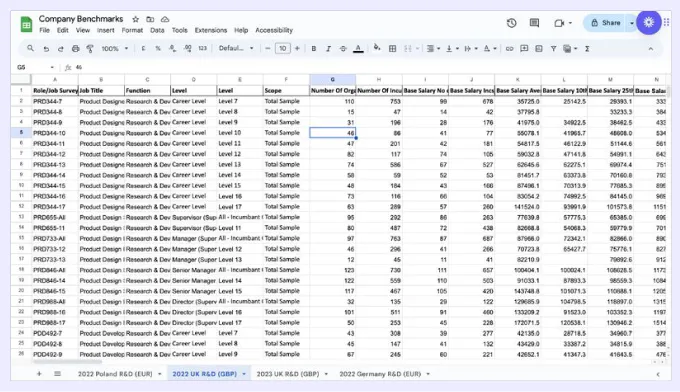
  • Traditional salary survey providers (e.g. Aon salary benchmarking)
example salary survey output

Run by HR consultancies like Mercer and Radford (Aon), salary surveys typically use a give-to-get model where companies submit their data to access pay insights.

Because data is manually submitted and usually takes months to aggregate and publish, it can be outdated and prone to reporting inconsistencies. 

And since participants are often large multinationals, the data reflects global enterprise compensation – often missing local market shifts and fast growing company dynamics.

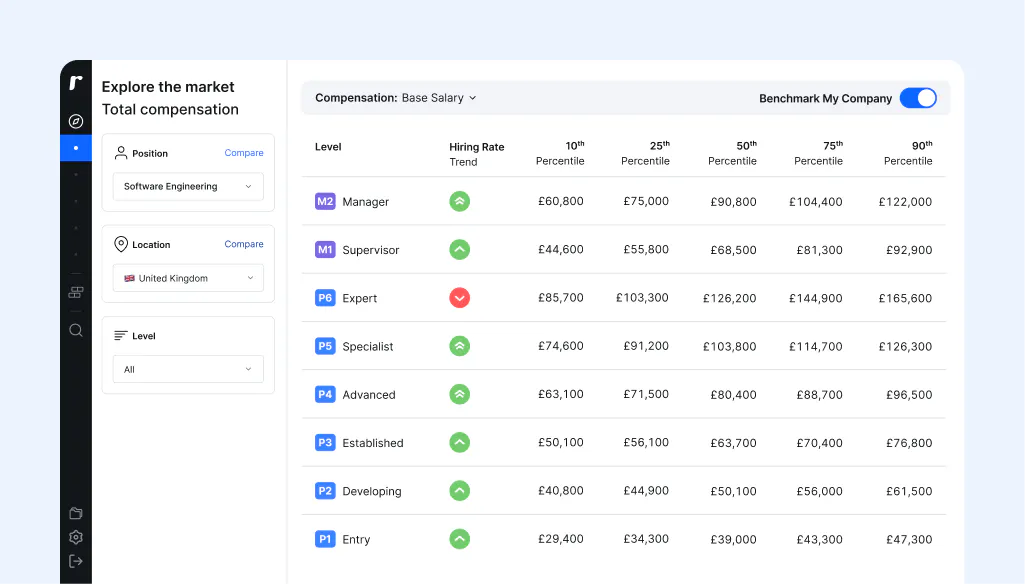
  • Real-time compensation data providers
Ravio's compensation benchmarking platform

These are platforms that pull data directly from companies’ HR systems (e.g. HRIS, ATS) and update benchmarks regularly.

Because the data is automatically sourced and updated, it’s free from reporting errors and reflects current market trends. 

However, data verification, granularity, peer group relevance, and location-specificity depend on the compensation benchmarking software provider you select.

What makes European salary benchmarks reliable enough for making pay decisions?

European salary benchmarks are reliable when they’re built from real-time, location-specific compensation data – not modelled or averaged across markets.

This comes down to three things:

1. Benchmarks are made from actual employee data in each location

The most reliable benchmarks are built from compensation data from employees in specific countries or cities you hire in. 

This ensures benchmarks reflect how roles are actually paid in those markets, rather than estimated from another region (e.g. applying US-to-Europe pay differences) – with roles and levels consistently mapped so you’re making like-for-like comparisons.

2. Sufficient, relevant data coverage in each European country 

Benchmark accuracy also depends on how much data a provider has in each location

Providers with strong European data contributors can build benchmarks from local data, while those with primarily US customers, for example, often rely more on modelled estimates due to limited European coverage. 

3. Data comes from companies you actually compete with for talent

Even with strong local coverage, benchmarks are only reliable if the data comes from companies similar to yours – in size, stage, and industry. 

Data skewed toward large enterprises or sectors irrelevant to you can misrepresent market rates and lead to inaccurate pay decisions.

This is why benchmarks differ between providers – differences in data coverage (e.g. US versus Europe) and how benchmarks are calculated (using comparable local data vs differentials derived from another market’s data) directly impact accuracy.

How do salary benchmarks account for location differences in Europe?

European salary benchmarks account for location differences in two main ways: using local market data or applying location-based adjustments (differentials):

  • Sample-based benchmarks (using local market data)

Benchmarks are built separately for each country or city using actual compensation data from employees in those locations.

Ideally, this data is pulled directly from HR systems to reduce reporting errors and keep it up to date – and comes from companies similar to yours. 

The output is distinct benchmarks per market, based on how roles are paid locally.

  • Location differentials (using market data for other locations as a baseline)

Benchmarks start from a reference market (e.g. US or UK), then apply percentage adjustments to estimate pay in other locations.

The output is derived benchmarks, where salaries are adjusted based on average differences between locations rather than directly observed data. 

Accuracy here depends on how these differentials are calculated – for example, whether they’re based on a comparable market or a broader regional baseline – and how robust that approach is (more on this below).

How to choose a European salary benchmarking provider 

Choosing a European salary benchmarking provider comes down to one question: does the data reflect how and where you actually hire?

In Europe, that means accounting for multiple countries in the region, differences in remote hiring and talent supply, and regulatory requirements – not just having “global” coverage.

Here’s what to look for:

Coverage across European markets

The provider should have strong, local data across the countries and cities you hire in the region – not just limited European data layered onto a global dataset or benchmarks estimated using location differentials.

Depth of coverage in each market matters here more than broad geographic reach. 

So make sure to look for providers that offer city-level benchmarks where relevant, not just region-wide averages. And ask what percentage of the dataset comes from European companies and how many data points exist per country or city.

Support for remote and cross-border hiring

Benchmarks should reflect where employees are based, not just company headquarters. This is especially important in Europe, where remote hiring across markets like Poland and other talent hubs is common.

For example, if your company is based in Germany but hires engineers in Poland and designers in Spain, benchmarks should reflect local salary levels in each of those markets, not a single Germany or Europe-wide rate.

Look for providers whose benchmarks reflect local hiring dynamics in each country – including differences in remote talent supply and demand – rather than applying uniform or averaged rates across regions.

Compliance with European regulations (EU Pay Transparency and GDPR)

Your benchmarks should support defensible pay decisions in line with the EU Pay Transparency Directive.

Data handling is equally important here – look for a GDPR-compliant provider with clear standards for how employee data is collected, stored, and processed, with data ideally kept within Europe. 

This reduces the risk of non-compliance, inconsistent pay decisions, and challenges during audits or pay gap reporting.

Transparent data collection, verification, and benchmarking methodology

You should be able to understand how benchmarks are built. That includes:

  • How data is collected (i.e. pulled from HR systems vs manually submitted surveys or self-reported free sources)
  • How often it’s updated (i.e. real-time or periodic releases) 
  • How data is verified (i.e. how it’s checked for duplicates, outliers, and incorrectly mapped roles)
  • How location differentials are calculated (i.e. whether they’re based on comparable markets, how data is weighted by sample size, and how robust the overall approach is)
  • How benchmarks are structured and delivered (i.e. whether you get mapped, ready-to-use benchmarks or raw data that needs manual job matching).

Without transparency here, it’s difficult to assess how much you can trust the benchmarks.

Peer group filtering and relevance

The provider should let you benchmark against companies similar to yours – by size, stage, and industry.

Without this, benchmarks can be skewed by companies you don’t compete with for talent, leading to inaccurate compensation decisions.

Ravio benchmarking: location filters

8 European salary benchmarking providers

Differences in how data is sourced, how much local coverage they have in the region, and how benchmarks are calculated mean data can vary significantly among providers.

Below are eight providers commonly used for European salary benchmarking, with a breakdown of who they’re best for, how they source data, and where their benchmarks are more or less reliable:

1. Ravio

Ravio is a real-time compensation benchmarking platform that uses HRIS integrations to automatically source up-to-date total rewards data, primarily from tech European companies.

Who is Ravio ideal for: Tech and tech-enabled high-growth companies hiring across Europe and globally. 

Pros: 

  • Real-time data collected from growing companies hiring in Europe, providing accurate and up to date European benchmarks 
  • Strong coverage in niche and emerging markets such as Estonia 
  • Differentials are used only where local data is limited, and are built from comparable European markets (not US-based baselines) using weighted data to improve benchmark accuracy
  • Data is verified by a team of data scientists to remove outliers, duplicates, and ensure consistent role mapping
  • Filtering by company size, stage, and industry to benchmark against relevant peers.

Cons

  • Tech-focused dataset makes Ravio less relevant for companies hiring primarily for non-tech roles.

How Ravio does location differentials: 

For the few locations where we've limited raw compensation data, we use differentials (calculated pay differences between countries) using weighted data we have from comparable European markets – not a single global baseline.

Here’s how it works:

  • We choose a base that has similarities with the location we’re aiming to produce a differential for. For example, when creating Switzerland benchmarks, we use Germany data due to the labour market similarities between the two.
  • We use weighed differentials. That is, differentials are weighted by sample size, so benchmarks with more data behind them carry more influence – reducing the impact of small samples and outliers to produce more reliable market benchmarks.
  • Differentials are calculated across functions and seniority levels, not in isolation, to capture patterns like steeper pay progression at senior levels and reflect them in the final benchmarks.
  • Finally, a team of data scientists reviews the derived benchmarks to ensure they align with observed trends (e.g. pay progression by level) forming a consistent and accurate view of the market.

2. Pave 

Pave is a real-time salary benchmarking platform that uses HRIS and ATS integrations with primarily US-based tech startups and enterprises to give you global compensation benchmarks.

Who is Pave ideal for: Tech organisations hiring in the US, Canada, and the UK.

Pros:

  • Real-time, up-to-date compensation data 
  • Strong data coverage in North America 
  • AI-led automated job mapping. 

Cons: 

  • Limited European benchmark coverage, with most data sourced from US and Canadian companies (67%) and only 14% from European organisations
  • European benchmarks are modelled using US-based differentials, which skews results given differences in US and European labour markets
  • Differential-based benchmarks are even less reliable in niche European markets where US companies don’t typically hire
  • Benchmarks are often limited to salary data outside North America.

3. TalentUp 

TalentUp is a salary data provider that aggregates compensation data from public surveys, job boards, and salary data shared on social platforms, publishing it as annual reports (PDF, Excel) and through its platform.

Who is TalentUp salary data ideal for: Organisations looking for high-level salary insights from public market data.

Pros: 

  • HRIS integration to let you compare internal pay with market benchmarks  (not to build a real-time dataset).

Cons:

  • Limited visibility into peer groups, role levelling, and data verification
  • Data is scraped from public sources like job boards, making reliability harder to assess
  • Limited ability to filter or customise compensation data.

4. Culpepper

Culpepper is a compensation consulting firm providing annually updated salary surveys across industries and functions, based on manually submitted employee data.

Who is Culpepper salary data ideal for: Mid-sized and large organisations looking for annual salary trends, particularly those with in-house teams that can handle manual data submission and job mapping.

Pros: 

  • Customisable survey datasets for specific regions and roles
  • Coverage across multiple industries and job functions
  • Advisory services to design and implement compensation strategies.

Cons

  • Data is manually submitted, increasing the risk of reporting inconsistencies
  • Requires in-house job mapping, adding operational overhead
  • Annual updates mean benchmarks don’t reflect current market conditions
  • Limited transparency into how data is validated and standardised with AI.

5. Hays

Hays is a specialist recruitment agency that provides annual salary reports (based on survey responses and recruiter insights) and pay benchmarking consulting services. 

Who is Hays salary data ideal for: Organisations looking for yearly salary insights and hiring trends across broad regions. 

Pros: 

  • Broad European data coverage
  • Consulting services available.

Cons: 

  • Data can be inconsistent, making it less reliable for structured, defensible benchmarking across roles and levels
  • Data is collected through annual survey submissions, which can impact accuracy and freshness
  • Limited transparency into data verification process and peer group relevance.

6. CompensationIQ

CompensationIQ is a salary benchmarking platform that combines data from a third-party partnership with Mercer, manual uploads, and publicly available salary ranges from job postings.

Who is CompensationIQ ideal for: Public sector organisations, charities, and nonprofit entities across Europe, particularly those with a strong presence in the UK.

Pros: 

  • HRIS integration to compare internal pay data with external benchmarks
  • Automated job mapping using AI
  • Customisable dashboards to track compensation metrics, trends, and gaps.

Cons: 

  • Data is sourced from multiple inputs, including self-reported publicly available and manually submitted data, which reduces data reliability for pay decisions
  • Reliance on broad, mixed data sources leads gives you limited data coverage in emerging or fast-growing European markets.

7. Radford 

Radford is a consultancy that runs quarterly and annual salary surveys, gathering compensation insights from global multinationals. 

Who is Radford best for: Large enterprises looking for global compensation data, particularly those with in-house teams to submit data and map survey outputs into their own job architecture.

Pros: 

  • Broad global dataset with European coverage
  • Established survey provider, making it easier to get stakeholder buy-in.

Cons: 

  • Data is manually submitted, increasing the risk of reporting errors and inconsistencies
  • Survey results take months to publish, so benchmarks may be outdated by the time you use them
  • Participant pool is skewed toward large enterprises, limiting coverage in niche or fast-moving tech markets in Europe (e.g. Estonia).

8. Willis Towers Watson 

Willis Towers Watson (WTW) is another consultancy-first salary benchmarks provider that offers compensation advisory services and global survey data. 

Who is WTW salary data ideal for: Large multinationals looking for multi-country benchmarking, with the internal resources to handle data submission and job mapping.

Pros

  • Broad global coverage across industries 
  • Optional compensation consulting services available.

Cons

  • Data is collected via a give-to-get survey model, increasing the risk of reporting errors and inconsistencies
  • Benchmarks are updated periodically, so data doesn’t really reflect current market conditions
  • Participant pool is primarily large multinationals, limiting relevance for niche European markets.

Make pay decisions with benchmarks grounded in European markets

European salary benchmarks aren’t just about compensation data – they’re about using the right data for where you hire, from companies hiring in the same markets.

Reliable European compensation benchmarks come down to three things, it’s: 

  • Built from real, location-specific data 
  • Sourced from companies you actually compete with for talent
  • Backed by robust methodologies for calculating differentials (where needed) and verifying data.

When these are missing, benchmarks become harder to trust and compensation decisions become harder to defend.

If you’re hiring across multiple European markets, the goal isn’t to find a single average. It’s to build a clear, reliable view of how roles are paid in each location you operate in – so your pay decisions are fair, competitive, and compliant.

Ravio helps you do exactly that, with real-time benchmarks built from companies hiring across Europe.

Try 3 free European salary benchmarks with Ravio

FAQs 

What is European salary benchmarking

European salary benchmarking is the process of comparing your internal compensation against companies in the same locations and hiring markets to ensure your pay reflects local market conditions. Use location-specific benchmarks sourced from companies hiring in Europe, relevant peer groups, and consistent role mapping to set accurate, defensible salary benchmarks across countries.

What alternatives to Mercer exist in Europe?

Alternatives to Mercer in Europe include real-time compensation benchmarking platforms that offer more frequently updated, location-specific data. Unlike traditional surveys, these tools use HR system integrations to provide up-to-date compensation for startups and tech companies hiring across multiple European markets.

Which tools have the best European salary data?

The best tools for European salary data are those with strong, local coverage across multiple countries and cities in the region, using real compensation data rather than differential estimates. Look for platforms with European customer bases, frequent data updates, and robust methodologies for data verification and location differentials, as these provide more accurate and relevant benchmarks for hiring decisions.

What is the best way to benchmark salaries for a tech startup in Europe?

The best way is to use real-time, location-specific benchmarks from companies similar in size, stage, and industry. Tech startups should prioritise tools with strong European coverage, accurate role mapping, and data from relevant peers, rather than relying on global surveys or broad averages that don’t reflect local hiring markets. Here’s more on finding and evaluating reliable tech salary benchmarks

Which compensation benchmarking tools cover multiple European countries?

Tools like Ravio cover multiple European countries by providing real-time, local compensation data in each market, with consistent role mapping for accurate comparisons across job roles and levels. This saves you from relying on estimates or market-irrelevant location differentials, and reflects differences in remote hiring and talent supply by using data from companies actually hiring in each market.

Which compensation benchmarking platforms cover European startups?

Platforms like Ravio cover European startups with real-time data from early-stage and growth companies, collected via HRIS integrations. Ravio also has a team of data scientists who verify and map this data into comparable benchmarks, and offers filters by company size, stage, and industry – helping you benchmark against relevant peers rather than enterprise-heavy datasets.

How do companies benchmark salaries for remote roles across Europe?

Companies benchmark remote roles by using location-specific data based on where employees are actually based, not company headquarters. This involves applying country- or city-level benchmarks for each location, ensuring salaries reflect local market conditions rather than using a single Europe-wide or HQ-based pay range.

Get the Compensation Review straight to your inbox

Your monthly dose of market insights and expert perspectives

You might also like