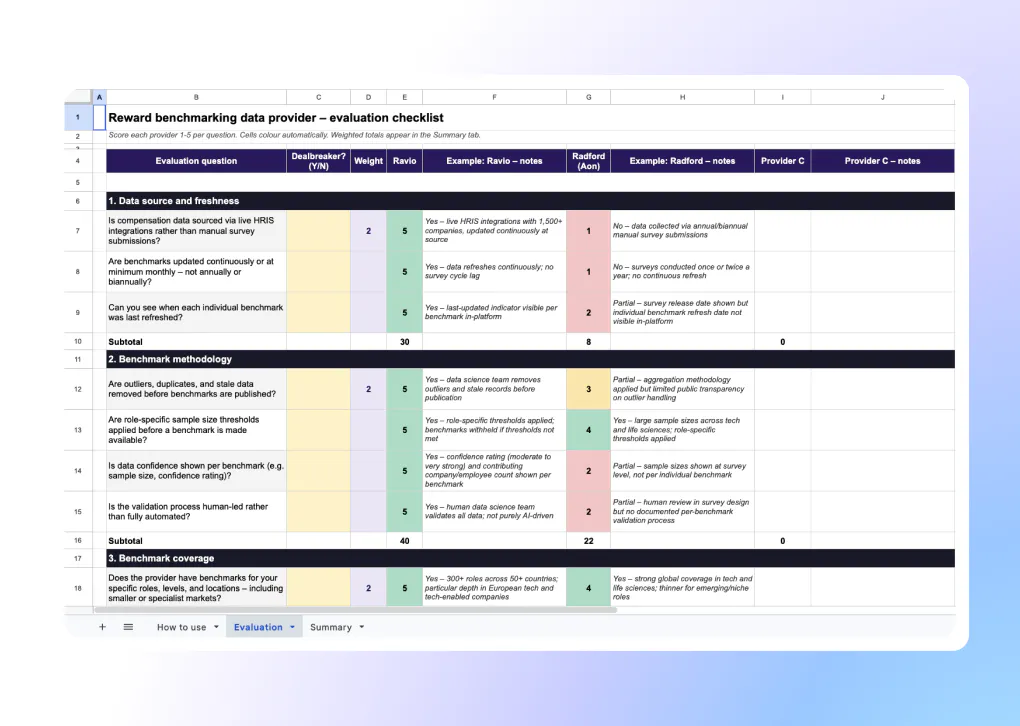
What to look for in a reward benchmarking data provider
When you’re looking for reward data, the natural starting place is coverage. Do you have benchmarks for my roles? Which parts of total reward do you cover? Do you have my locations?
Those are vital questions to ask – but they're not sufficient on their own.
A reward database can have broad coverage and still produce benchmarks you can't defend, because the underlying data is outdated, the peer group is wrong, or your roles have been mapped loosely against a job catalogue that doesn't reflect how your organisation is structured.
Claudia Korenko, People Experience Specialist at Sastrify, experienced this first-hand.
After investing time and budget in a reward data provider that seemed credible, her team ran their first compensation review of the year and the benchmarks didn't hold up.
"The benchmarks appeared inflated for key roles across product, customer success, and sales, particularly in Germany and Spain," she explains. "At some point we completely lost trust in the data and we were paying for a benchmarking tool we couldn't use."
The six criteria below are designed to surface those gaps before you commit:
- Data source and freshness – where does the reward data actually come from?
- Benchmark methodology – how is raw reward data turned into something usable?
- Benchmark coverage – does the reward database reflect your roles, locations, and peer group, and full reward package?
- Job mapping – how are your roles aligned to the reward database?
- Usability and workflow integration – can your team actually use it?
Let’s take a closer look at each.
1. Data source and freshness – where does the reward data actually come from?
The most important question to ask any provider is deceptively simple: how is your data collected?
There are two main approaches.
Traditional salary survey providers ask companies to manually submit compensation data, typically once or twice a year. That data is then aggregated and sold back as benchmarks.
Real-time benchmarking platforms typically integrate directly with companies' HR Information Systems (HRIS), pulling compensation data continuously from the source.
Manual submissions introduce room for human error – roles get miscategorised, levels get mismatched, submissions are rushed to meet a deadline. And by the time data collected in January reaches you as a published benchmark, it may already be six to twelve months old.
For Reward teams operating in fast-moving hiring markets, that lag is a real problem. A benchmark built on last year's data doesn't tell you what you're competing against today.
Evaluation questions:
- Is data collected via live HRIS integrations or manual survey submissions?
- How frequently is the underlying data updated – and what triggers that update?
- Can we see when the data was last updated?
- How is data stored? What data security and privacy measures are in place?
2. Benchmark methodology – how is raw reward data turned into something usable?
A large dataset is not the same as a reliable one.
Raw compensation data – even when sourced directly from HRIS systems – contains noise: outliers, duplicate entries, stale records, and roles that have been mapped inconsistently across companies.
What separates a benchmark you can defend from one you can't is what happens to that data before it reaches you as a benchmark.
The questions to ask here are about validation and methodology: how are outliers identified and removed? What methodology do you use for converting data into benchmarks? What sample size is required before a benchmark is published? Are confidence levels visible per benchmark, so you can see how much weight to place on a given figure?
Some providers publish benchmarks for roles where the underlying sample is too thin to be statistically meaningful. Others model benchmarks using machine learning where data is sparse – which can be valid if the methodology is robust, but can also produce plausible-looking figures that aren't grounded in real market data for that role, level, and location.
Claudia's experience at Sastrify is a useful reminder of what this costs in practice. When the benchmarks her team was using turned out to be inflated, it wasn't just a data quality issue – it was a trust issue. "We felt we could not provide reliable benchmarks that showed we were paying fairly."
Evaluation questions:
- How are outliers, duplicates, and stale data handled before benchmarks are published?
- Is the benchmarking methodology explained transparently?
- What sample size is required before a benchmark is made available?
- Is data confidence shown per benchmark?
- Where sample size thresholds aren't met, are benchmarks withheld or modelled?
3. Benchmark coverage – does the reward database reflect your roles, locations, and peer group?
Coverage is where provider claims tend to be broadest and least useful. ‘500,000 data points tells you very little about whether the benchmarks are reliable for a P4 Product Manager in Amsterdam, or the 90th percentile for a Senior Data Engineer in Warsaw.
There are four dimensions to evaluate:
- Role and level granularity. Does the provider have benchmarks for the specific roles and levels in your organisation – including specialist or emerging roles? A dataset built primarily from large legacy enterprises may not have meaningful data for the tech, product, and engineering roles that are hardest to price.
- Geographic depth. Coverage at the country level doesn't guarantee coverage at the city level, or meaningful data in smaller markets. Ask whether the provider can cover Estonia and India, or whether they can tell you the difference between salaries in Berlin and Munich – and whether they have local data or are applying a location differential from a broader regional average.
- Peer group relevance. This is often the most significant gap. A benchmark that blends Series A startups, mid-market tech companies, and FTSE 100 enterprises into a single average tells you very little about what your specific peer group is paying. Maartje Koopman, Head of People and Culture at Tiqets, found this directly: "It was very difficult for us to compare ourselves with the right sectors, organisations, and competitors as we are a digital tech scale-up. We have so many developer positions – like different engineering types and product roles – so we needed to look for more digital tech scaleups, versus large corporate organisations."
- Reward scope. Base salary benchmarks are the floor, not the ceiling. If your packages include equity, variable pay, or benefits, you need a reward database that covers those components too. Many providers don't – Figures, for example, covers base salary and variable pay but not equity or benefits. Pave does cover equity, but not in most locations in Europe, due to their USA focus.
Evaluation questions:
- Does the provider have benchmarks for your specific roles, levels, and locations – including smaller or specialist markets?
- Can you filter by industry, funding stage, headcount, or company size to get a relevant peer group?
- Are benchmarks built from local data, or derived from regional averages and location multipliers? If the latter, can they transparently explain their approach?
- Does the reward database include benchmarks for equity (new hire grants, vesting schedules), variable pay (OTE, bonus), and benefits benchmarks?
- Are those components covered across the same geographies as base salary, or does coverage drop outside core markets?
- Can you view total compensation benchmarks – base plus variable plus equity – in one place?
4. Job mapping – how are your roles aligned to the reward database?
Even excellent benchmark data becomes unreliable if your roles aren't mapped accurately to it. If a "Senior Engineer" at your company is benchmarked against "Principal Engineer" data because job titles were matched loosely, the resulting figures will mislead rather than inform.
This is one of the most underestimated risks in reward benchmarking.
Traditional survey providers typically give you a large job catalogue – Radford's technology survey alone covers 899 role titles – and leave the mapping to you. Matching your internal framework to that catalogue manually, across every role in your organisation, introduces significant scope for error.
As Evert Kraav, Senior Compensation Manager at Bolt, puts it: "Because most providers also have their own job levelling and job families structure, it's a huge effort to then convert ours to theirs. It requires keeping up with all the changes they might have implemented during a year."
Some modern providers do the job mapping for you to ensure more accurate benchmarking – some using a human team, other using an AI automation. The latter introduces its own risk – AI-powered matching has no human oversight to catch edge cases, hybrid roles, or roles where the title doesn't reflect the actual scope of work.
Evaluation questions:
- Who is responsible for mapping your roles to the provider's framework – you or the provider?
- Is there a correlation table or equivalent showing exactly how your internal levels align to the benchmark dataset?
- How are niche, hybrid, or emerging roles handled?
- Can you review and adjust mappings if something looks wrong?
5. Usability and workflow integration – can your team actually use it?
Reliable reward data that sits in a spreadsheet or a PDF report has limited value. The question is whether benchmarks can be accessed by the people who need them, at the moment they need them, in a format they can use.
For most companies this means a combination of the Reward or HR team owning the compensation planning and management, the talent team checking benchmarks at the point of offer, and the line managers reviewing their team's pay.
Each use case has different requirements – and a platform that only works for one of them creates gaps elsewhere.
User permissions, the ability to share benchmarks outside the platform, and integration with the HRIS your team already uses all affect how much of the value from your reward database your organisation can actually access.
Beyond access, consider whether the platform includes the compensation tools you'll need to act on the benchmarks – salary bands, pay equity analysis, compensation review workflows. Getting those from a different tool, or building them manually in spreadsheets, adds cost and reduces the integrity of the process.
Evaluation questions:
- Does the rewards data come in a platform that enables multiple users to access it?
- Can you control who sees what – managers, HRBPs, employees?
- Does the platform integrate with your HRIS, so internal and market data are in one place?
- Does it include compensation tools built on top of the benchmarks that support your processes – salary bands, pay equity analysis, compensation reviews?
- What does onboarding look like, and what ongoing support is available?