Market trendsBenchmarking
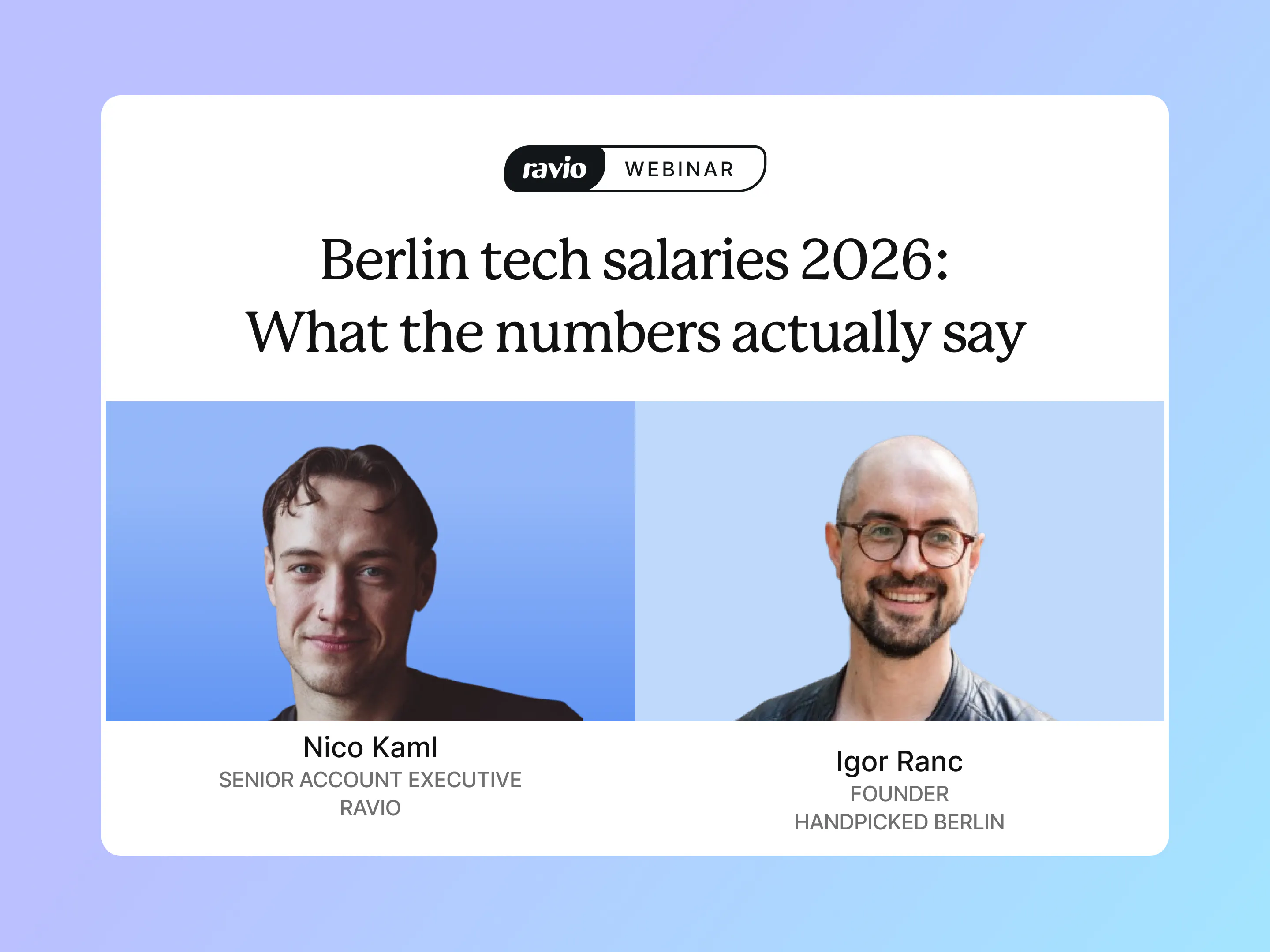
On-demand webinar: Berlin tech salaries 2026 – What the numbers actually say
Handpicked Berlin and Ravio are unpacking five findings from the 2026 Berlin Tech Salary Survey – with European benchmark data added in real time.


Getting executive bonuses wrong is expensive in both directions.
Underweight variable pay for a Sales leader and you'll lose them to a competitor's package that leads with commission. Overweight it for an Engineering or Product leader and you've built an incentive structure that doesn't match how the role actually creates value.
The problem is that the bonus doesn't get benchmarked with anything like the rigour of base salary.
Most Reward leaders can quote a competitive base salary for any function on demand – ask what a "normal" bonus looks like for a VP of Engineering versus a VP of Sales, and the answer gets vague fast.
Together with Erevena, we surveyed over 1,000 executives across European tech to fix that.
Here's what the data on executive bonus plans shows.
69% of executives receive a bonus as part of their compensation package (Ravio Executive Salary Survey 2026) – and it's more common at C-level than VP.
At VP level (E1 in the Ravio level framework), bonus size as a percentage of base salary ranges from 24% to 100% – depending on function.
Function | VP (E1) bonus size as a % of base salary |
|---|---|
Sales | 100% |
Marketing | 37% |
People | 34% |
Product | 29% |
Finance | 25% |
Engineering | 24% |
Sales stands apart from every other function at VP level, with bonuses at 100% of base salary – typically reflecting an equal 50:50 split between fixed and variable, rather than variable on top of base. This is expected given the incentive structure in Sales.
To give a example: P75 base salary for a Sales VP in European tech is £214,580.
So a 100% bonus takes total cash compensation to roughly £429,160 – base and bonus in equal measure.
In every other function, VP bonus sits in a much tighter band, between roughly a quarter and a third of base salary, so total cash stays far closer to base alone.
At C-suite level (E3 in the Ravio level framework), bonus size as a percentage of base salary ranges from 30% to 100%, depending on function.
Function | C-level (E3) bonus size as a % of base salary |
|---|---|
Global top management (CEO) | 50% |
Sales | 100% |
Marketing | 40% |
People | 33% |
Product | 39% |
Finance | 50% |
Compare this to the VP table, and it’s a similar picture – Sales remains the standout, and other functions have a lower bonus proportion, though of course the actual bonus value will increase as base salary increases.
Take CEO as an example: P75 CEO base salary in European tech is £282,500, so a 50% bonus adds roughly £141,250 – taking total cash compensation to around £423,750.
Finance is the one function where the jump in seniority genuinely changes the number – doubling from 25% at VP to 50% at C-level.
That reflects the material expansion of the role itself: the CFO takes on M&A, fundraising, commercial strategy, and board engagement, responsibilities a VP Finance simply doesn't carry.
What does shift with seniority, even where bonus size doesn't, is what the bonus is measured against:
Seniority changes what you're accountable for more than how much is at stake.

Metrics get more formalised and less discretionary as a company matures.
Rob Green, Founder of Darwin Total Rewards, has seen this shift play out repeatedly between private and listed companies: "In the private world there is more of a discretionary element. At a listed company the measurement becomes much more defined and focused – more KPI-driven, more tied to company-wide performance rather than individual judgement calls."
Common measures at more mature companies include revenue growth, EBITDA, operating margin, and earnings per share, increasingly alongside non-financial metrics like ESG.
As Rob puts it, "the metrics themselves become more complex but more generic" – more structured, and more tied to outcomes the whole company can see, rather than judgement calls made behind closed doors.
This formalisation also comes with governance attached.
Malus and clawback provisions – allowing a company to reduce or recover a bonus before or after payout, typically triggered by misconduct, regulatory enforcement, or a financial restatement – become standard practice once bonus structures reach this level of scrutiny, and should be built into design from the outset.
“Bonus KPIs get more complex as a company scales, but also less generic – because there’s less discretion involved.”

Rob Green
Founder of Darwin Total Rewards
Bonus prevalence and sizing are more standardised by function than by seniority – so the real design question isn't "how big should the bonus be at each level," it's which target type fits the level: individual accountability for a VP, company-wide accountability for the C-suite.
Of course, it’s also important to think about how the bonus sits within the entire executive compensation package – some companies might be more focused on bonus, others equity, and others guaranteed base salary.
As Figen Zaim, Founder of Olivier Reward Consulting, puts it: "Aim for a holistic package that isn't overreliant on one element."
An executive bonus plan is a performance-based variable pay structure for C-level and senior leadership roles, typically paid annually against individual or company-wide targets. According to Ravio and Erevena's 2026 survey, 69% of executives receive a performance-based bonus.
It depends heavily on function. Ravio's data shows Sales executives receive the largest bonuses, at 100% of base salary for both VP and C-level roles. Other functions cluster much lower – Engineering at 24-30% of base, People at 33-34%, and Marketing at 37-40%, with Finance the exception, doubling from 25% at VP to 50% at C-level.
69% of executives receive a bonus as part of their compensation package, according to Ravio and Erevena's 2026 survey, and it's more common at C-level than VP level.
Bonus size as a percentage of base salary barely changes between VP and C-level for most functions, even as base salary itself increases significantly with seniority, according to Ravio and Erevena's 2026 survey. What does change is what the bonus is tied to – 40% of VP bonuses are tied to individual targets versus just 8% at C-level, where 55% are tied to company-wide targets instead.
Ravio's 2026 European Executive Salary Survey, produced with Erevena, provides bonus prevalence and sizing data across CEO, Sales, Marketing, Engineering, and Finance leadership roles, cut by seniority level. Ravio's platform also provides executive variable compensation benchmarking data across a wider role catalogue.
Your monthly dose of market insights and expert perspectives
Handpicked Berlin and Ravio are unpacking five findings from the 2026 Berlin Tech Salary Survey – with European benchmark data added in real time.

AI compensation and hiring trends: 88% growth in AI hiring, 12% salary premiums, and how demand for AI skills is reshaping the tech talent market.

European tech has stabilised after years of volatility – but AI and pay transparency mean new transformation. Nico Kaml, Karam Deo, Chloe Paramatti, and Evert Kraav unpack the latest compensation trends for 2026 planning.

