CEO salaries: What does ‘competitive’ look like in European tech?

BenchmarkingMarket trends

Setting a CEO's salary is unlike setting anyone else's.

In a startup, it’s usually a founder setting their own pay, weighing personal financial need against investor pressure to preserve runway – usually entirely bespoke, without the same structured, data-driven approach to salary-setting that every other role receives.

At a listed company, the opposite problem: too much process, too many stakeholders, and a decision made under public scrutiny due to reporting requirements. 

Both situations end up asking the same question: what's actually competitive here?

And CEO benchmarking data isn’t always much help either – there’s only one CEO per company, and the packages vary hugely. Job ads, newspaper pay-ratio headlines, and industry salary guides all show wildly different figures.

What you need instead is a dataset you're confident reflects the reality of organisations like yours – to give you a baseline.

And then, as Michelle Coventry, VP of Talent at Creandum, puts it: "Use comp data as a compass, not a GPS” – the specifics of your unique company, your stage, and your priorities are what get you to the actual number.

If the dataset you need is CEOs in European tech, this one’s for you – let’s take a look at what the data shows.

What is the average CEO salary in European tech?

P75 CEO base salary across European tech sits at £282,500 overall (Ravio & Erevena Executive Salary Survey 2026). 

That's the 75th percentile of the market – a market-leading position, where 75% of companies pay below this level and 25% pay above it, representing ‘competitive’ here.

This is the overall figure, but CEO pay varies considerably depending on the company. 

Company revenue is one of the strongest predictors of CEO pay, so let’s break it down.

How do CEO salaries change with company revenue?

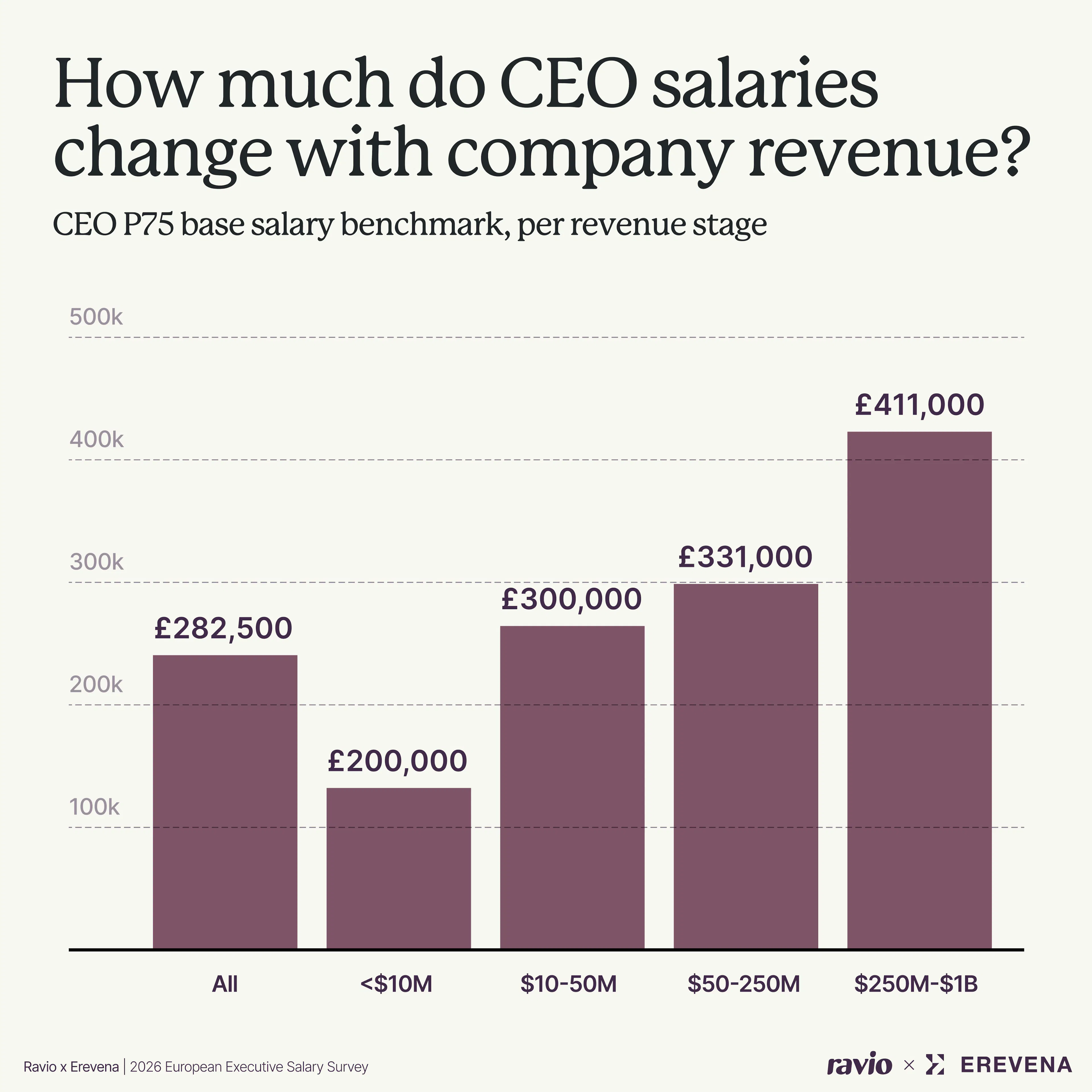
P75 CEO base salary rises steadily with revenue – from £200,000 at under $10 million ARR to £411,000 at $250 million-$1 billion ARR, a 106% increase (Ravio & Erevena Executive Salary Survey 2026).

Annual revenue 

CEO salary (P75, European tech)

All 

£282,500

Under $10m

£200,000

$10-50m

£300,000

$50-250m

£331,000

$250m-$1bn

£411,000

The sharpest single jump comes at the $250 million revenue mark, where P75 CEO pay increases by 24% – from £300,000 ($50-250m annual revenue) to £411,000 ($250-$1bn).

This is likely because there’s a more significant change in scope for the CEO role at this point in a company’s trajectory. By this scale, the CEO is managing through a full leadership team rather than leading functions directly, and board and investor accountability intensifies significantly.

CEO salaries per revenue stage – Ravio data

Whilst revenue stage is a vital factor in competitive CEO salary, it’s also often where benchmarking for CEO salaries goes wrong. 

As Marie Josife, Partner at Erevena, put it during our breakfast panel to launch the 2026 Ravio x Erevena European Executive Salary Survey report: "Too many companies think about the business they're going to become in the long-distant future when they're hiring for their leadership teams, instead of the business that's actually in front of them for the next chapter." 

Benchmark your CEO against the business you'll be in three years from now, and you'll consistently overpay or underscope the hire for the stage you're actually at today.

"Too many companies think about the business they're going to become in the distant future when hiring for their leadership team, instead of the business that's actually in front of them."

Marie Josife, Partner at Erevena

Marie Josife

Partner at Erevena

How does CEO salary vary by location?

Another important factor in determining what a competitive CEO salary looks like is location – a CEO in the UK is paid very differently from other locations in Europe.

In fact, UK CEOs earn more than their rest-of-Europe counterparts at every revenue stage – £300,000 overall against £264,370 (Ravio & Erevena Executive Salary Survey 2026). 

If we combine the two factors together – annual revenue and location – further nuance arises.

UK CEO salaries are particularly higher than the rest of Europe at the earliest stage (48% higher in the UK, under $10 million ARR) – likely because in the early stages, a UK startup will be hiring leadership talent locally (likely in London), and the UK talent market is generally more competitive than elsewhere in Europe.

The gap between the UK and the rest of Europe narrows through the mid-range of annual revenue, when companies may be hiring for executive talent across multiple locations in Europe, and then widens again to 42% at $250 million-$1 billion ARR. At this stage, UK companies increasingly compete with US firms for CEO talent – a market where salaries typically run 30-50% higher again, per Erevena's placement experience.

Typical CEO pay: UK and Europe per revenue stage – Ravio data

How does bonus and equity factor into total CEO compensation?

Base salary is only the starting point.

Most CEOs also receive a bonus and equity – overall 69% of executives receive a bonus, and 75% an equity award – and both can shift the total package considerably beyond the base salary figure above.

The typical bonus for a CEO bonus size is 50% of base salary (Ravio & Erevena Executive Salary Survey 2026). 

If we apply that to the overall typical P75 CEO base salary of £282,500, that's a bonus of roughly £141,250 – taking total cash compensation to around £423,750.

Executive bonus structures – Ravio data

Equity adds a further, less predictable layer on top. 

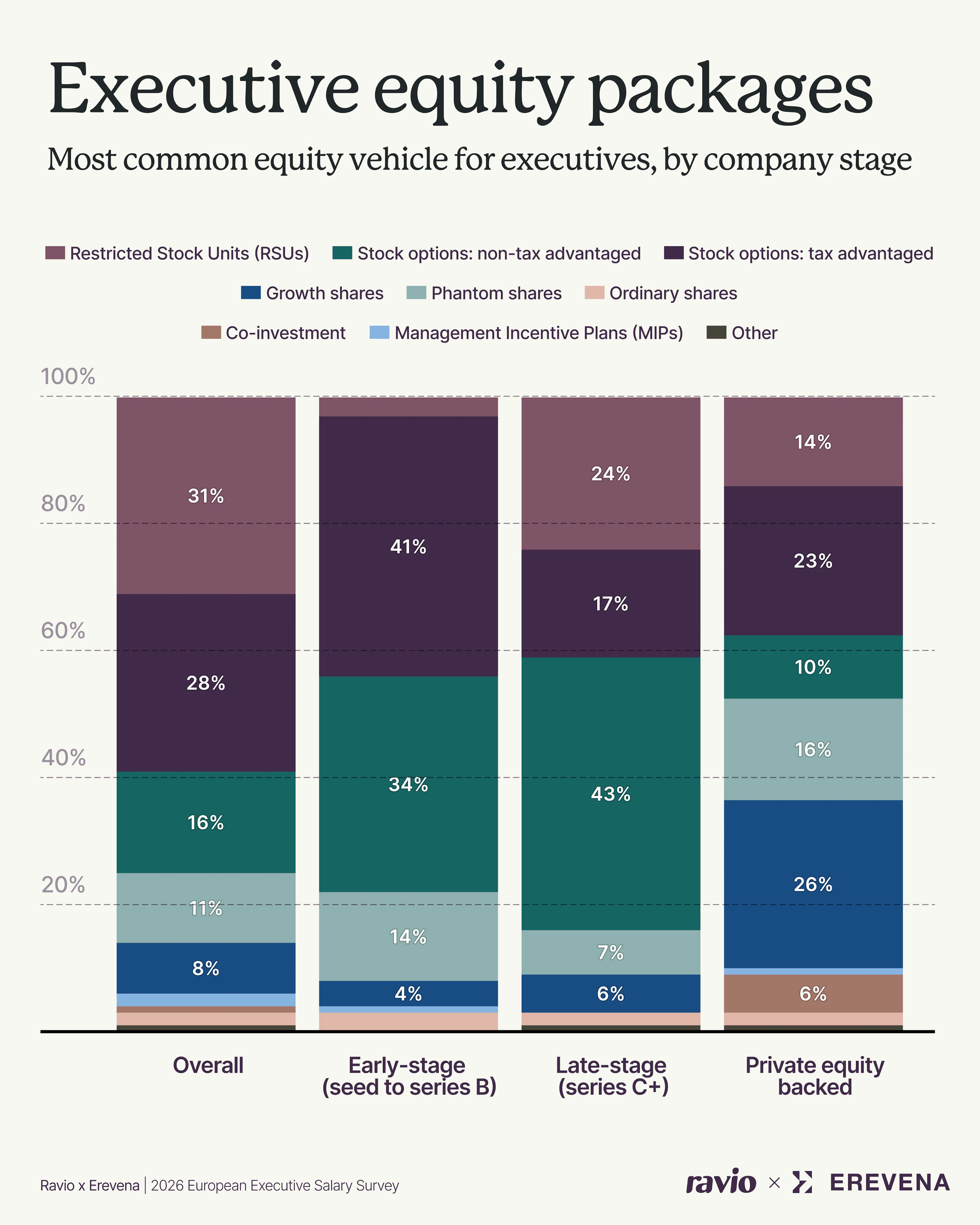
75% of executives receive equity, but unlike bonus, there's no single "typical" equity value to apply here – the vehicle and structure vary enormously by company stage, from tax-advantaged options at early-stage companies to RSUs and performance share units at listed ones. 

A CEO's equity grant can realistically be worth anywhere from a modest addition to several multiples of base salary, largely depending on company stage and ownership type, rather than following a percentage-of-base logic the way bonus does.

Executive equity vehicles per revenue stage – Ravio data

What this means for setting your CEO's salary

As we’ve seen, CEO salary is only "competitive" relative to the specific business and stage it's attached to – and this is only scratching the surface, because CEO packages are so bespoke to an individual company (and that’s not to mention the varying role of equity and bonuses too).

Which makes the single most useful benchmarking question not "what's the average," but "who would we actually be competing with to replace this person tomorrow."

Roy Blanga, Co-founder and Co-CEO at Ravio, uses exactly that test: "When looking at market data for executives, where the talent is coming from is what tells you who you're competing with, and what packages you're up against." 

Which is why, as Michelle Coventry, VP of Talent at Creandum, puts it, compensation benchmarks should be used “as a compass, not a GPS” – they give you the market perspective, but the real work is layering on top of that the individual needs of your specific company and CEO role. 

"When looking at market data for executives, where the talent is coming from tells you who you're competing with, and what packages you're up against."

Roy Blanga, Co-founder and Co-CEO at Ravio

Roy Blanga

Co-founder and Co-CEO at Ravio

See more executive compensation benchmarks in the full report

Get your (free) copy

FAQs

What is the average CEO salary?

There's no single average – CEO salary depends heavily on factors like company revenue. Ravio and Erevena's 2026 data shows P75 CEO base salary in European tech ranges from £200,000 at companies under $10 million ARR to £411,000 at $250 million-$1 billion ARR – all at the 75th percentile, a market-leading position.

How much does a CEO make in the UK?

UK CEO base salary sits at £300,000 at the 75th percentile overall, according to Ravio's 2026 Executive Salary Survey – rising from £225,000 at companies under $10 million ARR to £495,690 at $250 million-$1 billion ARR. That's 42-48% higher than the rest of Europe, depending on revenue stage.

What's the highest salary of a CEO?

Tesla's Elon Musk topped 2026's highest-paid CEO rankings with a package valued at $132.3 billion – almost entirely long-term stock tied to market-cap and performance targets – and a separate, pending award could eventually be worth up to $1 trillion. 

In Europe, Denise Coates, CEO of privately-held betting company Bet365, received a package of at least £280 million in 2025 – reportedly the highest pay package recorded for a UK executive. Among listed companies, Melrose Industries' pay stands out too: former and current CEOs Simon Peckham and Peter Dilnot received a combined £58.9 million in 2024-25.

These figures are real, but not representative of the reality for most CEOs – the true market-leading (P75) benchmark for CEO base salary in European tech is £282,500 overall, according to Ravio and Erevena's 2026 data – rising to £411,000 at the largest companies surveyed ($250 million-$1 billion ARR).

How does CEO salary change with company revenue?

CEO salary scales more steeply with revenue than any other executive function. Ravio's data shows P75 CEO base salary increases by 106% between under $10 million ARR and $250 million-$1 billion ARR, with the sharpest single jump – a 24% increase – at the $250 million mark.

Is CEO base salary the same as total CEO compensation?

No. Base salary is only one part of a CEO's total package – most CEOs also receive equity and bonus. Total compensation, particularly equity value, typically makes up a much larger share of the package at later-stage and listed companies.

Where can I find CEO salary benchmarking data?

Ravio's 2026 European Executive Salary Survey, produced with Erevena, provides P75 CEO benchmarks by revenue stage and region across European tech. For other cuts and always up-to-date market views, Ravio's compensation benchmarking platform also provides ongoing CEO and executive benchmarking data.


Get the Compensation Review straight to your inbox

Your monthly dose of market insights and expert perspectives

You might also like