Compensation reviewsCompensation strategy
Ravio Breakfast Club London: Comp planning for 2027
Join us for the launch of our Comp Trends 2027 report, fresh off the data.


Designing executive compensation at a private startup is hard.
Doing it at a public one is a different challenge entirely.
The packages are more structured. The governance is more demanding. The scrutiny is more intense – from your board, your shareholders, your external advisors, and from the public, because every decision you make is potentially visible to the world.
"The intensity grows," says Rob Green, Founder of Darwin Total Rewards. "The scrutiny goes up a level for sure."
Figen Zaim, Founder of Olivier Reward Consulting, agrees: "It's like you have to grow up. Up until now you're forgiven for things being less structured, but once you list, there is a way of life now that you have to adhere to."
We brought Rob and Figen back – they joined us earlier this year to share their advice on executive compensation at private companies – to work through what that shift actually looks like in practice, and share their advice on how to design exec comp as a public company.
Let’s dive in.
The fundamentals of what’s included executive compensation don't change at IPO – base salary, short-term incentives, long-term incentives, benefits.
But the way each element is designed, approved, reported on, and scrutinised changes significantly.
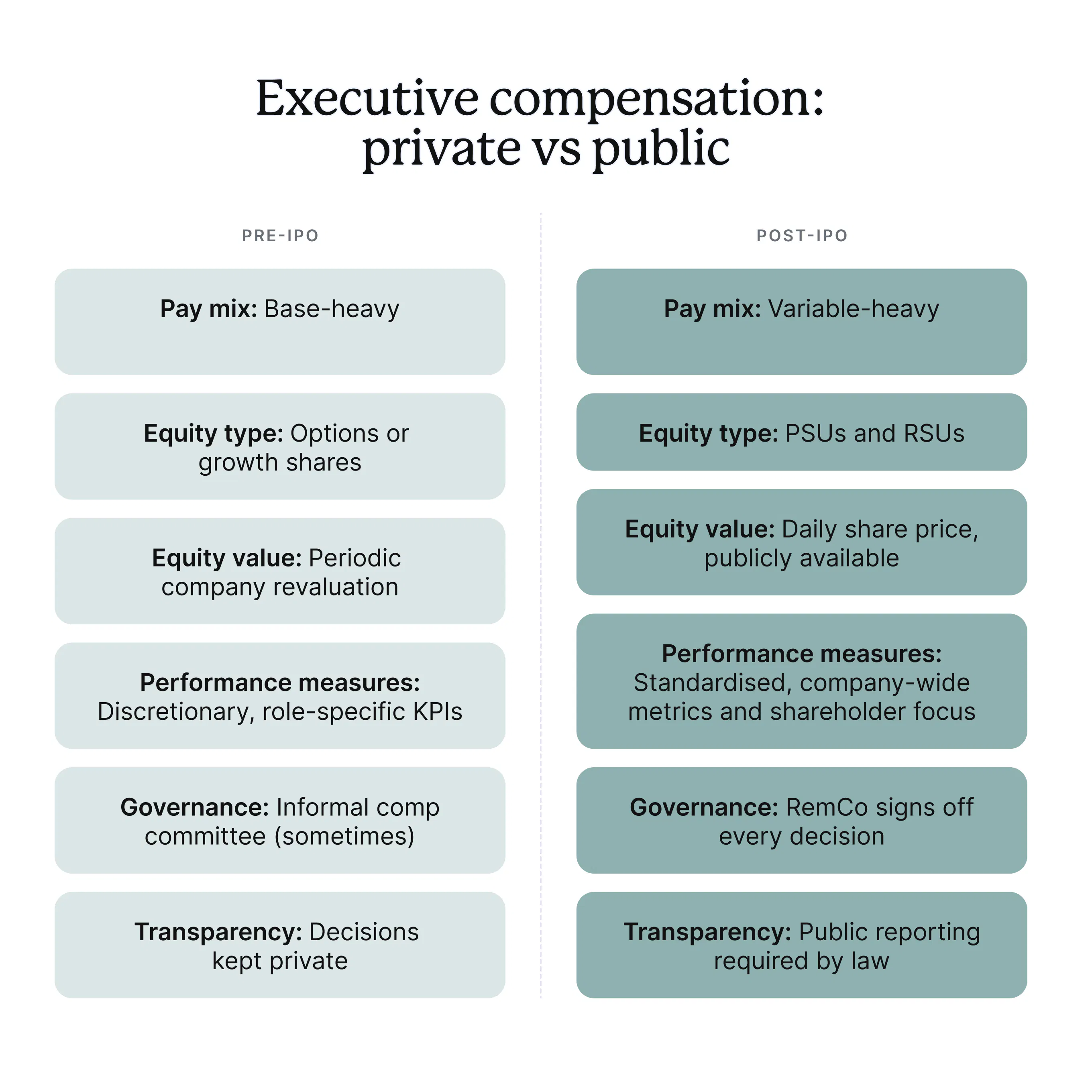
In practice, when a company lists, the changes look like this:
All of this means that exec comp at a listed company is – as Figen puts it – “simultaneously simpler and more complex”.
The structure is clearer. The framework is more defined.
But there’s a lot more that sits behind it – the performance management, the governance, the reporting, the stakeholder management, the approvals.
"The discretionary piece of exec comp really goes out of the window once you're a public company."

Figen Zaim
Founder, Olivier Reward Consulting
"Twelve months is usually where founders have had a tap on the shoulder to say: great news, quickly followed by lets start getting IPO ready – which includes 12 months of hard work alongside the day job for the exec team and Legal, Finance, HR Leaders etc," says Rob.
From an executive compensation perspective (and a compensation perspective more broadly), that period is about getting to a state where you're as close as possible to where you need to be on the other side of the listing.
Figen frames it as looking through a magnifying glass: "You're examining your comp committees, your governance, your structure, your comp philosophy. You're trying to mitigate anything that could look a bit out of shape."
Rob thinks about the pre-IPO work in three broad phases: talent attraction, talent retention, and structural readiness. They're not a neat sequence – in practice there's overlap and back-and-forth as the listing gets closer – but here’s what that looks like.
The IPO process demands a calibre of leadership that not every pre-IPO company has in place.
Exec team members who have led the business through early growth may not have all the skills to lead a listed company.
"Sometimes your execs do leave," says Figen. "The founder at the point of IPO has moved to the board and they've brought in a CEO because they want a completely different shift in strategy."
Getting the right exec team in place before listing means understanding how the compensation conversation changes with candidates who have listed company experience.
Their expectations around pay mix, equity vehicles, and governance will be different – and meeting those expectations requires having at least the shape of a listed company comp structure ready to present.
Once the right people are in place, keeping them is the next immediate challenge.
One of the top priorities when an IPO is announced is how do we retain talent through a very intense period," Rob says. "These are people who are going to be working on something very challenging and at new levels of performance to reach the target IPO together."
Retention through an IPO is a two-act challenge.
The first act is the listing itself – relentless, high-pressure, and often psychologically disorienting. Rob recalls an executive describing it as climbing Everest: "At the day of the IPO you feel like you've reached the peak. But then you realise that it's day one of a new challenge and a new company." The celebration is real, but motivations will naturally ebb and flow during this period.
The second act is the lock-up period. Executives are often subject to a period of restriction on selling shares post-IPO, to encourage leadership commitment and to keep share prices more stable. "It's not just oh-we've-IPOed-now-you-can-go, because there’s usually a lock up period of up to 12months," says Figen.
Retention structures need to account for both moments, not just the listing itself.
This is the internal comp work that needs to happen before public scrutiny arrives – and there's more of it than most teams anticipate.
We’ll dive deeper into how executive compensation should be structured in a public company in the next section, but a few key areas of focus in that pre-IPO period are:
Designing exec comp at a listed company is more structured than at a private one – but that structure creates its own complexity.
The framework is clearer, the vehicles are more standardised, and the peer group is more defined. What's harder is everything that sits behind the design: the approvals it has to go through, the scrutiny it will face, and the stakeholder management required to get anything agreed.
With that as context, here are the key design decisions Reward Leaders face.
The most fundamental shift in package design at a listed company is pay mix.
At a private company, base salary often dominates – founders tend to keep cash conservative and reach for equity to make up the difference.
At a listed company, the balance shifts significantly toward variable, risk-based compensation.
"A well-designed compensation package post-IPO is one that's not heavy on the base but heavy on the variable," says Figen."If you're looking at the most senior leadership – the CEO and direct reports – you're looking at putting at least 50% of that total package into risk. That includes both bonuses and equity.”
That shift is visible in Ravio's benchmarking data too.
Take a VP of Sales: at early-stage, 62% of total compensation is base salary, with 38% variable. By growth-stage that's 51% base, 32% variable, and 17% equity. At late-stage – Series C and beyond, including IPO – it's 47% base, 29% variable, and 23% equity.
The direction of travel: as companies scale toward a listing, variable and equity take up more of the package.
The same pattern holds for a VP of People, though the starting point is different. Early-stage is 100% base. By growth-stage it's 75% base and 25% equity. At late-stage, 67% base and 33% equity.

The pay mix shift reflects a change in what executives are being asked to focus on.
"Suddenly the conversations at that level are all about shareholder return," says Figen. "If you peel all the layers of the onion, the middle is the return."
"A well-designed compensation package post-IPO is heavy on variable risk-based comp, not base pay."
Figen Zaim
Founder, Olivier Reward Consulting
Peer group construction is one of the most consequential – and most underestimated – parts of exec comp design at a listed company.
At a private company, Rob's approach is to ask a simple question: if you had to rehire your C-level tomorrow, where would you hire them from? The answer defines the peer group.
At a listed company, it's more complicated.
Total Shareholder Return (TSR) measures mean the peer group often needs to extend beyond direct talent competitors to include companies you're being benchmarked against by shareholders and proxy advisors.
"It gets broader," says Rob. "It's not necessarily just your sector and your competitors, because of the TSR metrics. It's double-edged – it's easier because it's more defined, but it does get broader and more complex."
The result is peer groups that can span sectors, geographies, and company sizes in ways that make the data hard to use.
"It can be a real challenge when you've gone through that whole process and you open the results spreadsheet and the pay mix is nonsensical," says Rob.
"If you've got pharmaceutical, aerospace, and a logistics company in the same peer group it can be difficult to reconcile – a pharmaceutical company will by definition have a different pay mix because it's a lot more long-term. You have to then develop the results and narrative to tell the data led story to stakeholders."
"Exec comp peer groups are rarely right the first time. It takes a few iterations and change management with key stakeholders."

Rob Green
Founder, Darwin Total Rewards
This is evident from Ravio’s benchmarks too – a CFO in UK fintech has a median base salary of £241,100 at late-stage. In e-commerce, it's £203,500 – a gap of nearly £38,000 for the same role and seniority, in the same location and the same broad industry (tech).

Include both sectors in a peer group without accounting for that difference, and the benchmarks you're working from are pulling in different directions.
Figen recalls one engagement where the peer group took longer to agree than the package design itself. "We were aiming for 25 companies, and it took ages – making sure we were focusing on the right industry, the right sector, the right size, revenue, and geographical location. When it came to the design, we already knew what we were going to do. We just needed that peer group."
Rob's advice is to treat peer group construction as iterative. "It's rarely right the first time. It takes a few iterations and change management with key stakeholders"
The goal is a peer group tight enough to produce coherent data, broad enough to reflect where you actually compete for talent – and documented well enough that you can defend it to a RemCo that will want to know exactly how you got there.
At a private company, equity is typically a single vehicle – options, growth shares, or RSUs – applied broadly.
At a listed company, equity design becomes more layered, with different vehicles serving different purposes at different levels of the organisation.
At the most senior levels – CEO and direct reports – the primary vehicle is typically performance share units (PSUs).
"You start from performance shares at the top,” Figen explains, “and then towards the lower layers of the organisation it will be RSUs. And that's where personal performance management kicks in too, because you’re more likely to need to be nominated for equity if you are a consistent high performer.”
PSUs vest based on the achievement of specific performance conditions over a defined period, usually three years. Depending on performance, PSU payouts typically range from 0% to 200% of the target grant – with the most common measures are total shareholder return (TSR) and earnings per share (EPS), though companies increasingly incorporate non-financial metrics like ESG too.
"PSUs globally have become much more popular post-COVID," says Rob, "just because of the global economic environment, there's so much more focus on performance."
Figen adds that the performance period itself tends to be structured in a specific way at listed companies: "Measures for equity tend to be pretty long-term – on a yearly basis aggregated over three years, or measures that trigger before shares vest."
One design decision that often gets deferred too long is how equity refreshes will work once initial grants vest. Build that into the design from the start – an executive who's fully vested with no refresh in sight is an executive with one foot out the door.
"PSUs globally have become popular for executives globally – there's so much more focus on performance."
Rob Green
Founder, Darwin Total Rewards
Short-term incentives – typically an annual bonus – work differently at a listed company than at a private one too. The measures are more standardised, the targets more formalised, and the link between pay and performance more explicit.
STI structures usually combine company-wide financial metrics with personal or strategic objectives, with the financial component dominating.
"In the private world there is more of a discretionary element," says Rob. "At a listed company the measurement becomes much more defined and focused – more KPI-driven, more tied to company-wide performance rather than individual judgement calls."
"The metrics themselves become more complex but more generic," he adds. "The framework tightens even as the measures broaden – it gets more structured and generalised, leading to more line of sight for employees and customers."
Common measures include revenue growth, EBITDA, operating margin, and EPS – though non-financial metrics are increasingly incorporated alongside these.
One element that can surprise Reward Leaders moving into listed company work for the first time is that malus and clawback provisions are standard.
Malus allows a company to reduce or cancel a bonus or equity award before it's paid out; clawback allows it to recover compensation already paid. Both can be triggered by specific events – regulatory enforcement, financial restatement, or misconduct – and both need to be built into the design from the outset.
At a listed company, how those executive package decisions get made is significantly more complex than anything you'll have encountered in a private company context.
"You move into the realms of investor relations and their perceptions of what the company is doing," says Rob. "That brings a whole load of new challenges in managing the process over time."
That level of scrutiny has a practical implication that both Rob and Figen are clear on: one Reward person cannot manage this alone.
"You need to hire an exec comp manager," says Rob. "and that can be another big challenge as the skillset is quite niche."
Figen agrees: "Otherwise it's a full-time job – just managing equity grants, reporting, preparing for quarterly RemCo, then board meetings, plus any extraordinary RemCo meeting for a new hire approval or whatever it is."
Most private companies have some form of compensation committee – often an informal group of the founder, CFO, and perhaps a board member or investor.
But at a listed company, it becomes something more formal.
A listed company's Remuneration Committee – RemCo – is typically made up of independent non-executive directors, and is a legal requirement.
In the UK, for instance, companies with a premium listing are required to comply with RemCo requirements under the UK Corporate Governance Code.
Across Europe, the EU Shareholder Rights Directive II requires listed companies to put their remuneration policy to a binding shareholder vote at least every four years, with an annual advisory vote on the remuneration report.
Before any RemCo meeting can happen meaningfully, a policy document needs to exist.
The RemCo policy document is the foundation everything else is built on. It sets out how comp decisions are made, what can and can't be approved at which level, and what will be reported publicly.
"When you write your first RemCo policy and procedure, it should include what you're going to be reporting on," says Rob. "The first annual report is where the company needs to make some decisions on what information to share in year 1 – and develop that over time."
What gets reported publicly varies by market, but the principle is consistent across Europe: listed companies are required to disclose executive compensation in detail, and those disclosures are available to employees, investors, analysts, and the public.
The reporting obligations mean that every decision made during the year needs to be documented and defensible – otherwise when reporting time comes around, it’s going to be much more difficult.
Beyond the mechanics, the relationship with the RemCo chair is one of the most important things a Reward Leader can invest in, because the dynamics can be unpredictable.
"It's really important to build the relationship with your RemCo, especially your RemCo chair," says Figen. "Make sure you've briefed them in advance of what's going to happen – they might want you to change something before you go into the meeting, or they might tell you something is not going to work at short notice."
"I’ve worked in all sorts of environments and sometimes you have a really challenging comp committee because they can't agree between themselves," Figen says, "and you're sitting there thinking: I just need a decision."
Therefore, long-term relationships, consultation and change management are critical.
Beyond the formal reporting requirements, listed companies face a layer of external scrutiny that can shape what they're able to design in the first place.
Proxy advisors – principally ISS (Institutional Shareholder Services) and Glass Lewis, both US-headquartered but operating globally – provide institutional investors with research and voting recommendations on shareholder meeting resolutions, including say-on-pay votes on executive compensation.
Because large institutional investors hold shares in hundreds of listed companies and can't analyse every vote themselves, proxy advisor recommendations carry significant weight.
More importantly for Reward Leaders: companies actively design their exec comp programmes to avoid a negative recommendation in the first place.
Proxy advisor guidelines become a design constraint, not just a reporting one.
"You get scrutinised not just internally, not just by your RemCo or board, but by your shareholders, analysts, proxies,” highlights Figen. “Everybody's got a magnifying glass on every single detail of your compensation structure."
Overall, as Rob puts it, executive compensation “becomes quite a complex environment to navigate successfully over time.”
"Everybody's got a magnifying glass on every single detail of your compensation structure as a listed company."
Figen Zaim
Founder, Olivier Reward Consulting
Exec comp at a listed company is more structured than at a private one – but structure alone doesn't make it easier.
Here are the principles Rob and Figen kept coming back to:
Your monthly dose of market insights and expert perspectives
Join us for the launch of our Comp Trends 2027 report, fresh off the data.

Join us for the launch of our Comp Trends 2027 report, fresh off the data.
Join us for the launch of our Comp Trends 2027 report, fresh off the data.

