
Pay equity
EU Pay Transparency Directive: the complete guide for employers (2026)
What the EU Pay Transparency Directive requires, how each member state is implementing it, and what employers need to do to comply.


Updated: September 2026 — updated to reflect the projet de loi approved by France's Conseil des ministres on 10 September 2026.
Pay transparency isn't new. It's been part of the French compliance landscape for the best part of a decade. The Index de l'égalité professionnelle femmes-hommes (Gender Equality Index) has required companies with 50 or more employees to calculate, publish, and act on a structured equality score every year since 2019.
Yet despite this, France's gender pay gap remains at 11.8% (broadly in line with the EU average). When you strip out differences in working time and seniority and compare men and women in equivalent roles, a 3.8% adjusted gap still persists. It's that adjusted figure that matters most under the Directive: any gap above 5% in a worker category will require action.
This is where the EU Pay Transparency Directive (directive sur la transparence des rémunérations) comes in, and France isn't treating it as a light-touch compliance exercise.
On 10 September 2026, France's Conseil des ministres approved a draft law transposing the EU Pay Transparency Directive — three months after the EU's 7 June 2026 deadline. The bill confirms France's national design: private employers with 50 or more employees must report seven gender pay-gap indicators from 2028, with six calculated automatically via France's DSN payroll reporting system. The Index Egapro continues for the 2027 annual reporting cycle before being replaced. France goes well beyond the Directive's minimum requirements in several areas, including on pay secrecy, job posting obligations, and the definition of work of equal value.
This guide covers the current legal landscape in France, what the Directive introduces, how France's transposition is taking shape, and how to prepare.
Get prepared with the EU Pay Transparency Directive checklist →
France's current pay transparency regime is anchored in the Loi pour la liberté de choisir son avenir professionnel (2018), which introduced the Index de l'égalité professionnelle femmes-hommes (known widely as the Index Egapro).
The Index applies to all private-sector employers with 50 or more employees. Every year, by 1 March, employers must calculate their score, publish it publicly on their company website, and report it to the Ministry of Labour via the dedicated platform.
The Index is scored out of 100 across four indicators for companies with 50–249 employees, and five for companies with 250 or more: the adjusted gender pay gap by job category (40 points), differences in individual pay increase rates (20 points), the proportion of employees receiving a pay rise after returning from maternity leave (15 points), gender parity among the ten highest earners (10 points), and – for larger companies – differences in promotion rates (15 points).
Employers scoring below 75 must implement corrective measures within three years.
Failure to publish the Index, act on a low score, or demonstrate the effectiveness of measures taken can result in financial penalties of up to 1% of annual payroll.
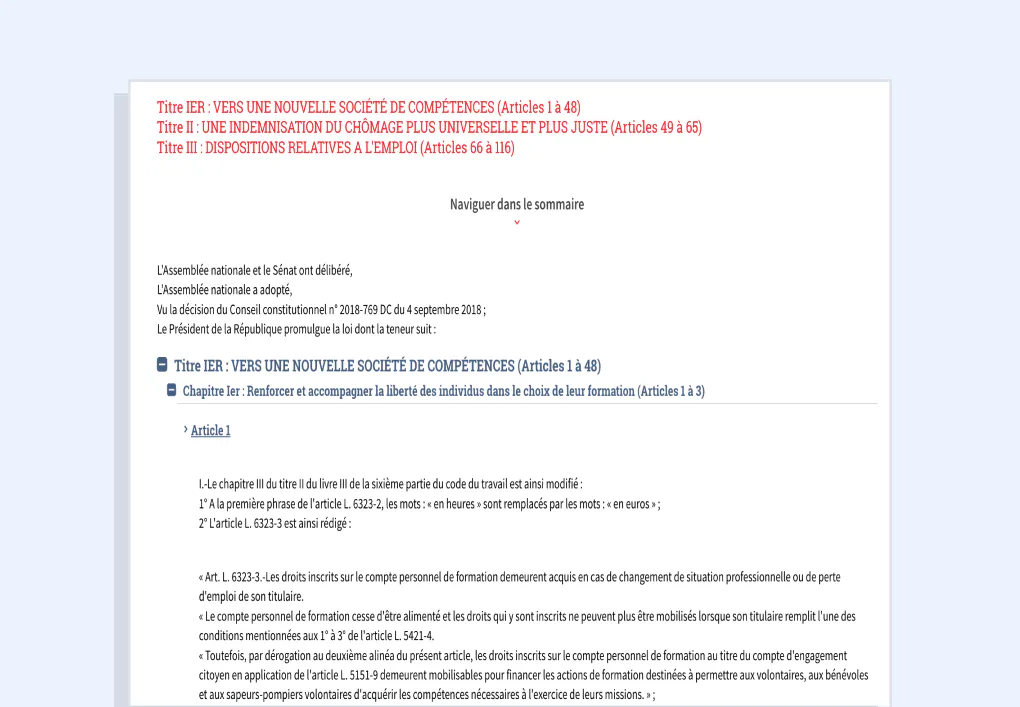
Beyond the Index Egapro, two additional pillars shape France's pay equity landscape:
The core concept of travail de valeur égale (work of equal value) already exists in French employment law, taking into account professional knowledge, experience, responsibilities, and physical or mental strain.
This gives France a foundation for EUPTD implementation that many other member states are only now building. That said, the Directive, and France's draft bill, expands the definition further.
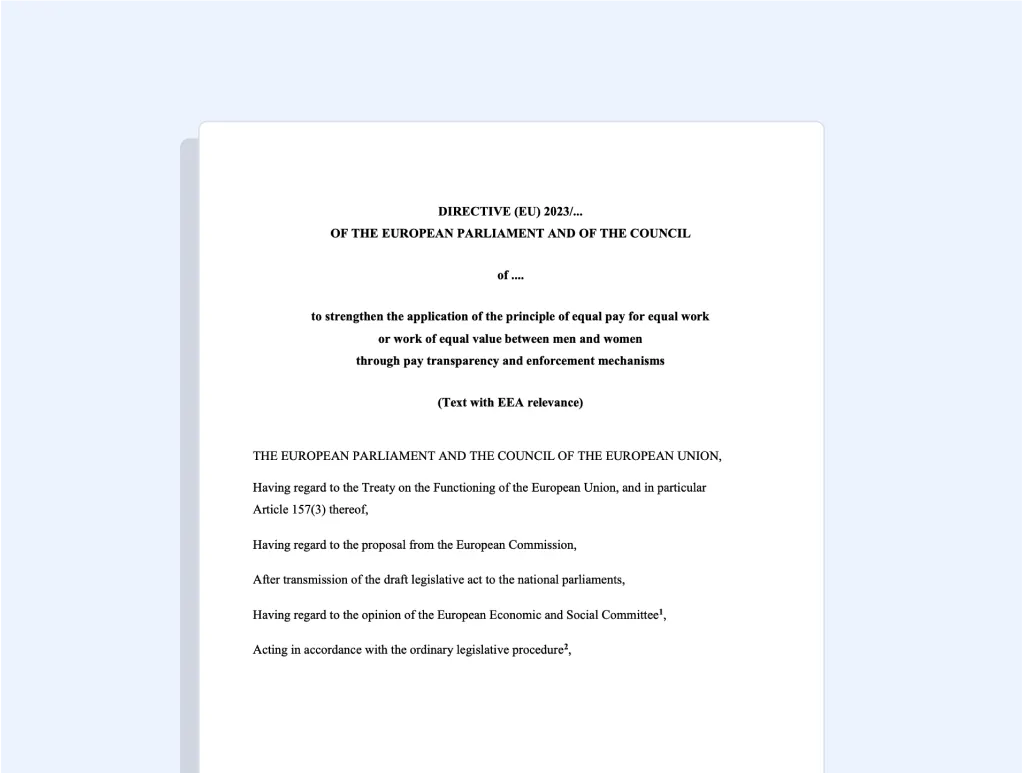
All 27 EU member states are required to transpose the EU Pay Transparency Directive into national law by 7 June 2026.
France sent a preliminary draft transposition bill to social partners for consultation on 6 March 2026. On 10 September 2026, the Conseil des ministres approved the revised projet de loi, formally launching the parliamentary process.
France missed the 7 June 2026 EU transposition deadline by approximately three months. The Conseil des ministres approved the projet de loi on 10 September 2026. Parliamentary debate is expected to follow in late 2026, with enactment likely in 2027. Four immediate rights — pay secrecy ban, salary ranges in job ads, individual pay information requests, and burden of proof reversal — are expected to enter into force in 2027. Reporting obligations are likely to apply from 2028, with variation by employer size.
Unlike some member states that have mirrored the Directive closely, France's draft treats the Directive as a floor. Lower thresholds, a more prescriptive remediation process, a stronger role for works councils, and robust financial sanctions all point to one of the more demanding transpositions in the EU.
Under the Directive, all employers must provide salary information to candidates before their first interview. France's draft bill goes a step further: salary ranges must appear in the job advertisement itself, not just be available on request before interview.
Where no job posting is published (for example, in a direct approach), the employer must provide the salary range in writing before or during the recruitment process.
The draft bill also introduces an explicit ban on asking candidates about their pay history during current or previous employment. Employers who fail to include salary ranges in job advertisements face a fixed penalty of €450 per breach. Salary expectations questions — asking candidates what salary they are looking for — remain permitted; it is questions about pay at a past or current employer that are prohibited.
This marks a fundamental shift in recruitment practice. Across France's labour market and compensation framework, remuneration has historically been a matter of individual negotiation, with little obligation on employers to set or disclose ranges in advance. That approach will no longer be legally compliant.
Under the Directive, all employees gain a proactive right to request pay information, without needing to suspect discrimination or take legal action.
Specifically, employees can request:
Under France's draft bill, this request can be made directly to the employer, or via trade union representatives or the CSE (Comité Social et Économique – the Works Council).
Employers must respond within a timeframe to be set by decree, and must remind employees annually of this right.
Where the employee's category is too small to allow disclosure without identifying individual pay levels, the employer is not required to share the information (due to GDPR), but must inform the employee accordingly.
Key difference from current French law: Pay information rights today are primarily exercised via the CSE or in the context of a discrimination claim before a court. The EU Pay Transparency Directive creates a direct, individual right available to any employee, regardless of whether they suspect any wrongdoing.
France already operates a gender pay gap reporting regime through the Index Egapro. The bill replaces this with a more granular, standardised seven-indicator framework, but retains France's existing lower threshold of 50 employees rather than adopting the Directive's 100-employee minimum. Crucially, the transition is staged: the Index Egapro continues for the 2027 annual reporting cycle — its last cycle under the existing system. The seven-indicator framework takes over from 2028 for private employers, and from 2028 for public employers managing 150 or more agents. Other public employers in scope have until 1 June 2030.
All employers with 50 or more employees must report all seven indicators.
Six of the seven indicators will be calculated automatically by the government using data from France's Déclaration Sociale Nominative (DSN) payroll reporting system; employers review and confirm the results before they are published by the Minister. France says it is the only EU member state to automate indicator calculation at this scale. The seventh indicator — the category-level gender pay gap for workers performing work of equal value — cannot be automated and requires manual employer calculation. Its reporting frequency is adapted to company headcount and will be confirmed by decree.
What must be reported (same across all in-scope employers):
Reports will be published on the Ministry of Labour's website – marking a shift from the current model where only the overall Index score is published. The seven specific indicators will be defined by decree.
Under France's bill, any unjustified gender pay gap in a worker category can attract scrutiny: where employee representatives question the published results and the employer's response does not justify the gap, corrective action may be required — even below the formal 5% threshold. The formal multi-stage remediation process is triggered where a gap in any worker category exceeds 5% and cannot be justified by objective, gender-neutral reasons. The exact percentage triggering the formal process will be set by decree, and France has explicitly left open the possibility of setting it below 5%.
For employers who exceed this in any worker category, France's draft bill replaces the Directive's single joint pay assessment requirement with a sequential, multi-stage procedure involving the CSE at each step:
Stage 1 – First declaration: If a significant gap is identified, the employer must either justify it with objective, gender-neutral criteria (and consult the CSE on those justifications) or immediately begin negotiations on corrective measures.
Stage 2 – Six-month correction window: Where the gap cannot be justified, the employer has six months to remedy it via collective agreement or unilateral decision, then re-report the indicator following further CSE consultation.
Stage 3 – Second declaration: If the gap remains unjustified or uncorrected, the employer must conduct a joint assessment with employee representatives.
Stage 4 – 12-month deadline: A collective agreement or action plan must be filed with labour authorities within 12 months of the declaration period opening.
The exact threshold that triggers this process will be set by decree, and France has explicitly left open the possibility of setting it below 5%, which would be stricter than the Directive's baseline.
For companies with 250 or more employees, a completed joint pay assessment remains valid for three years (covering two reporting cycles), though annual reporting and CSE consultation obligations continue throughout.
The Directive restructures how pay discrimination claims work in court.
The draft bill also expands the comparators employees can use in discrimination claims: employees may compare their pay to that of someone previously employed in the same role, or to employees at other companies covered by a shared collective agreement at group or unité économique et sociale level.
To understand the significance of France's implementation, the table below sets out a side-by-side of what the law currently requires, what the Directive mandates, and the practical impact on French employers.
Requirement | Current French Law | EU Pay Transparency Directive | Impact on France |
|---|---|---|---|
Pay equality principle | Yes – Code du travail Art. L. 3221-2: equal pay for equal work/value | Yes, same principle | ✓ Reinforces existing law |
Gender pay gap reporting | Annual Index Egapro (5 indicators, composite score) for 50+ employees | Standardised 7-metric reporting for 100+ employees | NEW: 7 indicators replace the Index; France retains 50-employee threshold. Reporting includes public category-level data for the first time. |
Public disclosure | Score published; no category-level detail | Full public disclosure required | NEW: Moves from composite score to granular public reporting |
Standardised reporting format | Employer methodology flexible within Index framework | Yes – mean, median, quartiles, by category | NEW: Eliminates methodological flexibility |
Salary range in recruitment | No requirement | Required before interview | NEW: France goes further – mandatory in the job posting itself. €450 per non-compliant advert. |
Salary history ban | Not addressed in law | Explicit prohibition | NEW: Changes hiring practice industry-wide |
Right to pay information | Via CSE or discrimination claim only | Proactive individual right and annual reminder | NEW: Direct right for any employee, regardless of suspicion of discrimination |
5% threshold with action requirement | No formal threshold mechanism | 5% gap triggers joint pay assessment | NEW: France introduces a multi-stage CSE process; threshold may be set below 5% |
Works council (CSE) role | Consulted on Index results | Consulted for joint pay assessment | EXPANDED: Formal CSE opinion required at multiple stages; transmitted to labour authorities |
Burden of proof | Employee establishes presumption; employer justifies | Employer must disprove on non-compliance | NEW: Full reversal where transparency obligations breached |
Pay secrecy clauses | Not explicitly addressed | Banned | NEW: Prohibition applies to clauses in employment contracts. Existing contracts may need to be updated (an addendum may suffice). Takes effect immediately on enactment. |
Penalties | Up to 1% payroll for Index failures | Proportionate, dissuasive sanctions | STRENGTHENED: Up to 1% payroll; 2% for repeat breaches; €450 fixed per breach of individual obligations |
France's implementation is further along than most member states, but also more complex, because France already has obligations that the Directive would otherwise replace, and has chosen not to weaken them.
On September 10, 2026, France's Ministère du Travail presented the draft bill to the Council of Ministers - three months after the EU's June 7, 2026 transposition deadline. The bill goes beyond minimum EU requirements, establishing lower reporting thresholds, mandatory salary ranges in job postings, expanded works council involvement, and steeper financial penalties.
Retaining the 50-employee threshold. The Directive's minimum reporting threshold is 100 employees. France has explicitly chosen to maintain its existing 50-employee scope – bringing significantly more SMEs into the full transparency framework than most EU member states will require.
Index Egapro continues through 2027; new framework applies from 2028. The Index Egapro continues for the 2027 annual reporting cycle — its last cycle. From 2028, the seven-indicator framework takes over for all private employers with 50 or more employees. Public employers managing 150 or more agents also move to the new indicators from 2028. Other public employers in scope have until 1 June 2030.
Six of seven indicators automated via DSN. Six of the seven indicators will be calculated automatically by the government using data from the Déclaration Sociale Nominative (DSN) — France's existing payroll reporting system. Employers review and confirm the calculations before publication by the Minister. France states it is the only EU member state to automate indicator calculation at this scale. The seventh indicator, which covers pay gaps between women and men performing work of equal value by worker category, requires manual calculation by the employer. Its filing frequency will be adapted to company headcount and confirmed by decree.
Several details are still subject to decree, including:
The bill is not yet law, but enough is settled to act now. The employers who will find compliance straightforward are those who have already invested in their pay infrastructure – job architecture, salary bands, and gender pay gap analysis — before the deadlines land.
Here are four key steps to get prepared:
For context on how salaries and compensation are structured in France and what employee benefits form part of the total package, these articles provide useful grounding.
The time to start is now. By the time the bill is enacted and implementing decrees are published, organisations that have already built their pay infrastructure will be in a far stronger position, both for compliance and for the employee conversations that greater transparency will inevitably prompt.
We've put together an EUPTD checklist to help you work through these preparation steps for your company. Go to the checklist →
Your monthly dose of market insights and expert perspectives
What the EU Pay Transparency Directive requires, how each member state is implementing it, and what employers need to do to comply.

Join Jessica Zwaan (VP People Strategy and Operations, Leapsome) and Natasha Delisle-Barrow (Acting CPO, Ravio) for a discussion on why Leapsome never negotiate salaries for their team, and the impact of salary negotiation on pay equity

Use Ravio to identify pay gaps across your organisation, understand what's driving them, and calculate the cost of closing them.

