
Compensation strategy
10 best compensation planning software, compared (2026)
Compare the best compensation planning software in 2026. Learn what to look for, compare leading platforms, and choose the right solution for your organisation.


Your company has just acquired another business. The deal has closed, the announcement has gone out, and somewhere in the middle of the congratulations and the all-hands presentations, the reality of what comes next starts to land.
You now have two sets of employees. Two compensation philosophies reflecting two different cultures. Two sets of job levels, salary bands, bonus structures, equity plans, and benefit packages.
It all needs bringing together cohesively.
Left unaddressed, the gap between two compensation structures creates retention risk and growing pay equity exposure.
This guide walks through what a successful compensation integration actually looks like.
Bringing two compensation structures together is one of the most complex projects a Reward Leader will take on, with high stakes and a pressured timeline.
We spoke to two people who have lived through it from every angle.
David Lynas, Head of Reward at Just Eat Takeaway.com, has navigated three major mergers and acquisitions during his ten years at the company – the merger with Takeaway.com, the sale of US-arm Grubhub, and the acquisition by Prosus.
Tobias Brinck, Head of Compensation, Benefits and HRIS at Kry, built the rewards function for acquisitions at Klarna, integrating companies including PriceRunner and Flex Engage across multiple geographies, before leading further integrations in his current role at Kry.
Neither of them sugar-coats how tough it can be to lead on compensation strategy for an M&A. As Tobias puts it: "No deal is a walk in the park, even when you've done several."
But, they both bring plenty of learnings that might help make your experience a little easier.
Reward is almost always brought into the M&A conversation late. The first conversations happen between finance, legal, M&A advisers, and C-suite – by the time the Reward team gets a seat at the table, significant decisions have already been made.
But employee compensation has implications for the deal itself, with factors like retention budgets, equity obligations, and bonus liabilities directly affecting the numbers.
“The sooner you get involved in a deal, the better,” says Tobias Brinck. “You can only plan and map risks effectively once you actually understand what’s happening.”
For David Lynas, the route in is relationship-led.
“Your access to deal conversations depends almost entirely on the trust you’ve built beforehand,” David explains.
“For me, it's always been about staying close to our General Counsel, our Company Secretary, and our finance teams – because they're the ones who are going to be there. If you're a trusted adviser to them, they'll bring you in early."
Before any decisions are made on how compensation structures might change, you need to be clear on the broader M&A integration strategy – because comp decisions flow directly from that.
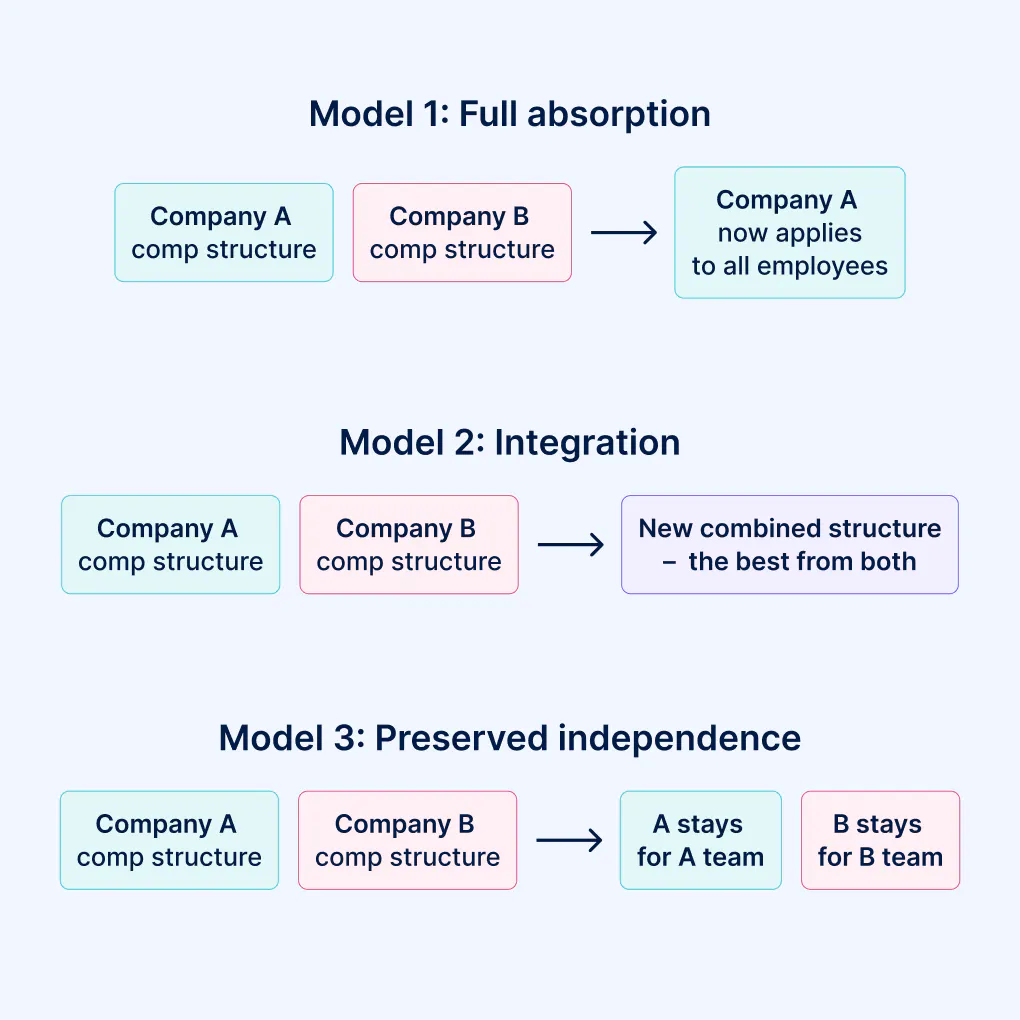
There are three broad models:
Whether the acquired company's culture is being preserved, adapted, or absorbed shapes everything downstream – including compensation, because compensation philosophy is an expression of company culture.
“The context of the deal is highly important,” says David. “A hostile takeover calls for a completely different approach than a merger of equals where the agreement is deliberately protecting the acquired company’s identity and operations.”
In that first scenario of a hostile takeover, where the acquirer is absorbing the acquired company, maintaining the existing compensation approach and bringing the gained employees into those structures makes sense.
But in the second scenario where the acquired company is retaining its identity, we need to find a way to combine two compensation approaches into something that works for everyone – which can be a lot trickier to manage.
This step is especially critical if you're merging two compensation philosophies rather than simply absorbing one into the other – you need to find that middle ground.
So, before deciding anything, listen.
"One of my biggest pieces of advice for M&A is to listen – listen and ask questions to the founders, to the senior management team, and where possible, to employees too,” says Tobias. “Learn about that company, their culture, what's important there, how the compensation structures were built.”
The goal is to understand the ‘why’ behind their compensation decisions.
What drove their philosophy? Were they a high-equity, lower-cash startup in the early days? A benefits-heavy business that competed on culture and flexible working? A company where variable pay was central to rewarding performance? Do they account for location when determining pay?
You need to know where you're starting from before you can plan where you're going.
And don’t underestimate the small details in these conversations.
Tobias learned this the hard way at Klarna: "In one deal, it was as trivial as a local gym that we missed that caused a level of friction that was difficult to imagine."
It's also worth understanding their current processes: how do they make new hire starting salary decisions, run compensation reviews, or communicate with employees about pay?
With a clear picture of both compensation structures, the integration model, and the culture you're working with, it's time to make a plan.
As we’ve seen, the core decision is whether to absorb – bringing new employees into your existing structures – or to combine, building something new that draws from both.
Whatever approach you land on for your unique situation, David and Tobias are aligned on one thing: take it slowly.
"Companies that move through M&A very fast are often the ones that have to fix the most things later," says Tobias. "Go slow to go fast."
In practice, this can often mean maintaining parallel structures for a defined period while the integration work happens properly.
If you're absorbing, that gives acquired employees time to transition to the new approach and have individual conversations. If you're combining two approaches, it gives you the space to design something that actually works rather than something that was rushed.
What it requires in return is careful governance and clear communication about what's temporary and what's permanent. Without that clarity, ambiguity fills the gap – and ambiguity at this stage creates exactly the kind of employee anxiety you're trying to avoid.
Document everything as you go: the strategy, the plan, and the rationale behind each decision. It's the foundation for every legal query and employee conversation that follows.
Finally, before moving forward, get sign-off from leadership on both sides.
The acquiring company's leadership need to be aligned on the approach – but so do the senior leaders and founders of the acquired company, whose buy-in will matter enormously when it comes to communicating changes to their teams.
It’s worth running the plan by team leads too, they’ll be responsible for implementing the new structures day to day, so getting them across the detail early avoids the kind of surprises that slow everything down later.
With the strategy agreed and signed off, this is where the structural work begins.
Every element of compensation needs to be redesigned for the combined entity: functions and org design, level framework, career progression frameworks, job title conventions, job evaluation approach, compensation bands, variable and incentive plans, equity plans, and benefits packages – it all needs refreshing in line with the new approach, and you'll need to work closely with department leads to make sure everything holds up in context.
This is also the moment to re-run your market benchmarking.
The combined entity may compete for talent in a different peer group, operate across a broader geographic spread, or call for a different pay positioning strategy than either company used before, all of which means different market pricing.
Don't carry over old assumptions – start from what the new business actually is.
With new structures in place, it's time to bring employees into them.
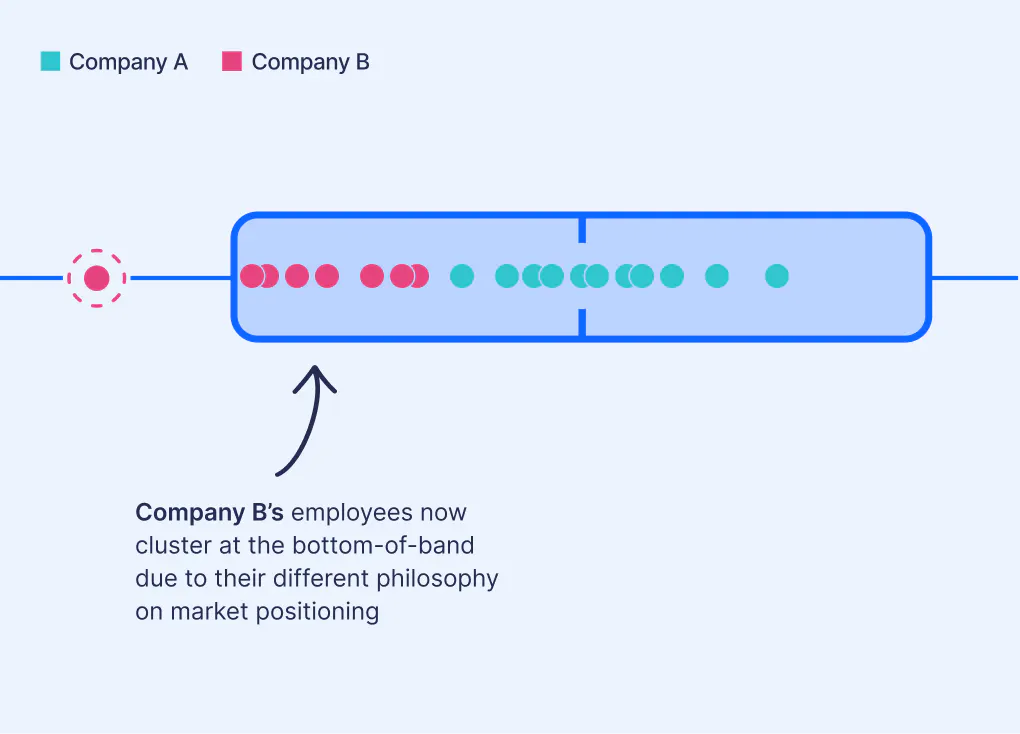
Map every employee in the acquired company against the new framework:
From there, identify the outliers – those above or below range, those whose level or title needs adjusting, those where there are significant gaps between people doing the same job at different companies.
Some of these will need addressing immediately, especially if they’re high-priority employees for retention (see step 7). Others will need more context, such as performance data, before a decision can be made. Others still can be managed over time through the normal compensation review cycle.
Pay equity risks should be particularly closely monitored.
Merging two populations can surface unexplained pay gaps at role or level that create future liability under legislation like the EU Pay Transparency Directive – “the acquired company paid differently historically” isn’t an objective justification for pay differences, and could leave the company at risk of fines.
It's far better to identify and address these during integration than find them much later down the line when issues have compounded.
Retention is one of the biggest risks in any M&A – on both sides of the deal. Compensation is one of the key levers for managing it.
But, as Tobias recalls, it's easy to lose sight of that under deal pressure.
“You’re acquiring a company for a reason, and often the people in the company are a huge part of that reason,” Tobias says. “Yes you want the tech and the forecasts, but it’s the employees in that company who are responsible for that success.”
“In my earlier deals we got stuck in P&Ls, spreadsheets, forecasts – and forgot about the employees who were actually behind those numbers. It led to a lot of turnover of acquired employees, because they felt forgotten.”
David agrees: "We don't want to lose the people who are going to be the biggest drivers of the business success." His approach is to categorise key talent into three distinct groups:
Once you've identified those groups, explore the right retention levers for each.
"The most important retention lever isn't financial," says David. "It's providing clarity and security. It’s a worrying time for every employee, so making sure people know they have a role, understand what's happening, and feel secure goes a long way."
Beyond that, equity rollover where plan rules allow, and cash retention plans for those critical to continuity, are the tools most commonly used.
Watch out for unintended consequences of your retention levers, though.
“We had a change of control policy in place that offered two months pay for every year worked to any employee impacted, which triggered when we went through our merger,” says David. “With senior leaders we had one from each organisation, but now only one role in the combined organisation. Several very talented, long-tenured senior leaders chose to walk away because they knew it would be a stressful time, and those terms were very generous.”
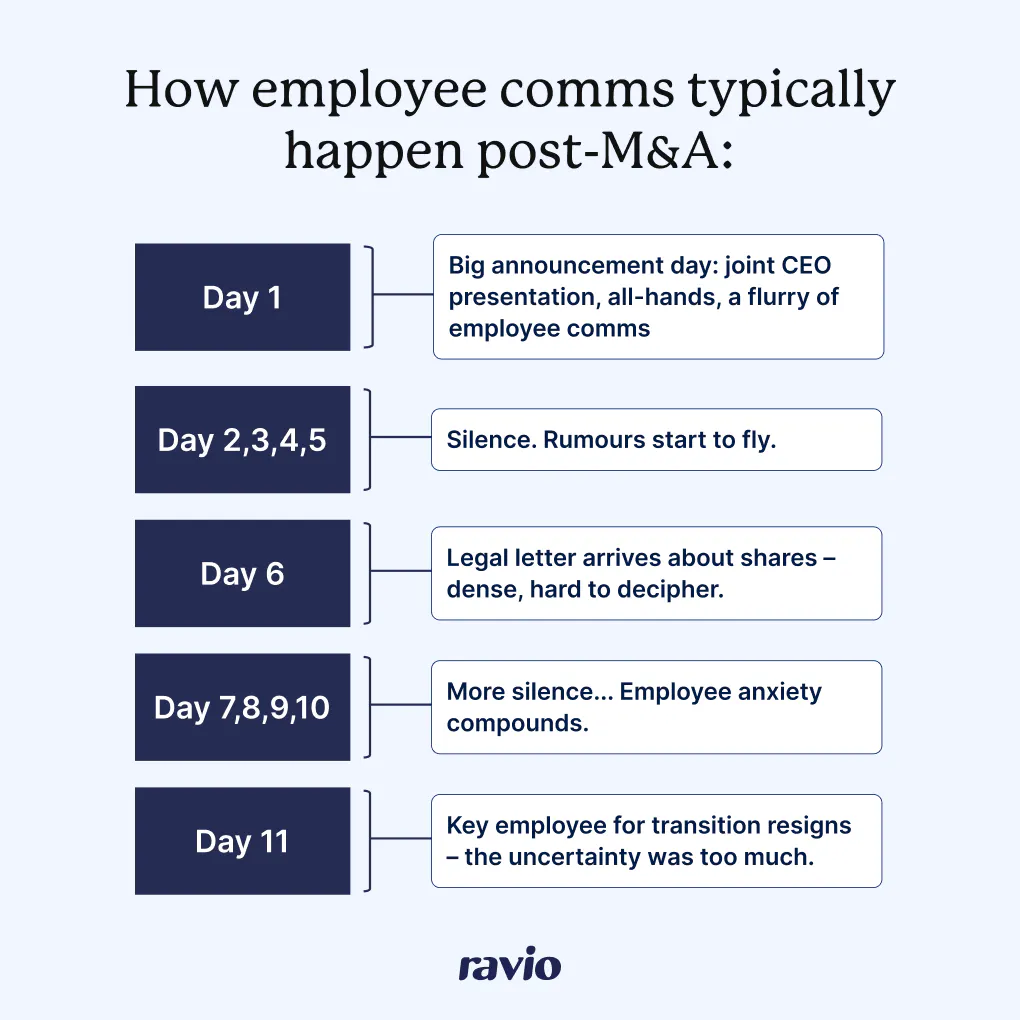
If there's one thing both David and Tobias would do differently looking back, it's communicate more, and start communicating earlier.
In every M&A, they’ve experienced the same pattern.
Day one brings a big announcement – joint CEO message, all-hands, a flurry of communications.
And then it goes quiet.
Acquired employees, who had questions from the moment the deal was announced, are left in a void.
“When employees are left with nothing, rumours start,” says Tobias. “Concerns about job security, about compensation, about what their level will be in the new structure. If you aren’t there providing the information, the assumptions can get quite bad.”
Employees on both sides will have immediate, personal questions: will I have a job, what happens to my bonus, will my benefits change, can I apply for roles in the combined entity?
“You won’t have answers to everything,” David says. “But it’s about communicating timelines and processes as much as outcomes. If you don’t have that answer, say that – but here's what we can answer today, here’s when we’ll next communicate, and here's what we're doing to find out the answers."
And be careful not to leave communication to legal and finance teams alone – their instinct is to protect the business, which produces legalistic language that doesn't reassure anyone.
"I over-relied on lawyers when wording communications in my first M&A,” shares David, “and we ended up with complex messages that didn't give employees comfort. They needed a warm hug, and instead they got a cold message that they couldn't decipher."
Partner with trusted team leads and senior leaders in both the acquirer and acquired company to build clarity and reassurance through a clear message, consistently delivered.
And don’t forget to train managers and department leads on what's changing and why in your compensation strategy and structures – particularly on elements specific to their teams, whether that's sales incentive plans, equity vesting schedules, or benefits that vary by location.
The process above applies across every element of total compensation – but each comes with its own specific considerations. Here's what to keep in mind for each.
It's worth noting that equity treatment is one of the most consequential decisions in any M&A. In 80% of all M&A deals, at least some of the target's employee stock options are cancelled by the acquirer and not replaced by new equity-based grants – and contract modifications reduce the value of employee stock options by 38.4% in the average deal.
The best time to prepare for an M&A is before one is on the table.
Every decision you make in your day-to-day reward work is either setting you up for M&A or leaving you exposed.
As David puts it: "We are all M&A professionals. Whether you're going through M&A right now or not, the decisions we make in our day-to-day lives are fundamental to our success if a deal happens."
Most of the groundwork for a smooth M&A transition is about having clear and documented compensation structures that enable consistent and explainable decisions to be made – it’s good practice rewards work, whether for an M&A or not.
Here's where to start:
All of this means you’re prepared when a deal does arrive.
And when it does? Take David and Tobias’ advice: understand the integration strategy before touching compensation, listen before deciding the approach, take it slowly, and keep communicating long after day one.
Your monthly dose of market insights and expert perspectives
Compare the best compensation planning software in 2026. Learn what to look for, compare leading platforms, and choose the right solution for your organisation.

Learn what compensation management software does, when you need it, and how it helps teams make fair, defensible pay decisions at scale.

The best compensation management software gives you tools for real-time benchmarking, salary bands, compensation reviews, and pay equity compliance. See how top platforms compare in 2026.

