New3x the coverage, same rigorous quality. 300 positions benchmarkedExplore

What pay positioning do tech companies typically opt for?

Market trendsBenchmarking

One of the most common questions we hear from Reward leaders is: how do other companies position their salaries against the market – what target percentile are they using?

Partly, it’s about sense-checking your own approach. Compensation & Benefits Managers are often teams-of-one, so understanding how peers approach compensation design for their company can be validating (or inspirational).

But it’s also strategically important. Those peers are competing in the same talent market, and knowing how they're positioning compensation helps you understand the market you're hiring in.

To answer it, we've analysed the target percentile choices made by companies using Ravio's compensation bands tool – giving us a direct window into how companies are intentionally setting their pay positioning across base salary, variable pay, and equity.

Here's what the data shows

What's the most common benchmark percentile used for base salaries?

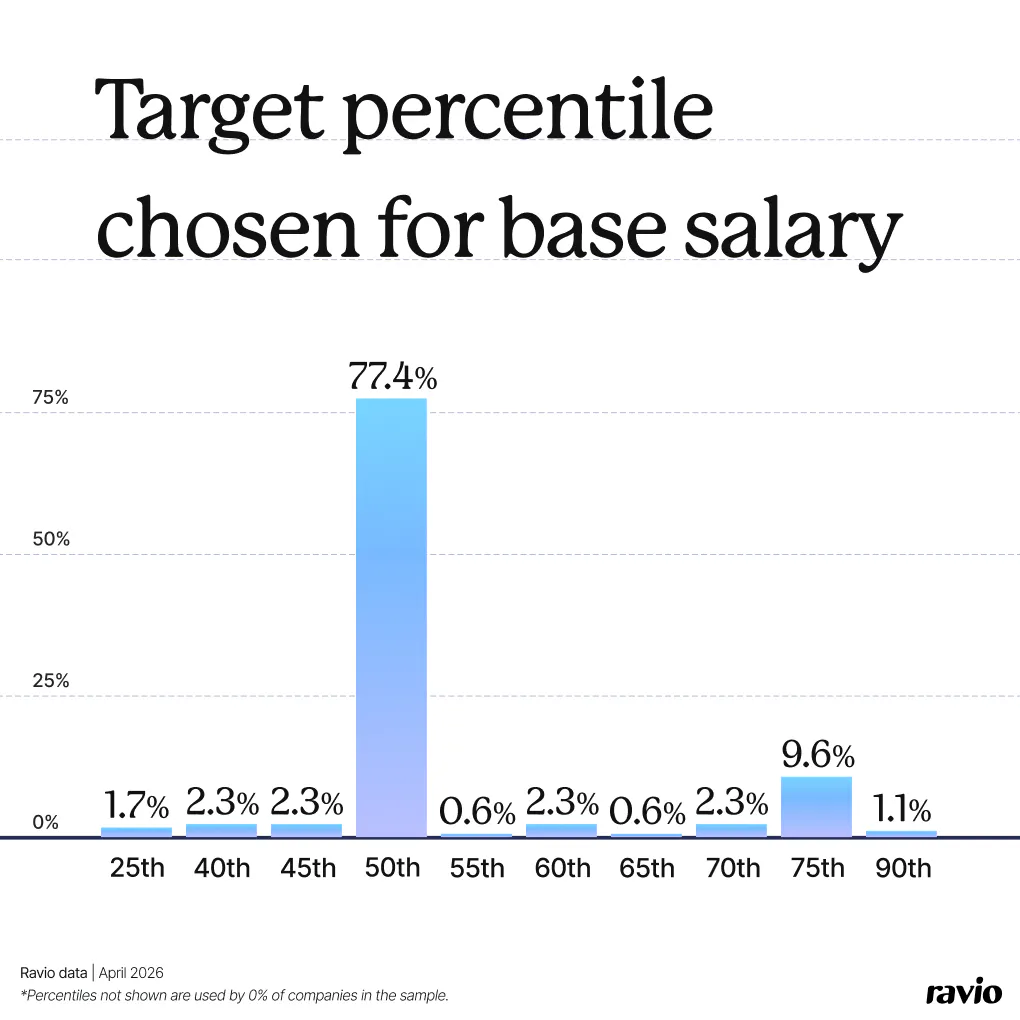
It’s a resounding answer of “the market median” – 77% of companies target the 50th percentile for base salary.

Of course, some clustering at the median is expected – that's what makes it the median.

But a typical distribution would show a smoother spread of companies above and below that central point. 

The degree of concentration we see here, with 77% of companies sitting exactly at the 50th percentile, is more extreme than you'd expect from a purely market-driven outcome, and suggests the median has become something of a default choice in compensation design.

Ravio data: target percentile chosen for base salary

For Jurgita Dainovskaja, Compensation & Benefits Principal at TransferGo, this finding is as expected: “The 77% number doesn't surprise me. The median has become a mantra. Companies repeat "we pay at market" and leave it there.”

Matt McFarlane, Director at FNDN highlights that this points to a lack of strategy on pay positioning. “Most of those 77% of companies will never have made an active choice to be at the median,” says Matt.

“The 50th percentile is the comfortable middle, the position that lets a company say 'we pay fairly' without anyone asking too many questions. Most companies land there without interrogating the alternatives and thinking about what paying above or below market could unlock for them.”

Some companies are doing just that, but the data shows it’s a slim proportion – the next most common choice is the 75th percentile at 9.6% of companies, followed by the 60th (2.8%) and 70th (2.3%), all choosing to lead-the-market with more competitively positioned salaries.

And a much smaller share (around 6% of companies in total) target below the median on base, spread across the 25th, 40th, and 45th percentiles. 

"If most companies are sitting at the median, then for any in-demand talent segment, median effectively means you're behind."

Joey Choy

Joey Choy

Matt is clear that this can be the right call:  “Paying below the 50th percentile isn’t a dirty word – it can be a strategic choice.”

“If a company has a strong employer brand, strong career development prospects, or a mission that people care about, they can attract solid candidates with lower cash. That’s a legitimate trade, and it doesn’t mean you're being cheap. It means you've thought about what you offer beyond salary and priced accordingly."

It’s also common for companies to apply different positioning for different roles. “The most strategic and financially sustainable companies take a differentiated approach to target percentiles,” explains Alistair Fraser, Founder of Justly. “You might see a company anchor overall at the 50th percentile, but flex to the 65th or 75th for hard-to-hire roles, and down to the 40th or even 25th where supply is strong.”

“If you can attract and retain the talent you need at the 25th percentile, that is your market rate,” Alistair explains, “but telling an employee they sit at the 25th percentile is a much harder story to land. There has to be an explanation of how you benchmark, and how that balances against what the business can sustainably afford.”

Jurgita agrees that positioning is as much a communication challenge as anything else, and flags that this is only going to intensify. 'With the EU Pay Transparency Directive around the corner, companies will have to explain their positioning to employees, not just to the Reward team. Those who already have a clear rationale will be ahead.'"

"Most companies land at the median because they've never actually interrogated the alternatives, or thought about what paying above or below market could unlock for them."

Matt McFarlane headshot

Matt McFarlane,

Director at FNDN

How does typical pay positioning vary by industry?

When we break the pay positioning data down, two cuts show meaningful variation from the overall picture: industry and funding stage.

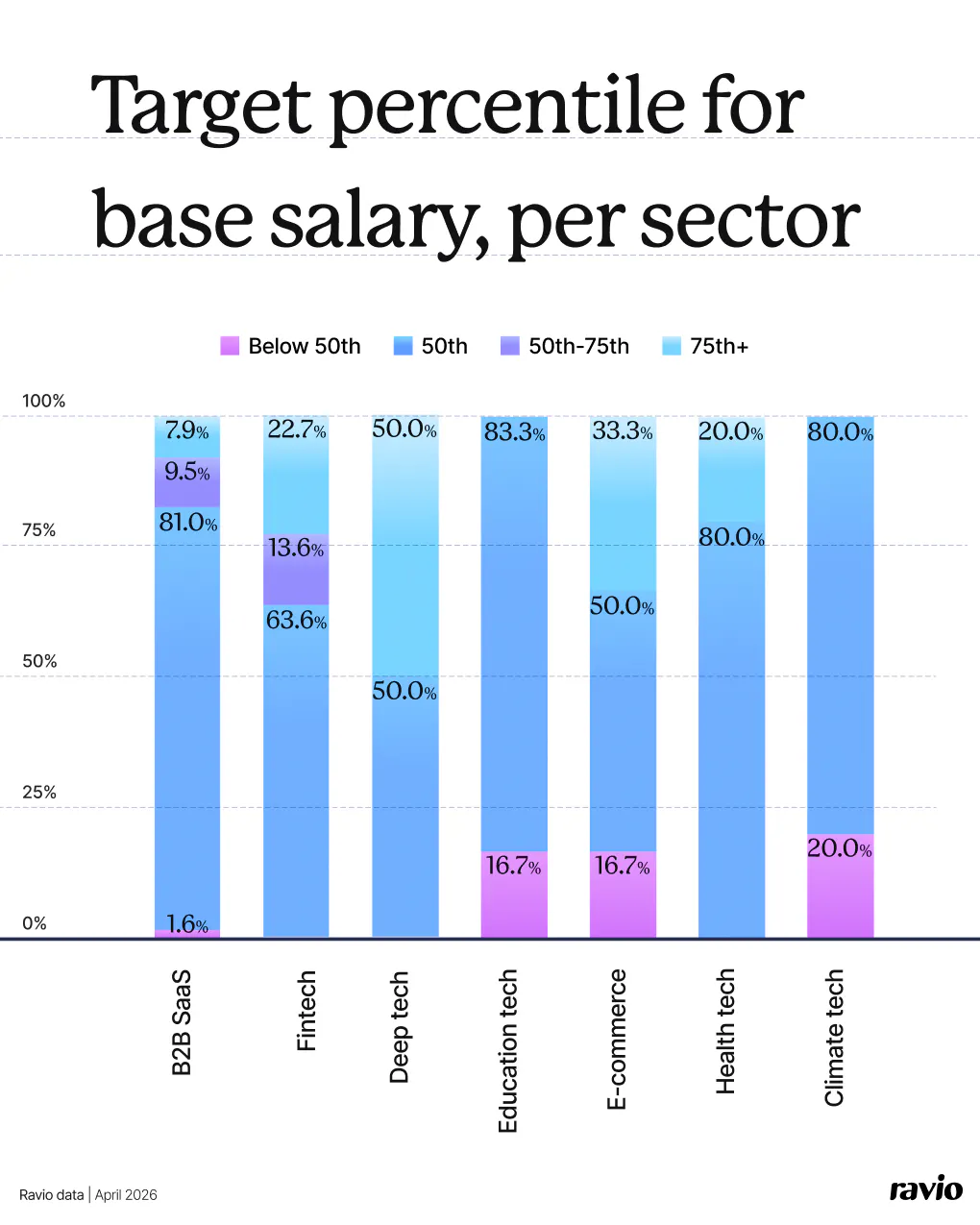
Looking per industry, deep tech stands out as the most competitive industry for base salary positioning, with 50% of companies targeting the 75th percentile or above. Only 50% of deep tech companies sit at the median – the lowest of any industry analysed. 

And fintech follows a similar pattern of market-leading pay positioning, with 36.3% of companies targeting above the median on base – 13.6% between the 50th and 75th, and 22.7% at the 75th or above.

Ravio data: target percentile for base salary, per sector

In the case of deep tech, the above-median cash positioning likely reflects the concentration of AI companies within deep tech, where leaner teams with highly competitive compensation are the norm – where demand has surged and salaries command a meaningful premium. 

For Joey Choy, the high demand for AI skillsets is largely responsible for this: "Candidates in this space have strong alternatives, including Big Tech. So it's a fairly direct trade-off: pay more upfront to reduce friction and secure talent faster."

But Santiago Gómez Fernández, Global Compensation & Benefits Specialist, at Amfresh, flags that leading the market on cash carries its own risks if not managed carefully.

"Leading market positioning is risky at scale, and should always be correlated with business strategy – whether that's growth or cost control," he explains. "It can drive wage inflation if not properly linked to value creation."

For Santiago, the discipline is in being able to objectively justify why specific roles warrant above-median positioning. “Pay positioning is all about context,” he explains, “We need to know deeply how the business operates, how value is created, and what the organisation wants to achieve – and the nuances of that across business units and roles may influence what we consider to be critical positions.” 

Jurgita Dainovskaja leads the Compensation & Benefits function at fintech TransferGo, and sees clear reasons for the sector’s higher pay positioning: "Fintech is particularly sensitive to talent attrition. When you need to ship product fast, you need the best people – and those people aren't job-hunting. You're going after them, which means a higher price."

"Fintech companies also regularly compete for global talent, and that competition naturally pushes positioning up,” she further explains.

“The willingness to pay above market median isn't random – there's a clear business case behind it: speed to market, scarcity of the profiles you need, and a global talent pool setting the floor."

At the other end, climate tech (20% below median), education tech (16.7% below median), and e-commerce (16.7% below median) have the highest shares of companies lagging the market on base salary.

“The willingness to pay above market median in fintech isn't random – there's a clear business case behind it: speed to market, scarcity of the profiles you need, and a global talent pool setting the floor."

Jurgita Dainovskaja

Jurgita Dainovskaja

Compensation & Benefits Principal at TransferGo

Of course, employee compensation is more than just salaries.

But the trend continues if we look at total cash. 

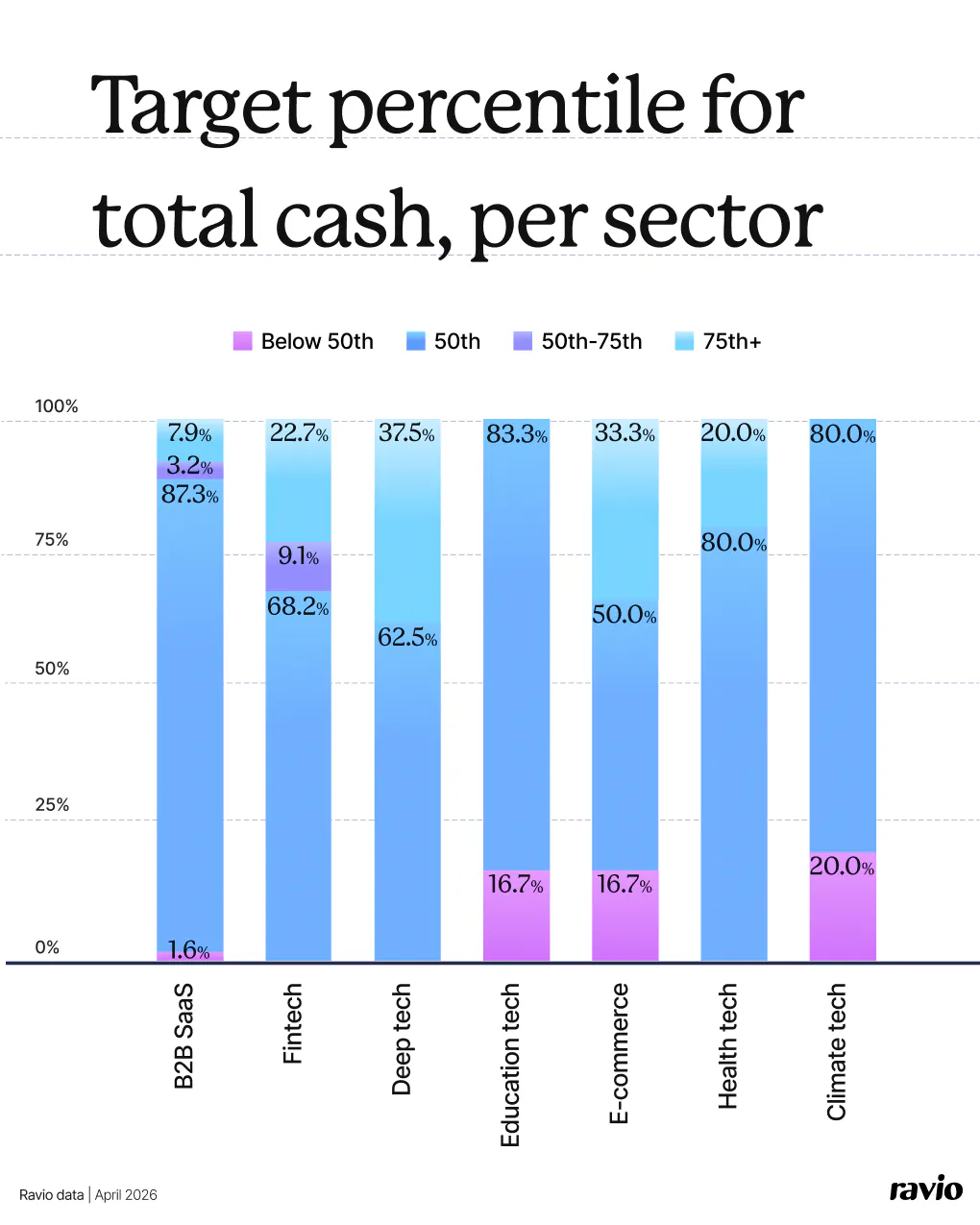
The vast majority of companies target the 50th percentile – with e-commerce, education tech, and climate tech again the most likely sectors to position their total cash below the market median. 

Ravio data: Target percentile for total cash, per sector

And deep tech and fintech (the two industries leading on base) also maintain their above-median positioning on total cash, with 37.5% of deep tech companies and 31.8% of fintech companies targeting above the median. 

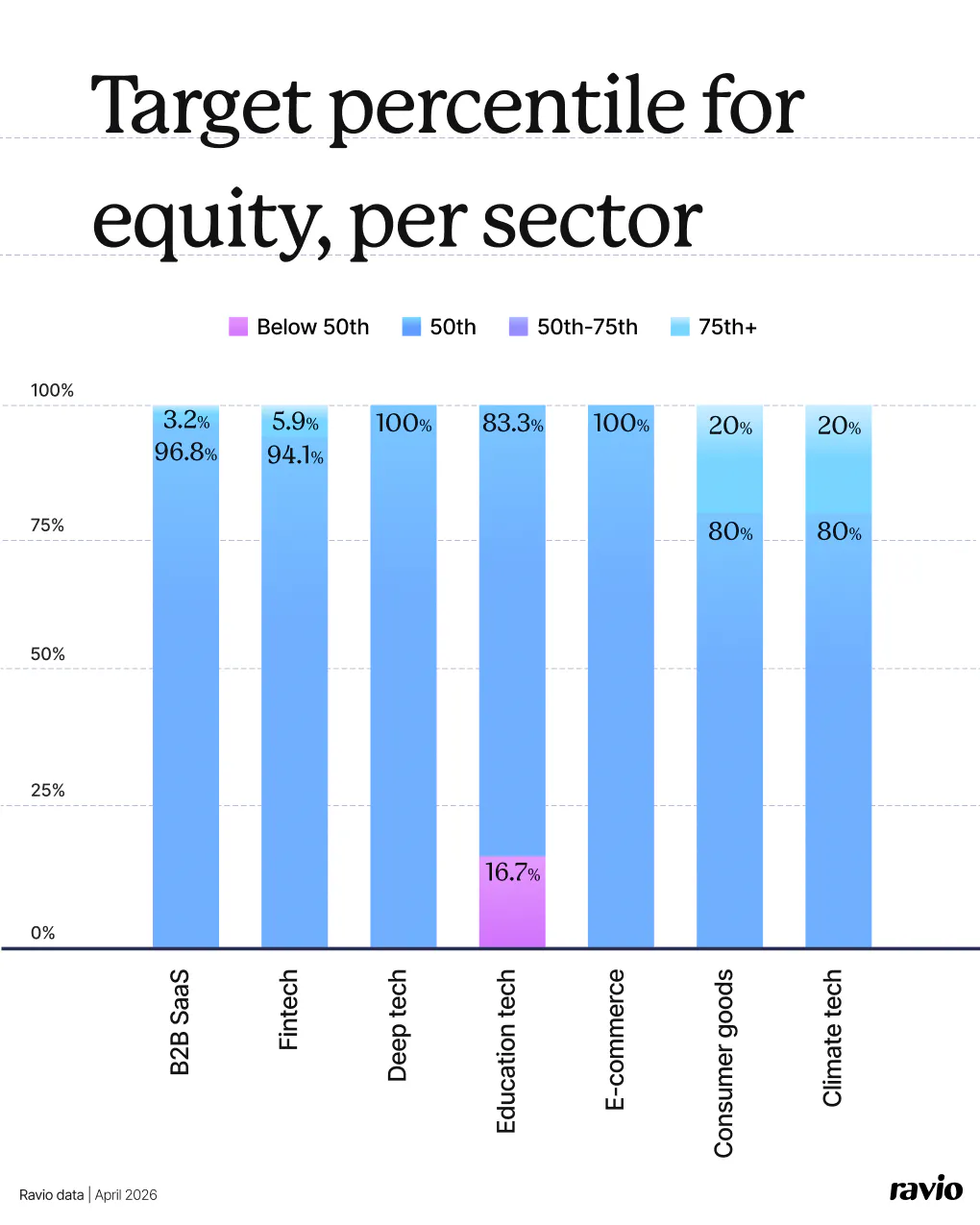
The same isn’t true for equity compensation – 100% deep tech companies target the median for equity, and 94.1% of fintechs, so these companies aren’t using equity as a lever to compete.

For Joey Choy, the fact that companies tend to compete on base and total cash together – and leave equity at the market standard – reflects a missed opportunity.

"There's more room to use variable pay and equity in a more targeted way, depending on stage and talent profile,” she says. “Companies tend to move base and total cash together, which is simple, but often underutilised from a design perspective."

Interestingly, it’s climate tech which has the most competitive positioning for equity, with 20% of companies target the 75th percentile or above for equity. Unlike e-commerce and education tech, climate techs are compensating for market-lagging salaries by using competitive equity as a lever.

But the most interesting differences in equity market positioning can be found when we break the data down by funding stage. 

Ravio data: Target percentile for equity, per sector

But the most interesting differences in equity market positioning can be found when we break the data down by funding stage. 

How does typical pay positioning vary by funding stage?

Funding stage shows the clearest variation in pay positioning of any cut we've analysed.

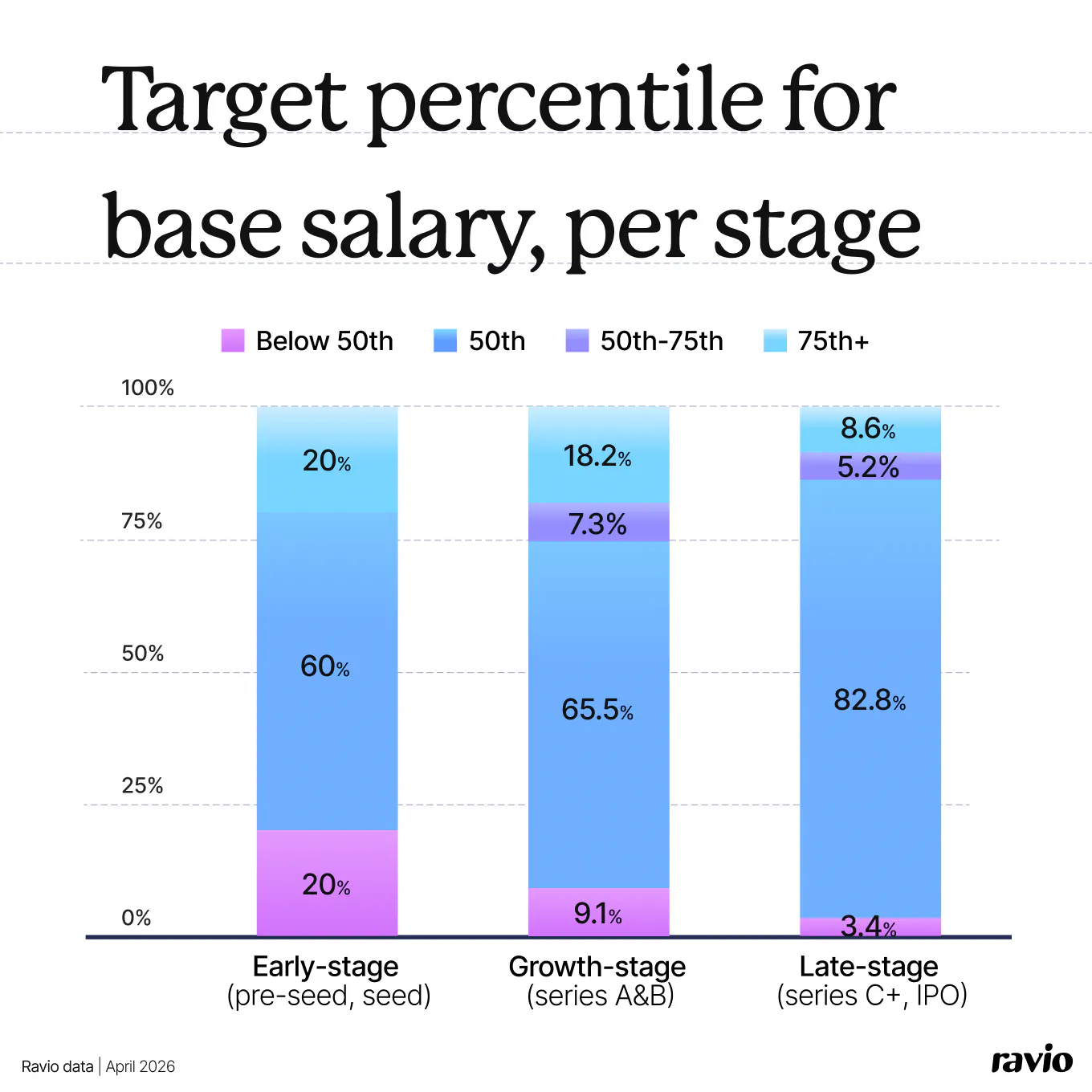
Early-stage companies (pre-seed and seed) are the most spread across the range of target percentiles for salaries – 60% target the median on base, but 20% target above the 75th percentile and 20% target below the median.

It's the only stage where a meaningful share of companies are both leading and lagging the market in roughly equal measure – a smoother distribution curve around the median, rather than a sharp spike at 50th percentile. 

As companies mature, there’s a clear regression towards the mean. 

At growth-stage (Series A and B), 65.5% target the median for base pay, with 18.2% at the 75th or above and 9.1% below. 

By late-stage (Series C+, IPO), 82.8% are at the median, with 8.6% at the 75th or above and just 3.4% below, and we see the same trend with total cash too. 

Ravio data: Target percentile for base salary, per stage.png

A change in pay positioning is to be expected as a company’s scale changes. In fact, Matt McFarlane recommends that “companies need to revisit the question every time their context shifts.”

“Your situation changes. Your funding changes. The market changes. What made sense at seed might not make sense at Series B,” he explains, “so market positioning shouldn’t be just a reactive conversation when someone complains about their salary.” 

Alistair Fraser agrees, and again flags the importance of communication if (and when) that happens: “You might move from targeting the 75th percentile to the 50th as your financial constraints change or as the business matures. But when you do that, you need to update your compensation philosophy and be ready to explain why.”

For Jurgita, this pull toward the median once a company reaches scale reflects a move towards greater clarity. “I think part of it reflects a growing need for internal pay equity as companies scale,” she says. “At 500+ people, ad-hoc positioning decisions from earlier stages start creating visible pay gaps. The pull toward the 50th percentile isn't always passive – sometimes it's a deliberate move to clean up legacy inconsistency.'"

"As the business matures or financial constraints change, you might move from targeting the 75th percentile to the 50th, or vice versa. Whenever those changes are made you must update your compensation philosophy and be ready to explain why."

Headshot: Alistair Fraser, Rewards Consultant and founder of Justly

Alistair Fraser

Founder of Justly

What about equity positioning across funding stages?

The pattern shifts when we look at equity. 

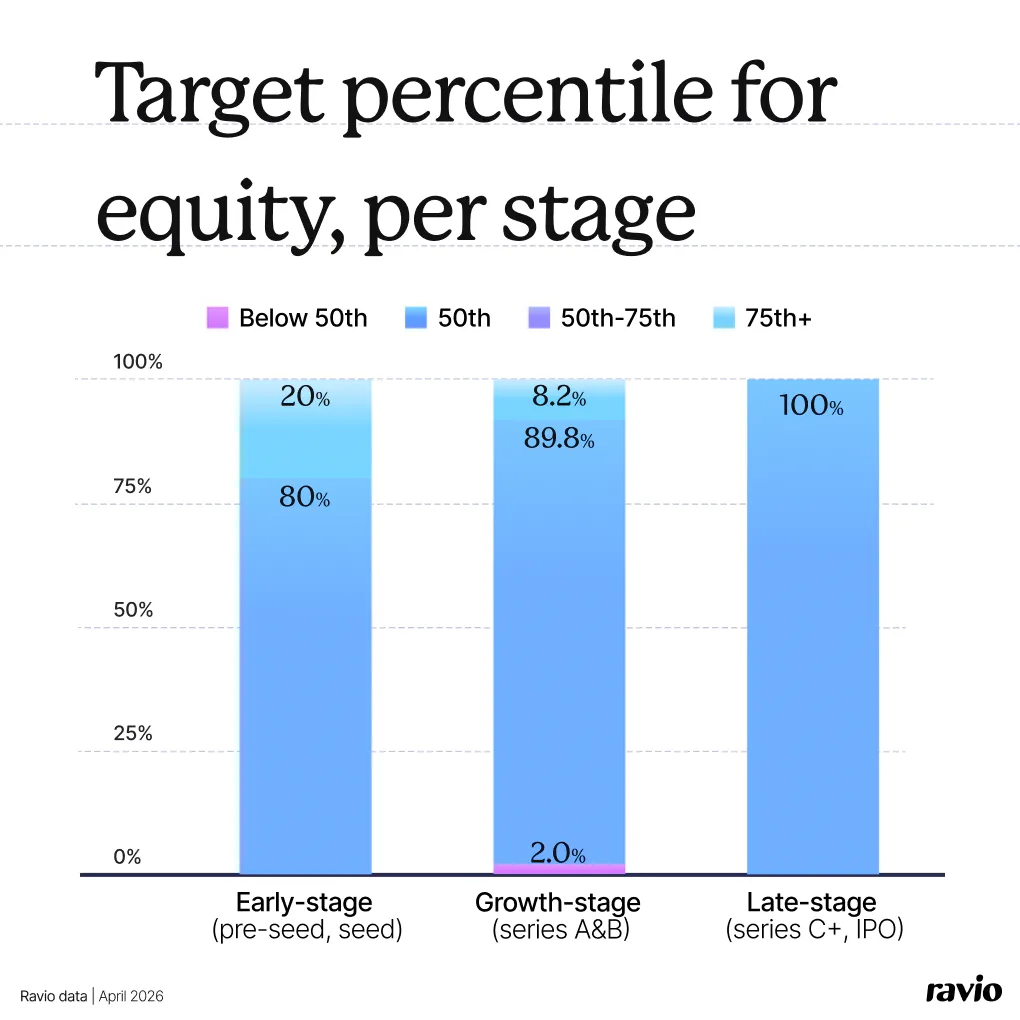
Early-stage companies are the most likely to target above the median on equity – 20% target the 75th percentile or above, compared to 8.2% at growth-stage and 0% at late-stage, where equity positioning is 100% at the median.

Ravio data: Target percentile for equity, per stage

This is in-line with the early-stage reality: with less cash available, ownership becomes a core lever for competitive total compensation.

But, Matt McFarlane does caution that this trade-off is getting harder to make.

"The old early-stage playbook was straightforward: if you can't compete on cash, compete on equity. But that playbook is getting harder to run, because candidates have watched friends hold options in companies that never exited, or saw their equity diluted into irrelevance. The perceived upside has changed."

"That doesn't mean equity is dead as a lever. But it does mean companies have to be more deliberate about how they use it – you can't slap a big option grant on a mediocre salary and expect candidates to be excited. The cash has to be defensible first, and it has to be a candidate who is still willing to trade for their belief in the potential upside."

What do these findings mean for your compensation design?

The data paints a consistent picture: for most companies, across most markets and compensation elements, the 50th percentile is the default. 

For many, that’s the right answer – the median exists for a reason.

But analysing by industry and funding stage tells a more nuanced story. 

Deep tech and fintech companies are actively leading the market on cash compensation to attract top talent; early-stage companies are the most likely to use equity as a differentiator with their higher risk profile and lower budgets. 

In both cases, the common thread is context: a clear reason to position differently, and a deliberate choice to do so.

Every expert we spoke to came back to the same underlying message: pay positioning is only valuable when it's a deliberate strategic choice, not a default. 

Here's what strategic pay positioning looks like in practice: 

  • Don't default to the median – interrogate what makes sense for your unique context. The median isn't wrong, but landing there without asking why, what it unlocks, and what it costs you, is. That means questioning assumptions regularly, not just when someone complains about their salary, and being honest about the trade-offs that sitting at median actually involves.
  • Set positioning by role, not by company. Multiple experts highlighted that the most effective approach isn't a single target percentile applied across the board. Lead on talent-scarce, business-critical roles; lag where supply is strong and other levers compensate. Focus budget investment on the roles where winning or losing talent has the highest business impact.
  • Anchor decisions in your hiring reality. Benchmarks give you market insight, but that has to be supplemented by your reality. Joey Choy's advice: "Ask yourself where are you losing candidates today because of being out-competed on compensation – that should drive positioning more than a top-down view of ‘we want to be at X percentile’.” 
  • Revisit positioning every time your context changes. As Matt McFarlane puts it: "What made sense at seed might not make sense at Series B." Pay positioning shouldn't be a set-and-forgotten decision.
  • Think beyond base salary. Where companies do go outside of the market median, it’s in base and total cash. There's room to differentiate through equity – particularly at earlier stages where cash is constrained – though as Matt McFarlane flags, this requires the right kind of candidates and solid communication. 

Methodology

These insights are produced by analysing the target percentiles set by Ravio customers who have completed our Bands module set up, to understand the common approaches taken when building market-informed compensation bands for base salary, variable pay, total cash, and equity. 

Users of Ravio Bands define their target percentile – used to determine the midpoint for their compensation bands. Every time a new company onboards onto the Bands module, the user is prompted to edit their target percentile (set at 50th percentile as default) to align with their compensation philosophy. 

Target percentiles reflect each company's chosen benchmark peer group – which can be filtered by industry, location, funding stage, and company size, which means a company targeting the 50th percentile is often aiming for the median of their specific relevant talent market, not the median of all companies in Ravio's dataset.

FAQs

What is pay positioning? 

Pay positioning is how a company sets employee salaries relative to the market – typically expressed as a target percentile against benchmark data. For example, targeting the 50th percentile means aiming to pay at the market median for a given role and level. It's a core component of compensation design, shaping how competitive your pay is against peers and talent competitors.

What is a percentile in compensation and benefits? 

A percentile in compensation indicates where a salary sits relative to the market. If the 50th percentile for a role is £60,000, half of companies pay below that and half pay above. The 75th percentile represents the top quarter of payers for that role. Percentiles are used to set target pay levels and salary bands (often called ‘target percentiles’), and to assess whether employee salaries are competitive.

What is the most common target percentile used in compensation design? 

The 50th percentile – the market median – is by far the most common target percentile. According to Ravio's compensation data, 77% of companies target the 50th percentile for base salary, rising to 80.8% for total cash, 95.1% for variable pay, and 95.2% for equity.

How do other companies approach market positioning for pay? 

Most companies target the market median across all compensation elements. Ravio's data shows 81.5% of companies target the 50th percentile consistently across base salary, variable pay, and equity. The second most common approach – used by just 4.3% of companies – is to lead the market on base salary (75th percentile) while staying at the median for variable and equity.

What does the 50th percentile mean in compensation? And the 75th percentile? 

The 50th percentile means paying at the market median – exactly in the middle of what companies pay for a given role and level. The 75th percentile means paying in the top quarter of the market, a lead-the-market position. According to Ravio's data, 77% of companies target the 50th percentile for base salary, while 9.6% target the 75th percentile or above.

How many companies pay at the 25th percentile? 

Very few. According to Ravio's compensation data, just 1.7% of companies target the 25th percentile for base salary – and the pattern is similar for variable pay (1.2%) and equity (1.2%). Lagging the market this significantly is rare, and typically only justifiable with a strong offsetting total rewards offer.

How many companies pay at the 75th percentile? 

9.6% of companies target the 75th percentile or above for base salary, according to Ravio's data. For total cash it's 9.0%, dropping to 4.3% for variable pay and 4.2% for equity. Leading the market on pay is more common on base salary than on any other compensation element.

How does market positioning fit into compensation design? 

Pay positioning is one of the foundational decisions in compensation design – it determines how competitive your salaries are against the market and shapes your ability to attract and retain talent. It should be set as part of a broader compensation philosophy that also defines which total rewards elements to prioritise, how to weight them against each other, how geography and performance factor in, and the principles that ensure pay stays fair and consistent across the organisation. As Ravio's data shows, most companies default to the market median – but the right market positioning depends on your specific context and goals.


Get the Compensation Review straight to your inbox

Your monthly dose of market insights and expert perspectives

You might also like