
Compensation reviewsCompensation strategy
Ravio Breakfast Club London: Comp planning for 2027
Join us for the launch of our Comp Trends 2027 report, fresh off the data.

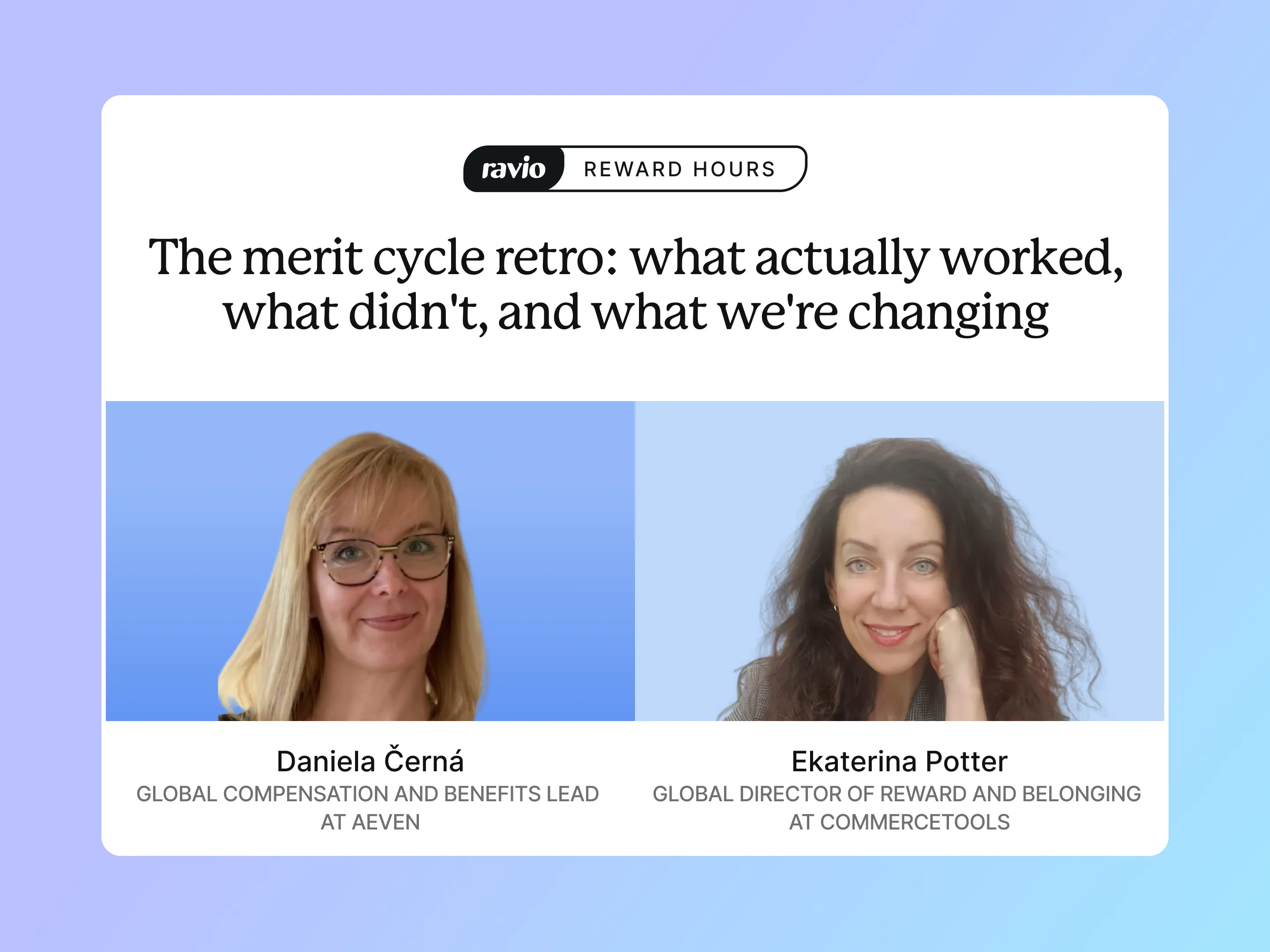
Most merit cycles look cleaner on paper than they do in practice.
The timeline slips. Managers rate everyone highly. Someone who deserves a raise is already at the top of their band. The calibration session surfaces inconsistencies you didn't anticipate. And then you're sitting across from someone explaining why their increase was lower than they expected.
Ekaterina and Daniela have both been through it – in different environments, with different challenges, but a lot of the same moments.
At commercetools, it took three cycles to get all managers genuinely involved in compensation planning. At Aeven, scaling the process across four countries meant dealing with headquarters resistance and managers who were making too many adjustments outside the provided range.
This session was a retro, not a best-practice walkthrough. They covered:
If you're more of a reader than a watcher, here are a few of the most interesting insights from Ekaterina and Daniela's discussion on merit cycle retrospectives.
A merit cycle that tries to please everyone is usually one that doesn't have a real strategy behind it. When budget is finite, difficult trade-offs are unavoidable – and making them well requires a clear philosophy about what the cycle is actually trying to achieve.
Using a performance-by-position-and-range matrix anchors decisions in data: the highest performers who sit lowest in their salary range receive the largest increases, and vice versa.
Once that logic is explained, most managers can follow it. The tension comes not from the framework itself, but from what sits outside it – lump sum payments instead of increases for those above range maximum, and pushback from managers who want to compensate for inflation rather than market rates of labour.
Having those guardrails written down, and training managers on them before the cycle opens, doesn't eliminate difficult conversations. But it does mean managers can have them with confidence.
One of the most practical challenges discussed was fragmented data – employee records, allowances, promotion history, performance ratings, and talent assessments all sitting across different systems, meaning managers have to piece together context themselves before making any decisions.
The fix: a merit tool that consolidates everything into one place, so managers enter the cycle with a complete picture of each employee rather than working from partial information. That kind of tool often becomes useful beyond the cycle itself, giving managers a single reference point for compensation decisions throughout the year.
The broader point: the quality of decisions made during a merit cycle is only as good as the data managers can see when they make them.
Both speakers run pay equity analysis well ahead of their merit cycle opening – not as a post-cycle audit, but as something that actively shapes how budget is allocated in the first place.
The approach: start identifying gaps across teams from October – long-tenured employees whose compensation hasn't kept pace with new hires, gender pay gaps, roles where the market has moved faster than internal ranges. Where significant gaps exist, budget is pre-allocated to address them before managers open their planning tools.
It's also worth building pay equity flags directly into the merit tool itself, so managers are prompted to review and justify any cases where someone remains underpaid even after their proposed increase.
💡 Practical application: Run your pay gap analysis early enough to influence the budget conversation, not after it's closed. A pay equity problem discovered post-cycle is much harder to fix than one built into the process from the start.
Both speakers run structured enablement sessions for managers before the cycle opens – covering the tool, the process, the philosophy, and the scenarios they're likely to face.
One approach is a dedicated one-hour session where managers work through the tool in real time before it goes live.
Another is providing soundbites for specific scenarios: what to say to someone who receives a lump sum instead of a salary increase, or to someone who receives nothing at all.
The common failure mode is giving everyone the same increase to avoid difficult conversations, or pointing to the rewards team when challenged – serves no one. Good enablement doesn't eliminate that risk entirely, but it reduces it.
Your monthly dose of market insights and expert perspectives
Join us for the launch of our Comp Trends 2027 report, fresh off the data.

Join us for the launch of our Comp Trends 2027 report, fresh off the data.

Join us for the launch of our Comp Trends 2027 report, fresh off the data.

