Comp review season lands and, almost immediately, the promotion conversations start.
Managers want to advocate for their team's career development. Employees who've had a strong year expect their growth to be recognised. HR knows that career progression is a vital lever for retaining great employees.
So it feels natural – efficient, even – to deal with performance reviews, compensation adjustments, and promotions all in one process.
But bundling promotions into your merit cycle can often create a set of predictable, avoidable problems.
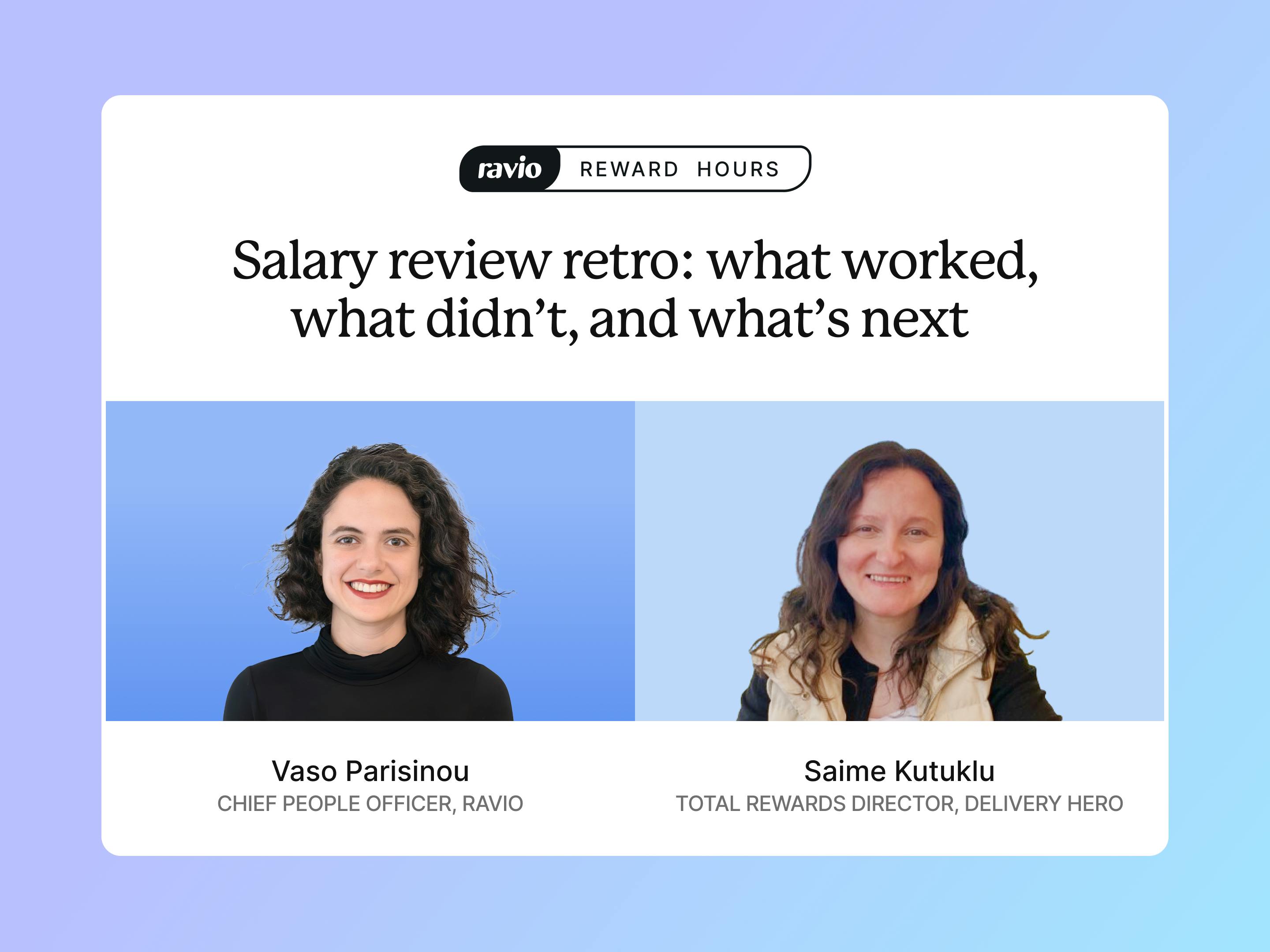
Saime Kütüklü has seen this play out first-hand.
As Director of the central Total Rewards team at Delivery Hero, one of the world's largest food delivery platforms, she's spent years untangling promotions from the merit cycle – and building something more intentional in its place.
Over time, promotions had stopped being a structured decision and started feeling like an expectation that happens to high performers at review time.
"We wanted to make sure that the merit cycle is a merit cycle," she says, "and that promotions are in alignment with our business plan and organisation structure."
Here's what that looked like in practice – the problems it solved, what a standalone promotion process actually requires, and how to decide what's right for your organisation.

Why promotions typically get entangled in compensation reviews
For most companies, the compensation review is the biggest people process of the year.
Performance is assessed, career progression is discussed, pay adjustments are decided – all at once, all with the same stakeholders in the room.
It's easy to see how promotions end up in the mix.
For employees, the logic feels obvious: if my performance has been strong and I’m progressing in my level, then surely this is the moment that progression should be recognised too.
For managers, the comp review is often the one structured opportunity they have to advocate for their people – and promotion is one of the most powerful things they can offer.
So most organisations end up handling promotions and compensation review decisions in the same breath.
For many organisations, that entanglement works just fine.
But, it can make it harder to be truly intentional about either – which is exactly what Saime found at Delivery Hero.
What goes wrong when promotions are tied to your comp review
When promotions are handled as part of the compensation review, they quickly start to feel like an expectation – something that’s always on offer to high performing employees during the review period, almost automatically.
For employees, that means self assessments become an exercise in justifying a promotion (and the salary bump that comes with it), rather than honestly reflecting on performance in their current level and what career development might look like for them.
For managers, it means the pressure is on to ensure their team members are included in that promotion run.
“It was always: I need to promote all of my team,” says Saime.
If those promotions are granted purely based on employee performance and progression, then it can easily cause structural issues – because organisational readiness hasn’t been factored into the equation.
“If everyone is promoted regularly the the job levels in the organisation keep going higher and higher all the time,” Saime explains. “Having everyone in a senior role isn’t always what the organisation actually needs, and it comes with big cost implications for payroll too.”
And if managers are told they can’t grant a promotion, they also look for other ways to make up for that – asking for bigger merit increases or additional one-off bonuses.
“We had managers asking if they could give their employee the same level of salary increase as if they’d had a promotion, to compensate for not being able to give them a promotion,” says Saime. “So no promotion, but the cost impact would still be there.”
When promotions have their own process, each conversation gets to do what it's actually for.
The compensation review focuses on performance and market positioning, for all eligible employees.
Promotions become a separate, deliberate decision, rather than something that happens by default at review time.
For Delivery Hero, promotions now explicitly require both individual readiness and role and organisational readiness – meaning that the business actually requires that job role at that increased level of seniority in order to achieve its goals.
"It’s ensured that our merit cycle is a merit cycle,” she says, "and that promotions are in alignment with our business plan and organisation structure."
When that separation is in place, the conversations change. Instead of "why didn't I get a promotion in the review", it becomes a forward-looking discussion about what ‘readiness’ actually looks like – and what needs to happen to get there.
Get your monthly dose of market trends and expert insights, delivered to your inbox 📧
Building a promotion process that works for your organisation
Separating promotions from the merit cycle only works if the promotion process itself is clearly defined. Without that, you've just created a gap – employees and managers still expect promotions to happen somewhere, but now there's no structure around when or why.
Define your criteria clearly
For Saime, the foundation is clear criteria.
As we've seen, at Delivery Hero, a promotion now requires two things: individual readiness and organisational readiness.
Individual readiness means the employee is already demonstrating the competencies and skills required at the next level – not just performing well in their current one.
"We are making sure that the bar has been set for the higher level role, and that the individual's competence and skills are aligned with that bar," says Saime, "and we don't compromise on that."
This is where a clear and well-communicated career progression framework becomes essential too – defining the competencies and expectations at each level (including any nuances on what that looks like per function or per role), and ensuring that's visible and understood across the organisation.
Employees know what they're working towards, managers have something concrete to reference in development conversations, and HR has the framework to push back when managers want to make exceptions.
Organisational readiness means the business actually needs that role at that level of seniority.
A high-performing employee in a role that doesn't actually need to grow for the business to reach its goals isn't a candidate for promotion at Delivery Hero. "The promotion needs to be aligned with our business plan and the organisation structure we're building towards to achieve that business plan," Saime explains.
Assumptions like "I've been here three years, I should be moving up" or "they've achieved an 'exceeds expectations' rating every cycle, so we should be promoting them" fall away when the bar is defined clearly and applied consistently.
Equip your managers
However well-designed the process is centrally, it lives or dies in the one-to-one conversation between a manager and their employee.
Managers are ultimately the ones explaining why a promotion has or hasn't been granted, what readiness looks like, and what the path forward is.
If they're not equipped to have that conversation in a way that aligns with the same message HR is communicating centrally, the process breaks down at the last mile.
That means investing time in helping managers understand not just what the criteria are, but why the process works the way it does – it took Saime’s team two years to implement this shift towards a standalone promotion process at Delivery Hero.
"We spent a lot of time communicating and making sure that managers and employees understood what we were doing and why this way of doing things is helpful for them," explains Saime. "It's taken a lot of explanation and consistent communication to get here."
Now Saime's team pushes managers to think about their team structure proactively before the year begins, as part of wider budget planning.
"We’ve been consistent in asking managers to evaluate why they actually need these promotions, why they need that level of that role in their team,” she says, “as well as how they’re going to manage it, and what the role and team structure will look like two years from now.”
“It pushes them to have real conversations about organisation structure and team development, and that’s really shown them that they don’t always need so many promotions.”
Getting the promotion pay increase right
When a promotion is granted, getting the compensation right is the final piece of the puzzle – and it’s an important one.
The instinct for many companies is to move the newly promoted employee to the bottom of their new salary band.
But an employee who has already progressed well in their current level may already sit towards the top of their existing band. Promote them to the minimum of the next one, and the actual increase can be surprisingly modest – especially if your bands overlap.
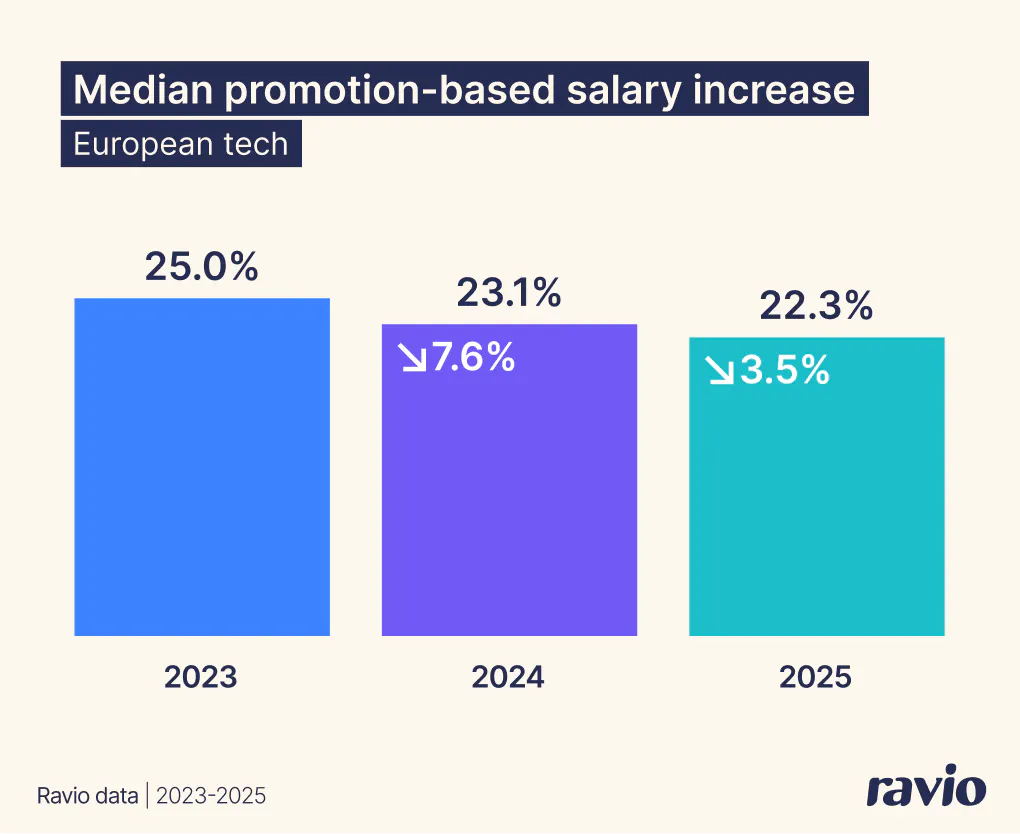
The average promotion increase in European tech is 22.3%, according to Ravio's 2026 Compensation Trends Report.
Fall meaningfully short of that and a newly promoted employee (one you've just invested in developing) may already be looking at what the market has to offer at their new level.
At Delivery Hero, the principle is to land newly promoted employees at the average pay for that level, rather than the minimum.
"We make sure that newly promoted employees move to the internal reference level," says Saime. “Whenever we hire new people, we align their salary with the average pay for that level, so we need to do the same for internal promotions.”
"When we’ve previously started them at the minimum of the range it always created an additional concern in the next pay review cycle, because managers would be asking for additional budget to catch that employee up to where others at the same level sit in band. When compensation review budgets are already limited, it’s hard to make room for those additional adjustments.”
Besides the budget implications, this also avoids issues with salary compression and internal pay equity.
When external hires are brought in at the average for a level while internal promotions start at the minimum, you quickly end up with people doing the same job, at the same level, being paid very differently. This kind of gap will become increasingly difficult to justify as legislation like the EU Pay Transparency Directive takes force.
In summary: design your promotion process intentionally, don't let it design itself
There's no single right answer on how to structure promotions relative to your compensation review. Some organisations will keep them connected. Others, like Delivery Hero, will separate them entirely.
What matters is that the choice is intentional.
When promotions happen by default, as a byproduct of review season rather than a deliberate decision, they stop serving the people they're meant to recognise or the organisation they're meant to support.
The questions worth asking are simple: does your current promotion process reflect what you actually believe about career progression? Do your managers understand it well enough to communicate it consistently? And do your employees know what readiness looks like?
If the answer to any of those is unclear, that's usually a sign the process evolved rather than was designed.