How to approach job evaluation (and which methods actually hold up to scrutiny)

Job architecturePay equity

A manager tells you their top engineer should be graded the same as a manager on another team – the impact is just as big, they argue. 

You don't have a clean way to say why they're wrong, or why they're right.

That's the problem that job evaluation solved: a shared, objective way to compare roles that doesn't depend on who's asking or how convincingly they argue it.

It's also one of the hardest structures to get right in Rewards.

As Alison Jenkins, Reward Consultant and Director at AJ Reward, puts it: "Job evaluation can be a hefty task.”

Getting job descriptions accurate enough to evaluate, calibrating out bias, keeping up-to-date as the organisation restructures over time – it isn’t quick, and it isn’t a one-and-done project.   

But it's also the most important structure in Reward. 

Everything else – market pricing, career progression, pay equity compliance – needs to be built on top of a solid job evaluation foundation.

This guide covers what job evaluation means, why it matters, the methods available, and a step-by-step approach to running it yourself – drawing on the expertise of both Alison and Luis Braga, Head of Rewards and Analytics at tonies.

What is job evaluation?

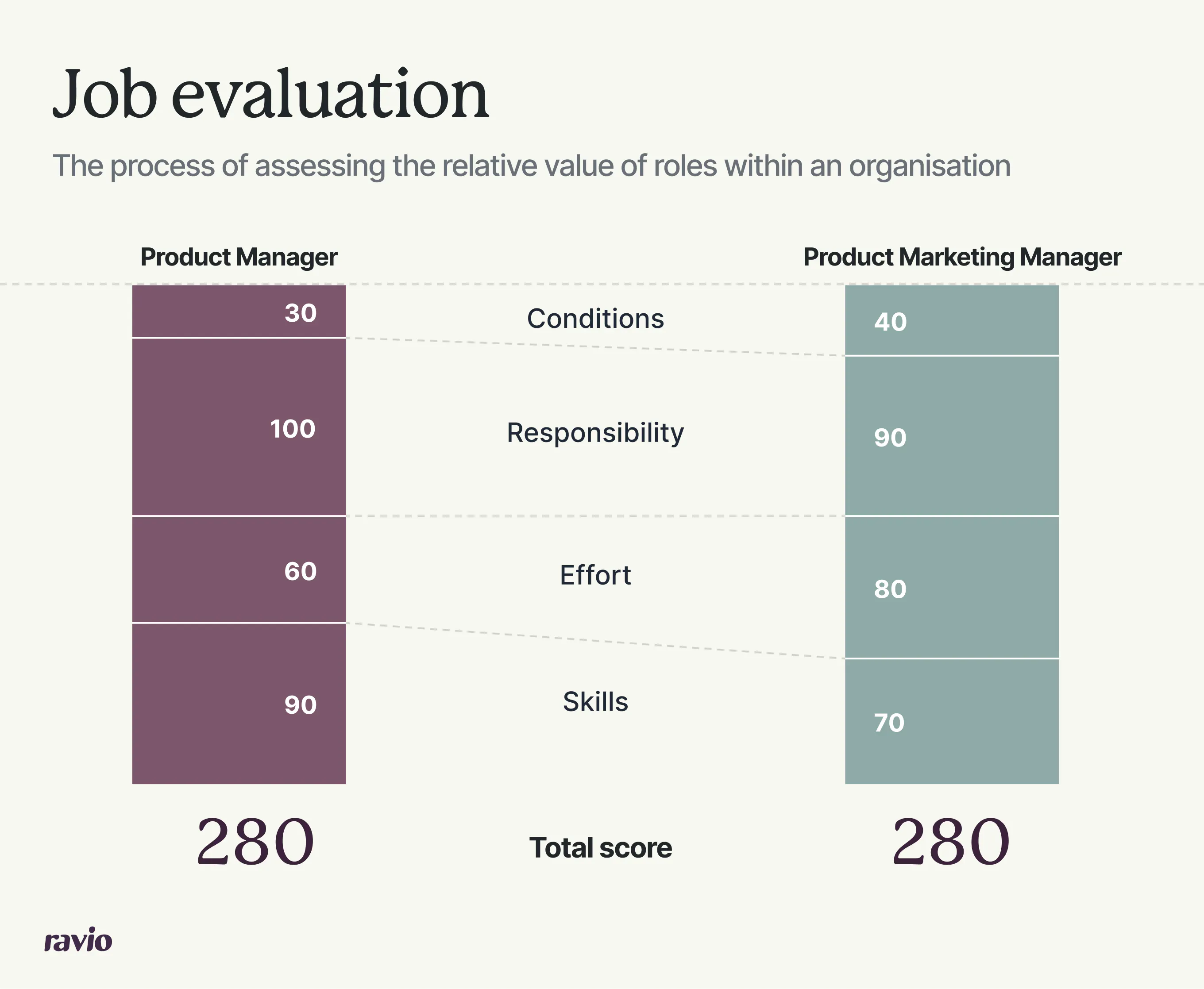
Job evaluation is the process of assessing the relative value of roles within an organisation, always based on the content of the job rather than the person doing it. 

By evaluating every role against the same, objective framework, it forms the foundation of compensation decisions that are fair, consistent, and, therefore, defensible.

Job evaluation is often confused with job architecture (the overarching framework for how roles are structured) and job levelling (the seniority framework within it). 

Rob Green, Founder of Darwin Total Rewards, frames the relationship as a cascade: "It's all interconnected, but if you're looking at it simply, there's a clear cascade: job architecture sits at the top, then comes your job roles, then levelling, then evaluation."

"It's all interconnected, but if you're looking at it simply, there's a clear cascade: job architecture sits at the top, then comes your job roles, then levelling, then evaluation."

Headshot: Rob Green

Rob Green

Founder, Darwin Total Rewards

Why job evaluation matters

Job evaluation matters because it gives you an objective basis for decision making. 

Without that objective basis, organisational and compensation decisions default to things that have nothing to do with a role's actual value.

Fair pay is the most obvious example of this in practice. 

Pay equity means equal pay for equal (value) work – and if you don't know which roles are actually of equal value, you have no real basis for knowing whether you're paying fairly. 

Where two roles might score the same in a job evaluation, but if you’re paying them based on market benchmarks – where historically male-dominated roles typically have higher rates – and on the individual’s negotiation during hiring – where men tend to negotiate harder than women – then you’ll end up paying those comparable roles very differently.

This is exactly the standard that legislation like the EU Pay Transparency Directive now requires organisations to meet, and market rate alone isn't accepted as a justification for a pay difference under it.

But the benefit of job evaluation isn't limited to pay alone.

The same objective basis that informs fair pay decisions also informs workforce planning, hiring, and promotion decisions – telling you which roles are critical to the business, to enable better budget calls.

Job evaluation

Job evaluation methods: analytical vs non-analytical

Job evaluation typically falls into one of two categories: analytical or non-analytical – and one category is much more robust than the other for driving fair outcomes.

Non-analytical methods of job evaluation

Non-analytical methods compare whole roles against each other, reaching a qualitative judgement on their overall perceived relative value rather than breaking either role down into separate, measured criteria. 

In Alison's experience, many companies use a non-analytical approach to job evaluation. 

“Most often they’re doing a form of what I would call ‘mapping’,” she explains. “Build an internal framework of descriptors that make sense for the company, and then map every role into that framework for internal relativity.” 

It’s quick and straightforward, and so many companies rely on non-analytical approaches like this.

But, it uses criteria whose answers are qualitative in nature versus quantitative, which may be considered subjective.

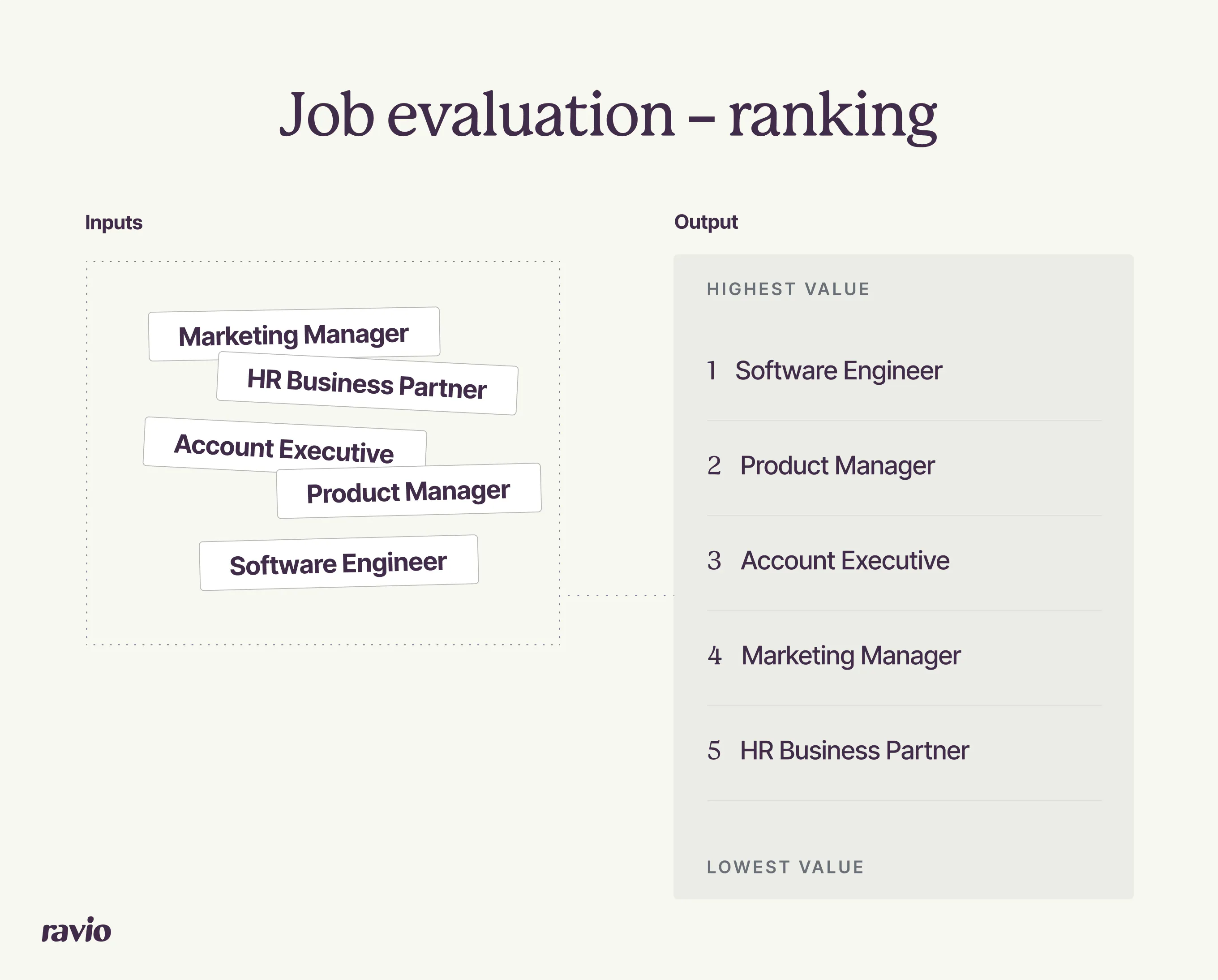
Luis also points to the ranking method, where roles are ordered by perceived overall value, either slotted directly into a hierarchy or compared in pairs – this role versus that one, repeated across the organisation until a rough order emerges. 

Job evaluation methods: ranking

Again, it’s simple, but not robust. 

"It's building a backbone structure and slotting roles in by perception," says Luis. "Fast, but vulnerable to politics and negotiation, and lacks any of the rigour that supports accuracy." 

However good your descriptors are, non-analytical methods are always reliant on judgement, and that judgement is vulnerable to inconsistency and bias – negating the purpose of job evaluation, especially in the context of the EU Pay Transparency Directive.

Analytical methods of job evaluation

In contrast, analytical job evaluation methods aim to break a role down into specific, measurable components – skills, responsibility, effort, or other factors an organisation defines – and scores each factor individually.

Luis distils the core factors that need to be included to three: "Know-how – what knowledge and experience the role requires. Problem solving – what proportion of that know-how goes into solving problems. And accountability – what results the role is responsible for generating within a specific autonomy."

Rather than making a judgment call on how each role as a whole compares to each other, analytical job evaluation aims to create an objective way to compare roles against the factors that determine business value. 

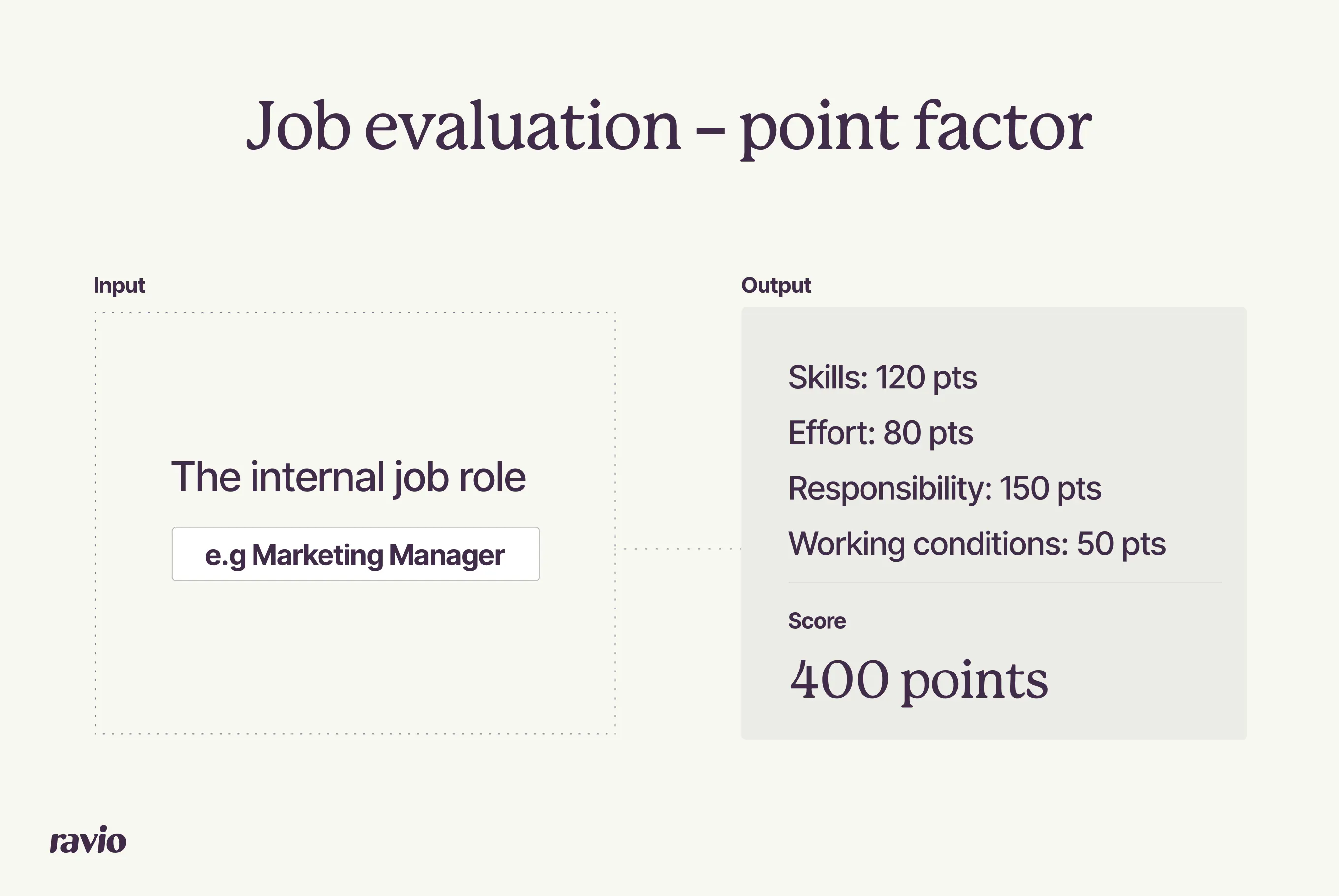
Point factor is the most common analytical method. 

Under the point factor method, a set of factors is defined and then weighted – some factors may be deemed more important than others. Every role is then scored against each of those factors, and the scores are totalled to enable a comparison between roles.

Job evaluation methods: point factor

It takes longer than a holistic judgement call, but it’s much harder to argue with.

This is also why point factor has been widely recommended as the most robust approach to job evaluation specifically for EU Pay Transparency Directive compliance. 

“With point factor you get fairness across the whole organisation, without qualitative judgement,” Alison explains. “It’s why it wins for equal pay purposes, because it’s much more likely to hold up in court as a robust, explainable approach to setting pay.” 

Alison does warn, though, that even with an analytical approach like point factor, it's still possible for subjectivity to reign. 

In practice, most organisations evaluate department by department – engineering first, then marketing, then the call centre – building the picture up one function at a time. That makes it easy to stay consistent within a function, but harder to notice if the same score means something different in another one. 

"You need to constantly be asking: have we done this fairly and consistently across the whole organisation, both vertically and horizontally?" Alison says. 

Luis agrees, which is why his rule for a truly analytical approach is to evaluate factor by factor, not role by role.

Score every role's "responsibility" before moving on to "skills" – not one role start to finish, then the next. It stops "high responsibility" meaning something different by the fortieth role you evaluate.

"It's not really a points system," says Luis. "It's a factors comparison methodology – you're comparing roles against each other across a defined set of factors, and building a justified rationale for each grade, not just assigning scores in isolation." 

Luis also flags that it’s important to consider talent market and business strategy alongside the analytical factors you choose. 

“A Software Engineer role might command a premium because there’s talent market scarcity currently,” Luis explains, “or because the company’s strategy is focused on overhauling the product this quarter – even if it sits at the same evaluation grade as other roles that don’t receive that premium.” 

This is a valid addition to your factors – but if it’s a short-term departure or exception from the overall approach, it’s important to document the reasoning behind those decisions, especially in the context of EUPTD compliance. 

So to summarise: non-analytical job evaluation gives you a fast, but subjective answer. Analytical takes more time, but gives you a framework for decisions you can actually defend internally and for legislative compliance too.

"With point factor you get fairness across the whole organisation, without qualitative judgement playing a role."

Alison Jenkins, AJ Reward

Alison Jenkins

Reward Consultant and Director at AJ Reward

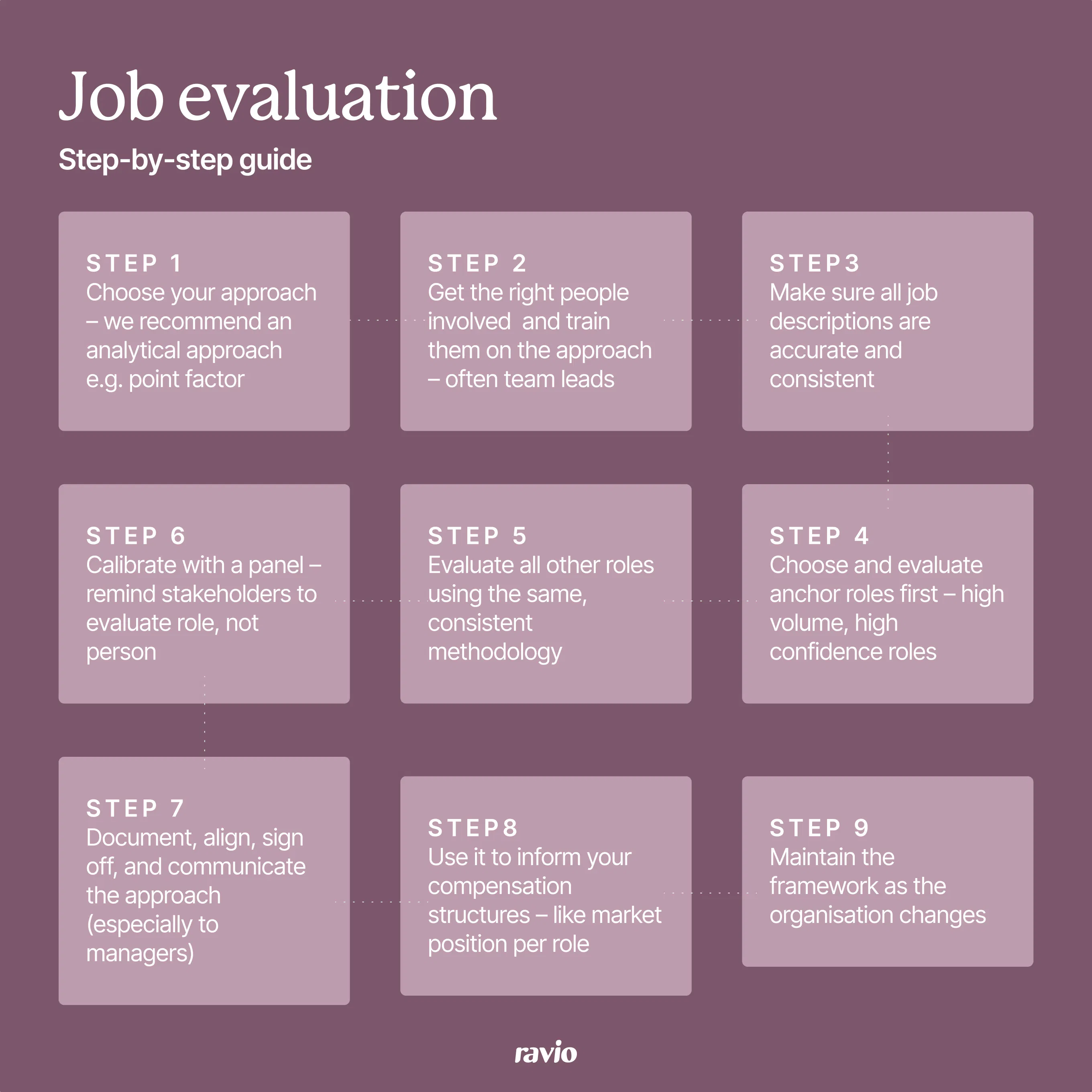
How to approach job evaluation – 10 key steps

As we’ve seen, there's no fixed formula for job evaluation.

But there is a reliable order of operations, from getting the inputs right through to keeping the whole thing accurate as the organisation changes.

That's what the steps below cover – drawing on Alison and Luis' experience running these projects, and real examples of organisations putting job evaluation into practice.

In terms of when you should implement job evaluation? Start early. "You can probably exist without structure in a small organisation," Alison says. "But once you hit 50-100 employees you need that structure in place."

Job evaluation: step-by-step guide to the process

How to approach job evaluation – 10 key steps

As we’ve seen, there's no fixed formula for job evaluation.

But there is a reliable order of operations, from getting the inputs right through to keeping the whole thing accurate as the organisation changes.

That's what the steps below cover – drawing on Alison and Luis' experience running these projects, and real examples of organisations putting job evaluation into practice.

In terms of when you should implement job evaluation? Start early. "You can probably exist without structure in a small organisation," Alison says. "But once you hit 50-100 employees you need that structure in place."

Step 1: Choose your approach

Decide which job evaluation method you’ll be adopting – and ensure alignment on that decision across all key stakeholders.

We’d recommend using an analytical approach like the point factor method because it ensures a more robust, objective system which paves the way for equitable pay decisions, as we saw previously.

But, this is inevitably a more time and resource intensive approach which, realistically, not every company will be able to commit to. 

Even Luis, who spent a decade running these projects professionally as a consultant, hasn't implemented full job evaluation at any of his last three companies. "Not because it lacks value," he says, "but because the time investment wouldn't have been proportionate to what those businesses needed at the time."

Alison makes the same point from the small-company end: "It is a heavy investment, and a small company wouldn't be able to afford it. Initially you just need to show structure. You can still be robust, but try and keep it as simple as you can."

The practical approach is to start with whatever level of structure your organisation can actually sustain, and move to formal evaluation over time. 

"A good enough framework the whole organisation understands is worth more than a precise one only Reward can use," says Luis.

Step 2: Get the right people involved

Job evaluation is rarely something one person runs alone. 

In most organisations, department leads end up evaluating the roles on their own teams – they're the ones with the closest knowledge of what those roles actually involve.

So before any role gets described or evaluated, define who's doing what: who's writing job descriptions, who's applying the evaluation methodology, who's calibrating results across teams, and who's signing off on the outcome. 

Whoever ends up being an ‘evaluator’ then needs to be trained on the approach decided in Step 1 – so that they’re equipped to apply it consistently and correctly.

A department lead evaluating their own team without that training is liable to bring exactly the kind of subjective judgement an analytical method is meant to remove, regardless of how rigorous the methodology looks on paper.

Step 3: Make sure all job descriptions are accurate

Nothing downstream works if the initial input is wrong.

"It's very much a rubbish in, rubbish out scenario," Alison says. "If managers can't accurately and consistently describe the job, you can't accurately evaluate it – it doesn't matter which organisation or which methodology. "

The whole basis for saying two different roles are of comparable value is that the descriptions feeding the evaluation are equally accurate and equally rigorous.

If one manager writes a thorough, honest account of the role and another inflates it – or simply doesn't have the skill to describe it well – the evaluation stops measuring role value and starts measuring how well a manager can write a job description, or how much they wanted their team to score highly.

Job evaluation can only produce a fair result if every role is being measured on a level playing field.

In Alison's experience, this is the single most common point of failure in job evaluation projects, regardless of which method is used – which is exactly why it has to be the first step, not an assumption you evaluate on top of.

"Job evaluation is very much a rubbish in, rubbish out scenario."

Alison Jenkins, AJ Reward

Alison Jenkins

Reward Consultant and Director at AJ Reward

Step 4: Choose and evaluate your anchor roles first

Start with a small number of reference roles – what Alison calls "anchor roles."

Her advice is to start with your volume roles first – the ones you have the most of, and feel most confident describing.

"Imagine you've got a tech company of 200 people, and they have 40 software engineers," Alison says. "You probably feel most confident describing that software engineer role, because you hire a lot of them and you’ve learnt what value they bring to the business. So if you evaluate that role first, it gives you a strong basis to start with. 

With that many people doing broadly the same job, you've got a clear, well-tested description and plenty of internal reference points to check it against – a much steadier starting point than a role you've only got one or two examples of.

But, it’s also worth remembering that even within those voluminous roles, there may be nuances that you need to factor into the evaluation. As Alison reminds: “Make sure that you are evaluating unique roles and not just the title.” 

Once you've chosen your anchors, evaluate them in full, using the approach you settled on in Step 1. If you're using point factor, for instance, this means scoring each anchor role against your defined factors and sub-factors.

Step 5: Evaluate all other roles

With the anchor roles evaluated, evaluate every other role across the organisation with the same agreed-upon methodology – and use the anchor roles to reflect on accuracy.

"Use those anchors that you know are already evaluated well," Alison says, "so that you can see the relativity across the organisation as other roles are evaluated."

Remember to keep coming back to the analytical factors that you’re using to evaluate each and every role – it can be easy to slip into subjectivity, especially when department leads are involved in the evaluation for their function.

One example is slipping into using metrics like headcount or team size as a contributing factor.

“The factors you’re using for comparison are there to create a fair and level playing field,” Alison says. “If you think about it in the context of a large country manager and a regional manager of several countries: the headcount might be similar, the revenue might be similar, the accountability might be actually very similar – but the complexity of each role can be completely different."  

"Always make sure that you are evaluating unique roles – not just the title, and never the person in that role currently."

Alison Jenkins, AJ Reward

Alison Jenkins

Reward Consultant and Director at AJ Reward

Step 6: Calibrate with a panel

With objective job descriptions in place and an evaluation approach applied consistently, the next job is calibration – making sure every role has actually been evaluated consistently against every other one.

"Bias can creep in during calibration," Alison says. "People start to think about evaluating the person who might be currently in a role, not the role itself."

The question to ask when this comes up: would you still describe the role the same way if someone else was doing it? 

"Would you still hold that belief about the role if a different person was in it?" Alison asks. "If you had to go to market, would you describe this job this way? Or are you describing someone who has done this job, and this is what they do?"

Alison flags two specific areas to listen out for. 

Firstly, seniority language creeping in without a genuine change in scope: "People will throw the word 'strategy' into a job description hoping it's going to be more senior," Alison says. "But they forget that, in reality, more senior means higher delivery expectations. So the real question is: what is this job actually responsible for?"

And secondly, tenure being used as a substitute for seniority.

"A lot of people go, 'oh but he's got twenty years' experience' – but they don't actually need that to do the job. Let's be practical about the role and the requirements for the role." 

In both cases, the most important rule to keep at the forefront during the entire job evaluation process is the need to focus on evaluating the role, never the person currently in that role.

For Luis, the composition of the panel matters as much as the process – diverse calibration panels produce measurably more robust outcomes than a single evaluator or a homogeneous group. 

"The methodology itself isn't where bias enters," he says. "It's in who's in the room, and how the criteria get applied." 

To eliminate subjectivity from the room, bring in people with different perspectives on the roles being evaluated, not just more people who'll agree with each other faster.

"The methodology itself isn't where bias enters. It's in who's in the room, and how the criteria get applied."

Luis Braga

Luis Braga

Head of Rewards and Analytics at tonies

Step 7: Document, align, and sign off

Leadership sign-off can override a well-reasoned grade, and if there's no documented rationale for the evaluator to point back to, that override goes unchallenged – which erodes the objectivity built into every step before this one.

"Validation is where grades drift," says Luis. "Even with a well-justified rationale, executives and other stakeholders can potentially create unreasonable justifications to override a grade.”

Be clear that any proposed change, even by leadership, should have to connect back to the company's strategy, or the tactics of the specific business area – and be checked against the methodology itself, not decided on gut feel or seniority alone.

“You have to be the one to put guardrails in place. If an organisation is going to administer it differently anyway, the evaluation result has limited purpose."

Luis opens these executive validation meetings with a slide containing six principles for the process, to frame the purpose of job evaluation and keep the meeting on track. 

  • Job evaluation methodology evaluates the job, not the current jobholder
  • The job is evaluated assuming the jobholder delivers 100% of what the role requires – performance isn't considered
  • The job is evaluated with no reference to the current jobholder's salary
  • The job is evaluated based on the present moment, not what it was in the past or will be in future, unless a change has been formally approved
  • Evaluations run top-down – hierarchically senior roles affect the evaluation of the roles reporting into them
  • The goal is to group jobs into grades, not to pin a job to one specific point within a grade.

Defining these principles upfront, before looking at a single role, and having them there as a reminder to keep coming back to, is what stops validation negating the objectivity of the approach entirely.

"If it's going to be administered differently across the organisation anyway, the evaluation result has limited purpose."

Luis Braga

Luis Braga

Head of Rewards and Analytics at tonies

Step 8: Communicate the approach – train managers and help employees understand how decisions are made

An objective basis for decision making only works if it's actually communicated. 

When a candidate asks why they can't negotiate their offer up, or an employee asks why they're paid differently to a colleague, the job evaluation outcome is what a manager should be able to use to explain decision-making – but only if the people fielding those questions actually know it exists and understand it.

That starts with manager enablement, and Luis is direct about what happens when that's missing.

"When compensation is treated as a black box, it's much easier for a manager to explain away direct report queries as 'this is an HR process that I don't understand’,” he explains. “It becomes an excuse for a lack of accountability from business decision-makers.” 

Making the process and criteria clear is what removes that excuse – managers need to be trained on how the job evaluation process works, and this needs to be explained to employees. 

"If the process, and especially the criteria, is clear to everyone in the organisation, that makes it harder to do that," Luis says. 

“Instead of ‘that's an HR thing’, the aim is that a manager should be able to say something closer to: ‘This was validated by me, and by our leadership, and it's connected to what we expect our structure to achieve.’”

The six validation principles that Luis shared in Step 6 double as the foundation for explaining how the job evaluation process works – and could be included in the internal documentation or communication materials that are shared organisation-wide.

That understanding of the approach is what makes the rest of the compensation framework function: it's how someone sees where their role sits relative to others, and why that translates into how they're paid relative to their colleagues.

“Employees want to know there’s a structure that makes sense, and see where they fit into that structure,” says Alison. “And then they know how they can use that information too – how do I move from this role to this role, or what do I need to do for promotion?”

It's also increasingly not optional. 

Under the EU Pay Transparency Directive, employees have the right to request information on how job levels, pay progression, and salary bands are determined – so the ability to explain your approach clearly isn't just good practice, it's something you'll be required to produce on request.

For Alison, great communication about job evaluation – and compensation more generally – is all about consistency. 

“Communications should be centralised.” she says. “Managers are then trained on that central communication to ensure they fully understand it, and can explain it to their team members.”

“Make sure it's appropriate for the audience,” she highlights, “if it’s too much, people don’t read it, if it’s too short, it doesn’t answer their needs.” 

"Employees want to know there's a structure that makes sense, and see where they fit into that structure."

Alison Jenkins, AJ Reward

Alison Jenkins

Reward Consultant and Director at AJ Reward

Step 9: Use it to inform every other reward decision

Job evaluation's output is a single thing: a comparable measure of how much value one role holds relative to another. 

Every other reward decision needs that measure as an input, because each one is really asking the same underlying question in a different form – is this role worth more, less, or the same as that one, and by how much?

So, with your job evaluation complete, it’s time to build or refresh your other compensation structures and processes on top of it.

Take pay positioning, for example – the decision of where a role's pay should actually sit against the market, at median, above it, or below it. Informed by a robust job evaluation, you might decide that some roles justifiably require a higher target percentile than others, because of their value to the business. 

This is exactly how Compensation and Benefits Specialist Santiago Gomez Fernandez approaches pay positioning at Amfresh. 

Percentile decisions are underpinned by a consistent job evaluation process, run in close collaboration with the business – area managers lead the initial assessment, and general managers across the relevant functions sign it off at the final stage.

Their job evaluation process centres on criticality, assessed against three factors:

  • Business impact. The role's effect on core operations, and how long it takes someone to reach full productivity in it.
  • Scarcity. How hard the role is to fill – a shortage of qualified candidates, or a genuinely difficult person to replace.
  • Knowledge concentration. Whether the role holds critical knowledge for operations or decision-making, and how dependent the business is on that one role for it.

Remuneration information is deliberately withheld from the people running this assessment until the end of the process – pay doesn't enter the room until the role's value has already been judged.

From there, roles judged highly critical are positioned above market to compete for scarce talent; roles with lower criticality and a larger available talent pool can sit at or below median without the same hiring and retention risk. 

This clearly demonstrates the very real payoff that this exercise can have – job evaluation doesn't just produce an internal ranking that sits in a policy somewhere, it tells you where to spend your pay budget and where you don't need to.

Step 10: Maintain it as the organisation changes

As an organisation changes and adds new roles, each new role will need to be evaluated in the same way. 

“Change is the only constant these days in organisations,” Alison says. “Every time there’s an organisation design change – whether it's a restructuring, a big hiring spurt of new roles, a merger – there needs to be a job evaluation exercise to ensure those roles are evaluated correctly into the new structure.”

Luis agrees: “this is the point where most job evaluation frameworks fail – months after you launch it, when it’s clear the organisation has moved on and the evaluation hasn't kept pace.”

Fast-growing companies feel this hardest, because the roles themselves are still forming. 

"If you imagine you've got a small company on a high-growth strategy, those jobs are going to change," Alison says. 

"An employee might start with very broad responsibility in a very small company, and that responsibility tends to narrow and become more specialised as the organisation grows. Those are two different roles, and the second might be a brand new role for the organisation that hasn't yet been evaluated.” 

"This is the point where most job evaluation frameworks fail — months after you launch it, when it's clear the organisation has moved on and the evaluation hasn't kept pace."

Luis Braga

Luis Braga

Head of Rewards and Analytics at tonies

What about using AI to run your job evaluation?

People and Reward teams are increasingly adopting AI to support their work and processes, so could job evaluation be a contender for automation?

Job evaluation, done properly, is a structured task – apply a fixed set of criteria consistently across a large number of roles. 

That's close to what LLMs are actually good at: applying clearly defined criteria consistently across a large volume of text, which is essentially the mechanics of point factor.

Alison sees real potential here. "I think job evaluation is a good use of AI in Rewards," she says. 

Her view of what that typically looks like: an AI agent with a full view of the organisation, writing job descriptions consistently from manager input, evaluating roles against the criteria, and proposing a fit into the organisation framework with a robust audit trail. 

"Used consistently, it could also identify similar jobs across the organisation to ensure fair treatment" – catching patterns a human evaluating department by department might miss.

But, she of course warns that the output is only as good as what it's trained on. "It must be trained on a robust methodology, with quality control from a human review," she says – meaning every step in this guide still applies: accurate job descriptions, defined factors, calibration, sign-off all remain non-negotiable steps.

And, as with any AI use cases in Rewards, if the process touches any sensitive employee data, you’ll need to check internal policies and ensure compliant data processing is in place.

In summary: know your jobs, then choose a robust method

If there's one thing to take from this guide, it's to start with ensuring every job description is clearly defined.

"That's probably my biggest piece of advice to any organisation: know your jobs,” says Alison.

Everything else – the method you choose, the anchors, the calibration, the sign-off – only works if that's true first. A more rigorous method can't fix a bad job description, and no amount of calibration can correct for roles nobody understood properly in the first place.

Once that foundation is solid, be deliberate about the method you build on top of it.

Non-analytical approaches are faster and lower-effort, and for plenty of organisations, that's a trade-off worth making. 

But if pay equity or EU Pay Transparency Directive compliance is a real focus for your company, analytical methods are what actually hold up when someone asks you to prove it.

Get the Compensation Review straight to your inbox

Your monthly dose of market insights and expert perspectives

You might also like

Job architecture

The best job evaluation software in 2026

A guide to the best job evaluation software in 2026 – covering enterprise job evaluation tools, independent software, and compensation platforms with built-in levelling and role mapping.