How are B2B contractors paid compared to UoP employees in Poland's tech market?

Market trendsBenchmarking

If you're hiring in Poland's tech market, you're likely offering two different types of contract: UoP (Umowa o Pracę, standard full-time employment) and B2B (business to business – referring to an agreement between two separate entities i.e. a self-employed contractor and a company).

Working under a B2B contract is a very common choice for Polish tech talent, driven by tax advantages of operating as a contractor rather than an employee.

"There are incentives on both sides to use it," says Piotr Sedlak, Managing Partner at Sedlak & Sedlak, Lecturer at Krakow University of Economics, and our expert for this article.

"Companies encourage it to keep their workforce more flexible, especially when talent is scarce – and employees ask for it too, whether for the tax advantage or because they want to contract for more than one company at once."

But it creates challenges for Reward teams hiring in Poland. 

If you offer both types of employment contract for the same role, what's the right pay differential? Pay contractors too little relative to employees, and you won't attract them. Pay too much, and you're overspending – or creating fairness issues with your employed team.

To answer this, we've partnered with Polish compensation survey provider Sedlak & Sedlak, drawing on their biannual salary survey – which includes a breakdown of pay by UoP vs B2B contract type, covering 17,000 employees in the tech industry. 

First things first, how does B2B contracting work in Poland?

B2B contracting is common in Polish tech, particularly among software engineers, driven largely by the flexibility and tax advantages of operating as a self-employed contractor rather than an employee.

But under Polish law, B2B isn't meant to be a free choice for every role. 

The default is standard employment – and the law is fairly specific about when a contractor arrangement is genuinely valid.

Under Article 22 of the Polish Labour Code, if someone works fixed hours, at a fixed location, under a manager's direction, and is required to do the work personally rather than delegate it, that's legally an employment relationship.

"In many organisations, it’s quite a grey area," says Piotr. “When I look at the data saying most programmers are on a B2B contract, I'd say probably 20% are using it correctly – the rest should actually be on a typical employment contract, but they prefer to keep the advantages."

That grey area is about to get a lot riskier. 

From 8 July 2026, Poland's National Labour Inspectorate gained the power to reclassify a B2B contract as employment if it meets those requirements, through a direct administrative decision – without needing to go through the courts first. 

Companies have a 12-month transition period to correct contracts without facing administrative penalties, but that grace period doesn't cover backdated tax and social security contributions, which authorities can pursue for up to five years if a contract is reclassified.

"Due to changes in the attitude of the government and the authorities, I think B2B use in Poland will be decreasing," Piotr adds.

How does contractor pay compare to employee pay overall?

A quarter (26.7%) of employees in Polish tech work under B2B (self-employed) contracts rather than UoP employment – a significant share, showing just how normalised contracting has become in Poland.

But how does contractor pay typically compare to full-time employees? 

Well, looking at Sedlak & Sedlak’s data, overall contractors are paid 35% more than full-time employees. This is the weighted average across all roles and levels (so that roles with a lot of contractors count for more than small, niche ones).

"There are two explanations for this, and both are quite rational," says Piotr. 

"First, in a B2B arrangement, the contractor is covering their own health insurance, pension contributions, and other benefits that in a typical employment contract, the employer would pay for, so the pay needs to be higher to account for that.”

“The second factor is that the more you earn, the bigger the incentive to switch into contracting is, particularly for income tax reasons. So higher earners and top talent are more likely to move to B2B in the first place."

There’s also a lot of nuance sitting under that headline number of a 35% premium for contractors. When we break the data down by role and by seniority, the premium ranges from close to parity to over 50%, depending on exactly who you're hiring. 

So let’s take a closer look. 

How does the contractor premium in Poland differ by role?

For this analysis we’ve drawn on Sedlak & Sedlak’s role-level survey data in tech, across all levels.

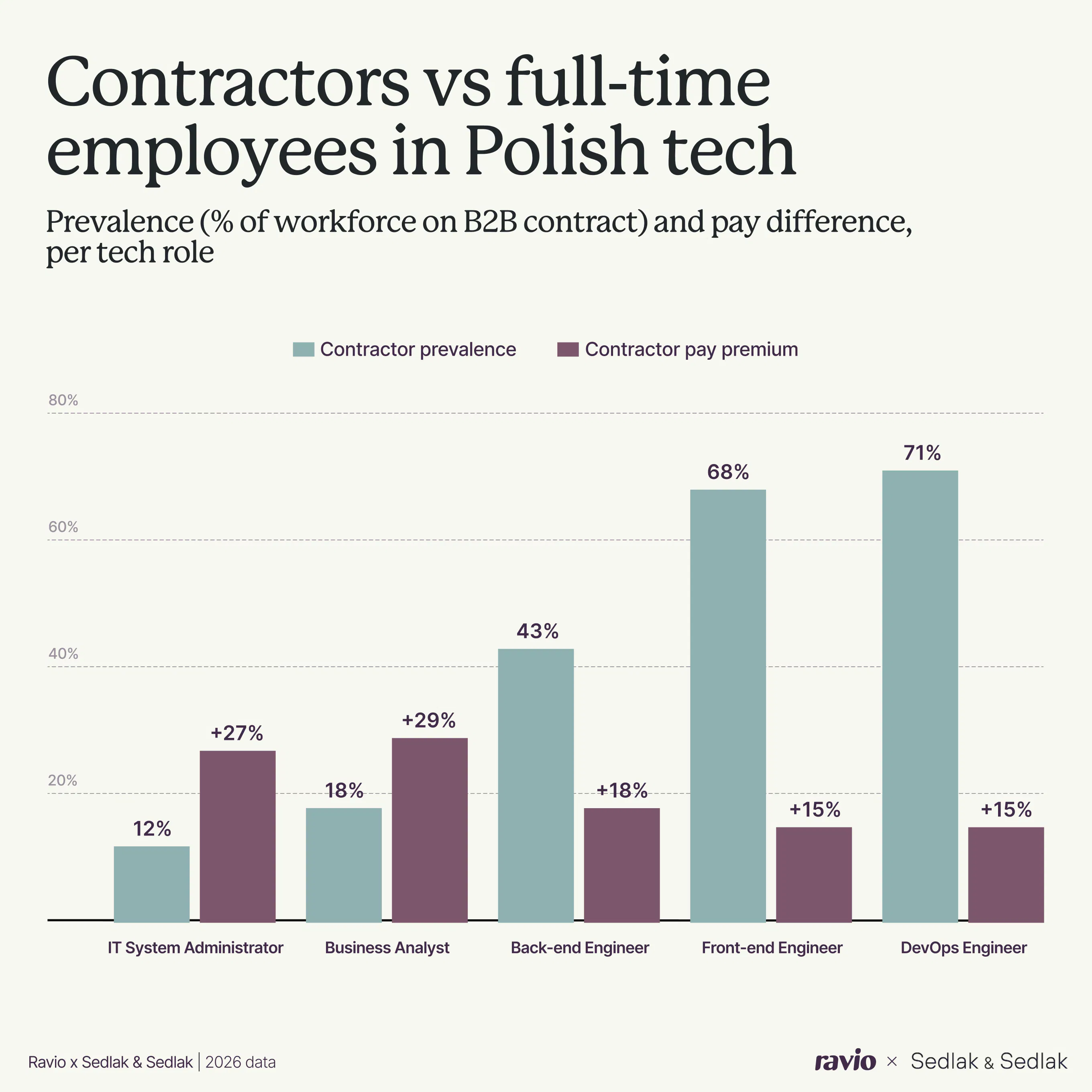
The clearest pattern in the data is that contractor prevalence and contractor pay premium move in opposite directions.

It's much less likely for IT System Administrators (12% of the workforce) and Business Analysts (18%) to be contractors. 

But those that are contractors receive a higher premium than in other roles, 27% and 29% higher than full-time employees, respectively.

Contractors vs full-time employees in Polish tech: prevalence of contractors, and pay difference per role

"IT System Administration is more associated with a typical internal function,” Piotr explains of the prevalence difference, “And those roles also earn a bit less compared to programmers – so the tax incentive to switch to B2B is lower.”

“Plus, programmers also create intellectual property when they build something, which brings tax advantages of its own. When you're a System Administrator, there's no equivalent – you do the work, but you don't create something in the same way."

Piotr is cautious about the exact size of this premium, though: "Of course there's data from different companies, different positions – behind each of those there's a bit of a different story, and each company has to decide their stance for themselves."

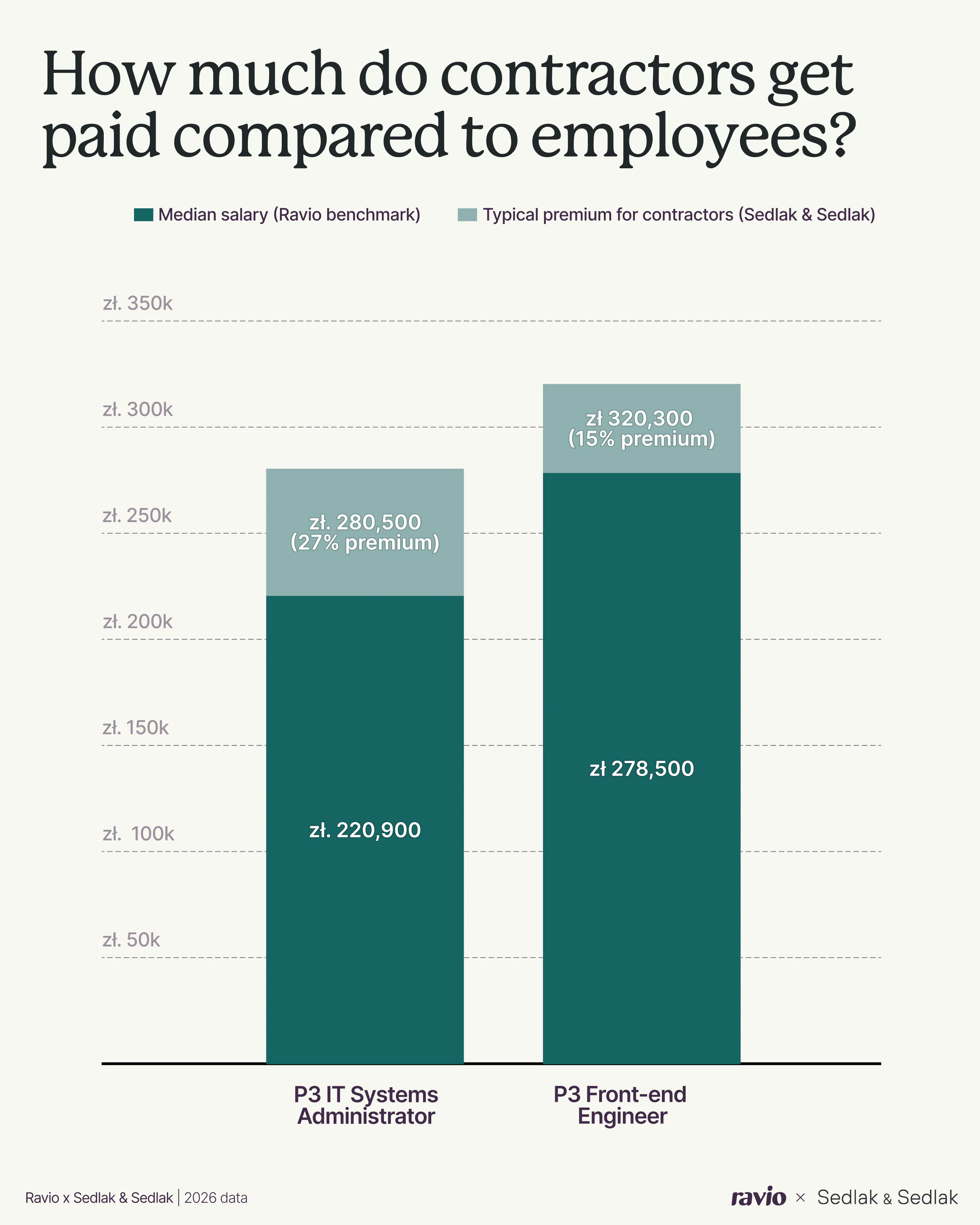
To put the pay difference into real terms, Ravio's Poland benchmarks show that the median salary for a P3 (mid-level IC) IT Systems Administrator is zł. 220,900 (or £43,300). If we apply that 27% premium, a B2B contractor in the same role is earning closer to zł. 280,500 or £55,000 – as well as getting additional tax advantages too. 

On the other side, over two-thirds of Front-end and Back-end Engineers are on B2B contracts, but they’re paid only 15% higher than employees – still a premium, but much less so. 

Again, to give a real example, the median salary for a P3 Front-end Engineer in Poland is zł 278,500 (£54,600) – so the average contractor in that role would be paid zł 320,300 (£62,800).

How much do contractors get paid compared to full-time employees? Ravio and Sedlak & Sedlak data

It seems that, overall, where B2B contracting is the market default and there’s a wider pool of freelance talent available, companies don't need to pay as competitively to attract contractors. 

But where it's the minority choice, employers pay a real premium to convince someone to give up UoP security.

Need salary data for a different role, location, or industry?

Get started with 3 free benchmarks

How does the contractor premium in Poland differ by seniority?

That's the picture by role. 

But it looks quite different once you factor in seniority too – the pay premium for contractors isn't a flat feature of the market, it moves substantially depending on how experienced the contractor is.

Professional / IC career track

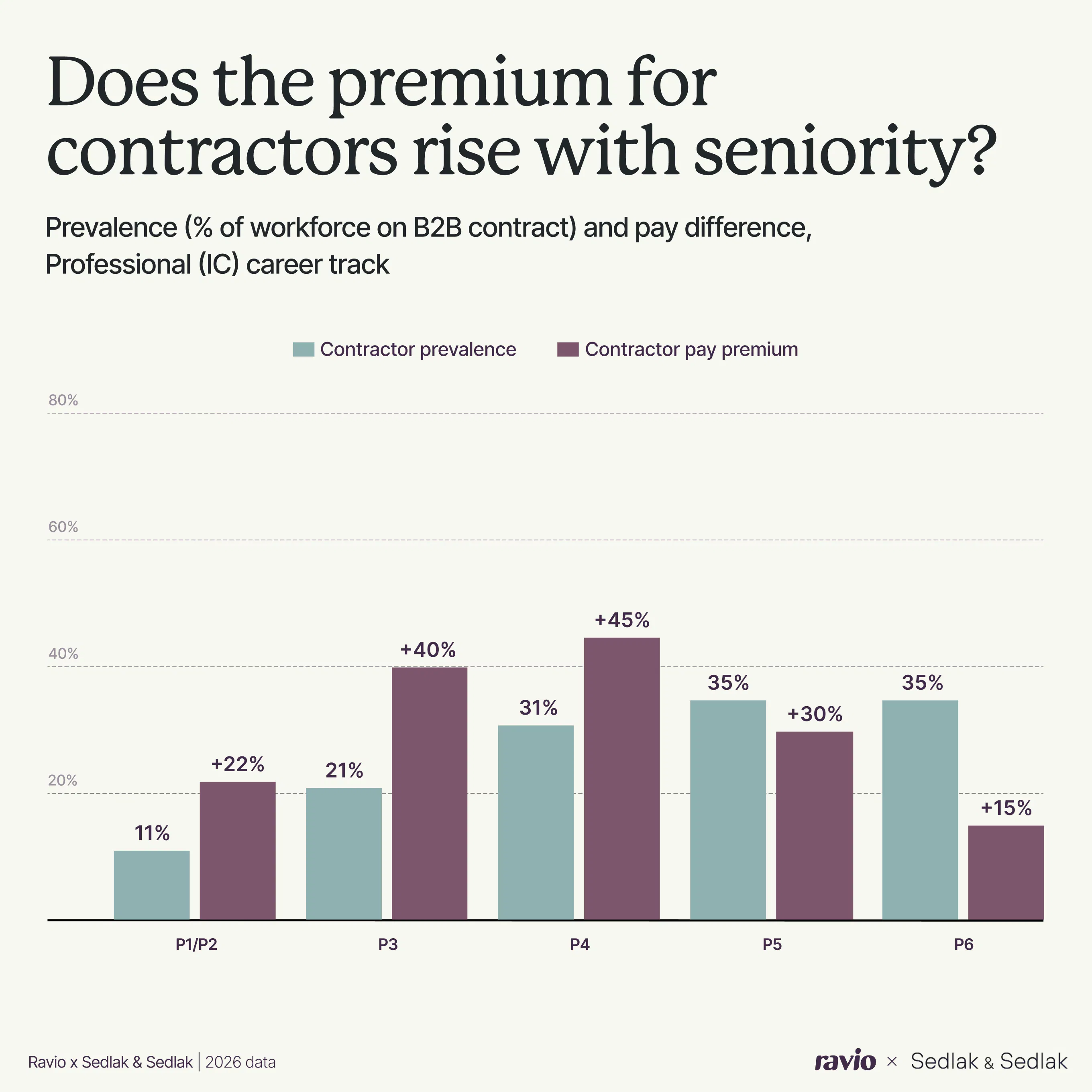
Looking at the Professional (IC) track (P1-P6), it’s more likely for more senior professionals to work under a B2B contract – with just 11% of P1/P2 roles filled by contractors, compared to 35% of P5 and P6. 

The difference in pay for contractors rises with seniority through the early career stages – from a 22% premium for P1/P2 contractors to 40% at P3 and 45% at P4. But it peaks at P4, falling back down at the most senior IC levels – to a 30% premium at P5 and just 15% at P6.

Does the pay premium for contractors compared to full-time employees rise with seniority in the IC/Professional career track? Ravio and Sedlak & Sedlak data

So the biggest premium doesn't go to the most senior ICs. It goes to those at P4 – past the early career stages, but not yet at the top of the ladder.

To put that into perspective, if we look at Ravio’s benchmarks for a Front-end Software Engineer role, the P4 median salary is zł 344,300 (£67,500) – so the typical contractor at that level would be on zł 499,200 (£98,000) per year with the 45% premium.

The P6 median salary for the same role is zł 477,900 (£93,700) – with a 15% premium the average contractor would be paid zł 549,600 (£107,800).

Whereas for full-time employees in this role there’s a large difference in pay between P4 and P6 (39% increase), for contractors it’s just a 10% increase.

"It comes down to what makes sense to outsource,” says Piotr. “You wouldn't outsource entry-level engineers – you want to train them up in-house, and it's cheap enough to do that. You wouldn't outsource your most senior specialists either, because you want to keep them close.”

“P4 sits in between: experienced enough to hand a whole project to as a contractor, but not so senior that you'd need that person to be permanently in-house.”

But, whilst that’s the overall pattern, it looks slightly different for every role.

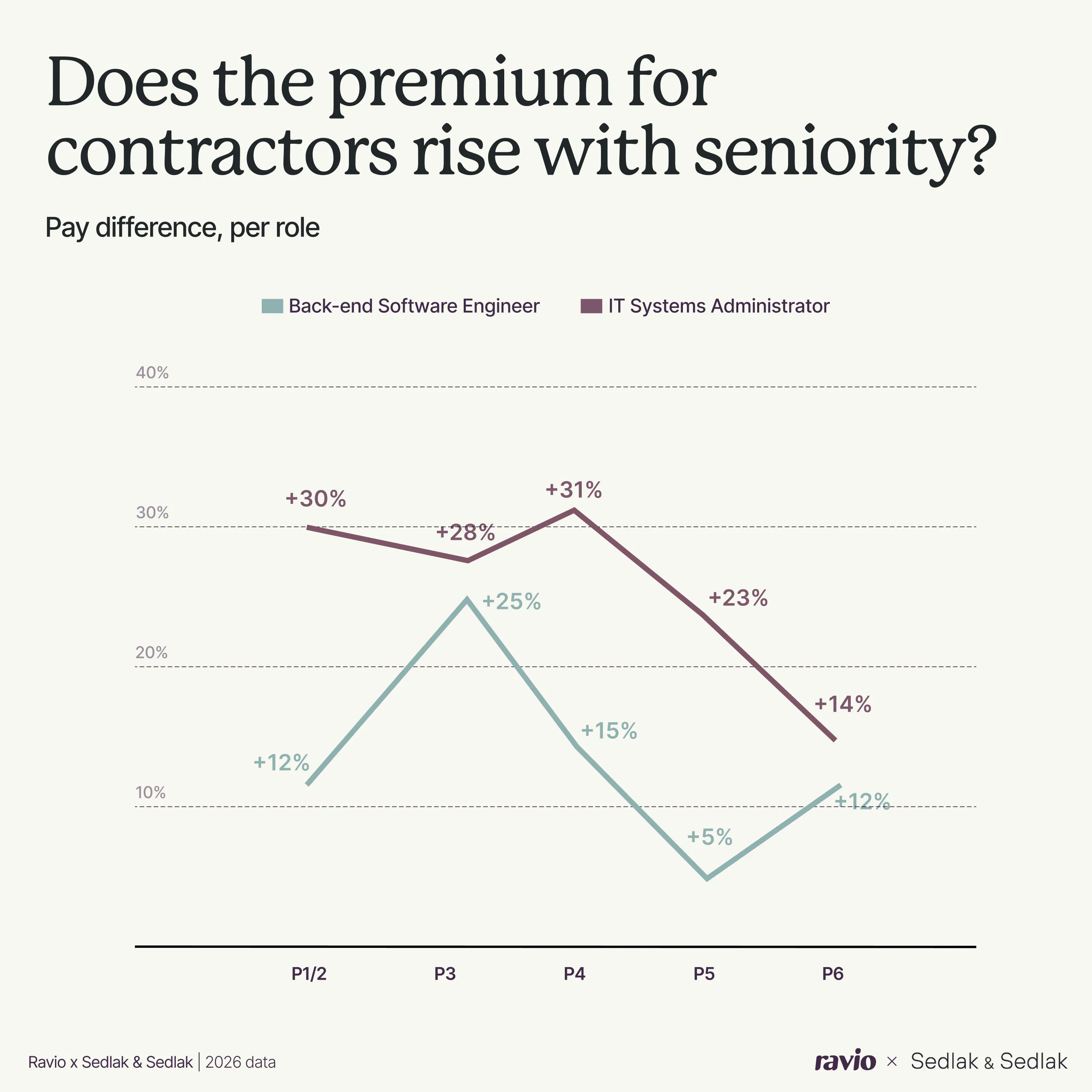
For instance, for Back-end Software Engineers we see the same increase in premium for contractors, but it peaks at P3 (25%) – a level earlier than the overall market – then falls through P4 (15%) and at P5 (5%), before ticking back up to 12% at P5. 

IT Systems Administrator follows the overall trend more closely, with the premium peaking at P4 (30%) before falling to 23% at P5 and 14% at P6. But, notably, the pay difference for contractors and employees is actually very similar in this role in early-to-mid-career stages – 30% at P1/2, 28% at P3, 31% at P4.

If you're setting contractor pay for a specific role at a specific level, it's always worth checking the market data for that specific role. 

Does the pay premium for contractors compared to full-time employees rise with seniority in the IC/Professional career track? Role split: Back-end Software Engineer vs IT Systems Administrator. Ravio and Sedlak & Sedlak data.

Management career track

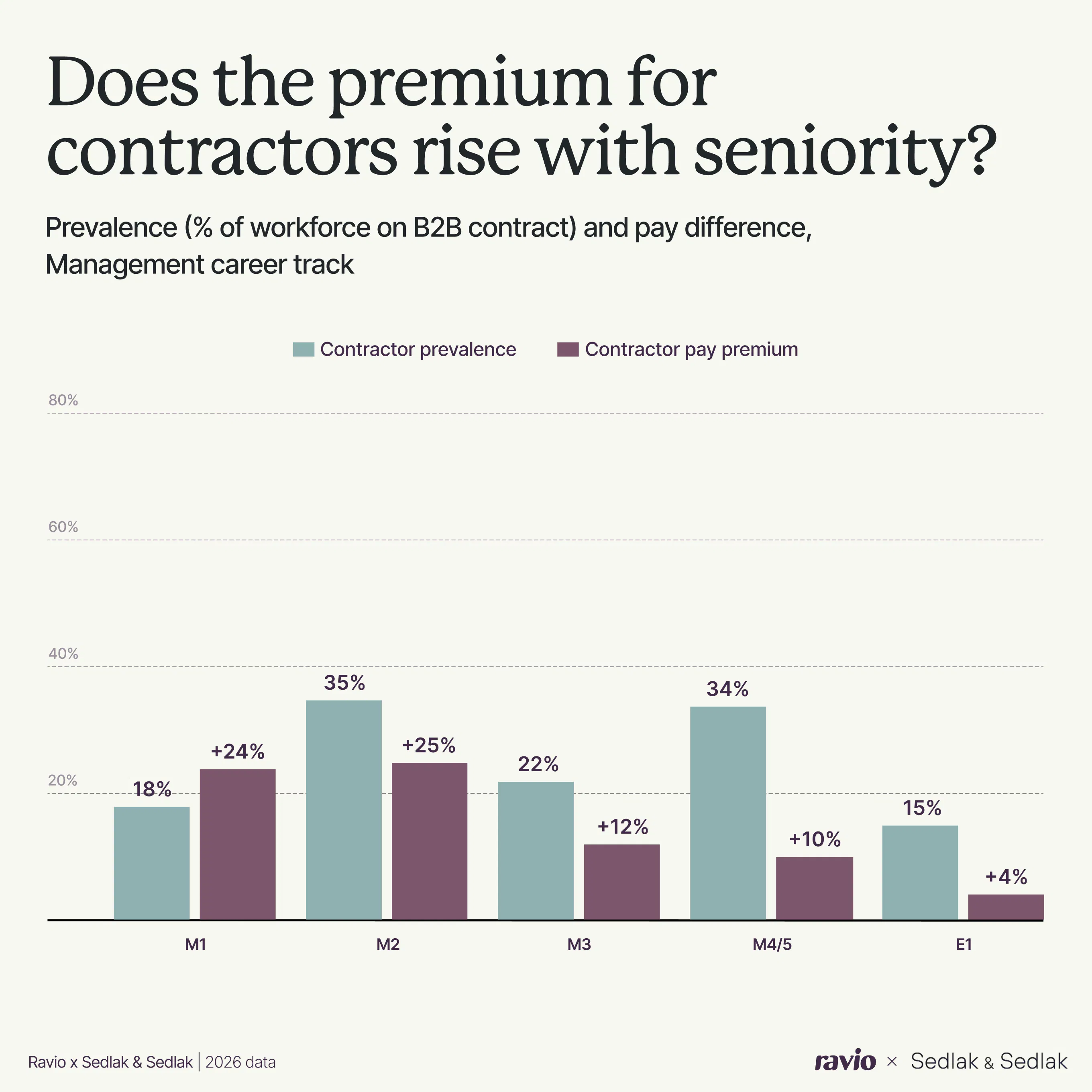
For the Management track (M1-E1), the pattern is more straightforward: the premium shrinks the more senior you go.

The percentage of the workforce on a B2B contract doesn't rise cleanly with seniority like it does with Professionals – instead it peaks in the middle, at M3 (Senior Manager, 35%), rather than at the top or bottom of the ladder. 

Just 18% of M1 roles and 15% of E1 roles are filled by contractors.

Does the pay premium for contractors compared to full-time employees rise with seniority in the Management career track? Ravio and Sedlak & Sedlak data

For Piotr, again this aligns with how he sees companies making talent decisions

 "Generally you wouldn’t outsource managerial functions, because that’s the core of the organisation, and you need that core to be stable,” he says. “Compared to programmers it’s also much harder to prove that managerial function can be performed effectively under B2B conditions instead of a standard employment contract.” 

The premium in pay for contractors is highest at the lower management levels – 24% at M1 (Coordinator) and 25% at M2 (Manager) – then falls steadily: 12% at M3, 10% at M4/M5 (Director), down to just 4% at E1, the most senior level in the dataset.

Again, we see that whilst full-time employees will see a substantial pay increase moving from M1 to E1, contractors barely see any – contractors are paid higher than typical employees overall, but there’s less opportunity to progress that income with seniority.

So, what does this mean for your compensation strategy?

The data has shown us that there's no single "right" approach to contractor pay in Poland – it depends on role, level, and how normalised B2B already is for that specific hire.

And, as we highlighted at the top of this article, the traditional full-time employment contract is the default way of hiring under Polish law – B2B contracts should be used sparingly where there’s a specific need, because using a B2B contract where a typical employment contract could be used is a legal risk. 

Practically, our findings suggest that you might need to increase your rates for contractors who are senior professionals in a role where contracting is more rare.

But Piotr does warn about creating too much inconsistency between how you pay contractors and how you pay full-time employees.

If you're setting contractor pay, he recommends starting with the total cost of employment. "I would calculate the total cost of employment, and make sure it’s the same whether you’re a contractor or an employee.” 

In this way, a contractor receives the same salary as an equivalent employee doing comparable work, but with the additional costs they take on that an employer would normally cover – like pension contributions or sick leave – added on top. 

Get the Compensation Review straight to your inbox

Your monthly dose of market insights and expert perspectives

You might also like