
Compensation strategy
10 best compensation planning software, compared (2026)
Compare the best compensation planning software in 2026. Learn what to look for, compare leading platforms, and choose the right solution for your organisation.

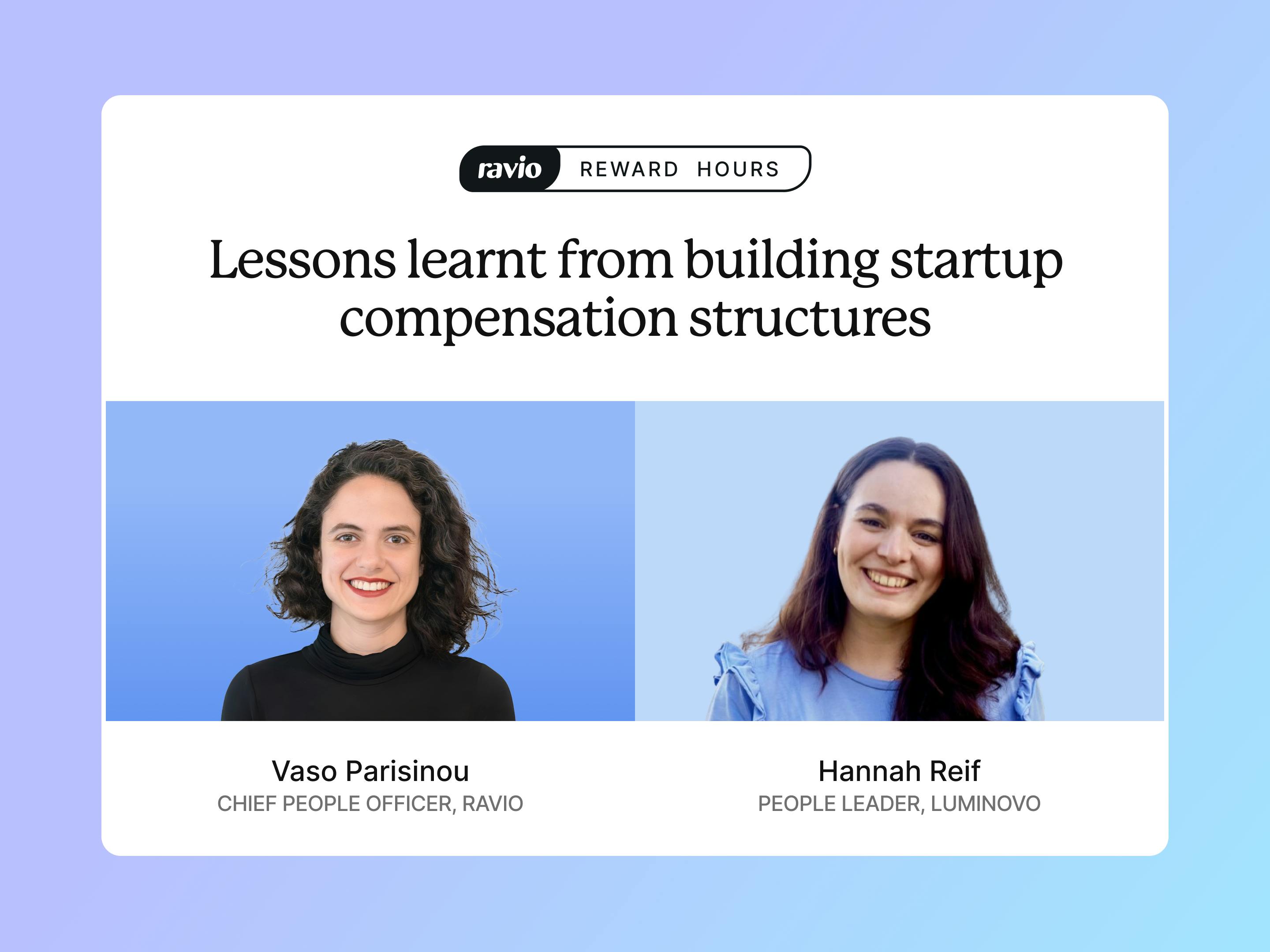
For many growing startups and scaleups, managing compensation evolves from simple case-by-case decisions to something requiring more structure, consistency, and scalability.
But when is the right time to focus on compensation structure? What are the foundations needed? And how do you roll out these changes in a way that builds trust with your team?
For our Reward Community Office Hours in April 2025, Ravio's Chief People Officer Vaso Parisinou was joined by Hannah Reif, People Lead at Luminovo, who shared her journey of building a compensation structure at the growing tech company.
Catch up with the on-demand video recording, and a summary of key takeaways.
If you're more of a reader than a watcher, here's a summary of the key takeaways and insights shared by Hannah during the webinar.
Both speakers emphasised that introducing compensation structures shouldn't wait until the pain of adhoc decision-making becomes unbearable.
Hannah shared that at Luminovo, the need for more structure became apparent around the 30-40 employee mark, when compensation decisions were taking up significant headspace for founders and managers, and employees were experiencing uncertainty about why their salary was what it was.
The speakers emphasised that starting early allows your managers and people to grow with the structure, and for the structure to evolve over time.
"From my own perspective, I don’t have the capacity to look after compensation decisions for our entire team,” explained Hannah. “If I can put the principles in place and equip managers to handle new hire offers and progression conversations then it’s much more efficient.”
However, they also cautioned against over-engineering compensation. Especially for early-stage startups, keeping it simple and iterating as you scale is key.
"Get the basics right first and then extend over time. So for instance, if you make sure you’re paying at or above the market rate, you don’t need to overthink your benefits package too much to begin with.”

Hannah Reif
People Lead at Luminovo
💡 Practical steps to get started with compensation structure:
Data plays a crucial role in creating an effective compensation structure – both external benchmarking data and internal analytics.
Hannah emphasised that using a reliable compensation data provider to benchmark against the market adds credibility to your compensation plan, builds trust in the packages you offer, and equips managers to explain decisions to their teams.
"Good data is very difficult to argue with," Vaso noted. "If you're able to present a dataset that is complete and taken from companies that we lose talent to or want to hire from, it's much harder for someone to say 'that's not what my friend said the salary should be.'"
💡 Advice on how to use data in your compensation strategy:
Creating a strong levelling framework emerged as the essential foundation for any compensation structure.
Hannah explained how Luminovo built a framework with levels and sublevels (.1 new, .2 established, .3 advanced) that provided clear progression paths for employees.
Having this structure in place is a vital starting point, because it makes it simple to:
The speakers stressed that a good leveling framework isn't about creating a complex hierarchy but rather providing clarity about what's expected at each stage of someone's career.
💡 Building an effective leveling framework:
A consistent theme throughout the webinar was the value of transparency in compensation structures.
Hannah took a notably transparent approach when implementing a new approach to compensation at Luminovo, showing employees:
Hannah noted that this transparency led to fewer questions and challenges than anticipated.
"I was surprised that there were very few critical questions when I presented the new approach to the team,” she notes. “One important factor that built confidence was sharing the benchmarking tools we were using, the other companies that rely on that data, how we use the market data to make our own compensation competitive, and why that approach is right for us.”
"If you are confident about your approach and you have answered all the 'why' questions, then personally I think there's no reason to keep compensation information from an employee. If we are sure about this, why are we keeping it a secret?"
Hannah Reif
People Lead at Luminovo
Your monthly dose of market insights and expert perspectives
Compare the best compensation planning software in 2026. Learn what to look for, compare leading platforms, and choose the right solution for your organisation.

Learn what compensation management software does, when you need it, and how it helps teams make fair, defensible pay decisions at scale.

The best compensation management software gives you tools for real-time benchmarking, salary bands, compensation reviews, and pay equity compliance. See how top platforms compare in 2026.

