
Market trendsHiring & offers
Tech hiring trends in 2026: inside the two-speed tech job market
Tech hiring rates fell to 21.8% in 2026 – but it's a two-speed market, with AI and top sales talent still hot. See hiring by country, function, and stage.


Defining which employees perform equal work or work of equal value is one of the most consequential decisions companies will make in preparing for the EU Pay Transparency Directive – because it underpins everything else.
Get the groupings wrong, and everything else that follows – pay gap reporting, employee rights to information, equal pay claims – is built on shaky ground.
It's also the area of the legislation that’s causing the most confusion amongst our Reward Room community.
So, we ran a survey to understand how Reward Leaders are actually approaching categorising their employees into those equal value groupings.
One note before we dive into the findings: respondents did skew towards larger organisations: 39% from companies with 100-499 employees, 23% from 500-999, 19% from 5,000+, and 16% from 1,000-4,999.
Here's what they told us.
One of the most debated questions in EUPTD preparation is what "equal value" actually requires in practice.
Does defining categories of equal value work mean undergoing a formal job evaluation process – using a methodology like the point factor method to evaluate every role against the Directive's criteria (skills, effort, responsibility, working conditions)?
Or is it enough to use existing compensation structures, provided those structures are applied consistently and documented clearly?
It's where a lot of Reward teams are getting stuck, so let’s see how others are approaching it.
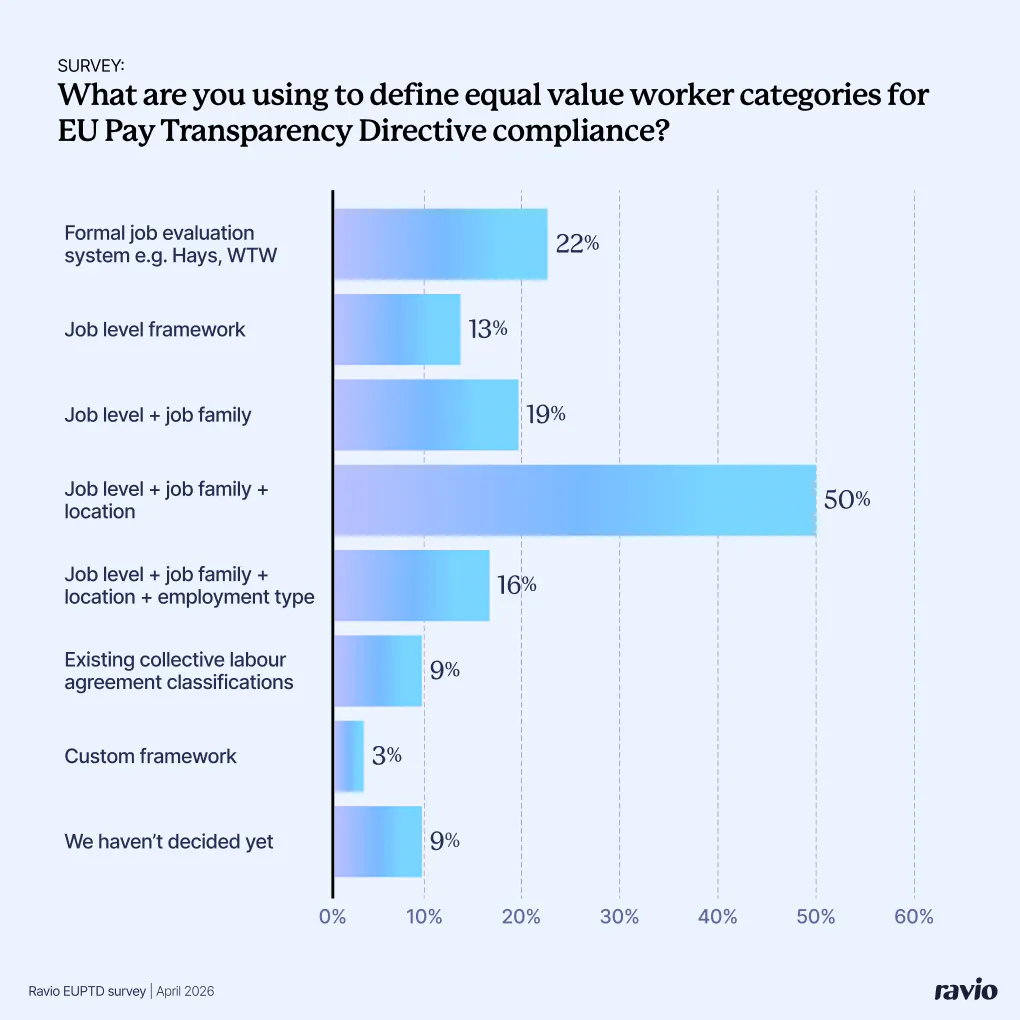
Only 22% of respondents are using a formal job evaluation system to determine their equal value worker categories.
The majority are instead using some combination of their existing compensation structures: job level and job family (the most common approach, at 50%), sometimes combined with location or employment type.
Sofía Guijarro, Advisor on EU employment law and the EU Pay Transparency Directive, sees this split as reflecting very different organisational starting points.
"There are very different starting points across companies," she says. "Some have had grading systems in place for years and are largely stress-testing what already exists. Others are reconsidering their whole approach.”
“One particular risk I’m seeing is that many companies have historically relied on market benchmarks alone to set salaries, without an internal job evaluation framework."
"It’s not a coincidence that market benchmarking isn’t explicitly named as an objective justification in the Directive,” Sofia explains. "The EU has long recognised that labour market structures are not always gender-neutral – historically feminised professions are often paid less, even where the value of the work is comparable.”
For companies that have been led by (rather than informed by) market rates for many years, there’s a lot to unpack.
Another risk that Sofia’s seeing is with companies where most employees are already covered by a collective bargaining agreement.
"I’m seeing many companies wrongly assume that applying a collective agreement automatically means they're safe from an equal pay perspective,” she says. “It’s a dangerous simplification – the Directive is clear that companies still need a framework capable of assessing equal value across the organisation."
There's no guidance in the Directive on how many categories of equal value work you should have – it depends entirely on your organisation's structure and the approach you take.
But it does have a direct knock-on effect on whether your analysis is statistically meaningful.
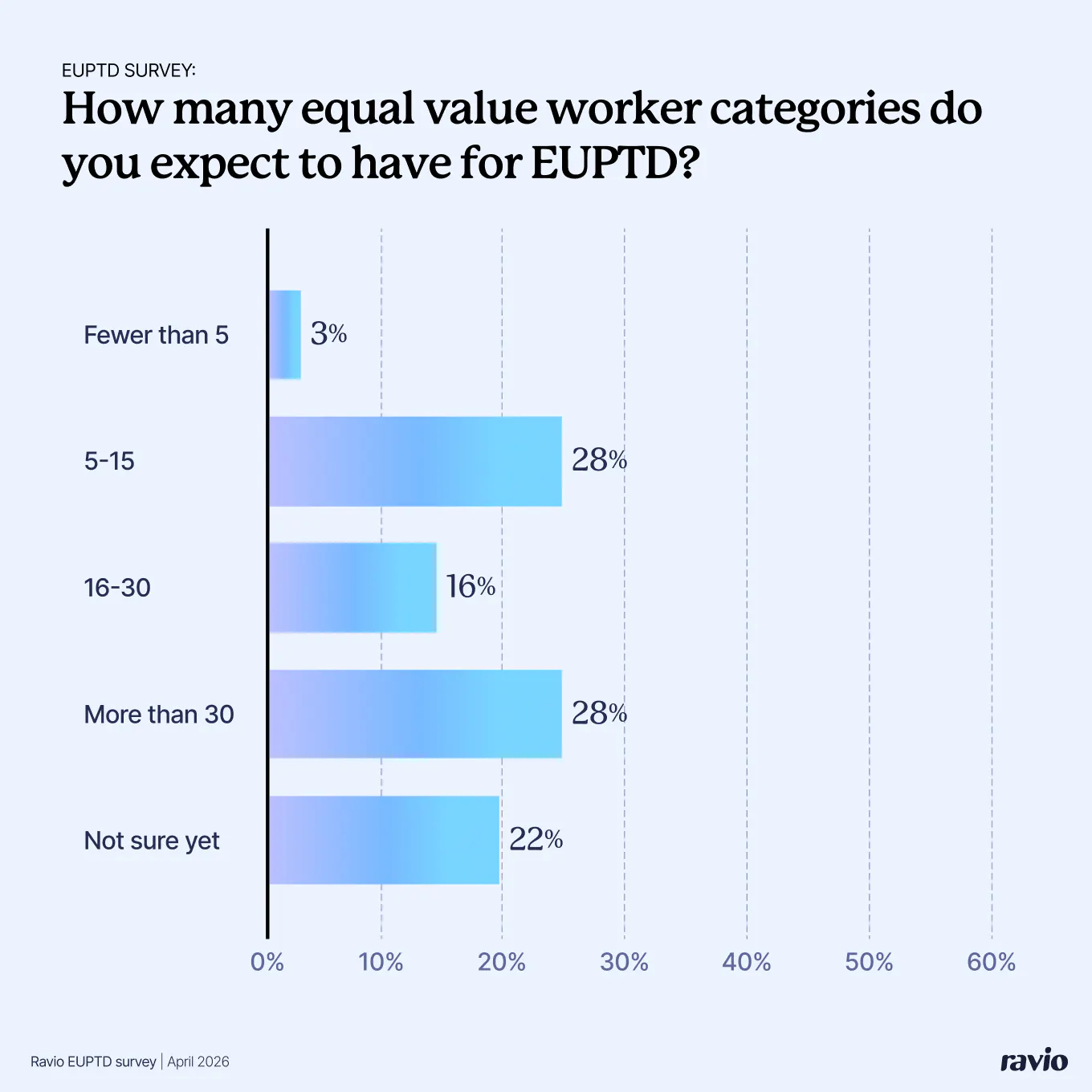
The largest group of respondents (38%) expect to end up with more than 30 categories – though remembering that our respondents did skew towards larger organisations.
Just over a quarter (28%) are targeting five to 15. 16% expect 16 to 30, and only 3% fewer than five. A further 22% aren't sure yet.
The concentration at the high end makes sense given the most common approach: combining job level, job family, and location naturally produces a large number of distinct groupings.
It means a company operating across five countries, with ten job families and five levels, can easily exceed 200 categories as a raw number – with consolidation across those then bringing this down.
The number of categories you land on is important to ensure that each group has enough workers to produce a statistically meaningful analysis, and not so few that it creates GDPR issues when employee information requests are added into the mix.
As Sofia points out, the number of categories you land on largely depends on how you decide to define your categories.
"One of the biggest questions many companies are still working through is whether dimensions like job family or location should sit inside the equal value category itself, or be treated as justifications for pay differences within the same category," says Sofía.
Put location inside your categories and you’ll have many more categories, and much smaller per-category populations.
"Both approaches could be defensible depending on your local transposition, but both have advantages and risks,” Sofia explains.
“Ultimately what matters is that companies make that choice consciously and can explain it. Your categories must follow a coherent and credible underlying logic, so that it’s compliant, and so that employees are able to understand why they are compared to certain peers and not others.”
Get the logic right, and the number of categories tends to land in the right place too.
Interpreting what the Directive actually requires – and, for international companies, how national transposition will affect that in each market – is not straightforward, and there are real consequences for getting it wrong.
It’s a 50-50 split amongst our respondents on whether or not it’s worth getting legal advice.
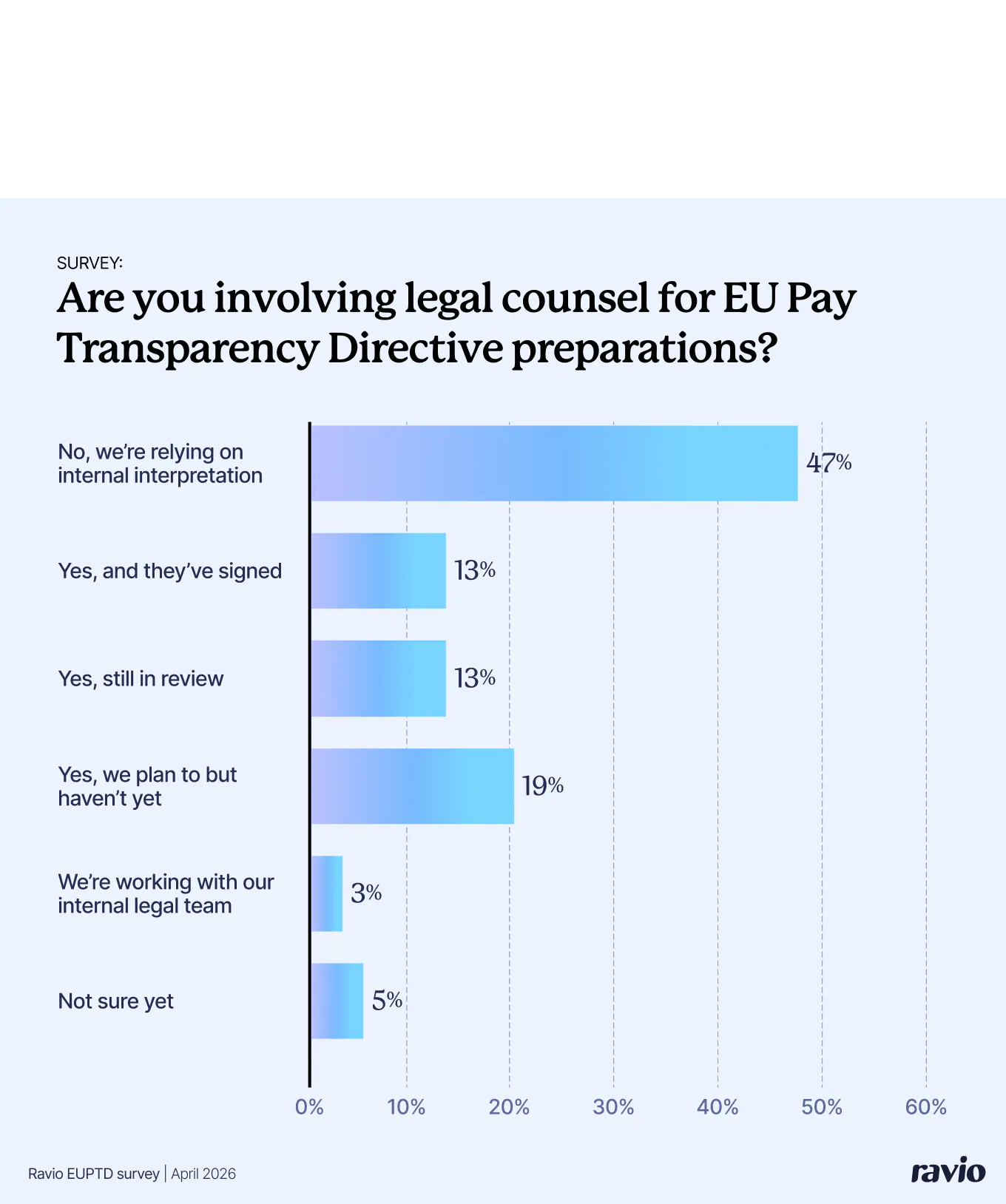
Half of respondents (47%) are relying entirely on internal interpretation to prepare for the EU Pay Transparency Directive, no legal counsel involved.
48% are involving legal counsel in some way – 26% have actively engaged legal counsel, a further 19% plan to, and 3% are working with an internal legal team for support.
Sofia’s advice is that, if you are seeking legal advice, ensure it’s from someone with a background in both employment law and compensation.
"The Directive sits at the intersection of employment law, compensation, governance and HR operations," she explains. "Many advisers are very strong in one of those areas, but not necessarily across all of them."
“I’ve also heard that many lawyers are advising companies to wait – which is bad advice.”
“They want to advise based on implemented national legislation rather than the broader Directive – but whilst there may be local nuances, the Directive gives clear direction on the structural decisions, and companies need to act on that now to be compliant in time.”
If you do decide to engage external advice, Sofia is clear that it only goes so far.
"At some point, companies need to define their own internal logic and decide what kind of organisation they want to be. Employees still experience one company and one culture – that means businesses need a degree of internal consistency in how they define value, fairness and pay structures, regardless of what local legal requirements look like."
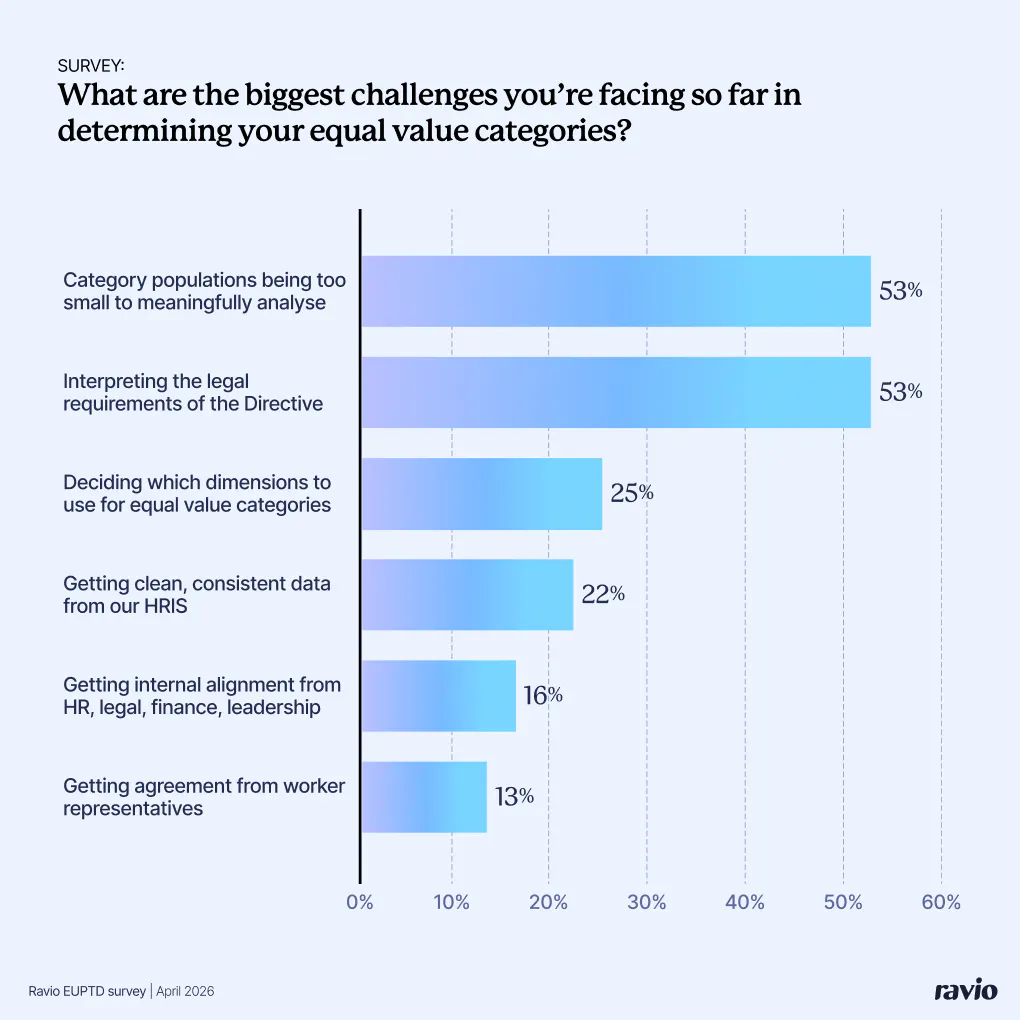
Two challenges came out tied at the top when we asked respondents where they're getting stuck with determining their equal value categories – both chosen by 53% of respondents when asked to choose their top two challenges:
Both are understandable.
The more granular your groupings, the more likely you are to end up with populations too small to draw reliable conclusions from – or even so small that data protection regulations becomes a concern when employee right to information comes into play.
"Of course, companies need populations that are large enough for meaningful analysis," says Sofía. "But the categories also need to reflect a credible equal value logic – you can't simply consolidate groupings to hit a number if the underlying rationale doesn't hold."
And the nature of the Directive does mean there’s a lot to unpack.
"It acts like a Swiss army knife, combining multiple mechanisms that all reinforce one another – job evaluation requirements, reporting obligations, candidates’ and employees’ rights to information,” Sofia explains. “It all works together to battle pay discrimination and end the systematic devaluation of feminine work within the EU.”
"It becomes very difficult to tick the compliance boxes successfully if the underlying structures aren't coherent. You can't satisfy one part and ignore the rest, because the other parts will expose you."
That's why Sofía argues the clearest starting point is getting those underlying structures in line.
"It's easy to get caught up in understanding the reporting obligations, but while national transpositions are still in progress things may continue evolving,” she explains. “Your job architecture, job evaluation approach, and equal value framework – those questions are clearer, and that's where companies should be starting."
Beyond these two concerns, a quarter of respondents (25%) cited difficulty deciding which dimensions to use for their equal value categories, and getting clean, consistent data from their HRIS was a challenge for 22%.
If any of these areas are causing you headaches, you’re not alone – and if you’d find it valuable to work through these issues with peers, come and join the Reward Room community.
The picture from this survey is one of companies at very different stages of EUPTD preparation – some stress-testing existing frameworks, others still deciding what approach to take.
The common thread is that the complexity of the Directive, and the ambiguity around national transposition, has left a lot of Reward teams unsure where to focus first.
For Sofía, the best starting point is your existing structures – no need to rewrite everything all at once, use what you already have as a basis.
"A good first step is simply to test your current structures," she says.
"If you had to define your equal value categories today with your pay decisions as they currently are, how would you do it? What logic would underpin them? How would pay progression be explained? What would the reporting output actually look like?"
Those questions tend to be clarifying.
"Once organisations start asking them seriously, they usually discover that certain systems, structures or processes don't fit together as cleanly as they assumed," she explains, “and that gives you a better understanding of what needs to be changed.”
"I also see this as a genuinely positive exercise – it's a chance to simplify, create consistency, and build systems that are easier to explain and maintain over time."
Your monthly dose of market insights and expert perspectives
Tech hiring rates fell to 21.8% in 2026 – but it's a two-speed market, with AI and top sales talent still hot. See hiring by country, function, and stage.

The average attrition rate in European tech is 11.1% in 2026, down from 17.4%. See attrition by country, function, and stage – and what's driving regretted leavers.

The average promotion raise in European tech is 21.8% in 2026, and 2.7% of employees were promoted. See Ravio data by country, function, and stage.

