Compensation reviewsCompensation strategy
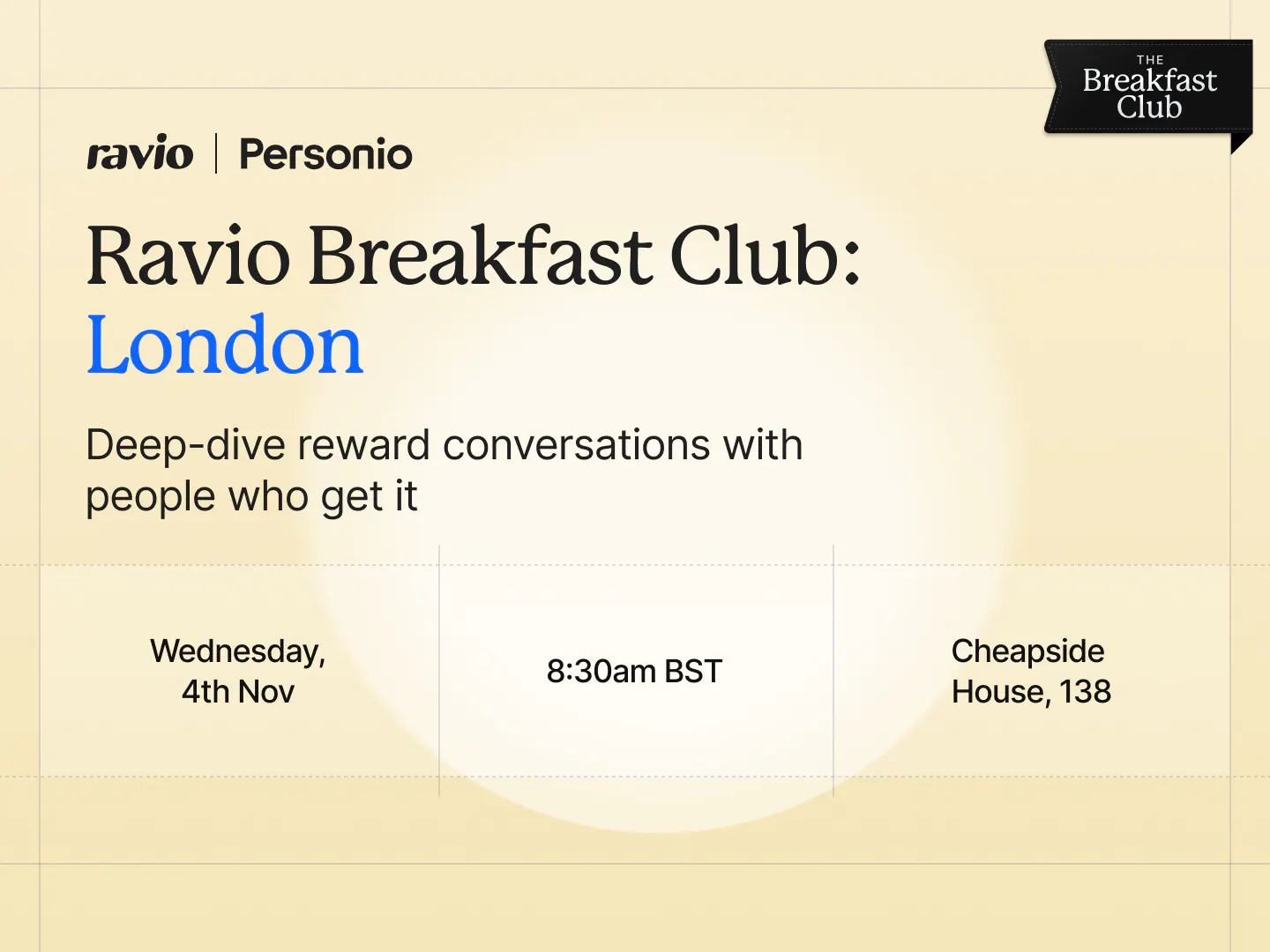
Ravio Breakfast Club London: Comp planning for 2027
Join us for the launch of our Comp Trends 2027 report, fresh off the data.


A line manager books an urgent meeting with you.
One of their best employees – consistently high-performing, always taking on additional work, furthering his knowledge – is a retention risk. His wife is telling him to look elsewhere. He hasn't had a raise in years.
The manager is prepared to fight to give him a significant salary increase.
But when you pull up the data, the employee is already at the top of his salary band.
You explain the constraints: approving this would create inequity, set a precedent you can't sustain, undermine the framework you've spent months building – and you know it won't get past leadership as a budget ask.
It's a conversation Reward leaders dread.
But it doesn't have to end with your best people walking out the door.
Here's how Matt McFarlane (Director at FNDN) and Ekaterina Potter (Global Director of Total Reward at commercetools) think through rewarding top performers who already sit at band maximum.

Before you assume you have a "top performer at band maximum" problem, make sure you don't actually have an "unclear or outdated salary bands" problem.
"If you find that your framework is starting to limit your ability to hold on to high performers or incentivise high performers," Matt McFarlane, Director at FNDN, says, "then you potentially need to rethink the structure of that framework. Your salary framework needs to serve the business.”
Salary bands should reflect market competitiveness at your chosen compensation philosophy percentile – whether that's 40th, 50th, 60th, or another.
If your bands are set correctly and your employees are banded correctly, then an employee at band maximum is already paid competitively for their role against your philosophy.
Many companies use salary increases to reward performance. But when this becomes the default, it's easy to lose sight of what bands are actually for.
This is also why Matt, and many other compensation experts, argue against merit increases that adjust base salary for performance.
"I don’t love base salary merit adjustments generally," Matt explains.
"If Joe has had a good two or three years where he’s received the highest rating for performance and compounded salary increases, but then Mary in another team performs equally well and hasn’t seen those increases, you start to see real disparity.”
"Your salary framework needs to serve the business. If it's starting to limit your ability to hold onto high performers, you need to rethink the structure."

Matt McFarlane
Director at FNDN
It’s also common that salary bands haven't been updated in years.
Bands only reflect your market-competitive compensation philosophy, if the underlying salary benchmarks used to define the band midpoint, minimum, and maximum, are regularly refreshed.
Otherwise, the market moves, your bands become out of touch with market reality, and your high performers start seeing higher salary offers elsewhere.
This is also a common cause for salary compression. Up-to-date benchmarks are used to define a new hire’s starting salary, but not to update existing salary bands, which means new hires are paid higher than experienced performers.
Benchmarks and bands should be updated at least once a year – tools like Ravio can streamline this by allowing you to refresh bands against real-time benchmarks instantly, rather than manually rebuilding them.

But refreshing doesn't mean blindly following every market movement.
Matt points out that companies need to make strategic choices: "Each company needs to decide whether to reflect market dips or 'hold firm.'”
“You can absolutely take a stand and say you’re comfortable maintaining that band for now, because we think this is a short-term shift rather than a long-term change in the value of that skill set. But that decision should be made intentionally, with current data, rather than letting bands drift out of date by default.”
Once you’ve accounted for structural issues, the next part of the interrogation is career progression.
If the employee has been a high performer for several years, receiving top performance ratings and significant merit increases so that they hit band maximum, it’s a strong signal that they might be ready to progress to the next job level – and, therefore, next salary band.
It might be that they’ve already grown into next-level responsibilities without receiving a formal promotion. If this is the case, consider a promotion as soon as possible to recognise their contributions – at your next compensation review if soon, or out-of-cycle if not. Some companies, like commercetools, support promotions at any time of the year (not just during the performance or compensation review period) for this exact reason.
Or it might be that they’re almost there, in which case supporting their development goals can be a brilliant way to recognise and reward the individual, without having to issue a salary increase that will make them a band outlier.
This is something that Ekaterina Potter, Global Director of Total Reward at commercetools, has designed into the company’s performance and pay review process.
“High-performing employees can also be recognised through a faster track to promotion,” she explains. “They’re supported to meet promotion requirements more quickly, through access to executive coaching, premium learning platforms like their Coursera subscription, or additional project leadership opportunities."
But, Matt does point out that a fast-tracked promotion isn’t always as easy as it sounds, and it’s important to prepare for that too.
"The expectations as you reach more senior levels are normally about increasing scope of impact,” he explains, “and that often requires very different skillsets.”
Being a great senior engineer doesn't automatically mean someone should be promoted to a staff engineer – the scope and impact required at the next level might be different from what made them successful at their current level.
In this scenario, clear communication on career progression and promotion requirements is the most important tool you have.
Some compensation leaders argue that salary bands should be seen as guidelines for consistency, not hard limits.
“Some companies choose not to have a strict upper band limit because, realistically, very few people consistently perform right at the top,” Matt explains. “Those who do are truly exceptional and are exactly who compensation programmes are designed to retain.”
But, this requires strong calibration to ensure the exception is warranted, checking overlap with the next range, and being clear on business value.

If bands are current, the employee is at the right level, and promotion isn't appropriate, above-band salary increases go against your compensation principles – and their manager is adamant that they can’t lose them – then building the business case is the next best step.
For Ekaterina, it’s often this thinking that brings clarity. “Normally the message I get from managers is that it’s counterproductive not to reward high performers,” she says. “And they’re right. These people do bring their best to the company. They do go the extra mile. They are the top performers. We're almost penalising them for our own decision to bring them into the company at the top of their band."
Matt emphasises that you bring the full equation to your leadership decision-makers: "What's the unique value this person brings? What would we pay to hire someone new for this role today? What's the risk if they leave? What are competitors paying for this role?"
The holistic costs compound quickly:
"These people bring their best to the company. They go the extra mile. They are top performers. And we're almost penalising them for that with no increase."

Ekaterina Potter
Global Director of Total Reward at commercetools
If bands are current, promotion isn't appropriate, and an exception on salary increases isn’t an option – you still have options.
Both Matt and Ekaterina emphasise you need to think of compensation as multiple levers that can be pulled to recognise and reward employees.
“You can't rely on base salary alone to reward your true top performers,” Matt says. “You need a blend of monetary incentives and experiential or non-monetary Rewards, tailored to the individual’s goals and priorities.”
"You can't rely on base salary alone to reward your true top performers. You need a blend of monetary and experiential rewards."
Matt McFarlane
Director at FNDN
Both Ekaterina and Matt emphasise that, whatever type of reward you choose, it has to be meaningful.
“For your small percentage of very top performers to feel the efforts they’ve demonstrated are appreciated, it has to be a really meaningful reward,” says Ekaterina. "This applies to 5-10% of the population who have significant impact. We need to measure that and then really, really reward that."
"For your small percentage of very top performers, it has to be a really meaningful reward. We need to measure that and then really, really reward that."
Ekaterina Potter
Global Director of Total Reward at commercetools
Your monthly dose of market insights and expert perspectives
Join us for the launch of our Comp Trends 2027 report, fresh off the data.

Join us for the launch of our Comp Trends 2027 report, fresh off the data.
Join us for the launch of our Comp Trends 2027 report, fresh off the data.

