How Formalize used Ravio to make compensation everybody’s business

Compensation stories
Formalize highlights of using Ravio

Company name: Formalize ApS

Industry: Compliance tech (RegTech)

Founded: 2021

Headcount: 200+ employees

HQ location: Denmark

Products used: Ravio benchmarking, Ravio bands

Formalize is a compliance software company, helping more than 8,000 organisations across Europe navigate GDPR, NIS2, DORA, and whistleblowing requirements.

Its business is built on helping other companies get regulation right, so when the EU Pay Transparency Directive started appearing on the horizon, Trine Palm, Global People Director at Formalize, wasn’t going to leave her own house in disorder.

But there's also more to this story than a compliance company simply practising what it preaches.

When Trine built a compensation function grounded in real market data, the impact spread quickly: today, 13.5% of people across Formalize – from Revenue Operations to the C-suite – have access to Ravio.

Trine's current goal is to extend that to 100% of the business.

Her own belief is that HR has been sitting on a goldmine of employee data and doing nothing with it – and her own view, stemming from her background of a master's in Human Centered Informatics, is that that data should be put to work to ensure transparency and fairness for employees.

"In Denmark’s agency industry there’s an unspoken rule: you only get a salary promotion by moving between agencies. I could sit next to someone doing the exact same work for the same clients who was making 10,000 Danish kroner more a month – simply because they came in at a different time. That’s my villain origin story. Why I’ve been so focused on making sure that transparency and fairness are part of how companies present what they offer their employees."

Trine Palm

Trine Palm

Global People Director at Formalize

What Formalize looked like on arrival

When Trine joined Formalize, the company was around 135 people across Denmark, Madrid, and Milan. One thing stood out from the start: they had built a Revenue Operations function early – before most companies at that stage would think to – and had been doing serious work with salary and commission data as a result.

The underlying framework, however, had no external market anchor.

"It was really good work. But what they’d built was informed by their own internal knowledge and experience. Given how young the company was, that experience simply wasn’t sufficient for what I wanted to achieve."

Trine Palm

Trine Palm

Global People Director at Formalize

The issue, she explains, isn’t internal knowledge itself – it’s the moment you need to communicate externally. “You can build a solid remuneration framework from general knowledge. But if you want it to be a credible, no-nonsense message to your talent (current and prospective) it needs to be grounded in something external. That’s when the conversation turned to adding a layer of benchmarking data.

Choosing Ravio

For Formalize, the choice of benchmarking tool came down to one critical requirement: depth of Danish market data.

With Denmark accounting for 68% of headcount, coverage gaps weren't an option. Ravio's data met that bar, and its shift toward live, real-time benchmarking meant the platform aligned with where the industry was heading, not where it had been.

"Live benchmarking matters more than annual reports when roles and levels are changing as quickly as ours. A snapshot from a year ago simply isn’t useful. But more importantly, I felt Ravio wanted to build things together – which is essentially what we’re doing now."

Trine Palm

Trine Palm

Global People Director at Formalize

Building the framework

The initial build took around three weeks.

Formalize uses a standard Individual Contributor (IC) model – levels from IC0 through to senior ICs – running in parallel with a management track. One design decision underpins the whole thing:

"Becoming a manager should never be an economic decision. IC and management tracks are fully aligned – IC3 and M1 sit in the same salary band. If someone moves from a senior IC track into management, they’re assessed against the management levelling criteria. That might mean a lower placement. We treat it as a new specialisation, not a demotion."

Each IC level contains three sub-levels with progression possible every six months. Each step carries a small salary increase; a full level move carries a larger one. Progression is skills-based, not tenure-based: tied to demonstrated growth in influence, autonomy, and complexity.

But the technical build, Trine is clear, is not the hard part.

"It’s very easy to put the Ravio tool in front of someone and say ‘go.’ What people don’t realise is how much effort goes into building the foundations beforehand – and into communicating it once you have it. The shift from not speaking openly about salaries to actually talking about them: that is the biggest shift."

The annual salary review has transformed as a result. With 200 employees across seven countries, the February review moved one benchmark.

"Because of Ravio, it’s become essentially a desktop exercise for me and finance. We go to the functional leaders, show them where the benchmarks sit now, flag anything that’s moved, and ask what they want to do. Everyone else was confident they were still in the right position.”

Trine Palm

Trine Palm

Global People Director at Formalize

When the data leaves the People team

Most companies use compensation benchmarking as a People team tool. The data lives with a few admins and gets shared across wider teams when needed. At Formalize, Trine has built it differently.

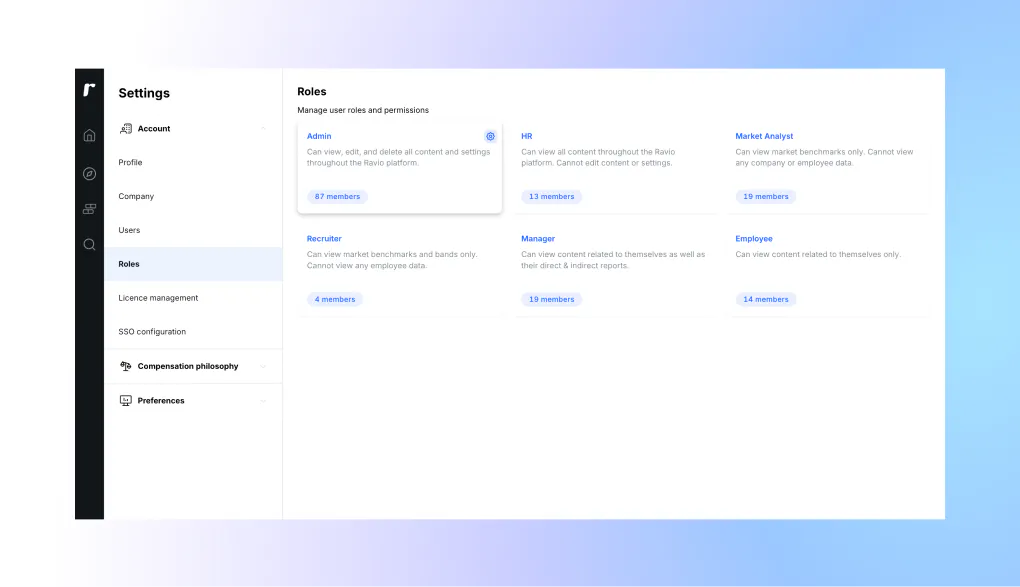
Anyone with personnel responsibility has access to Ravio – with their access controlled via Ravio's user permissions options.

The entire Revenue Operations team has access. All C-suite managers. Recruiters and People Ops through to commercial and operational leaders.

User permissions in Ravio

User permissions in Ravio

The result is that compensation benchmarking at Formalize isn’t a periodic, review-time exercise. Revenue Operations and Sales Development are among the most active users on the platform, and the roles they’re benchmarking reflect live business decisions, not just pay reviews.

"I want to run the smallest possible team. I don’t believe I’ll achieve more by having more people. When the organisation sees that about me, they start to emulate it. They know that when they come to me, they’re getting a direct answer with data and reasoning behind it."

Giving leaders direct visibility into benchmarking data has also changed who leads salary conversations.

“Empowering leaders to have these discussions without escalating to the People Director every time was one of the things I most wanted to achieve. Ravio data gives managers the confidence to lead these discussions themselves.”

Trine Palm

When Formalize was assessing how to structure its DACH expansion, Ravio data informed what compensation would look like for commercial roles in Munich - and the answer had direct P&L implications.

Building out a local team wasn't just a headcount decision; the salary expectations of Munich's tech market meant the cost structure looked fundamentally different from other markets where Formalize already operated.

"Placing SDRs in a market where the base would almost double takes a real hit on annual recurring revenue. So we’re using the data to ask: do we build full teams in every market, or do we keep business hubs where we can find the right talent at the right cost? That’s a conversation we couldn’t have had two years ago without Ravio data."

See if Ravio has data for your roles, locations, or sectors

Explore our benchmarks

Speaking to management differently

The day-to-day impact, Trine says, is one most People teams don’t get to experience: walking into a leadership conversation with genuine authority.

"The main reason people in my position should add a data set like Ravio is to speak to management with a level of confidence that simply hasn’t been available to People teams until now. If you’re sitting in a startup or scale-up, the confidence you can bring to your business cases with Ravio’s benchmarking data is unprecedented."

Trine Palm

Trine Palm

Global People Director at Formalize

It also changes how the People function is perceived.

“People teams are seen as the ones who carry the business’s emotional weight. That perception means we’re not always taken seriously as a strategic function. External data changes that. It moves the People team away from being seen as ‘feelings carriers’ towards being a genuine strategic partner.”

On a scale of one to ten, Trine rates her confidence when entering a new market at eight or nine. The conversations she has with senior local hires in those markets are telling.

"A lot of people say, ‘This data is wrong, I’m used to people making much more.’ And I’ll ask: isn’t it just that you’ve been used to sitting on a different percentile? If you’ve come from a company paying at the 90th and we’re at the 75th, that’s not a data error. Those conversations are quite enjoyable from my side. I think they find them clarifying."

Setting a target percentile in Ravio

Setting a target percentile in Ravio

Making transparency the default

At Formalize, full salary band transparency is already in place. All employees can see all salary bands across all departments. Individual salaries aren’t disclosed, but the combination of visible bands and sub-levels means employees can broadly understand where their colleagues sit.

Trine’s view is that this creates calm rather than friction.

"A lot of companies resist transparency because they believe it will create more problems than it solves. The problems you think transparency will create are systemic ones – problems that exist because you’ve deliberately kept people in the dark. Those are the systems that perpetuate unequal pay for women and make it harder for people of colour to enter the workplace on equal terms."

One hundred percent of Formalize’s hiring decisions are informed by Ravio data.

The long-term ambition goes further still: “Everyone in Formalize will eventually have access to Ravio – all salary benchmarks, all departments. The aspiration is that 100% of the organisation has full access to benchmarks within this year.

Preparing for the EU Pay Transparency Directive

Denmark is targeting 2027 for implementation of the EU Pay Transparency Directive. Companies under 200 employees will likely report every three years rather than annually. But Trine’s advice is simple: don’t wait for your country’s deadline.

"Employees already have the right to pay information. Pay gap reporting, fair pay reviews, and salary transparency on job postings are all coming. My expectation is that salary ranges on job adverts will begin appearing across markets from 2026 onwards. The foundations need to be in place before the legislation forces your hand."

Trine Palm

Trine Palm

Global People Director at Formalize

Formalize’s bi-annual review cycle has been structured deliberately as a readiness runway. The sub-level framework within each IC band – provides the granularity needed for meaningful pay gap reporting without disclosing individual salaries.

"Make sure you have sub-level increments to report against, rather than just full bands. This allows you to give employees meaningful pay information without compromising individual privacy."

For Formalize, a company whose product helps thousands of organisations navigate exactly this kind of regulatory change, full pay transparency isn’t just a cultural goal – it’s the infrastructure that makes compliance with the directive defensible.

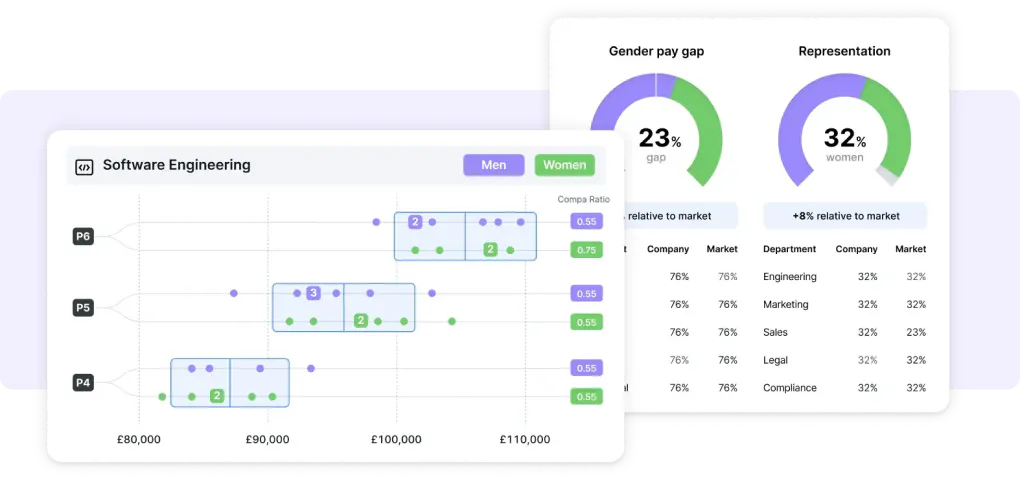
Graphic showing gender pay gap analysis in the Ravio platform

Pay equity analysis in Ravio's Bands module

What other People leaders should take away

Since Trine joined, Formalize has grown from 135 to over 200 people, opened offices in Munich and Copenhagen, and raised a €30 million Series B in October 2025.

The compensation infrastructure built on Ravio is not a People team tool. It’s part of what makes rapid, multi-market growth manageable.

Trine’s advice to People leaders at similar-stage companies is to start with the philosophy, not the tool – and to share it.

"Every company has a compensation philosophy, whether they’ve articulated it or not. If you can’t explain to an employee why they’re being paid what they’re being paid, you have a problem. The data gives you the language. But the shift from not speaking about salaries to speaking about them openly – that is the work. And it’s the most important work you can do."

For Formalize, that transparency is what turns difficult conversations into straightforward ones – and what makes a compliance company that helps 8,000 organisations get regulation right also get its own house in order.

The impact: Before and after Ravio

Impact

Before

After

Hiring decisions informed by data

None – no external data

100% of all hires

Confidence in compensation data (1–10)

6

8-9 out of 10

Time to build salary bands

Months of manual work

3 weeks from scratch

Annual review process

Ad hoc, no external anchor

“Desktop exercise” – one benchmark moved across 200 people

Explore Ravio’s benchmarks for yourself

Get started with 3 free benchmarks

Get the Compensation Review straight to your inbox

Your monthly dose of market insights and expert perspectives

You might also like