How FTAPI professionalised compensation decision-making with Ravio's reliable market data
FTAPI replaced inconsistent salary decisions with reliable German benchmarking data from Ravio. Learn how they built fair, defensible compensation at scale.

🏢 Company name: Checkly
🏭 Industry: Technology
🚀 Founded: 2018
👥 Headcount: ~50
🌍 HQ location: Remote-first – presence in New York and Berlin
💸 Compensation approach: Transparent salary formula, market-aligned, location-based
Application Reliability platform for software developers, Checkly, was founded in 2018.
The company has always been remote-first but with a strong presence in Berlin – now made up of around 50 employees working remotely from 16 different locations, including a sales hub in New York, USA.
For this installment of our ‘compensation stories’ series, we spoke to Kaylie Boogaerts, Director of People at Checkly, about how compensation works at Checkly – particularly the decision to standardise their salary decisions through a pay calculator, and to make that calculator openly available to both employees and the wider public.
Interested in more compensation strategy examples? Subscribe to our monthly newsletter to stay up-to-date with the latest.
When Kaylie joined the team in 2021 as Director of People, one of her top priorities was to implement a more structured approach to compensation.
This was a particular priority partly because there was a lot of hiring happening at the time – surfacing a need for candidates to receive competitive offers to bring them over the line.
Kaylie knew that these new hire salaries needed to also be consistent with the approach taken for existing employees’ compensation – otherwise inconsistencies would arise that would damage internal pay equity.

At the same time, with Checkly’s company values and culture including a focus on trust, transparency, and clear communication, Kaylie was also keen to apply this to the compensation approach too.
She’d been inspired for a while by the transparent approaches of companies like Buffer and Gitlab, who openly share how salaries are calculated with existing employees and job candidates alike, but had never been able to get the buy-in from senior leadership teams in previous roles to implement something similar.
In contrast, when Kaylie proposed this kind of approach to the C-level team at Checkly, they immediately saw the importance of a standardised and transparent approach for their team.
“When I shared an example pay formula with Checkly’s leadership team, I thought it would get a bad response – leaders tend to be hesitant about that kind of standardised formula, especially when shared openly. But they loved the idea because it felt like a much fairer way to approach pay.”

Director of People at Checkly
After this discussion, the core principles of Checkly’s compensation philosophy were cemented as:
These principles ultimately culminated in the decision to build a standardised formula for calculating employees salaries – and to make that formula public through a pay calculator tool.
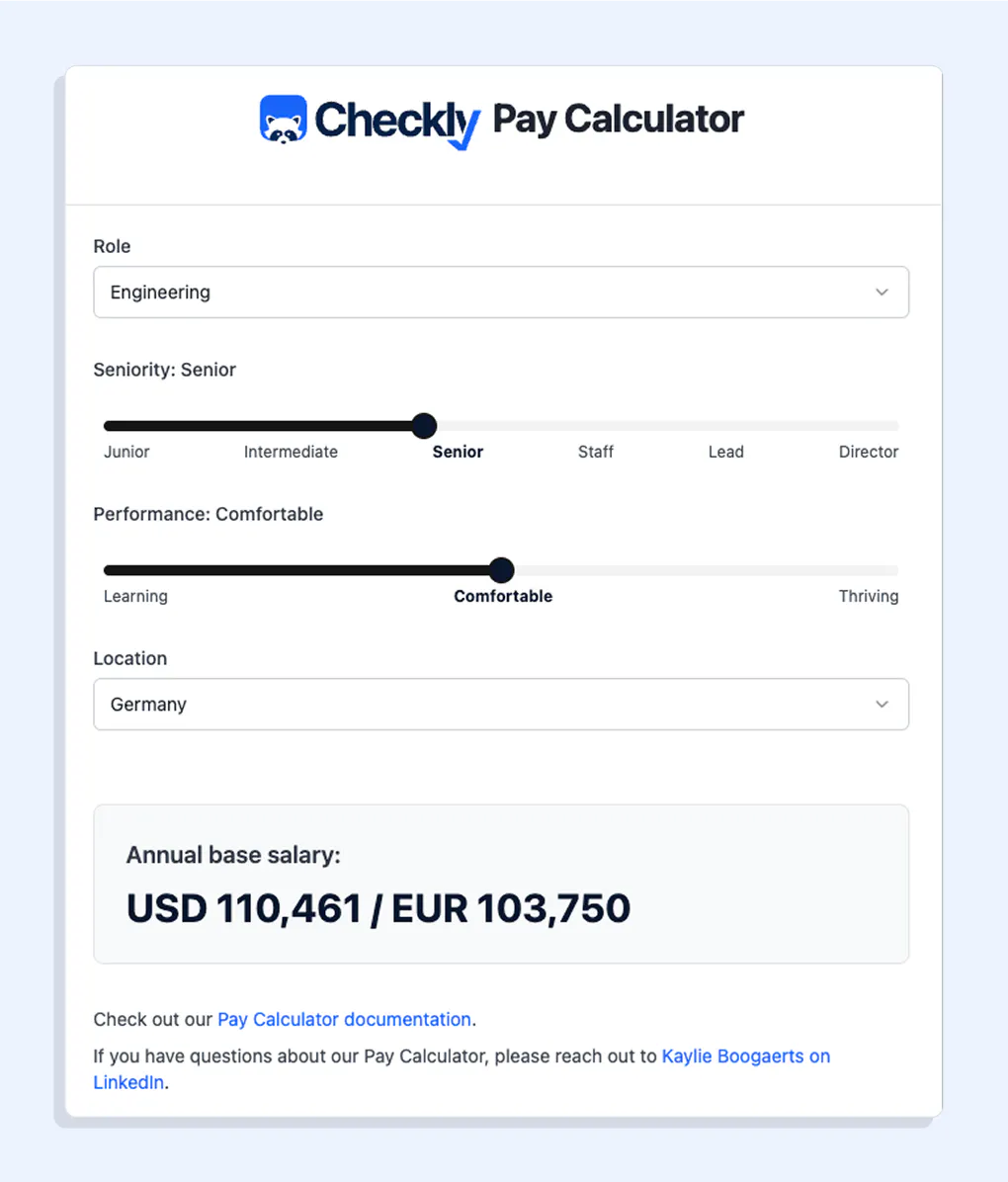
In 2022 Checkly launched an open source pay calculator – a publicly available calculator tool which enables users to find out what Checkly pays employees for each role and location within their team.

The key aims for this were:
After agreeing how Checkly’s salary calculations would actually work (more on this in the next section), the pay calculator was developed and launched.
The pay calculator was launched internally with the Checkly team first.
Kaylie first shared documentation via Notion with the team to read in their own time on why the calculator was being introduced, how it works, and what it would mean for their own compensation. Then she ran a company-wide Q&A session which was recorded, and the questions were also added to the Notion documentation too.
“It was important to roll out the calculator internally first to ensure clarity and enable any questions and concerns to be raised and addressed. We had an overwhelmingly positive reception from the team.”

Director of People at Checkly
The response from employees was overwhelmingly positive.
There were a couple of concerns from employees who were the only person operating in their specific role and level within the company – which meant that their individual salary was easy to deduce from the calculator, whereas in more common roles the result would be an average of all employees. This resulted in a couple of roles being removed from the calculator before it was launched externally.
Following this, Checkly’s pay calculator was then made public via Checkly’s website. The Notion documentation was also published for external viewers too, to build understanding about how Checkly’s pay calculator works.

Kaylie also authored a blog which detailed the rationale behind the project and the process she went through.
Having the calculator publicly available also made it possible to transparently include salary ranges within the job description for all new roles being hired, with links to the pay calculator and documentation to add additional context for job candidates.

In a word: yes.
Meeting salary expectations is always going to be at the top of the list for a job seeker evaluating whether a new role is a good fit for them – though work/life balance and purposeful work are becoming more and more important too.
When companies don’t list the salary range for roles, they waste everyone’s time in the recruitment process.
The hiring manager ends up with a bunch of candidates who look great on paper, but will never accept a job offer because the role doesn’t meet their salary expectations. The candidate spends time diligently filling out an application form, for a role that doesn’t actually meet their needs.
Plus, with pay transparency laws like the EU Pay Transparency Directive incoming, it will soon be a legal necessity to make job candidates aware of the salary band for a role before they reach the interview stage.
In Checkly’s case, the links through to the pay calculator and documentation on how compensation works at the company also provide great insight into the culture and values of the company – which helps to attract team members who align with that thinking too.
Additional information is also available transparently for candidates – the employee handbook explains the company culture and working approach (including how 1:1 meetings and feedback work at Checkly), and the hiring playbook breaks down the hiring process and tips for candidates. Kaylie even shares her own personal experience with Checkly’s interview process on the company blog.

Plus, for successful candidates, Checkly’s job offer template is also very clear and transparent about the final compensation offer – including what the equity offer looks like, which can be a confusing element of total rewards.
Kaylie has also open sourced the job offer template for others in the industry to use.

Since the pay calculator launched in 2022, Checkly has seen a hugely positive impact.
There has been great feedback from job candidates about the clarity it brings to the hiring process – even those who don’t end up being offered a role.

Kaylie also recently interviewed several team members at Checkly about their experiences, and she found that the public pay calculator was one of the top factors in why they chose to apply to a Checkly role in the first place, and what made them feel it was the right company for them.
“When I ask team members why they applied for their role at Checkly, the pay calculator consistently comes up as a key reason.”

Director of People at Checkly
It’s also been positive for the existing team too.
One of Kaylie’s aims was that the team would never have to worry about their pay or progression because they knew it was taken care of in their best interests, and could instead focus on delivering great work.
She’s seen this come to fruition within the team, especially as Checkly’s new cadence of performance feedback and pay reviews has become cemented within the company (more on this in the section ‘how do pay reviews work at Checkly’).
“Team members have told me that they feel like they can be honest and open in their 1:1s now, because they don’t have to worry about the constant build up of evidence towards the next performance review and salary increase.”

Director of People at Checkly

When we spoke with Kaylie about Checkly’s compensation approach, we asked her about the key lessons learnt that she’d take with her if she was to undergo a similar process again.
Here’s her advice:
As we’ve seen, Checkly introduced a pay calculator system in order to ensure a standardised and consistent way for compensation decisions to be made across the team.
The calculator uses the following formula:

Let’s break down each part of the formula.
Checkly uses multiple benchmarking data providers (including Ravio) to understand what market competitive pay looks like for each role in their company.
The 50th percentile is used as their target percentile to ensure market-aligned pay.
London is used as the location for these role benchmarks.
Checkly has a core presence in Berlin, but feel that benchmarking data for Berlin doesn’t align with their desire to be competitive and generous with salaries, so London feels more relevant for them.
Let’s take a look at a couple of examples from our salary benchmarking dataset.
Looking at a P3 Software Engineer (established / mid-career IC), the median salary for growth-stage companies in London is £70,600.
The same role in Berlin has a median salary of £61,800 – so for this role the benchmark is 14% higher in London than in Berlin.
On the commercial side of the business, for a P3 Direct Sales Executive, the median base salary for growth-stage companies in Berlin is £46,900. In London the median is £53,400 – a 13.9% higher salary.

The benchmarks for each role are sourced at three tracks: one benchmark for individual contributors, one for leads (i.e. Head of), and one for directors.
Seniority multipliers are then applied to account for the individual job levels within each of these tracks, as follows:
The aim with the use of multipliers is to keep the formula as simple and standardised as possible across the entire team.
The market moves independently for each job level, which means that a standardised approach to seniority like this won’t always take into account real market competitiveness per job level.
For this reason, we’d always recommend that the salary for each level should always be determined using up-to-date market benchmarks for that level.
Without this market reference point, over time employee compensation for some team members will fall behind market rates.
This could cause heightened attrition, as employees look elsewhere to increase their salary, so it’s something to be careful about.
In Checkly’s case, there are currently only a few job levels within the company (the Ravio level framework, for instance, has six levels for ICs, and eight for management/executives, compared to Checkly’s five in total) which makes this easier to manage – as the team grows and more levels are introduced, a more granular approach may be necessary.
Checkly takes a ‘pay for performance’ approach, wherein employees are rewarded for their performance through salary – but this is built into their standardised approach, rather than being handled separately through a performance review process.
The performance multipliers are as follows:
As we’ve seen, Checkly uses London as the core location for the role benchmarks within the pay formula.
However, the team works remotely from 16 countries across the world. So, employee location is taken into account through a cost of living multiplier – to ensure employees have similar purchasing power in their respective locations.

Numbeo’s cost of living index is used as the data source, and the multiplier works as following:
Whether to include location-based pay as a factor within the compensation approach was a big debate at Checkly.
Kaylie has observed that as companies have been hiring more globally and remotely, the gaps between locations in benchmarking data are decreasing – and she feels this will only continue. Therefore, it was important to avoid large inconsistencies being present in future by relying on geography based rules.
However, with fair and competitive salaries the core aim, the decision was ultimately made to factor cost of living into the formula through a multiplier.
Cost of living is just one factor, alongside others like supply vs demand for a specific role and location – which can actually have much more of an impact on market data.
Therefore, relying on cost of living alone to determine salary differences per location can be unreliable.
It’s also very hard to objectively measure the cost of living in different locations. This is especially true outside of major cities, where data is not readily available in databases like Numbeo’s.
Every company is different, and Checkly have, of course, made their decisions based on the approach that works for their team – but we’d typically recommend that the best practice approach here would be to use compensation benchmarking data from a global benchmarking provider to understand competitive pay in each location.
Checkly runs an annual full compensation review process in October and November each year.
There are two key parts to this.
Firstly, updating the benchmarking data that forms the basis of all employee salaries, to check if any market changes have occurred. If there have been significant market shifts, then the role benchmark within the calculation will be changed and the employee will receive a salary increase based on the market adjustment to ensure their pay remains competitive.
Secondly, line managers are asked to confirm both seniority and performance, and make any changes for their direct reports. Notably, there is no standalone performance review process as part of the pay review, because feedback is gathered continuously and performance and development conversations happen all year round – the pay review is simply a formal time in which changes are reflected. If an employee’s level or performance has increased, then their corresponding multiplier will also be increased, and they will receive a salary increase.
Taking these two factors (benchmarking and performance) into account, pay increases are finalised.
Performance-based increases and promotions can also happen at any time during the year.
Employees who are already at the top ‘thriving’ performance level who are continuing to perform highly but are not yet eligible for promotion are given the option to choose between a one-off cash bonus or an equity refresh grant as a retention incentive.
In May / June, a second pay review takes place. This is much smaller in scope, with the People team reviewing market benchmarks for any exceptional differences, and making any off-cycle adjustments needed within the team.
Throughout the year, employees are also encouraged to inform the People team if they receive any job offers with a salary about their current package – a way to keep an eye on the live talent market all year round and maintain competitiveness to avoid losing team members.
Of course, base salaries aren’t the only element of fair and competitive compensation.
In terms of total rewards, on top of salary Checkly offers equity for all employees, a competitive benefits package, and bonuses for performance.
Every employee at Checkly receives stock options as part of their compensation package, which vest over four years, with a one year cliff and a monthly vesting schedule.
This increases the competitiveness of Checkly’s compensation, whilst also providing clear incentive for employees to be motivated and loyal to the company – because they’re able to share in the company’s future success.
Looking at Ravio’s equity benchmarking data, the most common vesting schedule is a four year vesting period with a one year cliff and monthly vesting – the approach taken by 62% of the companies in our dataset.

Whereas Checkly are highly transparent with their salary calculator and documentation on how salaries are calculated, there is little public information about how equity compensation works at Checkly.
Kaylie explained that the company does have a similar stock options calculator and documentation via Notion on how it works for transparency internally – but because it contains information on the company’s stock price and fair market value, the decision was made not to host this publicly.
Employees who have the highest performance multiplier (thriving, 1.1x) and who are continuing to perform at a high standard but don’t have room to grow in seniority at Checkly yet – for instance where the role above is already taken and there is no scope to add an additional role at that level currently – are offered a choice between a cash bonus or an additional equity grant.
With Checkly’s team working remotely from 16 countries around the world, they of course adhere to the statutory benefits required depending on location.
In terms of optional benefits and perks, there’s a clear focus on flexibility and work-life balance, with benefits including:

Employees are increasingly looking for employers who offer such a focus on work-life balance, and this kind of benefits package can really boost the appeal of a company.
Checkly has also previously offered a generous $1,000 budget for employees to use on learning and development and visiting colleagues – which is increasing to $1,500 for 2025, with employees also able to now use the budget for wellbeing expenses too.
For the past two years, the People team has conducted an analysis to find out what the team typically spends their learning and visiting budget on.
In 2024, 25% of the budget was spent on coaching and mentoring opportunities, with tools coming in second space and subscriptions in third.

How Checkly's team spent their learning and visiting budget in 2024
The focus on coaching and mentoring is a big increase from 2023 (where it accounted for 2.75% of the budget spend) – which reflects an increased focus on knowledge-sharing and leadership development within the company culture.
In 2023, training, courses, and conferences came out on top!

How Checkly's team spent their learning and visiting budget in 2024
We asked Kaylie what she sees as the next steps and priorities in terms of Rewards at Checkly, now that the public pay calculator has been up and running for a couple of years, and she highlighted four key areas:
Book a demo to see how easy it is to find the data you need on market benchmarks and compensation trends in Ravio – or get started yourself with 3 free benchmarks.
Your monthly dose of market insights and expert perspectives

FTAPI replaced inconsistent salary decisions with reliable German benchmarking data from Ravio. Learn how they built fair, defensible compensation at scale.

Market-leading salaries, the flexibility to choose between cash and equity, and meaningful employee benefits – learn more about Netflix’s compensation structure.

Bolt uses Ravio’s real-time benchmarking software to deliver fair, competitive, and cost-efficient compensation for their international employee base.