- Existing pay transparency laws in Denmark: The Danish Equal Pay Act (Ligelønsloven)
- Other pay equity standards and protections in Denmark
- The upcoming EU Pay Transparency Directive (Løngennemsigtighedsdirektiv)
- How will Denmark implement the EU Pay Transparency Directive?
- What do Danish companies need to do to prepare for the EU Pay Transparency Directive (Løngennemsigtighedsdirektiv)?
Denmark has long been recognised as a global leader in gender equality. The country's Equal Pay Act dates back to 1976, and for decades, Danish employers have been required to maintain gender-segregated wage statistics to ensure fair compensation.
Yet despite this long-standing commitment to equality, Denmark's gender pay gap still remains stubborn at 12.9%, mirroring the EU average. This persistent gap, even in a country renowned for its progressive labour practices, highlights why more needs to be done.
This is where the EU Pay Transparency Directive (Løngennemsigtighedsdirektiv) comes in, introducing stricter pay transparency and gender pay gap reporting requirements for Danish employers, going beyond what the Equal Pay Act currently requires.
The Directive marks a fundamental shift in how Danish companies must operate – from internal compliance to external accountability, from flexible methodologies to standardised reporting, and from passive employer obligations to active employee rights.
This guide serves to help you understand the current legal landscape in Denmark, what's changing under the Directive, and precisely how to prepare your organisation for compliance by June 2026.
Skip to the EUPTD checklist ✅
Get prepared with the EU Pay Transparency Directive checklist →
Existing pay transparency laws in Denmark: The Danish Equal Pay Act (Ligelønsloven)
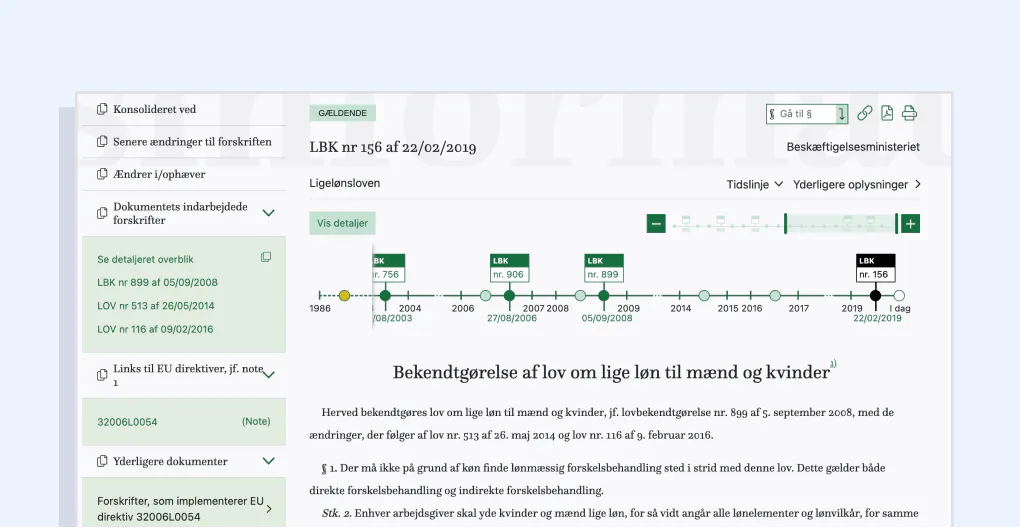
The Danish Equal Pay Act, first enacted in February 1976, was among the earliest gender equality legislation in Europe. Over five decades later, the country has built a comprehensive legal framework around the principle that equal work deserves equal pay, irrespective of gender.
The foundation of Denmark's current pay equity landscape rests on the Consolidation Act on Equal Pay to Men and Women, which consolidates decades of legal amendments and interpretations into a single, coherent statute. This law applies to both public and private sector employers, with clear rules about who must comply and what constitutes compliant reporting.

Public and private employers (exempting employers in the farming, gardening, forestry, and fishing sectors) with 35 or more employees are required to comply with Denmark's Equal Pay Act.
Danish employers meeting the 35-employee threshold have flexibility in how they demonstrate compliance, with the law offering two distinct reporting pathways:
- Option 1: Gender-segregated wage statistics. Employers prepare detailed wage statistics organised by gender for comparable employee groups defined by the 6-digit DISCO-08 classification (the Danish version of the international Standard Classification of Occupations ISCO-08). Organisations can calculate these statistics themselves, or submit raw payroll data to Statistics Denmark (DST) for official calculation.
- Option 2: Equal pay report. Employers can opt to submit a report instead of wage statistics – if agreed by their employee representatives. The report has to include a description of the criteria used to determine wages and a description of initiatives taken to prevent gender pay gaps. This option provides flexibility for organisations with complex compensation structures or implementing longer-term pay equity initiatives.
Regardless of pathway, job classification schemes, pay bands, and progression pathways must also be gender-neutral by design.
Other pay equity standards and protections in Denmark
Beyond the Equal Pay Act itself, Denmark also has two additional rulings relating to pay equity in employment:
- The Gender Equality Act promotes gender equality across all functions in society, based on the equal value of men and women.
- The Act on Equal Treatment between Men and Women extends protections to working conditions, employment and termination, promotion and training, membership of labour organisations, and more.
The core principle across all these laws is that people performing the same work or work of equal value in Denmark must receive the same pay, irrespective of gender – with equal value is determined by considering the competence required, effort, responsibility, and working conditions of the role.
This means that Denmark is already in a very strong position ahead of the introduction of the EU Pay Transparency Directive.

The upcoming EU Pay Transparency Directive (Løngennemsigtighedsdirektiv)
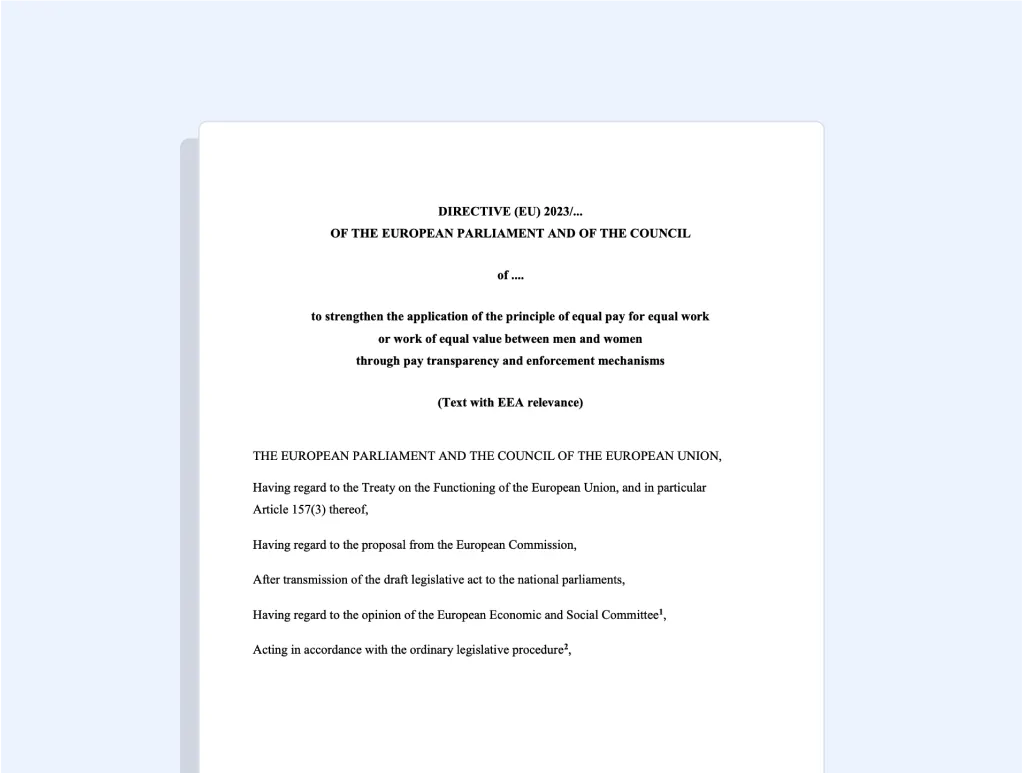
All 27 EU member states are required to adopt the EU Pay Transparency Directive into national law by June 7, 2026.
For Denmark, while no draft bill has been presented by the government yet (as of January 2026), implementation by this deadline is expected.
Once adopted, the directive will replace certain aspects of Denmark's current Equal Pay Act with stricter, more standardised requirements.
5 key changes the EU Pay Transparency Directive brings to Denmark
1. Pay transparency in recruitment (for all company sizes)
From June 2026, all Danish companies, regardless of size, must provide salary information to job candidates before the first interview. Vague language like "competitive salary" or "negotiable compensation" will no longer be compliant.
The Directive also explicitly bans employers from asking candidates about their previous pay or compensation history. This represents a fundamental shift in recruiting practices.
For Danish employers accustomed to flexibility and salary negotiation as a cultural norm, this change is material. The traditional practice of advertising positions with "løn efter aftale" must end.
2. Employee right to pay information (for all company sizes)
Under the Directive, all employees gain a right to request information about pay, without needing to suspect discrimination has taken place
Specifically, employees can request:
- Their individual salary level
- Average salary levels by gender for colleagues performing the same work or work of equal value
- The criteria used to determine pay and how career progression works.
Employers must provide this information within two months of the request.
Employers are also required to remind employees of this right at least once per year. This is not a one-time notice; it is an ongoing obligation to keep employees aware.
Key difference from current Danish law: Today, employees can request this information only if they suspect discrimination (Section 32). Under the Directive, it becomes a proactive right, available to all employees. This represents a significant expansion of employee transparency rights.
3. Gender pay gap reporting (for companies with 100+ employees, phased)
The Directive introduces mandatory gender pay gap reporting on a phased timeline:
- Companies with 250+ employees: Must report annually (first report due June 2027 for 2026 data)
- Companies with 150-249 employees: Must report every three years (first report due June 2027)
- Companies with 100-149 employees: Must report every three years (first report due June 2031)
- Companies with <100 employees: Exempt from reporting requirements.
Unlike Denmark's current flexible approach, reports must follow a standardised format specified by the Directive, ensuring comparability across organisations.
Gender pay gap reports must also be publicly disclosed (subject to applicable confidentiality rules). This is a significant change from Denmark's current internal-only reporting model.
What must be reported:
- Overall gender pay gap (mean and median)
- Gender pay gap for variable pay (mean and median)
- Proportion of men and women receiving variable pay
- Proportion of men and women in each pay quartile
- Gender pay gap for each "category" of workers (groups performing equal work or work of equal value)
- Gender pay gap for variable pay for each worker category.
This level of granularity forces organisations to go beyond high-level statistics and confront disparities within specific job categories and at different pay tiers.
4. 5% pay gap threshold – accountability and corrective action
A cornerstone of the Directive is the 5% threshold rule. If a gender pay gap exceeds 5% in any employee category and cannot be objectively justified, the company must take action.
Once you identify a gender pay gap greater than 5% in a category, you must either:
- Provide objective, gender-neutral justification for the gap, or
- Remedy the gap within six months.
If the gap cannot be justified the employer must conduct a joint pay assessment in collaboration with employee representatives. This assessment must:
- Analyse the company's pay practices and policies
- Identify the root causes of the pay disparity
- Develop a corrective action plan with specific measures to address the gap.
This is not a voluntary exercise. The Directive mandates this collaborative approach, giving employees and their representatives formal input into pay equity remediation.
5. Burden of proof reversal for discrimination cases
Perhaps the most significant legal change is the reversal of burden of proof in cases of alleged unequal pay discrimination.
- Today (Danish Equal Pay Act): The employee must prove that discrimination has occurred.
- Under the EU Pay Transparency Directive: The employer must prove that discrimination has not occurred.
This shift has profound implications. It places the onus on organisations to have clear, documented, defensible reasons for pay differences, incentivising proactive compliance rather than reactive defence.
In summary: How the EU Pay Transparency Directive differs from existing Danish law
To understand the significance of the Directive for Danish employers, it is useful to see side-by-side how the new requirements compare to the current legal landscape.
Requirement | Current Danish Law | EU Pay Transparency Directive | Impact on Denmark |
|---|---|---|---|
Pay equality principle | Yes (Section 34: equal pay for equal work/value) | Yes, same principle | ✓ Reinforces existing law |
Gender pay review requirement | Biennial for 50+ employees; flexible methodology | Standardised reporting for 100+ employees | NEW: Higher threshold BUT standardised format required |
Public disclosure | NO – only internal to employees/reps | YES – public disclosure required | NEW: Moves from internal to external transparency |
Standardised reporting format | NO – companies decide methodology | YES – specified metrics (mean, median, quartiles, by category) | NEW: Eliminates methodological flexibility |
Salary range in recruitment | NO requirement | YES, mandatory before interview | NEW: Affects all companies, all positions |
Salary history ban | Not explicit; varies by collective agreement | Explicit prohibition | NEW: Changes recruiting practices industry-wide |
Right to pay information | Only if discrimination suspected (Section 32) | Proactive right to request and annual reminder | NEW: Stronger employee rights, broader scope |
Employee category definition | Flexible; determined by employer | Must be objective and gender-neutral | NEW: Requires structured, defensible criteria |
5% threshold rule | NOT specified | YES – exceeding 5% gap triggers action | NEW: Accountability mechanism with defined consequences |
Burden of proof | Employee must show discrimination | Employer must prove non-discrimination | NEW: Shifts compliance risk to employer |
How will Denmark implement the EU Pay Transparency Directive?
What to expect: Denmark's current equal pay law applies to employers with 35+ employees – lower than the EU Pay Transparency Directive's 100+ threshold. It is likely that Denmark will maintain or lower this threshold when implementing the Directive, requiring more organisations to comply than the EU minimum mandates.
Why this matters: While the Directive allows smaller companies to escape reporting requirements, Danish employers with 35-99 employees should prepare for the possibility that Denmark will impose the same standardised reporting and 5% threshold accountability on them. Preparing now for compliance at the current threshold ensures you're ready regardless of how the government chooses to implement.
Timeline: Denmark's government has not yet presented a draft implementation bill. Based on the timeline for similar labour directives in the past, a consultation paper is expected in late 2026, with parliamentary debate and adoption in early 2027. This means final rules may not be confirmed until late 2026 or early 2027 – but the June 2026 EU deadline still applies.
What do Danish companies need to do to prepare for the EU Pay Transparency Directive (Løngennemsigtighedsdirektiv)?
Here's the 4 key steps needed to get prepared:
Step 1: Build your job levelling framework
Define clear job levels in your organisation, ensure all criteria are gender-neutral, map all current employees to levels, define salary ranges for each level, document your methodology.
Step 2: Update recruitment practices
Audit all current job postings and templates. Identify instances of vague language like "competitive salary," "salary negotiable," or "lön efter aftale." These will no longer be compliant. Establish a standard that all job postings include the salary range or starting salary.
Create recruiting guidelines for salary discussions. Document that your organisation does not ask candidates about previous compensation. Train recruiters, hiring managers, and anyone involved in hiring on this requirement.
Step 3: Establish employee pay information processes
Document your pay-setting criteria (compensation philosophy, benchmarking approach, how bands are set, how increases work).
Create a simple, clear process for employees to request pay information, develop a consistent template for responding to pay information requests, create a process for reminding employees at least once per year of their right to request pay information.
Step 4: Prepare for gender pay gap reporting (if 100+ employees, or if Denmark lowers threshold)
Audit your HRIS data – ensure correct, up-to-date information for every employee (name, gender, role, level, salary, bonus/variable pay).
Define your employee categories. Using your job levelling framework from Step 1, group employees into categories based on equal work or equal value work. This should align with your levels but should be documented clearly.
Calculate gender pay gaps for each category and identify gaps exceeding 5%. For any gap over 5%, prepare to explain why. If you have gaps over 5% that you cannot justify and cannot fix independently, be prepared to conduct a furtherjoint pay assessment" with employee representatives.Plan your reporting: understand what you must report and to whom.
For Danish employers, the EU Pay Transparency Directive represents both challenge and opportunity.
The challenge is immediate: recruiting practices must change, compensation frameworks must be formalised, data infrastructure must be strengthened, and reporting systems must be built.
Organisations that execute on these steps now will find compliance straightforward when June 2026 arrives. The advantage belongs to those who prepare early.
We've put together an EUPTD checklist to help you work through these preparation steps for your company. Go to the checklist →